


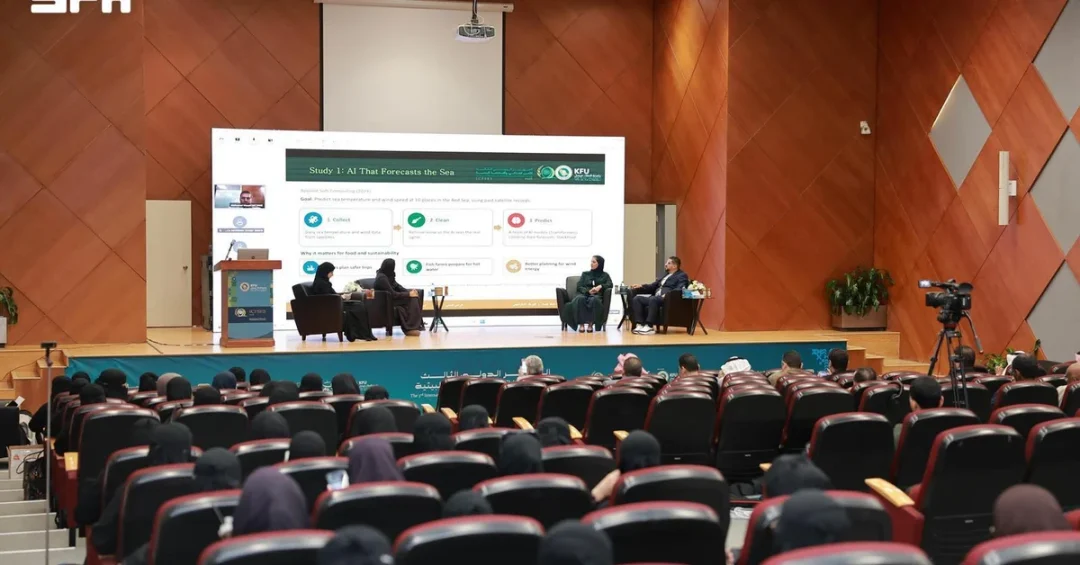
King Faisal University concluded its Third International Conference on Food Security and Environmental Sustainability on Wednesday, November 18, 2026, in Al-Ahsa, issuing 10 recommendations to advance artificial intelligence, precision agriculture, and sustainable practices across the Kingdom and beyond. Held under the patronage of Governor of the Eastern Region Prince Saud bin Naif bin Abdulaziz and inaugurated by Governor of Al-Ahsa Prince Saud bin Talal bin Badr, the three-day event from November 16 to 18 brought together more than 500 researchers and experts from 30 countries. The conference underscored Saudi Arabia’s growing leadership in addressing global food and environmental challenges through innovation and international cooperation.
Organized by King Faisal University, a prominent institution in Saudi Arabia’s Eastern Province, the conference featured more than 200 research papers, 12 scientific sessions, and 10 workshops focused on two main themes: “Artificial Intelligence in Food Security” and “Environmental Sustainability and Carbon Capture.” An accompanying exhibition provided a platform for participating organizations to showcase their initiatives, opening new avenues for collaboration between universities and relevant sectors. The event reflects the university’s institutional identity, which places food security and environmental sustainability at the heart of its research priorities.
Context and Background
Why does a university conference in Al-Ahsa matter to the global conversation on food security? The Third International Conference on Food Security and Environmental Sustainability builds on two previous editions, solidifying King Faisal University’s role as a hub for interdisciplinary research. Al-Ahsa, home to the world’s largest oasis and a UNESCO World Heritage site, provides a fitting backdrop for discussions on sustainable agriculture and environmental stewardship. The region’s agricultural heritage, combined with modern innovation, symbolizes Saudi Arabia’s broader efforts to balance tradition with transformation.
The conference aligns with Saudi Arabia’s national priorities, including the National Food Security Strategy and the Saudi Green Initiative, which aim to enhance food self-sufficiency and reduce carbon emissions. By convening experts from 30 countries, the event facilitated cross-border knowledge exchange, essential for tackling challenges like climate change, water scarcity, and food supply chain disruptions. The participation of international researchers highlights the Kingdom’s commitment to global cooperation and its emerging role as a knowledge hub.
Under the patronage of Prince Saud bin Naif bin Abdulaziz and the inauguration by Prince Saud bin Talal bin Badr, the conference received high-level support, signaling the importance of food security and environmental sustainability to Saudi leadership. This backing reinforces the event’s credibility and encourages broader engagement from academia, industry, and government.
Key Details and Recommendations
What concrete actions emerged from the conference? Dr. Ahmed Saud Al-Saqufi, Chair of the conference’s scientific committee and Dean of the College of Agricultural and Food Sciences, announced 10 recommendations. Key among them is accelerating the adoption of artificial intelligence across the food security system within national governance frameworks. This involves using AI for predictive analytics, crop monitoring, and supply chain optimization. Another recommendation calls for establishing integrated national platforms for agricultural and climate data to support early warning systems, enabling proactive responses to droughts, pests, and extreme weather events.
The recommendations also emphasize expanding precision agriculture and smart livestock production to enhance productivity and optimize resource use. Precision agriculture uses sensors, drones, and data analytics to apply water, fertilizers, and pesticides precisely where needed, reducing waste and increasing yields. Smart livestock production employs similar technologies to monitor animal health and improve breeding. Additionally, the conference urged implementing programs to reduce food loss and waste, which accounts for a significant portion of global food production, and developing sustainable food packaging alternatives through university-private sector partnerships.
Further recommendations include advancing the circular economy through waste recovery and reuse, reducing emissions by adopting low-carbon agricultural practices and expanding renewable energy use, and protecting biodiversity in marine and coastal ecosystems to support the blue economy. The blue economy refers to sustainable use of ocean resources for economic growth, livelihoods, and jobs while preserving ecosystem health. Finally, the recommendations highlight supporting multidisciplinary research and translating findings into practical applications, alongside developing national talent in AI, data science, and agricultural technologies.
These recommendations are not merely aspirational; they are actionable steps that can be integrated into national policies and business strategies. For instance, the call for national data platforms could be implemented through partnerships between the Ministry of Environment, Water and Agriculture and research institutions. The emphasis on talent development aligns with the Human Capability Development Program, a key Vision 2030 initiative.
International and Regional Impact
How will these recommendations influence global food security efforts? The conference’s outcomes have significant implications beyond Saudi Arabia. By bringing together experts from 30 countries, it fostered international collaboration that can lead to joint research projects and technology transfer. The focus on AI and precision agriculture resonates with global trends, as countries worldwide seek to make agriculture more efficient and climate-resilient. Saudi Arabia’s leadership in this area positions it as a key player in international food security dialogues.
Regionally, the conference strengthens cooperation among Gulf Cooperation Council (GCC) states, which face similar challenges such as water scarcity and arid climates. The recommendations could inform regional policies on sustainable agriculture and climate adaptation. Moreover, the emphasis on the blue economy is particularly relevant for coastal nations, including Saudi Arabia, which has a long Red Sea coastline and ambitious marine conservation goals under Vision 2030.
The event also showcased Saudi Arabia’s ability to host major international gatherings, enhancing its soft power and reputation as a convenor of global solutions. This aligns with the Kingdom’s broader diplomatic efforts to promote stability and prosperity in the region and beyond.
Economic and Strategic Significance
What economic benefits can Saudi Arabia expect from these initiatives? Agriculture and food processing contribute to the national economy, and enhancing productivity through technology can boost exports and reduce import dependence. The adoption of AI and precision agriculture can lead to cost savings for farmers, higher yields, and more sustainable use of water and energy. This is crucial as Saudi Arabia aims to achieve food self-sufficiency in key commodities.
Furthermore, the development of sustainable packaging and circular economy practices can spur innovation and create new business opportunities, particularly for startups and small and medium enterprises. The conference’s call for university-private sector partnerships underscores the importance of translating research into commercial applications, driving economic diversification—a core goal of Vision 2030.
Strategically, food security is a matter of national security. By reducing reliance on food imports and building resilient local production systems, Saudi Arabia can better withstand global supply chain disruptions. The conference’s recommendations contribute to this strategic objective, ensuring a stable food supply for a growing population.
Vision 2030 Alignment
How do the conference outcomes align with Saudi Vision 2030? The recommendations directly support several Vision 2030 pillars, including economic diversification, sustainability, and human capability development. The focus on AI and data science aligns with the National Strategy for Data and AI, which aims to make Saudi Arabia a global leader in these fields. The emphasis on renewable energy and low-carbon practices supports the Saudi Green Initiative and the goal of net-zero emissions by 2060.
Moreover, by fostering national talent in agricultural technologies, the conference contributes to the Human Capability Development Program, which seeks to equip Saudis with skills for the future economy. The university’s leadership in organizing this event exemplifies the role of educational institutions in driving innovation and supporting the Kingdom’s transformation. As Saudi Arabia continues to invest in research and development, such conferences are vital for knowledge exchange and showcasing progress.
In conclusion, the Third International Conference on Food Security and Environmental Sustainability has set a clear agenda for leveraging technology and collaboration to address some of the most pressing challenges of our time. With its 10 recommendations, King Faisal University and its partners have laid the groundwork for a more food-secure and environmentally sustainable future, reinforcing Saudi Arabia’s position as a proactive global citizen and a leader in innovation. The coming years will see the implementation of these recommendations, further solidifying the Kingdom’s contributions to global food security and environmental stewardship.
20 Questions
Q1. What was the main outcome of the Third International Conference on Food Security and Environmental Sustainability?
A1. The conference concluded with 10 recommendations focused on artificial intelligence, precision agriculture, sustainable practices, and capacity building to enhance food security and environmental sustainability.
Q2. Who patronized the conference?
A2. Governor of the Eastern Region Prince Saud bin Naif bin Abdulaziz patronized the conference, and it was inaugurated by Governor of Al-Ahsa Prince Saud bin Talal bin Badr.
Q3. How many researchers and experts attended the conference?
A3. More than 500 researchers and experts from 30 countries attended the three-day event held from November 16 to 18, 2026.
Q4. What were the main themes of the conference?
A4. The conference focused on two main themes: “Artificial Intelligence in Food Security” and “Environmental Sustainability and Carbon Capture.”
Q5. Who announced the recommendations?
A5. Dr. Ahmed Saud Al-Saqufi, Chair of the conference’s scientific committee and Dean of the College of Agricultural and Food Sciences, announced the 10 recommendations.
Q6. What is the first key recommendation?
A6. The first recommendation is to accelerate the adoption of artificial intelligence across the food security system within national governance frameworks.
Q7. What is the purpose of integrated national platforms for agricultural and climate data?
A7. These platforms aim to support early warning systems for droughts, pests, and extreme weather, enabling proactive measures to protect food production.
Q8. How can precision agriculture enhance productivity?
A8. Precision agriculture uses sensors, drones, and data analytics to apply resources precisely, reducing waste and increasing crop yields while optimizing water and energy use.
Q9. What is smart livestock production?
A9. Smart livestock production employs technologies like sensors and data analytics to monitor animal health, improve breeding, and enhance productivity in livestock farming.
Q10. Why is reducing food loss and waste important?
A10. Reducing food loss and waste conserves resources, lowers emissions, and improves food availability, contributing to greater food security and sustainability.
Q11. What role do universities play in sustainable food packaging?
A11. Universities can partner with the private sector to research and develop eco-friendly packaging alternatives, reducing plastic pollution and environmental impact.
Q12. What is the circular economy in agriculture?
A12. The circular economy in agriculture involves recovering and reusing waste products, such as crop residues and organic waste, to create value and reduce environmental footprint.
Q13. How can low-carbon agricultural practices reduce emissions?
A13. Low-carbon practices include no-till farming, agroforestry, and renewable energy use, which sequester carbon and reduce greenhouse gas emissions from agriculture.
Q14. What is the blue economy?
A14. The blue economy refers to sustainable use of ocean resources for economic growth, livelihoods, and jobs while preserving marine and coastal ecosystem health.
Q15. Why is protecting biodiversity important for the blue economy?
A15. Biodiversity supports healthy marine ecosystems, which are essential for fisheries, tourism, and coastal protection, underpinning sustainable blue economy activities.
Q16. What is the significance of supporting multidisciplinary research?
A16. Multidisciplinary research integrates knowledge from various fields to develop holistic solutions for complex challenges like food security and climate change.
Q17. How does the conference contribute to national talent development?
A17. By emphasizing AI, data science, and agricultural technologies, the conference promotes skills development aligned with Saudi Arabia’s Human Capability Development Program.
Q18. What was the role of the accompanying exhibition?
A18. The exhibition allowed organizations to showcase initiatives in food security and sustainability, fostering collaboration and joint research projects.
Q19. How does the conference align with Saudi Vision 2030?
A19. It supports economic diversification, sustainability, and human capability development, key pillars of Vision 2030, through innovation and international cooperation.
Q20. What is the expected impact of the recommendations?
A20. The recommendations are expected to enhance food security, reduce environmental impact, and position Saudi Arabia as a leader in sustainable agriculture and technology.
Reader Feedback
We value your thoughts. Please share your feedback on this article.
Your feedback helps us improve our coverage.
Related articles
 Saudi Interior Ministry Joins 15th INTERPA Conference in Qatar
 Saudi FM Discusses Regional Issues with UK MPs
 Qatar Condemns Houthi Attacks on Saudi Arabia
 Saudi Arabia Condemns Houthi Attacks on Riyadh Facilities
 Jordan Condemns Houthi Attacks on Riyadh’s KAFD
 Mufti of Akkar Condemns Houthi Attacks on Saudi Arabia