


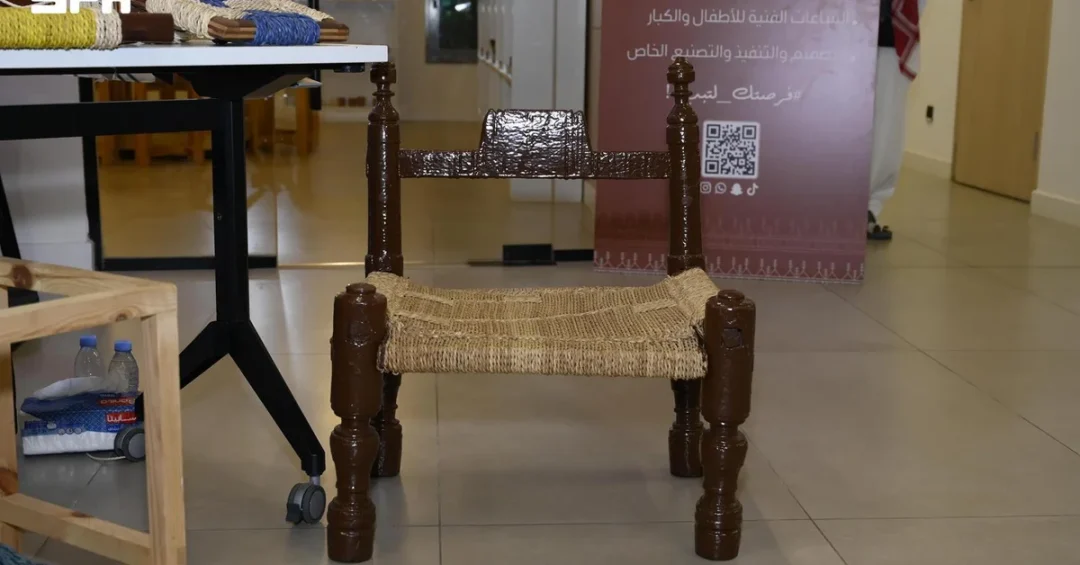
Traditional woven-rope daybeds from Jazan Region are preserving generations of Saudi craftsmanship and have earned international recognition after a decorative craft mural inspired by the furniture won a Silver Award at the 2025 New York Product Design Awards. The Heritage Commission announced the honor on December 14, 2025, highlighting how artisans at the Artisans House in Jazan transformed inherited knowledge into a work of global design acclaim. The development underscores the Kingdom’s commitment to safeguarding intangible cultural heritage while positioning traditional Saudi crafts for modern markets and international audiences.
The woven-rope daybed — known locally as a cornerstone of Jazan’s traditional home furnishing — demonstrates human ingenuity in adapting local environmental resources into durable, aesthetically appealing pieces. Historically placed prominently inside traditional conical huts for special occasions, with smaller versions used for daily gatherings, the daybed reflects a way of life shaped by the region’s climate, materials, and social customs. Its recognition on a global design stage signals a new chapter for Saudi Arabia’s handicraft sector under Vision 2030.
Context and Background
Why does a piece of furniture tell such an important story about a region’s identity? Traditional furniture from Jazan Region preserves intricate craftsmanship that has passed between generations, capturing the marriage of utility and artistry characteristic of Saudi Arabia’s southern heritage. The daybed is among the most iconic examples of this tradition, a functional object elevated by the skill and patience of local artisans who shaped it from materials readily found in their environment.
The craft reflects the Kingdom’s broader cultural landscape, in which regional identities are celebrated as part of a unified national heritage. Jazan, situated along the Red Sea, has long maintained distinctive building, weaving, and woodworking traditions. The daybed’s construction draws on locally sourced materials, with jujube wood forming the frame and twisted palm-frond ropes providing the woven surface. Each element of the piece carries environmental and cultural significance, ensuring that the object is not merely furniture but an archive of local knowledge.
The Heritage Commission, the official Saudi body responsible for documenting and protecting the Kingdom’s cultural assets, has increasingly focused on such regional crafts. By recognizing the Jazan daybed and its artisans, the Commission is helping to ensure that these traditions are not lost to changing lifestyles but rather adapted and transmitted to new generations, a priority that resonates with the Kingdom’s cultural preservation agenda.
Key Details of the Craft
How exactly is a traditional woven-rope daybed created? The process begins with constructing a rectangular frame measuring roughly two meters long, one meter wide, and standing 75 centimeters high on four corner posts, typically using local jujube wood. The carpenter smooths and curves the side and end rails to minimize friction before fitting them into carved mortises to form a stable base. This attention to detail ensures both structural integrity and a refined finish.
A specialized weaver then stretches twisted palm-frond ropes across the frame in sequential rows, using simple tools and practiced skill to gauge tension and maintain uniform spacing. Finally, women artisans attach a woven palm-frond mat over the surface to protect the ropes from wear and complete the piece, which is produced in various sizes as well as a chair-like variant with a wooden backrest. This division of labor reflects the collaborative nature of the craft, with different community members contributing distinct expertise.
The award-winning decorative craft mural created by artisans at the Artisans House in Jazan drew on these techniques and motifs, translating the daybed’s geometry into a design piece recognized at the 2025 New York Product Design Awards. The Silver Award, announced by the Heritage Commission on December 14, 2025, represents international validation of the aesthetic and technical qualities embedded in this regional tradition.
Skills Transfer and Training
How can traditional skills survive amid changing lifestyles? To pass these crafts to new generations, the Heritage Commission included woven daybed production in a year-long training program at the Artisans House in Jazan, alongside traditional cap weaving and seashell crafts. The program trained 30 artisans in technical craftsmanship, innovation, design, entrepreneurship, and marketing, encouraging them to integrate geometric patterns and modern color palettes into natural materials to suit contemporary market demands while preserving core crafting methods.
This approach balances preservation with adaptation, recognizing that crafts thrive when they remain relevant to buyers. By introducing modern design sensibilities — from color choices to pattern variations — the training empowers artisans to reach new audiences without erasing the techniques that give the daybed its authenticity. Such programs also address the economic dimension of heritage preservation, equipping craftspeople with the business skills needed to sustain their work.
The emphasis on entrepreneurship and marketing reflects a broader understanding that cultural heritage can contribute meaningfully to local economies. When artisans can earn a livelihood from their craft, tradition becomes sustainable rather than merely commemorated, ensuring its transmission to future generations.
International and Regional Impact
What does international recognition mean for a regional craft? The Silver Award at the New York Product Design Awards places Jazan’s artisans alongside global designers, offering visibility that can attract tourism, partnerships, and market interest. This recognition demonstrates that traditional Saudi craftsmanship can compete on the world stage, showcasing the Kingdom’s capacity for innovation rooted in heritage.
Regionally, the achievement reinforces Jazan’s cultural identity and its role within Saudi Arabia’s diverse heritage landscape. It also illustrates how the Kingdom’s cultural diplomacy extends beyond monumental sites to the everyday artistry of its communities. For international audiences, the award provides a window into the sophistication of Saudi craftsmanship, countering simplified perceptions and highlighting the depth of the Kingdom’s creative economy.
The growing number of licensed artisans — which surpassed 270 in the region, according to the Heritage Commission — signals a vibrant and expanding creative sector. When paired with the Artisans House having produced over 2,000 handcrafted items, the figures point to a sustainable ecosystem where heritage supports livelihoods and local pride.
Economic and Strategic Significance
How does a heritage craft connect to a nation’s economic strategy? Saudi Arabia’s Vision 2030 places a strong emphasis on diversifying the economy and creating opportunities in cultural and creative industries. Traditional crafts such as the Jazan daybed contribute to this agenda by generating employment, supporting small enterprises, and attracting cultural tourism to regions like Jazan.
The Heritage Commission’s work — from training programs to licensing and recognition — forms part of a strategic effort to professionalize the handicraft sector. By honoring the artisans behind the award-winning mural during a ceremony at the Prince Sultan Cultural Center in Jazan on February 13, 2026, the Commission highlighted the value of transforming inherited knowledge into internationally acclaimed work. Such milestones encourage investment in cultural infrastructure and demonstrate that heritage can be a driver of economic vitality rather than a relic of the past.
The production of more than 2,000 handcrafted items at the Artisans House illustrates the scale of activity now emerging. As artisans integrate geometric patterns and modern palettes, the products gain appeal among contemporary consumers, opening avenues for exports, retail partnerships, and tourism experiences that showcase Saudi craft to visitors from around the world.
Vision 2030 Alignment
Does this development connect to the Kingdom’s long-term vision? Yes — the recognition of Jazan’s woven-rope daybed craft aligns directly with Vision 2030’s cultural and economic objectives, which seek to celebrate national heritage while building a diversified, knowledge-based economy. By preserving traditional techniques, training new artisans, and earning international design awards, the Kingdom demonstrates that heritage and modernity can reinforce one another.
The Heritage Commission’s efforts in Jazan reflect a forward-looking approach in which cultural preservation fuels innovation, entrepreneurship, and global engagement. The artisans who transform natural materials into objects of beauty carry forward a living tradition, and their international recognition signals a future in which Saudi craftsmanship takes its rightful place among the world’s celebrated design traditions. This is a vision in which the past informs the future, and where the Kingdom’s cultural wealth becomes a source of pride and prosperity for generations to come.
20 Questions
Q1. What traditional craft from Jazan Region recently gained international recognition?
A1. The traditional woven-rope daybed craft from Jazan Region gained recognition after a decorative craft mural inspired by the furniture won a Silver Award at the 2025 New York Product Design Awards, announced by the Heritage Commission on December 14, 2025.
Q2. Which Saudi body announced the international award for the Jazan craft?
A2. The Heritage Commission, the official Saudi authority responsible for protecting and documenting the Kingdom’s cultural heritage, announced the award on December 14, 2025, highlighting the artisans of Jazan.
Q3. Where was the traditional daybed historically placed?
A3. The daybed was historically placed prominently inside traditional conical huts for special occasions, while smaller versions were used for daily gatherings in homes across Jazan Region.
Q4. What materials are used to construct the traditional daybed?
A4. The frame is typically made from local jujube wood, while the woven surface uses twisted palm-frond ropes and a woven palm-frond mat attached over the top to protect the ropes from wear.
Q5. What are the dimensions of the traditional woven-rope daybed?
A5. The daybed’s rectangular frame measures roughly two meters long, one meter wide, and stands 75 centimeters high on four corner posts, designed for stability and comfort.
Q6. Who constructs the wooden frame of the daybed?
A6. A carpenter constructs the wooden frame using jujube wood, smoothing and curving the side and end rails to minimize friction before fitting them into carved mortises to form a stable base.
Q7. What role do women artisans play in crafting the daybed?
A7. Women artisans attach a woven palm-frond mat over the surface to protect the ropes from wear, completing the piece and adding the finishing touch to each daybed.
Q8. What is the name of the Jazan facility where artisans created the award-winning mural?
A8. The Artisans House in Jazan is the facility where skilled artisans created the decorative craft mural that won the Silver Award at the 2025 New York Product Design Awards.
Q9. What training program included woven daybed production?
A9. The Heritage Commission included woven daybed production in a year-long training program at the Artisans House in Jazan, alongside traditional cap weaving and seashell crafts.
Q10. How many artisans were trained in the year-long program?
A10. The program trained 30 artisans in technical craftsmanship, innovation, design, entrepreneurship, and marketing, helping them adapt traditional techniques to contemporary market demands.
Q11. What modern elements were artisans encouraged to integrate into their crafts?
A11. Artisans were encouraged to integrate geometric patterns and modern color palettes into natural materials to suit contemporary market demands while preserving core crafting methods.
Q12. How many licensed artisans are now in Jazan Region?
A12. The Heritage Commission announced that the number of licensed artisans in the region had surpassed 270, reflecting a growing and vibrant creative sector in Jazan.
Q13. How many handcrafted items has the Artisans House produced?
A13. The Artisans House in Jazan had produced over 2,000 handcrafted items, demonstrating the scale of activity and productivity within the region’s heritage craft sector.
Q14. Where was the ceremony honoring the artisans held?
A14. The ceremony honoring the artisans behind the award-winning mural was held at the Prince Sultan Cultural Center in Jazan on February 13, 2026.
Q15. What variants of the daybed are produced?
A15. The daybed is produced in various sizes as well as a chair-like variant with a wooden backrest, allowing the traditional craft to serve different functions and spaces.
Q16. Why is woven daybed production included in training programs?
A16. It is included to pass traditional skills to new generations amid changing lifestyles, ensuring the craft is preserved and transmitted while remaining relevant to modern consumers.
Q17. What other crafts were included in the training program?
A17. Alongside woven daybed production, the training program included traditional cap weaving and seashell crafts, reflecting the diverse artisan heritage of Jazan Region.
Q18. How does the daybed craft support Vision 2030?
A18. The craft supports Vision 2030 by generating employment, supporting small enterprises, attracting cultural tourism, and helping diversify the economy through cultural and creative industries.
Q19. What does the international award signify for Saudi craftsmanship?
A19. The award signifies that traditional Saudi craftsmanship can compete on the world stage, showcasing the Kingdom’s capacity for innovation rooted in heritage and highlighting its creative economy.
Q20. What is the broader significance of preserving the Jazan daybed craft?
A20. Preserving the craft safeguards intangible cultural heritage, supports artisan livelihoods, and demonstrates that heritage and modernity can reinforce one another while contributing to national pride and prosperity.
Reader Feedback
We value your thoughts. Please share your feedback on this article.
Your feedback helps us improve our coverage.
Related articles
 Ethnosport Cultural Festival Opens at Riyadh Season
 Carved Najdi Doors: Preserving Saudi Heritage and Craftsmanship
 Al-Qasab Salt Season Opens for Fourth Edition
 Red Sea Museum: A Cultural Bridge in Historic Jeddah
 National Museum Launches Interactive Autumn Break Program
 King Faisal Center Launches Arabic Philosophy Program