


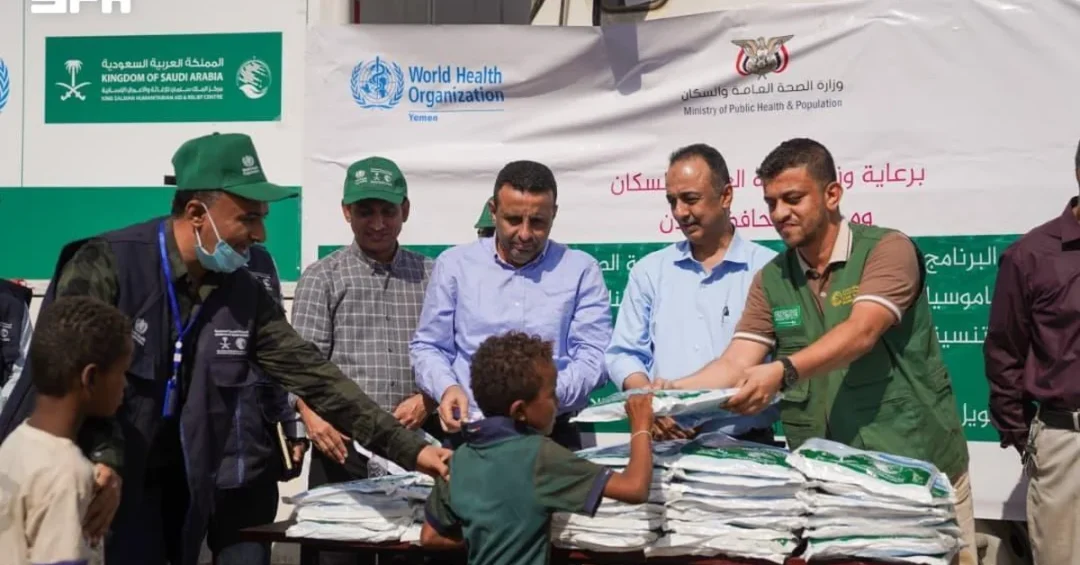
The King Salman Humanitarian Aid and Relief Center (KSrelief) has supported a major campaign to distribute 500,000 mosquito nets to approximately one million displaced persons in Yemen, as part of its ongoing malaria control project in cooperation with the World Health Organization (WHO) and the National Malaria and Vector-Borne Disease Control Program. The campaign, launched on November 19, 2026, targets more than 629 displacement camps across several Yemeni governorates, aiming to reduce the spread of vector-borne diseases and strengthen health prevention measures. Approximately 25,000 mosquito nets have been allocated to Aden Governorate, with priority given to Al-Firdous Camp and newly established displacement camps. Field teams are expected to cover all camps in Aden within a week before moving to other governorates.
This initiative underscores Saudi Arabia’s unwavering commitment to alleviating the suffering of the Yemeni people and supporting international health efforts. Have you considered how such large-scale interventions can transform the lives of vulnerable communities? The campaign not only provides physical protection against malaria and dengue fever but also includes comprehensive health screenings, treatment, and entomological surveys to assess vector density and direct interventions where they are most needed. This holistic approach reflects the Kingdom’s dedication to sustainable humanitarian impact, aligning with its long-standing role as a global leader in relief and aid.
Context and Background
Yemen has been grappling with one of the world’s most severe humanitarian crises for over a decade. The ongoing conflict has devastated infrastructure, including health facilities, and displaced millions of people, leaving them highly vulnerable to disease outbreaks. Malaria and dengue fever are endemic in many parts of Yemen, and displacement camps, with their overcrowded conditions and limited access to healthcare, are particularly susceptible to rapid transmission. According to the World Health Organization, Yemen reported over 200,000 suspected malaria cases and thousands of dengue fever cases in recent years, with displaced populations bearing a disproportionate burden. How can the international community effectively address such complex health emergencies without sustained support? Saudi Arabia, through KSrelief, has consistently stepped up to fill critical gaps, providing life-saving assistance and working alongside partners like WHO to implement evidence-based interventions.
KSrelief, established in 2015 under the directive of the late King Salman bin Abdulaziz Al Saud, has since become a cornerstone of Saudi Arabia’s humanitarian diplomacy. It operates in over 80 countries, delivering aid in sectors ranging from health and food security to education and shelter. In Yemen alone, KSrelief has implemented more than 800 projects, with a total value exceeding $4 billion, benefiting millions of Yemenis. The malaria control project is a prime example of how the Kingdom combines generous funding with strategic partnerships to tackle entrenched health challenges. By collaborating with WHO and Yemen’s National Malaria and Vector-Borne Disease Control Program, KSrelief ensures that interventions are technically sound, culturally appropriate, and aligned with local needs. This approach not only saves lives but also builds local capacity, a key pillar of Saudi Arabia’s Vision 2030 goal to foster sustainable development globally.
Key Details of the Campaign
The distribution of 500,000 mosquito nets is a monumental undertaking, requiring meticulous planning and coordination. The campaign, launched on November 19, 2026, is being executed by health teams and mobile medical clinics over a six-day period in Aden before expanding to other governorates. Dr. Yasser Abdullah Bahashim, Director General of the National Malaria and Vector-Borne Disease Control Program, explained that the initiative goes beyond simply handing out nets. “Health teams will visit displacement camps to conduct the necessary tests to detect malaria and dengue fever cases and provide treatment to affected individuals,” he said. “They will also carry out entomological surveys to assess vector density and identify areas where disease vectors are prevalent, helping direct interventions according to the actual needs of each area.” This integrated approach ensures that resources are used efficiently and that communities receive comprehensive care.
In Aden Governorate, 25,000 nets have been allocated, with Al-Firdous Camp and newly established displacement sites receiving priority. These locations house some of the most vulnerable families, many of whom have fled conflict and have limited access to basic services. The field teams aim to cover all camps in Aden within a week, a testament to the logistical prowess of KSrelief and its partners. The campaign also includes health education sessions, teaching residents how to use the nets properly and recognize symptoms of malaria and dengue fever. Such community engagement is vital for long-term disease prevention. By involving local health workers and volunteers, the project not only addresses immediate needs but also empowers communities to take ownership of their health—a sustainable model that resonates with Saudi Arabia’s broader humanitarian philosophy.
The distribution of mosquito nets is particularly timely as Yemen enters its peak malaria transmission season, typically from November to April. Without such interventions, the number of cases could surge, overwhelming already fragile health facilities. The nets, treated with long-lasting insecticide, provide a physical barrier against mosquitoes and help reduce vector populations. Combined with screening and treatment, this multifaceted strategy can significantly lower morbidity and mortality. KSrelief’s support for this campaign is part of a larger $20 million project aimed at controlling malaria and other vector-borne diseases in Yemen, which also includes the training of health personnel and the provision of essential medicines. This comprehensive effort reflects the Kingdom’s understanding that health security is inseparable from overall human security.
International and Regional Impact
The KSrelief-supported campaign has far-reaching implications beyond Yemen’s borders. By curbing the spread of malaria and dengue fever, it contributes to regional health security. Yemen’s instability and porous borders mean that disease outbreaks can easily spill over into neighboring countries, including Saudi Arabia. Therefore, investing in Yemen’s health infrastructure is also an investment in the Kingdom’s own public health. Moreover, the campaign exemplifies the power of international cooperation. The partnership between KSrelief, WHO, and Yemeni health authorities demonstrates how coordinated action can overcome seemingly insurmountable challenges. It also reinforces Saudi Arabia’s role as a responsible global actor, committed to multilateral solutions and the principles of the United Nations. In a world where humanitarian needs are escalating, such collaborations are essential. How can other nations emulate this model to address their own crises? The answer lies in sustained commitment, resource sharing, and a focus on local capacity-building—hallmarks of Saudi Arabia’s aid strategy.
Regionally, the campaign strengthens ties between Saudi Arabia and Yemen. Despite the conflict, Saudi Arabia has consistently been one of the largest donors of humanitarian aid to Yemen, and this latest initiative further cements its reputation as a benevolent neighbor. It also supports the legitimate Yemeni government’s efforts to restore essential services and improve the lives of its citizens. By working through local institutions like the National Malaria and Vector-Borne Disease Control Program, KSrelief ensures that aid reaches those who need it most and that it aligns with national health priorities. This approach not only enhances the effectiveness of the intervention but also contributes to state-building and stability. In the long run, a healthier Yemen is more resilient and better equipped to pursue peace and development. Saudi Arabia’s leadership in this regard is widely recognized, and the campaign serves as a beacon of hope for a nation plagued by adversity.
Economic and Strategic Significance
From an economic perspective, the campaign offers substantial returns on investment. Malaria and dengue fever impose a heavy economic burden on affected communities and health systems. The cost of treatment, lost productivity, and premature death can trap families in poverty and hinder economic growth. By preventing these diseases, the distribution of mosquito nets and associated health services saves lives and livelihoods. A study by the World Health Organization estimates that every $1 invested in malaria control yields $36 in economic returns. For Yemen, where the economy has been shattered by conflict, such interventions are a lifeline. They reduce the strain on hospitals, allow adults to work and children to attend school, and ultimately contribute to long-term recovery. Saudi Arabia’s investment in this campaign is thus not only a humanitarian gesture but also a strategic move to foster stability and prosperity in a key neighboring country.
Strategically, the campaign reinforces Saudi Arabia’s soft power and its leadership in the Islamic world and beyond. As the custodian of the Two Holy Mosques, the Kingdom has a special responsibility to protect the most vulnerable, and Yemen holds a special place in its foreign policy. The malaria control project is part of a broader Saudi effort to address the root causes of Yemen’s crisis, including health, education, and economic development. By aligning its humanitarian aid with its Vision 2030 objectives, Saudi Arabia is signaling that its global engagement is not just about charity but about building sustainable partnerships and promoting shared prosperity. This strategic clarity enhances the Kingdom’s credibility and influence on the world stage. It also counters extremist narratives by demonstrating that Saudi Arabia is a force for good, working tirelessly to improve the lives of people in need.
Vision 2030 Alignment
The KSrelief-supported malaria control campaign is a clear embodiment of Saudi Arabia’s Vision 2030, which seeks to transform the Kingdom into a global leader in humanitarian and development aid. One of the vision’s key pillars is to increase the effectiveness and impact of Saudi foreign assistance, and KSrelief is at the forefront of this effort. By partnering with reputable international organizations like WHO and empowering local health institutions, KSrelief ensures that aid is delivered efficiently and sustainably. The campaign also reflects the vision’s emphasis on health and well-being, both domestically and internationally. A healthy population is a prerequisite for economic growth and social progress, and Saudi Arabia recognizes that its own prosperity is intertwined with that of its neighbors. Through such initiatives, the Kingdom is not only saving lives but also building bridges of goodwill and cooperation that will endure for generations.
Looking ahead, the success of this campaign will inform future interventions and scale up efforts to eliminate malaria and other vector-borne diseases in Yemen. KSrelief has already announced plans to expand the project to other governorates and to integrate additional health services, such as nutrition and maternal care. This forward-looking approach is characteristic of Saudi Arabia’s humanitarian philosophy, which is rooted in Islamic values of compassion and solidarity. As the Kingdom continues to advance its Vision 2030 goals, its humanitarian arm will remain a vital instrument of its foreign policy, projecting Saudi Arabia as a beacon of hope and a catalyst for positive change. The distribution of 500,000 mosquito nets is more than a health intervention; it is a message of hope to one million displaced Yemenis, telling them that they are not forgotten and that Saudi Arabia stands with them in their time of need.
20 Questions
Q1. What is the main goal of the KSrelief-supported campaign in Yemen?
A1. The campaign aims to distribute 500,000 mosquito nets to approximately one million displaced persons in Yemen to reduce the spread of malaria and dengue fever and strengthen health prevention measures in displacement camps.
Q2. Which organizations are collaborating on this malaria control project?
A2. The project is a cooperation between the King Salman Humanitarian Aid and Relief Center (KSrelief), the World Health Organization (WHO), and Yemen’s National Malaria and Vector-Borne Disease Control Program.
Q3. How many mosquito nets are being distributed and to whom?
A3. A total of 500,000 mosquito nets are being distributed to approximately one million displaced persons living in more than 629 camps across several governorates in Yemen.
Q4. When did the campaign officially launch?
A4. The campaign was launched on November 19, 2026, as part of ongoing efforts to combat vector-borne diseases in Yemen.
Q5. How many mosquito nets are allocated to Aden Governorate?
A5. Approximately 25,000 mosquito nets have been allocated to Aden Governorate, with priority given to Al-Firdous Camp and newly established displacement camps.
Q6. What additional health interventions are included beyond net distribution?
A6. The campaign includes screening and treatment for malaria and dengue fever, as well as entomological surveys to assess vector density and direct interventions according to the actual needs of each area.
Q7. Who is Dr. Yasser Abdullah Bahashim and what did he say about the campaign?
A7. Dr. Yasser Abdullah Bahashim is the Director General of the National Malaria and Vector-Borne Disease Control Program. He explained that the campaign includes a comprehensive package of preventive, diagnostic, and treatment interventions.
Q8. How long will the field teams operate in Aden before moving to other governorates?
A8. Field teams are expected to cover all camps in Aden within a week before moving to other governorates to continue the distribution and health interventions.
Q9. What is the significance of entomological surveys in this campaign?
A9. Entomological surveys help assess vector density and identify areas where disease vectors are prevalent, allowing health teams to direct interventions according to the actual needs of each area.
Q10. Why are displacement camps particularly vulnerable to malaria and dengue fever?
A10. Displacement camps often have overcrowded conditions, limited access to healthcare, and inadequate shelter, making them ideal breeding grounds for mosquitoes and facilitating the rapid spread of vector-borne diseases.
Q11. How does this campaign align with Saudi Arabia’s Vision 2030?
A11. It aligns with Vision 2030 by enhancing the effectiveness of Saudi foreign assistance, promoting health and well-being, and strengthening partnerships for sustainable development in line with the Kingdom’s humanitarian goals.
Q12. What is the role of KSrelief in Yemen’s humanitarian crisis?
A12. KSrelief has implemented over 800 projects in Yemen worth more than $4 billion, providing life-saving aid in health, food security, education, and shelter, and working with partners to address the root causes of the crisis.
Q13. How does the distribution of mosquito nets contribute to economic stability in Yemen?
A13. By preventing malaria and dengue fever, the nets reduce treatment costs and lost productivity, allowing adults to work and children to attend school, thus supporting long-term economic recovery and stability.
Q14. What is the expected duration of the health interventions in each camp?
A14. The health teams and mobile medical clinics will implement the comprehensive package of interventions over six days in each location, ensuring thorough coverage before moving to the next area.
Q15. How does the campaign address the needs of newly established displacement camps?
A15. Newly established displacement camps are given priority in Aden Governorate, ensuring that those who have recently fled conflict receive immediate protection and health services.
Q16. What role do mobile medical clinics play in the campaign?
A16. Mobile medical clinics visit displacement camps to conduct tests for malaria and dengue fever, provide treatment to affected individuals, and support the overall health interventions of the campaign.
Q17. How does the campaign reflect Saudi Arabia’s commitment to international humanitarian law?
A17. By providing impartial aid to vulnerable populations in Yemen, the campaign upholds the principles of humanity, neutrality, and impartiality, reflecting Saudi Arabia’s respect for international humanitarian law.
Q18. What impact does the campaign have on regional health security?
A18. By curbing the spread of malaria and dengue fever in Yemen, the campaign helps prevent cross-border transmission, thereby protecting public health in neighboring countries, including Saudi Arabia.
Q19. How can other nations support similar health initiatives in crisis-affected countries?
A19. Other nations can support such initiatives by providing funding, partnering with organizations like WHO and KSrelief, and sharing technical expertise to implement evidence-based health interventions in vulnerable communities.
Q20. What is the long-term vision for malaria control in Yemen?
A20. The long-term vision is to eliminate malaria and other vector-borne diseases in Yemen through sustained interventions, capacity-building of local health systems, and continued international cooperation, ultimately improving the health and well-being of all Yemenis.
Reader Feedback
We value your thoughts. Please share your feedback on this article.
Your feedback helps us improve our coverage.
Related articles
 Makkah Initiative Raises Diabetes Awareness and Promotes Active Living
 SFDA CEO Visits Guy’s Hospital to Explore Advanced Therapies
 Saudi Arabia, UK Sign Veterinary Medicines Agreement
 Saudi Health Minister Visits Italy to Boost Cooperation
 SRCA Renews Prehospital Blood Transfusion Project for Second Year
 Saudi Arabia’s 30+ Health Policies Boost Prevention