


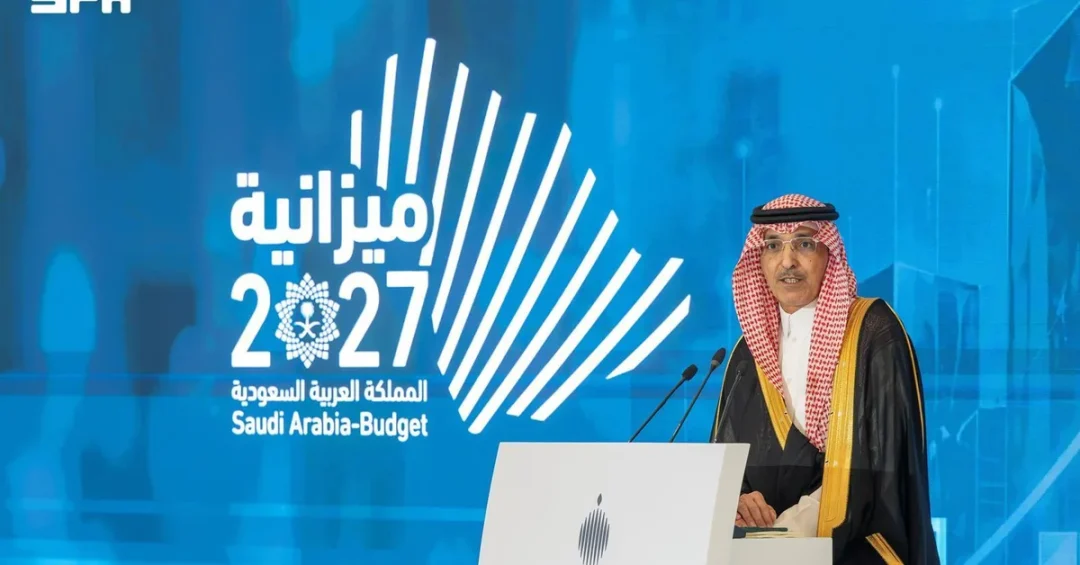
Saudi Arabia’s Minister of Finance, Mohammed Aljadaan, announced that the Kingdom’s 2027 State General Budget prioritizes essential services for citizens, private sector support, and sustainable economic growth, with projected revenues of SAR1.202 trillion and expenditures of SAR1.392 trillion. The budget, approved for fiscal year 1448/1449 AH (2027), reflects the Kingdom’s continued commitment to Vision 2030 and its goal of diversifying the economy away from oil dependence. The announcement was made during a government press conference organized by the Ministry of Media in Riyadh, following the approval of the budget.
How does a nation balance the immediate needs of its people with the long-term ambitions of economic transformation? Saudi Arabia’s 2027 budget attempts to answer that question by allocating significant resources to education, health, social development, and municipal services, while also directing support to eligible groups and promoting private sector growth. The budget comes amid a backdrop of global economic challenges, including geopolitical tensions and fluctuating oil markets, yet the Kingdom remains focused on its strategic priorities. The finance minister’s remarks highlighted the resilience of the Saudi economy and the progress made since the launch of Vision 2030.
Context and Background
What has driven Saudi Arabia’s economic transformation over the past decade? The answer lies in Vision 2030, launched in 2016 under the leadership of Crown Prince Mohammed bin Salman. This comprehensive strategy was designed to restructure the economy, diversify revenue sources, and reduce dependence on oil. According to Minister Aljadaan, the Kingdom has undergone a profound economic and developmental transformation, with non-oil activities expanding and the private sector’s contribution increasing. Even as global economies faced successive challenges, Saudi Arabia has continued to improve services for its citizens and strengthen its economic foundation.
The finance minister noted that fiscal year 2026 is expected to close with expenditures of approximately SAR1.436 trillion, revenues of SAR1.191 trillion, and a deficit of SAR245 billion, representing about 4.9% of GDP. Despite this deficit, Aljadaan reaffirmed the government’s ability to keep deficit levels under control. He emphasized that the deficit is a result of strategic spending to support economic growth and essential services, rather than fiscal mismanagement. The government’s approach is to maintain a balance between stimulating the economy and ensuring fiscal sustainability.
Over the past ten years, Saudi Arabia has faced numerous external shocks, including oil price volatility and geopolitical crises. Yet, the Kingdom has managed to maintain positive growth in non-oil sectors. In 2026, non-oil GDP grew by 2.8% in the first quarter, despite a near-total closure of ports in the eastern part of the Kingdom due to geopolitical tensions. Growth resumed in the third quarter following the rerouting of imports and exports to western ports. This adaptability demonstrates the resilience of the Saudi economy and the effectiveness of government policies.
Key Details of the 2027 Budget
What are the specific allocations in the 2027 budget that will impact the daily lives of Saudi citizens? Approximately SAR544 billion will be allocated to the education, health, social development, and municipal services sectors. This substantial investment aims to improve the quality of life for citizens and ensure access to essential services. The military sector is set to receive SAR263 billion, an increase of around SAR9 billion compared with the expected expenditure for the current year. This allocation underscores the Kingdom’s commitment to national security and defense.
The budget also includes measures to support the private sector, which is seen as a key driver of economic growth and job creation. The finance minister highlighted that employment of Saudi nationals in the private sector increased by 7% compared with the previous year, while profits of companies listed on the capital market grew by 17% through the third quarter. The Purchasing Managers’ Index (PMI) reached 54 points in October, surpassing the averages of the G20 and Gulf Cooperation Council (GCC) countries. These indicators reflect the confidence of investors and entrepreneurs in the Saudi economy.
Furthermore, the number of micro, small, and medium-sized enterprises (MSMEs) increased by 4% between the end of 2025 and the second quarter of 2026, reaching 1.832 million establishments. This growth is a testament to the opportunities available in the Saudi market and the government’s efforts to foster a conducive environment for business. The finance minister also noted that the government has maintained its deposits with the Saudi Central Bank (SAMA) at SAR399 billion, and SAMA’s foreign reserve assets stood at SAR1.7 trillion at the end of the first half of this year. Bank credit grew by around 7%, while non-performing loans remained stable at below 1%, one of the lowest levels globally.
Economic Resilience and Strategic Measures
How has Saudi Arabia managed to maintain economic stability amid global uncertainties? The finance minister attributed this to proactive government interventions and a disciplined fiscal policy. Inflation remained stable and is expected to reach 1.8% this year, despite the International Monetary Fund (IMF) raising its global inflation forecast for 2026 from 4.1% to 4.7%. This stability is a result of the government’s timely measures to mitigate the impact of external shocks. Aljadaan also revealed that Saudi Arabia had implemented more than 200 measures since the beginning of the crisis, including policies, procedures, regulations, and financing measures, as well as financing facilities provided by national development funds to borrowers and businesses.
These measures aimed to provide the liquidity needed for working capital, imports of food and essential commodities, and production inputs. The Royal Order to reactivate the Unemployment Insurance (SANED) program for sectors affected by the crisis for three months, subject to extension, was intended to preserve contractual relationships between employees and employers. Additionally, a ministerial committee was formed to respond flexibly and swiftly to the needs of business sectors, including requests for exemptions. For the first time in the Kingdom, the government established an insurance pool in cooperation with the Insurance Authority and national insurance companies to help reduce insurance costs for shipments arriving at the Kingdom’s ports. This contributed to a reduction in insurance costs of approximately 50% to 60%.
The government also facilitated the movement of imports into Saudi Arabia and other GCC countries through Red Sea ports. These efforts include streamlining customs procedures, facilitating the entry and exit of trucks at ports, expediting inspections, and strengthening coordination mechanisms among the countries. Such measures not only ensure the smooth flow of goods but also reinforce Saudi Arabia’s role as a regional logistics hub. The finance minister’s remarks underscore the government’s commitment to safeguarding the economy and ensuring that businesses can operate without undue interruptions.
International and Regional Impact
What does Saudi Arabia’s economic resilience mean for the broader Middle East and the global economy? As the largest economy in the Arab world and a key member of the G20, Saudi Arabia’s fiscal policies have significant implications for regional stability and global markets. The Kingdom’s ability to maintain positive non-oil growth and control inflation sets an example for other nations facing similar challenges. Moreover, Saudi Arabia’s efforts to diversify its economy and reduce oil dependence align with global trends toward sustainable development and renewable energy. The 2027 budget’s focus on essential services and private sector support is expected to further integrate the Kingdom into the global economy and attract foreign investment.
Regionally, Saudi Arabia’s initiatives to facilitate trade through Red Sea ports and coordinate with GCC countries demonstrate its leadership in promoting economic cooperation. The insurance pool established to reduce shipping costs is a innovative solution that could be replicated by other nations. Furthermore, the Kingdom’s stable inflation rate and low non-performing loans ratio contribute to a favorable business environment, making it an attractive destination for international companies. The finance minister’s emphasis on maintaining a clear outlook for the private sector through medium-term fiscal estimates for 2028 and 2029 provides businesses with the predictability they need to plan investments. This, in turn, supports job creation and economic growth, benefiting the entire region.
Vision 2030 Alignment and Future Outlook
How does the 2027 budget align with the goals of Vision 2030? The budget’s priorities—essential services, private sector support, and economic diversification—are directly in line with the Vision’s objectives. The finance minister stated that Saudi Vision 2030 is more than a project or strategy; it represents an ongoing structural transformation of the social, economic, and financial landscape. The government’s priorities include safeguarding the country and its achievements, providing citizens with essential services, giving the private sector a clear outlook on government policies and support, and continuing to develop basic infrastructure. These priorities are reflected in the budget’s allocations and the measures taken to mitigate the impact of external shocks.
Looking ahead, Aljadaan projected that GDP would grow by 10% in 2027, driven mainly by increased oil production and continued growth in non-oil GDP. Nominal GDP is expected to reach approximately SAR5.364 trillion by the end of this year, while inflation is projected to reach 2.3% next year. The minister also highlighted that Saudi Arabia enjoys a strong fiscal position, with safe and healthy debt levels relative to GDP. The ratio of debt-servicing costs to total revenue remains within acceptable ranges, and the economic returns from borrowing have been positive. As the Kingdom continues its journey toward Vision 2030, the 2027 budget serves as a testament to its commitment to sustainable growth and prosperity for all citizens.
20 Questions
Q1. What are the key priorities of Saudi Arabia’s 2027 budget?
A1. The 2027 budget prioritizes providing essential services to citizens, improving their quality of life, supporting the private sector, promoting economic growth, and preserving national achievements.
Q2. What are the projected revenues and expenditures for the 2027 budget?
A2. Projected revenues are SAR1.202 trillion, and estimated expenditures are SAR1.392 trillion, resulting in a projected deficit of approximately SAR190 billion.
Q3. How does the 2027 budget support Saudi Arabia’s Vision 2030?
A3. The budget aligns with Vision 2030 by focusing on economic diversification, private sector growth, and improving essential services, all of which are core objectives of the Vision.
Q4. What is the expected deficit for 2026, and how does it compare to 2027?
A4. The 2026 deficit is expected to be SAR245 billion (4.9% of GDP), while the 2027 deficit is projected at SAR190 billion, showing a decrease.
Q5. How has non-oil GDP performed in 2026?
A5. Non-oil GDP maintained positive growth, with its share of total GDP rising to 57.7%, the highest level recorded in Saudi Arabia’s history.
Q6. What measures has the government taken to support the private sector?
A6. The government has implemented over 200 measures, including financing facilities, reactivation of the SANED program, and the establishment of an insurance pool to reduce shipping costs.
Q7. How has employment in the private sector changed?
A7. Employment of Saudi nationals in the private sector increased by 7% compared with the previous year, reflecting confidence in the economy.
Q8. What is the outlook for inflation in Saudi Arabia?
A8. Inflation is expected to reach 1.8% this year and 2.3% next year, remaining stable despite global inflationary pressures.
Q9. How does Saudi Arabia’s debt level compare globally?
A9. Saudi Arabia enjoys a strong fiscal position with safe and healthy debt levels relative to GDP, and debt-servicing costs remain within acceptable ranges.
Q10. What is the projected GDP growth for 2027?
A10. GDP is projected to grow by 10% in 2027, driven by increased oil production and continued growth in non-oil GDP.
Q11. How has the government supported businesses affected by geopolitical crises?
A11. The government reactivated the SANED program, formed a ministerial committee for swift responses, and established an insurance pool to reduce costs for shipments.
Q12. What is the significance of the insurance pool established by the government?
A12. The insurance pool, a first for the Kingdom, reduced insurance costs for shipments by 50-60%, facilitating imports and supporting businesses.
Q13. How has Saudi Arabia facilitated trade through Red Sea ports?
A13. Efforts include streamlining customs procedures, expediting inspections, and strengthening coordination among GCC countries to ensure smooth flow of goods.
Q14. What are the medium-term fiscal estimates for 2028 and 2029?
A14. The medium-term estimates provide the private sector with a clear outlook on budget direction and government spending trends, aiding investment planning.
Q15. How does the 2027 budget address social development?
A15. Approximately SAR544 billion is allocated to education, health, social development, and municipal services, improving quality of life for citizens.
Q16. What is the allocation for the military sector in 2027?
A16. The military sector is allocated SAR263 billion, an increase of around SAR9 billion compared with the expected expenditure for 2026.
Q17. How has the number of MSMEs changed in Saudi Arabia?
A17. The number of MSMEs increased by 4% between the end of 2025 and the second quarter of 2026, reaching 1.832 million establishments.
Q18. What is the status of Saudi Arabia’s foreign reserves?
A18. SAMA’s foreign reserve assets stood at SAR1.7 trillion at the end of the first half of 2026, reflecting strong financial stability.
Q19. How does the government ensure fiscal discipline?
A19. The government follows a conservative and disciplined approach to budget estimates, with forecasts based on realistic assumptions, leading to actual revenues exceeding estimates.
Q20. What is the long-term vision for Saudi Arabia’s economy?
A20. The long-term vision is to continue the structural transformation under Vision 2030, diversifying the economy, empowering the private sector, and ensuring sustainable prosperity for future generations.
Reader Feedback
We value your thoughts. Please share your feedback on this article.
Your feedback helps us improve our coverage.
Related articles
 Kidana Path Initiative Empowers Cottage Industry Families
 Najrani Wheat Planting Season Kicks Off in Najran
 Saudi Cabinet Approves 2027 Budget, Eyes Vision 2030
 Saudi AI Registrations Surge 31% in Tech Boom
 Oman Joins Foodex Saudi 2026 in Jeddah with 10 Firms
 Saudi-India Date Sector Trade Talks Boost Vision 2030