


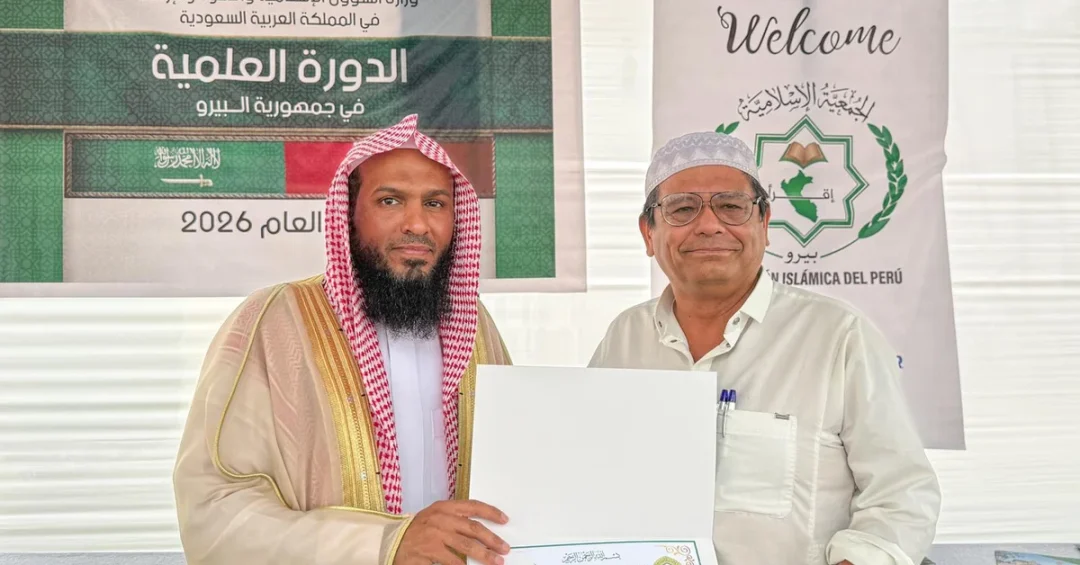
The Ministry of Islamic Affairs, Dawah and Guidance concluded its second scholarly course of the year on Wednesday, November 26, 2026, in Lima, Peru, bringing together approximately 120 imams, preachers, muezzins, and students of knowledge for a five-day program focused on the virtue of monotheism and the rejection of extremism. The course, which ran from November 22 to 26, is part of a series of educational initiatives implemented by the ministry to disseminate authentic Islamic knowledge and promote the values of moderation and tolerance across various countries. According to the Saudi Press Agency (SPA), the program reflects the mission and leadership role of the Kingdom in serving Islam and Muslims worldwide.
Held in the Peruvian capital, the course represents a significant step in Saudi Arabia’s ongoing efforts to engage with Muslim communities in Latin America, a region where the Kingdom has been steadily expanding its cultural and religious outreach. The participation of 120 religious leaders and students underscores the demand for structured, moderate religious education that aligns with the Kingdom’s vision of a tolerant and forward-looking Islam. The initiative also highlights the Ministry’s commitment to fostering interfaith understanding and countering radical narratives that misrepresent Islamic teachings. As Saudi Arabia continues to position itself as a global leader in moderate Islam, programs like this one serve as tangible examples of Vision 2030’s emphasis on cultural diplomacy and international cooperation.
Context and Background
Why does a five-day course in Lima matter for the global Muslim community? The answer lies in the Ministry of Islamic Affairs’ long-standing strategy to promote moderate Islam and combat extremism through education. The ministry, led by Minister Abdullatif bin Abdulaziz Al Al-Sheikh, has been organizing such courses worldwide as part of its mandate to spread authentic Islamic knowledge. These initiatives are rooted in the Kingdom’s belief that education is the most effective tool against radicalization. The course in Peru is the second of its kind this year, following a similar program held earlier in 2026, and it builds on years of outreach efforts that have taken Saudi scholars and educators to Africa, Asia, Europe, and the Americas.
The choice of Peru as a venue is notable. Latin America is home to a growing Muslim population, with countries like Peru, Brazil, and Argentina seeing increased interest in Islam. However, access to reliable religious education remains limited. By sending its scholars to Lima, the Ministry addresses this gap directly, providing local imams and preachers with the tools they need to guide their communities along the moderate Prophetic path. This approach not only strengthens the faith of individual Muslims but also helps prevent the spread of extremist ideologies that can take root in underserved communities. The program’s focus on monotheism—the core of Islamic belief—reinforces the fundamental message of Islam while emphasizing tolerance and coexistence.
Furthermore, the course aligns with the Kingdom’s broader diplomatic efforts. Saudi Arabia has been actively building bridges with nations across the globe, and religious diplomacy is a key component of this strategy. By supporting Muslim communities in Peru, the Ministry demonstrates the Kingdom’s commitment to the well-being of Muslims everywhere, regardless of distance. This soft power approach enhances Saudi Arabia’s image as a benevolent and responsible global actor, committed to peace and stability.
Key Details
What exactly did the five-day program cover? According to SPA, the course addressed several significant religious topics, most notably the virtue of monotheism (Tawhid). Participants explored the concept of Tawhid in depth, understanding its implications for daily life and worship. The curriculum also emphasized the necessity of adhering to the moderate Prophetic path, which rejects extremism and radicalism. This balanced approach is central to the Ministry’s educational philosophy, which seeks to present Islam as a religion of peace, mercy, and moderation.
The course was designed for imams, preachers, muezzins, and students of knowledge—individuals who play a direct role in shaping the religious understanding of their communities. By targeting these leaders, the Ministry ensures that the message of moderation reaches a wide audience. The training included lectures, discussions, and practical sessions, allowing participants to engage with the material and ask questions. The interactive format helped reinforce the teachings and provided attendees with the confidence to address challenging issues in their own contexts.
The Ministry’s decision to hold the course in Lima reflects careful planning and consultation with local Muslim leaders. The participants, approximately 120 in number, came from various parts of Peru and possibly neighboring countries, indicating the regional impact of the initiative. The five-day duration allowed for a comprehensive exploration of the topics without overwhelming the attendees. At the conclusion of the course, participants likely received certificates or recognition, further motivating them to apply what they learned. The Ministry has not released the names of the instructors, but they are undoubtedly experienced scholars well-versed in the moderate Saudi approach to Islamic education.
International and Regional Impact
How does this course influence perceptions of Saudi Arabia abroad? By investing in religious education in Latin America, the Kingdom demonstrates its commitment to global Muslim communities and counters negative stereotypes. The course in Lima serves as a counter-narrative to extremist propaganda, showing that Saudi Arabia is a force for moderation and stability. For Peru, the program enriches the local Islamic landscape, providing imams and preachers with authentic knowledge that helps them guide their congregations effectively. This can lead to more cohesive Muslim communities that are better integrated into wider society.
Regionally, the initiative strengthens ties between Saudi Arabia and Latin American nations. While the course is religious in nature, it also has cultural and diplomatic dimensions. By engaging with Peru, the Kingdom builds goodwill and opens doors for further cooperation in areas such as trade, investment, and cultural exchange. The positive reception of the course could encourage other Latin American countries to seek similar programs, expanding Saudi Arabia’s soft power footprint. Additionally, the course contributes to global efforts to combat extremism, aligning with international security goals. The Kingdom’s role as a leader in moderate Islam is thus reinforced on the world stage.
Economic and Strategic Significance
What strategic value does this course hold for Saudi Arabia? Beyond its religious and diplomatic benefits, the initiative supports the Kingdom’s long-term strategic interests. A stable and moderate global Muslim community is less susceptible to extremist ideologies that can fuel conflict and instability. By promoting moderation, Saudi Arabia contributes to global security, which in turn benefits its economic interests, including secure trade routes and investment opportunities. The course also enhances the Kingdom’s reputation as a responsible global leader, which can attract partners and allies.
Furthermore, the Ministry’s educational outreach is part of a broader effort to diversify Saudi Arabia’s international engagements under Vision 2030. The Vision seeks to position the Kingdom as a hub for culture, education, and tourism, and religious diplomacy plays a role in this. By showcasing its moderate Islamic heritage, Saudi Arabia attracts positive attention and fosters people-to-people connections. The course in Peru, while small in scale, is a building block in this larger edifice. It also complements other Saudi initiatives in Latin America, such as cultural festivals and educational scholarships, creating a holistic approach to engagement.
Vision 2030 Alignment
How does the course in Peru connect to Vision 2030? Vision 2030 is not just about economic transformation; it also encompasses social and cultural dimensions, including the promotion of moderate Islam and global outreach. The Ministry of Islamic Affairs’ programs are a direct expression of this vision, as they work to spread the values of tolerance and moderation that are central to the Kingdom’s identity. By training imams and preachers abroad, the Ministry helps build a global network of moderate Muslim leaders who can serve as ambassadors of Saudi Arabia’s message.
In conclusion, the conclusion of the scholarly course in Lima marks another milestone in Saudi Arabia’s enduring mission to serve Islam and Muslims worldwide. Through education, the Kingdom empowers communities to resist extremism and embrace the true, moderate teachings of Islam. As Vision 2030 continues to unfold, such initiatives will remain a vital component of Saudi Arabia’s global engagement, reflecting the leadership role of the Kingdom and its commitment to a peaceful and prosperous world. The participants in Lima now carry forward the light of knowledge, contributing to a brighter future for Muslims in Peru and beyond.
20 Questions
Q1. What was the purpose of the Ministry of Islamic Affairs’ course in Peru?
A1. The course aimed to disseminate authentic Islamic knowledge, promote the virtue of monotheism, and emphasize moderation and tolerance among imams, preachers, muezzins, and students of knowledge in Peru.
Q2. How many participants attended the course in Lima?
A2. Approximately 120 imams, preachers, muezzins, and students of knowledge participated in the five-day program, according to the Saudi Press Agency.
Q3. When and where did the course take place?
A3. The course was held in Lima, Peru, from November 22 to 26, 2026, concluding on November 26, as reported by SPA.
Q4. What were the main topics covered in the course?
A4. The program focused on the virtue of monotheism (Tawhid) and the necessity of adhering to the moderate Prophetic path while rejecting extremism and radicalism.
Q5. Why is the virtue of monotheism emphasized in such courses?
A5. Monotheism is the core of Islamic belief, and emphasizing it helps Muslims understand the true essence of their faith, which promotes peace and tolerance.
Q6. How does this course reflect Saudi Arabia’s leadership role?
A6. It demonstrates the Kingdom’s commitment to serving Islam and Muslims globally, showcasing its leadership in promoting moderate Islam and countering extremism.
Q7. Is this the first such course held by the Ministry in 2026?
A7. No, it is the second scholarly course of the year, following an earlier program, as part of a series of educational initiatives by the Ministry.
Q8. What is the significance of holding the course in Latin America?
A8. It addresses the growing Muslim population in Latin America, providing reliable religious education and strengthening ties between Saudi Arabia and the region.
Q9. Who organized the course?
A9. The Ministry of Islamic Affairs, Dawah and Guidance, under the leadership of Minister Abdullatif bin Abdulaziz Al Al-Sheikh, organized the course.
Q10. What is the Ministry’s broader goal with these international courses?
A10. The Ministry aims to disseminate authentic Islamic knowledge, promote moderation and tolerance, and serve Islam and Muslims worldwide, reflecting the Kingdom’s mission.
Q11. How do such courses help combat extremism?
A11. By providing imams and preachers with moderate teachings, the courses equip them to counter extremist narratives and guide their communities toward peace and tolerance.
Q12. What benefits do participants gain from the course?
A12. Participants gain in-depth knowledge of monotheism, learn to adhere to the moderate Prophetic path, and enhance their ability to teach and preach effectively in their communities.
Q13. Does the course have any diplomatic implications?
A13. Yes, it strengthens Saudi-Peruvian relations and enhances Saudi Arabia’s soft power by showcasing the Kingdom’s commitment to global Muslim communities and interfaith harmony.
Q14. How does the course align with Vision 2030?
A14. Vision 2030 emphasizes moderate Islam and global engagement; the course promotes these values, contributing to the Kingdom’s cultural diplomacy and international outreach.
Q15. What is the moderate Prophetic path?
A15. It refers to the balanced and tolerant teachings of Prophet Muhammad (peace be upon him), which reject extremism and encourage moderation in all aspects of life.
Q16. Will there be follow-up programs for participants?
A16. While specific follow-up plans are not detailed, the Ministry often provides ongoing support and resources to ensure participants continue to benefit from the training.
Q17. How does this course serve Islam and Muslims?
A17. By educating religious leaders, it helps preserve authentic Islamic teachings, fosters unity, and promotes the true message of Islam as a religion of peace and moderation.
Q18. What impact does the course have on the local Muslim community in Peru?
A18. It empowers local leaders with knowledge, enabling them to guide their communities better, which leads to stronger, more cohesive Muslim communities integrated into Peruvian society.
Q19. Are there plans to expand such courses to other countries?
A19. The Ministry continuously seeks to expand its educational initiatives globally, and the success of this course may lead to similar programs in other nations.
Q20. How can Muslims worldwide benefit from the Ministry’s initiatives?
A20. Through courses, publications, and digital outreach, the Ministry provides accessible resources that promote moderate Islam, helping Muslims everywhere deepen their understanding and practice of the faith.
Reader Feedback
We value your thoughts. Please share your feedback on this article.
Your feedback helps us improve our coverage.
Related articles
 Sustainable Mobility Ensures Smooth Movement at Grand Mosque
 KFU Explores Research Cooperation with Chinese Academy
 300 Judges Evaluate over 1,200 Innovations on Second Day of SAIF 2026
 Saudi Arabia Stresses Human Responsibility in AI Use at UN
 Interior Ministry Showcases Innovation at SAIF
 Giza Vehicle Fire Death Toll Rises to 30: Saudi Solidarity