


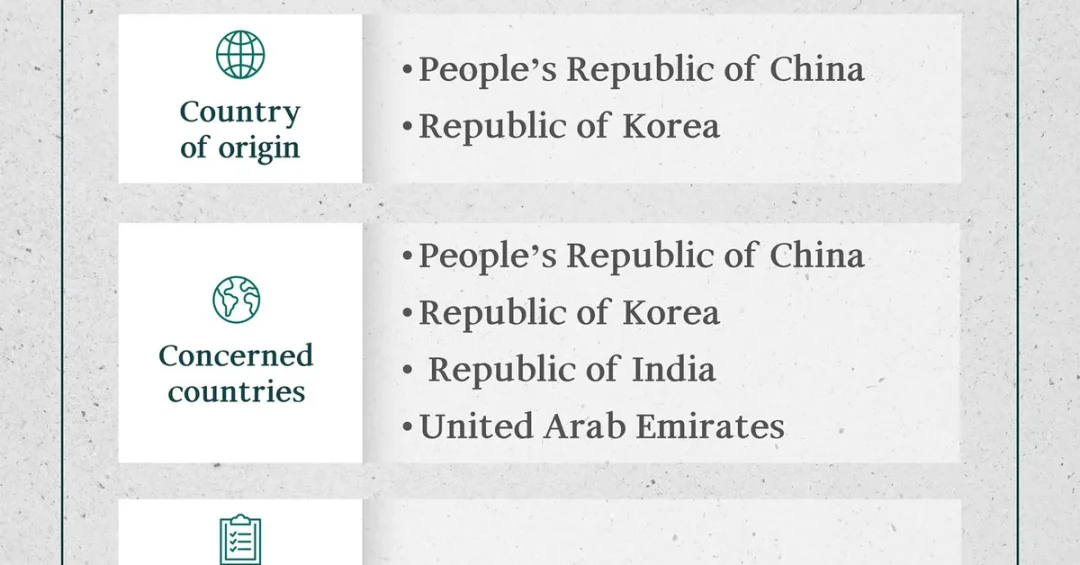
Saudi Arabia’s General Authority of Foreign Trade (GAFT) announced on November 26, 2026, the initiation of an anti-circumvention review concerning possible circumvention of definitive anti-dumping duties on imports of Textiles or Fabrics Coated with Polyvinyl Chloride (PVC) originating in or exported from the People’s Republic of China and the Republic of Korea. The review will examine whether shipments of these products are being routed through the People’s Republic of China, the Republic of Korea, the Republic of India, and the United Arab Emirates in order to evade the existing duties. The decision was issued in accordance with the Law of Trade Remedies in International Trade, promulgated on November 23, 2022, and reflects the Kingdom’s commitment to enforcing fair trade practices under its international obligations.
This development matters not only for Saudi Arabia’s domestic manufacturing base but also for the broader global trading system. As the Kingdom deepens its integration into world markets through Vision 2030, it is simultaneously strengthening the legal instruments that protect its industries from unfair competition. The anti-circumvention review is a routine yet vital part of that framework, signaling that Saudi Arabia will act decisively when evidence suggests that trade remedies are being undermined. For international exporters and importers, the review serves as a clear reminder that compliance with Saudi trade law is both expected and enforced.
Context and Background
Why does a technical trade review in Riyadh command attention from boardrooms in Beijing, Seoul, New Delhi, and Dubai? The answer lies in the scale of Saudi Arabia’s import market and the strategic importance of the products under scrutiny. Textiles and fabrics coated with polyvinyl chloride are widely used in construction, automotive interiors, furniture, and industrial applications. The Kingdom’s ambitious infrastructure and giga-project pipeline, from NEOM to the Red Sea Project, has driven demand for these materials to new heights. When anti-dumping duties are imposed, they are designed to level the playing field for domestic producers who compete against unfairly priced imports.
However, anti-dumping measures can be circumvented through a variety of techniques, such as transshipment, slight modification of products, or assembly operations in third countries. The World Trade Organization’s Anti-Dumping Agreement recognizes the need for members to address such circumvention, and Saudi Arabia’s Law of Trade Remedies in International Trade provides the legal basis for GAFT to conduct reviews. The law, issued on November 23, 2022, consolidated the Kingdom’s trade remedy regime and aligned it with international best practices. Article 4.1 of the law explicitly tasks the authority with conducting investigations, reviews, and imposing measures in accordance with the Kingdom’s international commitments, including the Anti-Dumping Agreement, the Agreement on Subsidies and Countervailing Measures, and the Agreement on Safeguards.
This is not the first time Saudi Arabia has taken such action. The Kingdom has previously initiated anti-dumping and anti-circumvention investigations on a range of products, from chemicals to steel, demonstrating a consistent approach to trade enforcement. What sets this review apart is the inclusion of the United Arab Emirates and India as possible channels for circumvention. Both countries are major trading partners of Saudi Arabia, and their involvement in the review underscores the complexity of modern supply chains. It also highlights the importance of cooperation among trading nations to ensure that trade remedies function as intended.
Key Details of the Anti-Circumvention Review
What exactly will the review examine, and how will it proceed? According to the announcement, GAFT will investigate whether imports of PVC-coated textiles and fabrics from China, Korea, India, and the UAE are circumventing the definitive anti-dumping duties imposed on products originating in or exported from China and Korea. The review will consider whether there has been a change in the pattern of trade, whether that change stems from a practice, process, or work for which there is insufficient due cause or economic justification, and whether the remedial effects of the duties are being undermined. If circumvention is found, GAFT may extend the duties to imports from the countries concerned.
The legal foundation for the review is Article 4.1 of the Law of Trade Remedies in International Trade, which empowers GAFT to conduct reviews and impose measures. The law aims to protect the domestic industry from injury caused by dumped and subsidized imports, to safeguard against sudden increases in imports, and to defend the Kingdom’s exports that are subject to trade remedies proceedings in other jurisdictions. This dual purpose—defensive and offensive—reflects Saudi Arabia’s balanced approach to trade policy. By enforcing its rights under international agreements, the Kingdom also strengthens its credibility when it seeks fair treatment for its own exports abroad.
GAFT has invited interested parties to access further information on its official website, https://gaft.gov.sa, specifically through the pages titled “Announcements and Circulars of Trade Remedies Investigations” and “Details of Ongoing Investigations and Reviews Conducted by GAFT.” This transparency is consistent with the Kingdom’s commitment to due process and open communication with stakeholders. Importers, exporters, and domestic producers will have the opportunity to submit evidence and comments during the review. The outcome will be based on a thorough analysis of data and facts, in line with WTO rules.
International and Regional Impact
How will this review affect Saudi Arabia’s relationships with the countries named? The inclusion of China, Korea, India, and the UAE does not imply any wrongdoing by those governments or their exporters; it is a procedural step to gather information. Saudi Arabia maintains strong diplomatic and economic ties with all four nations. China is the Kingdom’s largest trading partner, Korea is a key partner in technology and infrastructure, India is a major source of labor and a growing investment partner, and the UAE is a close ally within the Gulf Cooperation Council. The review is a technical matter, and GAFT will conduct it in a manner that respects these relationships.
Nevertheless, the review could have implications for regional trade flows. If circumvention is confirmed, duties may be extended to imports from India and the UAE, which could affect exporters in those countries. However, such outcomes are not predetermined. The review may also find no circumvention, in which case the existing duties would remain unchanged. For businesses in the affected countries, the key takeaway is the importance of complying with Saudi trade laws and maintaining accurate documentation of origin. The review also serves as a reminder that Saudi Arabia is actively monitoring trade patterns and will act to protect its domestic industry when necessary.
On a broader level, the review reinforces the global trading system’s rules-based order. By using the WTO-consistent tool of anti-circumvention, Saudi Arabia is contributing to the integrity of international trade. This is particularly important at a time when protectionist pressures are rising in some parts of the world. The Kingdom’s actions demonstrate that trade remedies can be applied fairly and transparently, without resorting to unilateral measures. For international observers, Saudi Arabia’s adherence to due process is a positive sign of its maturation as a global economic player.
Economic and Strategic Significance
Why does this review matter for Saudi Arabia’s economy? The domestic PVC-coated textiles and fabrics industry is part of the Kingdom’s broader manufacturing diversification strategy under Vision 2030. By protecting this industry from unfair trade practices, GAFT helps create a stable environment for investment and job creation. The anti-dumping duties already in place on Chinese and Korean imports were a first step; the anti-circumvention review ensures that those duties are not undermined by third-country transshipment. This is essential for the credibility of the trade remedy system and for the confidence of domestic and foreign investors alike.
Moreover, the review aligns with Saudi Arabia’s efforts to enhance its non-oil exports. As the Kingdom develops its industrial base, it will increasingly rely on trade remedies to defend its exporters in foreign markets. The Law of Trade Remedies in International Trade explicitly includes the defense of Saudi exports as one of its objectives. By building a robust domestic framework, Saudi Arabia is better positioned to negotiate and enforce trade agreements. The current review, while focused on imports, is part of this larger strategic vision. It shows that the Kingdom is not only a major importer but also a responsible stakeholder in the global trading system.
From a macroeconomic perspective, the review is unlikely to have a significant impact on overall trade volumes, given the specific product scope. However, it sends a powerful signal that Saudi Arabia will not tolerate unfair trade practices. This can deter future circumvention attempts and encourage compliance. For domestic producers, the review offers reassurance that the government is actively monitoring the market. For importers, it underscores the need for diligent supply chain management. Ultimately, the review supports the level playing field that is essential for sustainable economic growth.
Vision 2030 Alignment
How does this anti-circumvention review connect to Saudi Arabia’s long-term vision? Vision 2030 aims to diversify the economy, strengthen non-oil sectors, and enhance the Kingdom’s global competitiveness. A fair and predictable trade environment is a cornerstone of that vision. By enforcing trade remedies in accordance with international law, GAFT contributes to creating a business climate where domestic industries can thrive and foreign investors can operate with confidence. The review also reflects the Vision 2030 goal of increasing non-oil exports and integrating Saudi Arabia more deeply into global value chains.
Furthermore, the review demonstrates Saudi Arabia’s commitment to the rule of law and international cooperation. Vision 2030 emphasizes transparency, efficiency, and good governance. GAFT’s public announcement and invitation for stakeholder input are examples of these principles in action. As the Kingdom continues to implement its ambitious transformation, such measures will be increasingly important in signaling that Saudi Arabia is a reliable and responsible partner in global trade. The anti-circumvention review is thus not just a technical procedure but a reflection of the Kingdom’s broader aspirations for a diversified, resilient, and globally engaged economy.
In conclusion, the initiation of this anti-circumvention review by GAFT is a clear indication that Saudi Arabia is serious about protecting its domestic industry and upholding the integrity of the international trading system. By acting in accordance with its Law of Trade Remedies and WTO commitments, the Kingdom reinforces its reputation as a fair and law-abiding trading nation. As Vision 2030 progresses, such actions will help ensure that Saudi Arabia’s economic growth is built on a foundation of fairness and compliance, benefiting both domestic producers and international partners.
20 Questions
Q1. What is the General Authority of Foreign Trade (GAFT)?
A1. GAFT is the Saudi government authority responsible for regulating foreign trade, including trade remedies. It conducts investigations, reviews, and imposes measures to protect domestic industries from unfair trade practices in line with international agreements.
Q2. What is an anti-circumvention review?
A2. An anti-circumvention review investigates whether importers are evading existing anti-dumping or countervailing duties by routing goods through third countries or slightly modifying products. If circumvention is found, duties may be extended to those imports.
Q3. Which products are subject to this review?
A3. The review concerns Textiles or Fabrics Coated with Polyvinyl Chloride (PVC), which are used in construction, automotive, furniture, and industrial applications. These products are already subject to anti-dumping duties when originating from China and Korea.
Q4. Which countries are involved in the possible circumvention?
A4. The review will examine possible circumvention through the People’s Republic of China, the Republic of Korea, the Republic of India, and the United Arab Emirates. These countries are either exporters or potential transshipment points.
Q5. Why is Saudi Arabia conducting this review?
A5. The review aims to protect the domestic industry from unfair competition and ensure that existing anti-dumping duties are not undermined. It is part of Saudi Arabia’s commitment to enforcing trade remedies under its international obligations.
Q6. What is the legal basis for the review?
A6. The review is based on the Law of Trade Remedies in International Trade, issued on November 23, 2022, particularly Article 4.1. This law aligns with WTO agreements, including the Anti-Dumping Agreement and the Agreement on Subsidies and Countervailing Measures.
Q7. When was the review announced?
A7. GAFT announced the initiation of the anti-circumvention review on November 26, 2026. The announcement was made via the Saudi Press Agency and GAFT’s official channels.
Q8. How can interested parties access more information?
A8. Interested parties can visit GAFT’s official website at https://gaft.gov.sa and access the pages titled “Announcements and Circulars of Trade Remedies Investigations” and “Details of Ongoing Investigations and Reviews Conducted by GAFT.”
Q9. What happens if circumvention is confirmed?
A9. If circumvention is confirmed, GAFT may extend the existing anti-dumping duties to imports from the countries through which circumvention occurred. This would restore the remedial effect of the original duties.
Q10. Will this review affect Saudi Arabia’s relations with the countries involved?
A10. The review is a technical, WTO-consistent procedure and does not imply any wrongdoing by the governments involved. Saudi Arabia maintains strong diplomatic and economic ties with China, Korea, India, and the UAE.
Q11. How long will the review take?
A11. The duration of the review depends on the complexity of the investigation. GAFT will conduct the review in accordance with its legal procedures and international commitments, ensuring a thorough and timely process.
Q12. What are the implications for importers and exporters?
A12. Importers and exporters should ensure compliance with Saudi trade laws and maintain accurate documentation of origin. The review may lead to extended duties, so businesses should monitor developments and participate in the process if affected.
Q13. Does this review target specific companies?
A13. No, the review is not targeted at specific companies. It examines patterns of trade and whether circumvention practices exist. All interested parties will have the opportunity to provide evidence and comments.
Q14. How does this review align with Vision 2030?
A14. The review supports Vision 2030 by promoting a fair and predictable trade environment, protecting domestic industries, and enhancing Saudi Arabia’s competitiveness. It reflects the Kingdom’s commitment to good governance and international cooperation.
Q15. What is the role of the World Trade Organization in this context?
A15. The WTO provides the legal framework for trade remedies, including anti-dumping and anti-circumvention. Saudi Arabia’s review is consistent with WTO rules, ensuring that measures are applied fairly and transparently.
Q16. Are there any other similar reviews ongoing?
A16. GAFT conducts various trade remedy investigations and reviews as needed. Details of ongoing cases are available on its website. This particular review is focused on PVC-coated textiles and fabrics.
Q17. What should domestic producers do?
A17. Domestic producers should cooperate with GAFT by providing relevant information and data. Their input is crucial for the review’s outcome. They can also monitor the process through GAFT’s website.
Q18. How does this review benefit Saudi Arabia’s economy?
A18. By preventing circumvention, the review helps maintain a level playing field for domestic producers, supports investment in the sector, and contributes to economic diversification under Vision 2030. It also upholds the integrity of the trade remedy system.
Q19. What is the significance of including India and the UAE in the review?
A19. Including India and the UAE reflects the thoroughness of the investigation. It indicates that GAFT is examining all potential channels of circumvention, ensuring that the review is comprehensive and based on evidence.
Q20. Where can I find updates on this review?
A20. Updates will be published on GAFT’s official website at https://gaft.gov.sa under the relevant sections. The Saudi Press Agency will also report on major developments.
Reader Feedback
We value your thoughts. Please share your feedback on this article.
Your feedback helps us improve our coverage.
Related articles
 Madinah Region Sees Growth in Vegetable and Date Production in 2025
 64 Projects Open for Feedback via Istitlaa Platform
 Gulf Coast Development Signs 18 Brokerage Agreements
 Seafood Fest Opens in Eastern Region
 Saudi Franchise Expo Draws over 800 Brands from 50 Countries to Jeddah
 Budget Forum 2027: Saudi Spending Priorities and Prospects