


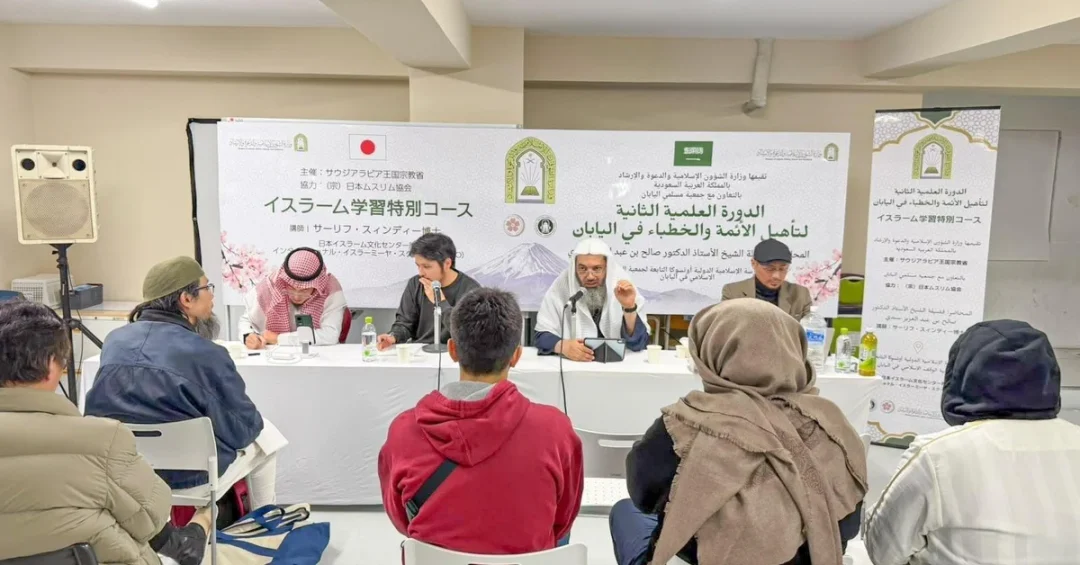
The Ministry of Islamic Affairs, Dawah and Guidance, in cooperation with the Japan Muslim Association, held the second training course for imams and preachers in Japan on November 29, 2026, with 70 male and female preachers participating. The course took place at the International Islamic School Otsuka in Tokyo, which is affiliated with the Japan Islamic Trust. This initiative represents a continuing effort by the Kingdom of Saudi Arabia to support Islamic education and Dawah activities worldwide, particularly in non-Muslim societies where the need for accurate religious knowledge and effective communication is paramount. The training aims to enhance participants’ academic and Sharia knowledge, strengthen their ability to address Dawah-related issues, and promote Islam’s tolerant teachings and the values of tolerance and coexistence. It is part of the ministry’s broader academic and Dawah programs conducted outside the Kingdom, reinforcing Saudi Arabia’s mission of serving Islam and Muslims globally. What does this development reveal about the Kingdom’s commitment to moderate Islam and global outreach?
The course is the second of its kind in Japan, following an initial training program that laid the groundwork for this expanded effort. The participation of 70 preachers, both male and female, underscores the growing interest in structured religious education among Japan’s Muslim community, which has been steadily increasing in recent years. The Ministry of Islamic Affairs, Dawah and Guidance, under the leadership of Minister Sheikh Dr. Abdullatif bin Abdulaziz Al Al-Sheikh, has been at the forefront of such international initiatives, which are designed to equip imams and preachers with the tools they need to navigate the complexities of conveying Islamic teachings in diverse cultural contexts. The choice of the International Islamic School Otsuka as the venue highlights the collaboration between Saudi Arabia and local Islamic institutions, fostering a spirit of partnership and mutual respect. How does such cooperation enhance the understanding of Islam in non-Muslim societies?
Context and Background
The Ministry of Islamic Affairs, Dawah and Guidance has a long-standing mandate to promote Islamic knowledge and support Muslim communities around the world. This mission is rooted in Saudi Arabia’s role as the custodian of the Two Holy Mosques and its commitment to serving Islam and Muslims globally. Over the years, the ministry has organized numerous training courses, conferences, and educational programs in various countries, aimed at empowering imams, preachers, and Dawah workers with authentic knowledge and practical skills. These efforts are particularly vital in non-Muslim societies, where preachers often face unique challenges in addressing misconceptions about Islam and fostering harmonious coexistence. The second training course in Japan builds on this legacy, demonstrating the Kingdom’s unwavering dedication to spreading the message of moderate Islam and countering extremism. What drives Saudi Arabia to invest in such international Dawah programs?
Japan, with its rich cultural heritage and advanced society, presents a unique environment for Islamic outreach. The Muslim population in Japan, though a minority, has been growing, with an increasing number of Japanese citizens embracing Islam and a steady influx of Muslim migrants and students. The Japan Muslim Association, established in 1952, has been a key partner in facilitating Islamic activities and education in the country. Its collaboration with the Ministry of Islamic Affairs reflects a shared vision of promoting tolerance and understanding. The International Islamic School Otsuka, affiliated with the Japan Islamic Trust, serves as a hub for Islamic education in Tokyo, providing a conducive setting for the training course. By holding the event there, the ministry ensures that participants benefit from a supportive environment that aligns with their educational and spiritual needs. How do local partnerships amplify the impact of Saudi Arabia’s Dawah initiatives?
The course curriculum is designed to enhance both academic and Sharia knowledge, covering topics such as Quranic exegesis, Hadith studies, Islamic jurisprudence, and contemporary issues in Dawah. Participants also receive training in communication skills, interfaith dialogue, and community engagement, enabling them to effectively address the questions and concerns of non-Muslims. This holistic approach reflects the ministry’s understanding that preachers must be well-versed in both traditional Islamic sciences and modern methodologies to succeed in diverse societies. The emphasis on tolerance and coexistence is a cornerstone of the program, aligning with the Kingdom’s Vision 2030 goals of promoting moderate Islam and fostering global peace. What are the key elements that make such training courses effective?
Key Details
The second training course for imams and preachers in Japan commenced on November 29, 2026, at the International Islamic School Otsuka in Tokyo. The event was organized by the Ministry of Islamic Affairs, Dawah and Guidance in cooperation with the Japan Muslim Association. A total of 70 male and female preachers participated, reflecting the inclusive nature of the program and the growing role of women in Islamic outreach. The course aimed to strengthen participants’ ability to address Dawah-related issues in non-Muslim societies, with a focus on promoting Islam’s tolerant teachings and the values of tolerance and coexistence. The ministry’s academic and Dawah programs outside Saudi Arabia are part of its broader efforts to train imams, preachers, and Dawah workers, reinforcing the Kingdom’s mission of serving Islam and Muslims worldwide. What specific outcomes are expected from this training course?
The participation of female preachers is particularly noteworthy, as it highlights the ministry’s recognition of women’s contributions to Islamic education and community leadership. In many Muslim communities, women play a crucial role in transmitting religious knowledge and nurturing the next generation. By including female participants, the course ensures that the needs and perspectives of all segments of the community are addressed. The training also provides a platform for participants to share experiences and best practices, fostering a network of preachers who can support one another in their respective localities. This collaborative aspect enhances the sustainability of the program’s impact, as participants return to their communities equipped with new insights and a renewed sense of purpose. How does the inclusion of women enrich the Dawah landscape?
The course was held at the International Islamic School Otsuka, a facility affiliated with the Japan Islamic Trust. This school is known for its commitment to providing quality Islamic education and fostering a welcoming environment for Muslims in Japan. Its location in Tokyo, a cosmopolitan city with a diverse population, makes it an ideal venue for training preachers who will engage with people from various backgrounds. The choice of this venue also symbolizes the strong ties between Saudi Arabia and Japanese Islamic institutions, which have collaborated on numerous educational and cultural initiatives. The ministry’s decision to hold the course there underscores its strategic approach to supporting local infrastructure and empowering community-based organizations. What role do such institutions play in the global Islamic landscape?
International and Regional Impact
The training course in Japan is part of Saudi Arabia’s broader international Dawah efforts, which span continents and cultures. By investing in the education of imams and preachers, the Kingdom contributes to the development of moderate, well-informed religious leaders who can guide their communities in accordance with Islam’s peaceful teachings. This approach not only benefits Muslim minorities in non-Muslim societies but also enhances global understanding of Islam, reducing misconceptions and fostering interfaith harmony. In a world where extremism and Islamophobia pose significant challenges, such initiatives are vital for promoting stability and coexistence. Saudi Arabia’s leadership in this field is widely recognized, and its programs serve as a model for other nations seeking to support their Muslim communities. How does Saudi Arabia’s Dawah outreach contribute to global security?
Regionally, the course reinforces the Kingdom’s role as a beacon of moderate Islam, countering the narratives of extremist groups that seek to distort the religion. By training preachers to address contemporary issues with wisdom and compassion, the ministry helps to inoculate communities against radicalization. The impact extends beyond Japan, as participants often share their knowledge with others, creating a ripple effect that reaches across Asia and beyond. Furthermore, the collaboration with the Japan Muslim Association strengthens bilateral ties between Saudi Arabia and Japan, promoting cultural exchange and mutual respect. Such partnerships are essential for building bridges between the Islamic world and other societies, paving the way for greater cooperation on shared challenges. What are the long-term benefits of Saudi-Japanese cooperation in Islamic education?
Economic and Strategic Significance
While the training course is primarily an educational and religious initiative, it also carries economic and strategic significance. Saudi Arabia’s commitment to global Dawah is part of its soft power strategy, enhancing its influence and reputation as a leader in the Muslim world. By supporting Muslim communities abroad, the Kingdom fosters goodwill and strengthens diplomatic relations, which can translate into economic and political cooperation. Japan, as a major global economy and a key partner in the Middle East, benefits from a stable and well-integrated Muslim community that contributes to its diverse social fabric. The course thus serves both spiritual and strategic interests, aligning with Vision 2030’s goal of projecting Saudi Arabia as a moderate, modern, and outward-looking nation. How does soft power translate into tangible economic outcomes?
Moreover, the ministry’s programs are designed to promote self-sufficiency among local Islamic institutions, reducing dependency on external funding and fostering sustainable development. By training preachers who can then train others, the initiative creates a multiplier effect that maximizes the impact of the Kingdom’s investment. This approach is cost-effective and ensures that the benefits are long-lasting. In Japan, where the Muslim community is relatively small but growing, such capacity-building is crucial for establishing robust institutions that can serve future generations. The strategic value of these efforts lies in their ability to nurture leaders who will uphold the values of tolerance and coexistence, contributing to social harmony and economic productivity. What makes capacity-building a cornerstone of Saudi Arabia’s Vision 2030?
Vision 2030 Alignment
The second training course for imams and preachers in Japan is a clear manifestation of Saudi Arabia’s Vision 2030, which seeks to promote moderate Islam, foster global engagement, and enhance the Kingdom’s role as a leader in the Islamic world. Vision 2030 emphasizes the importance of serving Islam and Muslims, and the Ministry of Islamic Affairs, Dawah and Guidance is at the forefront of translating this vision into action. Through programs like this, Saudi Arabia demonstrates its commitment to spreading the true message of Islam, which is one of peace, tolerance, and coexistence. The Kingdom’s efforts to train religious leaders abroad also contribute to its goal of countering extremism and promoting a positive image of Islam globally. How does this course exemplify the principles of Vision 2030?
Furthermore, Vision 2030 aims to strengthen Saudi Arabia’s international partnerships and cultural exchanges. The collaboration with the Japan Muslim Association and the Japan Islamic Trust reflects this objective, showcasing the Kingdom’s ability to work with diverse partners to achieve common goals. By investing in human capital and educational initiatives, Saudi Arabia is building bridges of understanding that will endure for generations. The training course not only benefits the participants but also enhances the Kingdom’s soft power and diplomatic reach. As Saudi Arabia continues to implement Vision 2030, such initiatives will play an increasingly important role in shaping its global identity and fostering a more interconnected world. What does the future hold for Saudi Arabia’s global Dawah efforts?
20 Questions
Q1. What is the second training course for imams and preachers in Japan?
A1. It is a program organized by Saudi Arabia’s Ministry of Islamic Affairs, Dawah and Guidance in cooperation with the Japan Muslim Association, held on November 29, 2026, to enhance the skills of 70 male and female preachers in Tokyo.
Q2. Where was the training course held?
A2. The course took place at the International Islamic School Otsuka in Tokyo, which is affiliated with the Japan Islamic Trust, providing a suitable environment for Islamic education and training.
Q3. How many preachers participated in the course?
A3. A total of 70 male and female preachers participated, reflecting the inclusive nature of the program and the growing role of women in Islamic outreach in Japan.
Q4. What are the main objectives of the course?
A4. The course aims to enhance participants’ academic and Sharia knowledge, strengthen their ability to address Dawah-related issues in non-Muslim societies, and promote Islam’s tolerant teachings and values of coexistence.
Q5. Why is this course important for Japan’s Muslim community?
A5. It equips local imams and preachers with the knowledge and skills to effectively serve their communities, address misconceptions about Islam, and foster harmony in Japan’s diverse society.
Q6. What is the role of the Japan Muslim Association in this course?
A6. The Japan Muslim Association cooperated with the Saudi Ministry of Islamic Affairs to organize the course, leveraging its local expertise and network to ensure the program’s success and reach.
Q7. How does this course align with Saudi Arabia’s Vision 2030?
A7. It reflects Vision 2030’s goals of promoting moderate Islam, enhancing global engagement, and serving Islam and Muslims worldwide, showcasing the Kingdom’s leadership in Islamic affairs.
Q8. What topics are covered in the training course?
A8. The curriculum includes Quranic exegesis, Hadith studies, Islamic jurisprudence, contemporary Dawah issues, communication skills, and interfaith dialogue, among other subjects.
Q9. Why is the course held outside Saudi Arabia?
A9. It is part of the ministry’s academic and Dawah programs conducted abroad to support Muslim communities, train local preachers, and reinforce the Kingdom’s mission of serving Islam globally.
Q10. How does the course promote tolerance and coexistence?
A10. By teaching participants to convey Islam’s tolerant teachings and engage in respectful dialogue, the course helps build bridges between Muslims and non-Muslims, fostering mutual understanding and peaceful coexistence.
Q11. What is the significance of including female preachers?
A11. It highlights the important role of women in Islamic education and community leadership, ensuring that the perspectives and needs of all community members are addressed in Dawah efforts.
Q12. How does this course benefit the participants?
A12. Participants gain advanced religious knowledge, practical Dawah skills, and a network of peers, enabling them to serve their communities more effectively and confidently.
Q13. What is the International Islamic School Otsuka?
A13. It is an educational institution in Tokyo affiliated with the Japan Islamic Trust, dedicated to providing quality Islamic education and serving as a hub for Muslim activities in Japan.
Q14. How does Saudi Arabia support Islamic education worldwide?
A14. Through the Ministry of Islamic Affairs, the Kingdom organizes training courses, distributes religious materials, and partners with local organizations to promote moderate Islam and support Muslim communities.
Q15. What impact does this course have on Saudi-Japan relations?
A15. It strengthens bilateral ties by fostering cultural and educational cooperation, enhancing mutual understanding, and showcasing Saudi Arabia’s commitment to global peace and tolerance.
Q16. How does the course address the challenges of Dawah in non-Muslim societies?
A16. It provides preachers with strategies to address misconceptions, engage in interfaith dialogue, and present Islam’s teachings in a way that resonates with diverse audiences.
Q17. What is the expected outcome of the training course?
A17. Participants will return to their communities better equipped to lead, educate, and promote the values of tolerance and coexistence, contributing to the spiritual and social well-being of Japan’s Muslims.
Q18. How does the course reflect Saudi Arabia’s commitment to moderate Islam?
A18. By promoting Islam’s tolerant teachings and rejecting extremism, the course embodies the Kingdom’s dedication to spreading moderate Islam and countering radical narratives globally.
Q19. What other similar programs does the Ministry of Islamic Affairs conduct?
A19. The ministry conducts numerous training courses, conferences, and educational initiatives in various countries, all aimed at empowering imams, preachers, and Dawah workers with authentic knowledge and skills.
Q20. How can other countries benefit from Saudi Arabia’s experience in training preachers?
A20. They can adopt similar models of cooperation with local Islamic organizations, focusing on capacity-building, moderate teachings, and interfaith dialogue to support their Muslim communities effectively.
Reader Feedback
We value your thoughts. Please share your feedback on this article.
Your feedback helps us improve our coverage.
Related articles
 Coalition Air Defense Intercepts Houthi Missile Targeting Riyadh
 Coalition Destroys Houthi Missile Launcher in Saada
 Coalition Air Defense Intercepts Two Houthi Missiles Targeting Eastern Region
 Coalition Destroys Houthi Terror Resources in Yemen
 Saudi Red Crescent Joins Arab Consultative Meeting in Geneva
 KSrelief Delivers 18 Containers of Medical Supplies to Yemen