


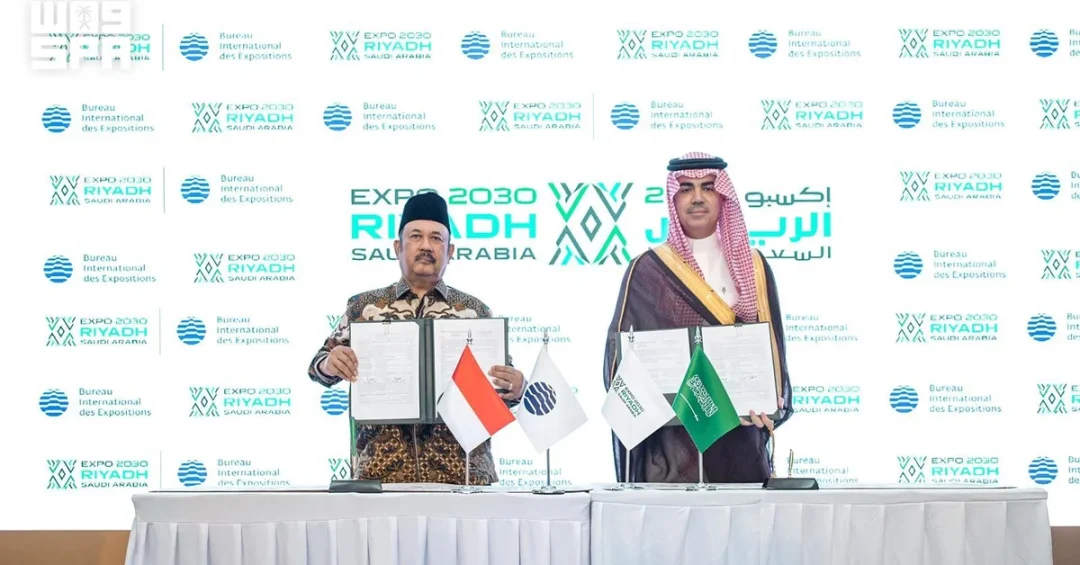
Indonesia has formally signed its Participation Contract for Expo 2030 Riyadh, becoming one of more than 185 Official Participants confirmed for the World Expo, in a ceremony held in Jakarta on November 23, 2026. The agreement was signed by Talal Al-Marri, Chief Executive Officer of Expo 2030 Riyadh, and Rachmat Pambudy, Indonesia’s Minister for National Development Planning and Head of Bappenas, according to the Saudi Press Agency (SPA). The signing marks a significant milestone in the lead-up to the six-month global gathering, which will be hosted in the Saudi capital under the theme “Foresight for Tomorrow.”
But what does Indonesia’s early commitment signal about the broader international momentum behind Riyadh’s World Expo? The Southeast Asian nation’s decision to formalize its participation well ahead of the 2030 opening reflects growing global confidence in the event’s organization and its potential to deliver tangible economic and diplomatic outcomes. With more than 185 countries and organizations already on board, Expo 2030 Riyadh is shaping up to be one of the most widely supported World Expos in recent history. The signing also underscores the deepening partnership between Indonesia and Saudi Arabia, two G20 nations whose long-term development visions—Golden Indonesia 2045 and Saudi Vision 2030—increasingly intersect.
Context and Background
Why has Indonesia chosen to sign its participation contract so early in the Expo 2030 Riyadh preparation cycle? The answer lies in the country’s strategic approach to international expos as platforms for economic diplomacy. Indonesia’s Minister for National Development Planning, Rachmat Pambudy, noted that the early signing “reflects our readiness to lead through partnership and strengthen ties between Indonesia and Saudi Arabia.” He also pointed to the momentum generated by Expo 2025 Osaka, which he said produced over $28 billion in investment commitments for Indonesia. By securing its place early in Riyadh, Indonesia aims to build on that success and position itself as a proactive participant in shaping the global dialogue on sustainable development.
Expo 2030 Riyadh itself is advancing rapidly across all delivery fronts. According to official Saudi information, construction activity is scaling up across the six-million-square-metre site, with major infrastructure works progressing and key vertical assets taking shape. The event will be held under the theme “Foresight for Tomorrow,” organized around five thematic areas: Technology, Planet, Humanity, Culture, and Collaboration. These pillars are designed to encourage participating nations to showcase their achievements, explore solutions to shared challenges, and inspire new possibilities for the decades ahead. Indonesia will be located in the Planet District, a zone dedicated to environmental sustainability and humanity’s relationship with the natural world.
For Saudi Arabia, hosting a World Expo represents a historic opportunity to demonstrate its capacity for large-scale international event management and to accelerate progress toward Vision 2030 goals. The Kingdom’s selection as host for Expo 2030 was confirmed by the Bureau International des Expositions (BIE) in 2023, and since then, Saudi authorities have moved swiftly to prepare the site and engage the international community. The participation of countries like Indonesia—a key partner in trade, investment, and cultural exchange—adds both credibility and diversity to the event.
Key Details of Indonesia’s Participation
What exactly will Indonesia bring to Expo 2030 Riyadh? The country has announced an ambitious vision for its pavilion, which will be located in the Planet District. Under the theme “Nature Unfolding: Explore, Wisdom, Nurture,” Indonesia plans to showcase its rich heritage, creative industries, and forward-looking development ambitions. Minister Pambudy emphasized that the pavilion will serve as “a lasting meeting point where governments, businesses, and investors turn ideas into concrete development outcomes.” He also highlighted the Indonesian philosophy that nature is the greatest teacher, framing the pavilion as a space where wisdom and collective action can shape a sustainable, inclusive, and prosperous future.
The signing ceremony was held in Indonesia, with CEO Talal Al-Marri representing Expo 2030 Riyadh and Minister Rachmat Pambudy signing on behalf of the Indonesian government. Al-Marri praised Indonesia’s role, saying: “Indonesia is a powerful example of what becomes possible when different cultures and communities come together while retaining what makes them distinct. That same possibility lies at the heart of a World Expo—bringing countries and cultures together around a shared purpose, to learn from one another and explore what we can achieve together.” His remarks underscore the Expo’s core mission of fostering international cooperation and mutual understanding.
Indonesia’s participation is not merely symbolic. The country intends to use the Expo as a platform to advance its own development agenda, particularly the Golden Indonesia 2045 vision, which aims to transform the archipelago into a high-income economy by the middle of the century. By aligning its pavilion narrative with the Expo’s thematic focus on Planet and Collaboration, Indonesia hopes to attract investment, forge new partnerships, and share its experiences in sustainable development with a global audience. The early signing gives Indonesian planners ample time to design a compelling pavilion experience and coordinate with Saudi organizers on logistics, programming, and business engagement.
International and Regional Impact
How does Indonesia’s signing affect the broader landscape of international participation in Expo 2030 Riyadh? With more than 185 Official Participants already confirmed, the event is demonstrating a truly global character. The breadth of countries involved—from major economies to small island states—reflects the World Expo’s unique ability to convene diverse perspectives under one roof. Indonesia’s early commitment adds momentum to this process and may encourage other nations in Southeast Asia and the wider Asia-Pacific region to accelerate their own participation plans. As the largest economy in Southeast Asia, Indonesia’s active engagement sends a strong signal about the value that emerging powers place on Saudi Arabia’s global initiatives.
Regionally, the signing reinforces the growing ties between the Kingdom and Southeast Asia. Saudi Arabia has been deepening its diplomatic and economic relationships across Asia, recognizing the region’s dynamism and its importance to global supply chains, energy markets, and investment flows. Indonesia, with its population of over 270 million and rapidly expanding digital economy, is a key partner in this outreach. The Expo provides a structured framework for both countries to collaborate on issues ranging from renewable energy and sustainable agriculture to Islamic finance and halal industries. By working together on the Expo stage, Saudi Arabia and Indonesia can set an example of South-South cooperation that resonates beyond their immediate regions.
Economic and Strategic Significance
What economic benefits can Indonesia and Saudi Arabia expect from this collaboration? For Indonesia, the Expo represents a chance to replicate the success of Expo 2025 Osaka, where the country reportedly secured over $28 billion in investment commitments. Minister Pambudy explicitly linked the Riyadh Expo to economic diplomacy, noting that it will be a vital platform where Golden Indonesia 2045 and Saudi Vision 2030 converge. The Indonesian pavilion will host business forums, investment showcases, and cultural events designed to attract foreign direct investment and promote exports. Given Saudi Arabia’s role as a major investor through the Public Investment Fund (PIF) and its strategic position as a gateway to Middle Eastern markets, Indonesia sees clear opportunities to expand trade and investment ties.
For Saudi Arabia, Indonesia’s participation enhances the Expo’s appeal to international investors and visitors. A strong showing by Indonesia—one of the world’s most populous nations and a member of the G20—adds to the event’s credibility and draws attention to the Kingdom’s broader economic transformation. Expo 2030 Riyadh is expected to attract millions of visitors, generate significant tourism revenue, and create lasting infrastructure that will support Saudi Arabia’s post-oil economic diversification. The presence of a vibrant Indonesian pavilion in the Planet District will enrich the visitor experience and contribute to the Expo’s thematic focus on sustainability and collaboration. Moreover, the partnership underscores Saudi Arabia’s ability to convene global stakeholders around shared goals, a key element of its soft power strategy.
Vision 2030 Alignment
How does Expo 2030 Riyadh fit into Saudi Vision 2030, and why does Indonesia’s participation matter for the Kingdom’s long-term goals? Vision 2030, launched in 2016 under the leadership of Crown Prince Mohammed bin Salman, aims to diversify the Saudi economy, reduce dependence on oil, and position the Kingdom as a global hub for tourism, entertainment, and business. Hosting a World Expo is a centerpiece of this strategy, showcasing Saudi Arabia’s modernization and its capacity to host world-class events. The Expo will leave a legacy of upgraded infrastructure, including transportation networks, hotels, and public spaces, all of which align with Vision 2030 objectives to improve quality of life and attract international visitors.
Indonesia’s participation also reflects the international community’s recognition of Saudi Arabia’s progress and its growing role on the world stage. By bringing its own vision—Golden Indonesia 2045—to Riyadh, Indonesia is effectively endorsing the Expo as a platform for global dialogue and cooperation. The convergence of these two national visions highlights a shared commitment to sustainable development, innovation, and inclusive growth. As the countdown to 2030 continues, each new participation contract signed strengthens the foundation for an Expo that will not only celebrate human achievement but also forge lasting partnerships. Saudi Arabia’s leadership in hosting this event demonstrates its dedication to fostering international collaboration and its ambition to inspire a better future for all.
20 Questions
Q1. What is Expo 2030 Riyadh?
A1. Expo 2030 Riyadh is a World Expo hosted by Saudi Arabia in 2030 under the theme “Foresight for Tomorrow.” It will run for six months and feature pavilions from more than 185 countries, focusing on technology, planet, humanity, culture, and collaboration.
Q2. Who signed Indonesia’s Participation Contract for Expo 2030 Riyadh?
A2. The contract was signed by Talal Al-Marri, CEO of Expo 2030 Riyadh, and Rachmat Pambudy, Indonesia’s Minister for National Development Planning and Head of Bappenas, in a ceremony held in Indonesia on November 23, 2026.
Q3. Why is Indonesia’s early signing significant?
A3. Early signing demonstrates Indonesia’s readiness to lead through partnership and strengthens ties with Saudi Arabia. It also allows ample time for planning a impactful pavilion and leveraging the Expo for economic diplomacy, building on momentum from Expo 2025 Osaka.
Q4. What theme will Indonesia’s pavilion feature?
A4. Indonesia’s pavilion will be in the Planet District and will follow the theme “Nature Unfolding: Explore, Wisdom, Nurture.” It will showcase Indonesia’s heritage, creativity, and sustainable development ambitions, guided by the philosophy that nature is the greatest teacher.
Q5. How many countries have confirmed participation in Expo 2030 Riyadh?
A5. More than 185 Official Participants have confirmed their participation, according to official Saudi sources. This high number reflects the truly global character of the Expo and the broad range of perspectives that will be represented in Riyadh.
Q6. What did Minister Rachmat Pambudy say about Indonesia’s goals?
A6. Pambudy said the early signing reflects Indonesia’s readiness to lead through partnership. He noted that Expo 2025 Osaka generated over $28 billion in investment commitments for Indonesia and described Riyadh as a vital platform for economic diplomacy.
Q7. What is the Golden Indonesia 2045 vision?
A7. Golden Indonesia 2045 is Indonesia’s long-term development plan aiming to transform the country into a high-income economy by its centennial independence anniversary. It focuses on human capital, infrastructure, and sustainable growth, aligning with Saudi Vision 2030’s goals.
Q8. How does Expo 2030 Riyadh align with Saudi Vision 2030?
A8. Expo 2030 Riyadh supports Vision 2030 by showcasing Saudi Arabia’s modernization, attracting international visitors, and accelerating infrastructure development. It reinforces the Kingdom’s role as a global hub for tourism, business, and cultural exchange.
Q9. Where will Expo 2030 Riyadh be held?
A9. The Expo will be held in Riyadh, the capital of Saudi Arabia, on a six-million-square-metre site. Construction is advancing rapidly, with major infrastructure works and key vertical assets taking shape ahead of the 2030 opening.
Q10. What are the five thematic areas of Expo 2030 Riyadh?
A10. The five thematic areas are Technology, Planet, Humanity, Culture, and Collaboration. These pillars encourage participants to showcase achievements, explore shared challenges, and inspire new possibilities for the future.
Q11. What did CEO Talal Al-Marri say about Indonesia’s participation?
A11. Al-Marri said Indonesia is a powerful example of what becomes possible when different cultures and communities come together while retaining their distinct identities. He welcomed Indonesia’s contribution to the World Expo and looked forward to its pavilion.
Q12. How will Indonesia benefit economically from Expo 2030 Riyadh?
A12. Indonesia aims to use the Expo as a platform for economic diplomacy, attracting investment and forging partnerships. It hopes to replicate the success of Expo 2025 Osaka, which generated over $28 billion in investment commitments for the country.
Q13. What is the Planet District at Expo 2030 Riyadh?
A13. The Planet District is one of the thematic zones at Expo 2030 Riyadh, focused on environmental sustainability and humanity’s relationship with nature. Indonesia’s pavilion will be located there, highlighting its commitment to sustainable development.
Q14. When will Expo 2030 Riyadh take place?
A14. Expo 2030 Riyadh is scheduled to take place in 2030, running for six months. The exact dates will be announced by the organizers, but preparations are already well underway across the site.
Q15. How does Indonesia’s participation reflect South-South cooperation?
A15. Indonesia’s participation demonstrates collaboration between two G20 nations from different regions. It highlights how countries can work together on shared development goals, exchanging knowledge and resources to address global challenges.
Q16. What is the role of the Bureau International des Expositions (BIE)?
A16. The BIE is the intergovernmental organization that oversees World Expos. It selected Saudi Arabia to host Expo 2030 Riyadh in 2023, recognizing the Kingdom’s capacity to organize a world-class event.
Q17. How many visitors are expected at Expo 2030 Riyadh?
A17. While exact figures have not been released, World Expos typically attract millions of visitors. Expo 2030 Riyadh is expected to draw a significant number of international and domestic visitors, boosting Saudi tourism and global engagement.
Q18. What infrastructure developments are underway for Expo 2030 Riyadh?
A18. Construction is scaling up across the six-million-square-metre site, with major infrastructure works advancing and key vertical assets taking shape. These developments will leave a lasting legacy for Riyadh, supporting Vision 2030 goals.
Q19. How does Indonesia’s participation strengthen Saudi-Indonesia relations?
A19. It deepens diplomatic and economic ties between the two nations. The collaboration on Expo 2030 Riyadh builds on existing partnerships in trade, investment, and culture, and reinforces mutual commitment to sustainable development.
Q20. What legacy will Expo 2030 Riyadh leave for Saudi Arabia?
A20. The Expo will leave upgraded infrastructure, enhanced global standing, and strengthened international partnerships. It will accelerate Vision 2030 objectives by promoting tourism, economic diversification, and cultural exchange, inspiring a lasting positive impact.
Reader Feedback
We value your thoughts. Please share your feedback on this article.
Your feedback helps us improve our coverage.
Related articles
 Saudi Water Authority Launches Leadership Program with Harvard
 OIC Condemns Settler Terrorism in West Bank as War Crimes
 Saudi Ministry Reaches 300,000+ Umrah Pilgrims in Makkah
 Jubail Plants 6,000 Trees Across Roads, Parks and Walking Paths
 4.1-Magnitude Earthquake Strikes Japan’s Kyushu Region
 Saudi Arabia Weather Forecast for Monday: NCM Issues Alert