


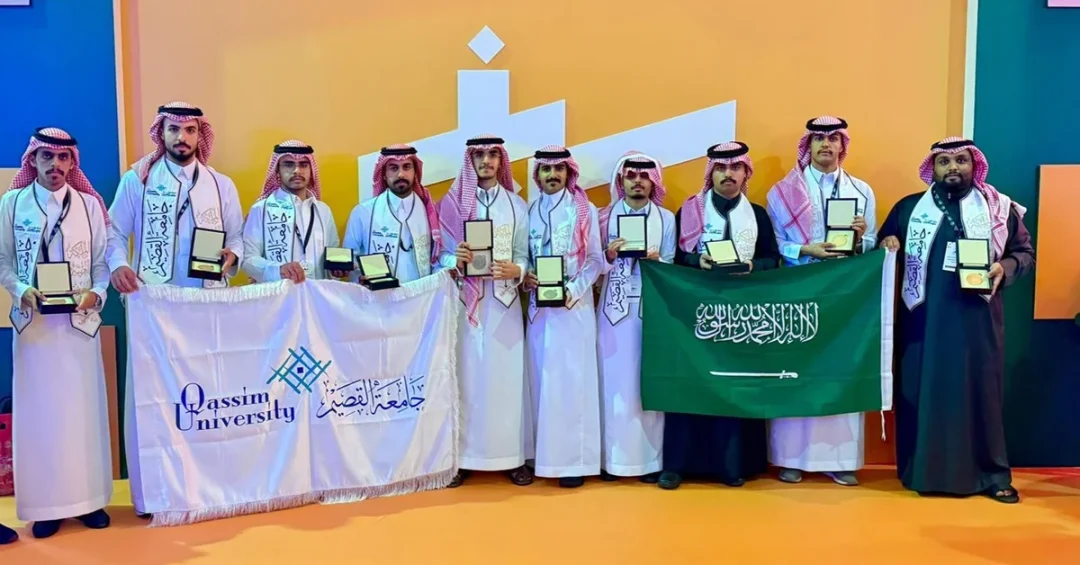
Qassim University secured 11 medals at the Global Security and Innovation Fair and Competition (SAIF 2026), held as part of the Global Security and Technology Summit, winning three gold, five silver, and three bronze medals for its innovative student projects, according to the Saudi Press Agency. The strong showing places the Buraidah-based institution among the most decorated participants at the international event, which convenes researchers, institutions, and technology companies from around the world to exhibit advances in security, innovation, and applied science. The medal tally reflects the breadth of the university’s academic disciplines, drawing winning teams from the colleges of Business and Economics, Computer Science, Science, Languages and Humanities, Pharmacy, Sharia, Engineering, and the Applied College.
The results were announced by Saudi Press Agency (SPA) on November 29, 2026, and represent one of the clearest recent demonstrations of how Saudi higher education is translating classroom research into internationally recognized problem-solving. What makes a single competition meaningful enough to headline? The answer lies in the pattern behind the medals: projects that address air quality, sustainable construction, and data-driven detection, all areas that intersect directly with the Kingdom’s long-term modernization goals. The recognition arrived on an international stage, which matters for a university seeking to build a global research reputation.
Context and Background: A University Building a Research Identity
Qassim University, established in the central region of the Kingdom, has steadily expanded its research portfolio across engineering, health sciences, computer science, and the humanities. Why does a regional university’s performance at an international fair carry weight beyond the campus? Because competitions such as SAIF serve as neutral benchmarks, comparing student innovation against peers from other countries and disciplines rather than against local standards alone. The 11-medal haul signals that Qassim’s students can compete credibly in an open field.
The Global Security and Technology Summit brings together stakeholders from defense, cybersecurity, environmental monitoring, and applied industrial research. Participation is not merely ceremonial; teams submit working prototypes, datasets, and business models that are evaluated by expert panels. For a university, entering this environment requires coordination across departments, faculty mentorship, and often funding for materials and travel. The fact that winning entries came from seven different colleges underscores how the effort was distributed rather than concentrated in a single laboratory.
The competition also sits within a broader regional push to internationalize Saudi academia. Universities across the Kingdom have been encouraged to file patents, publish in indexed journals, and pursue partnerships abroad as part of national human-capital development. Against that backdrop, medals function as visible milestones, evidence that investment in student research is producing measurable output on a competitive world stage.
Key Details: The Winning Projects and Their Disciplines
The three gold medals went to projects involving students from the College of Business and Economics, the College of Computer Science, the College of Science, and the College of Languages and Humanities. The cross-college composition of these teams is notable, and it raises a practical question: does innovation flourish most where disciplines meet? The gold-winning entries combined technical development with commercial reasoning and communication skills, a combination increasingly valued by judges who assess whether a prototype can become a viable product or service.
Five projects earned silver medals. Among them was “Developing a Low-Carbon Bio-Concrete Block Using Coffee Husks as Partial Aggregate Replacement,” a study involving students from the College of Pharmacy, the College of Business and Economics, and the College of Sharia. The project explores turning agricultural by-products into construction materials, an idea with obvious relevance to waste reduction and sustainable building. Another silver went to “Spectra Trace,” which featured participants from the Applied College, while a third, “Strix,” included a student from the College of Business and Economics. The remaining two silver-medal entries drew students from the College of Engineering, the College of Computer, and the College of Business and Economics.
The three bronze medals were awarded to projects developed by students from the College of Computer and the College of Engineering. How should readers interpret the spread of awards across such different fields? The distribution suggests a deliberate institutional strategy of cultivating innovation in multiple faculties simultaneously, rather than concentrating resources on one flagship department. It also indicates that students in the humanities and business disciplines are contributing meaningfully to technical projects, often by shaping the framing, feasibility, and social impact dimensions that competition judges weigh heavily.
International and Regional Impact: Recognition Beyond the Campus
International competition results travel quickly in academic and policy circles. For Qassim University, medals earned in an open global forum provide third-party validation that is difficult to generate through self-reporting. Does external recognition change how a university is perceived abroad? It often does, because prospective research partners, scholarship sponsors, and employers use such signals when assessing the quality of an institution’s graduates and the reliability of its research culture. A strong showing can open doors to joint projects and student exchange.
Regionally, the performance adds to a growing record of Saudi students succeeding in international science and innovation contests. This matters for the Kingdom’s positioning as a knowledge economy, because a country’s reputation for innovation is built incrementally through visible wins by its institutions. The diversity of the winning projects, from sustainable materials to detection technologies, projects a versatile research capability rather than a narrow specialization, which is attractive to international collaborators seeking multidisciplinary partners in the region.
There is also a diplomatic dimension. Educational and scientific exchange is a longstanding channel of soft engagement, and Saudi universities that perform well internationally help sustain the Kingdom’s reputation as a serious participant in global science. The medals announced via SPA therefore carry significance that extends beyond a single competition hall.
Economic and Strategic Significance: From Prototype to Application
What distinguishes a competition medal from commercial impact? The bridge is translation, taking a demonstrated project and developing it toward practical application. The bio-concrete research involving coffee husks illustrates the opportunity: construction materials are a large, measurable market, and locally available agricultural waste streams could reduce input costs while lowering carbon intensity. Projects of this kind align with national priorities around sustainability and industrial localization, and they invite the question of how quickly promising student work can be advanced with institutional and private support.
Similar logic applies to the computer science and engineering entries, which address detection, security, and applied systems. The Kingdom’s labor market increasingly rewards graduates who can build, test, and refine technical solutions under real constraints. Competitions function as rehearsal environments where students practice the full cycle of ideation, prototyping, and presentation before expert evaluators. When universities produce cohorts comfortable with this cycle, they strengthen the pipeline of talent available to employers in technology, energy, logistics, and manufacturing sectors.
Strategically, the results reinforce the value of embedding research training early in undergraduate programs. Students who have competed internationally return with skills in teamwork, deadline management, and technical communication, and they often mentor younger peers. Over time, this creates a self-sustaining culture of applied innovation that benefits the university and the wider regional economy.
Vision 2030 Alignment: Education as a Pillar of National Progress
How does a student medal tally connect to a national development blueprint? Saudi Arabia’s Vision 2030 places human capital, innovation, and a diversified knowledge economy at the center of its ambitions, and universities are among the primary institutions tasked with delivering on those goals. Qassim University’s success at SAIF 2026 gives practical substance to that agenda, showing that students are producing competitive, forward-looking work in fields such as sustainable materials, security technology, and data analysis.
The range of participating colleges, spanning business, computer science, pharmacy, engineering, sharia, science, languages, and the applied college, also reflects the vision’s emphasis on cross-disciplinary collaboration and on widening opportunity across regions of the Kingdom. By earning recognition on an international platform, the university underscores that quality higher education and research capacity are not confined to major metropolitan centers. That message resonates with the broader effort to develop talent and innovation across all regions.
Looking ahead, the challenge and the opportunity are the same: convert momentum into durable results. With continued institutional support, mentorship, and pathways to turn prototypes into applications, achievements like these can become routine rather than exceptional. For an international audience watching the Kingdom’s modernization, the 11 medals provide a concrete, verifiable example of Saudi students competing and succeeding globally, a signal that the country’s investment in education is yielding returns on the world stage.
20 Questions
Q1. What event did Qassim University compete in?
A1. Qassim University competed in the Global Security and Innovation Fair and Competition (SAIF 2026), which was held as part of the Global Security and Technology Summit.
Q2. How many medals did Qassim University win at SAIF 2026?
A2. The university won a total of 11 medals: three gold, five silver, and three bronze medals for its innovative student projects.
Q3. When was the result announced?
A3. The results were reported by the Saudi Press Agency on November 29, 2026, with the announcement dated from Buraidah.
Q4. Which colleges won the gold medals?
A4. Gold medals went to projects involving students from the College of Business and Economics, the College of Computer Science, the College of Science, and the College of Languages and Humanities.
Q5. What was one notable silver-medal project?
A5. One notable silver project was “Developing a Low-Carbon Bio-Concrete Block Using Coffee Husks as Partial Aggregate Replacement,” involving pharmacy, business and economics, and sharia students.
Q6. Which students contributed to the “Spectra Trace” project?
A6. The “Spectra Trace” project featured participants from the Applied College, earning a silver medal at the competition.
Q7. Which project involved a student from the College of Business and Economics and won silver?
A7. The project named “Strix” included a student from the College of Business and Economics and earned a silver medal.
Q8. Which colleges were represented in the remaining two silver-medal entries?
A8. The remaining two silver entries involved students from the College of Engineering, the College of Computer, and the College of Business and Economics.
Q9. Which colleges received the bronze medals?
A9. The three bronze medals were awarded to projects by students from the College of Computer and the College of Engineering.
Q10. Why is the medal spread across colleges significant?
A10. It shows that innovation is being cultivated across multiple faculties rather than concentrated in one department, reflecting a broad institutional research strategy.
Q11. What does the bio-concrete project address?
A11. It explores using coffee husks as a partial aggregate replacement to create low-carbon building blocks, supporting waste reduction and sustainable construction practices.
Q12. What kind of event is the Global Security and Technology Summit?
A12. It is an international gathering that convenes researchers, institutions, and technology companies to exhibit advances in security, innovation, and applied science.
Q13. How are competition entries typically evaluated?
A13. Teams submit working prototypes, datasets, and business models that are assessed by expert panels against criteria of technical merit and practical feasibility.
Q14. Why does international recognition matter for the university?
A14. It provides third-party validation that can attract research partners, scholarship sponsors, and employers, strengthening the institution’s global reputation.
Q15. How does this connect to Vision 2030?
A15. Vision 2030 emphasizes human capital, innovation, and a knowledge economy, and the medals demonstrate students producing competitive work in priority fields.
Q16. What disciplines were represented among the winning teams?
A16. Winning teams drew from business and economics, computer science, science, languages and humanities, pharmacy, sharia, engineering, and the applied college.
Q17. What is the next step for promising projects?
A17. Turning prototypes into practical applications requires continued institutional support, mentorship, and pathways toward development and commercialization.
Q18. Which agency reported the results?
A18. The Saudi Press Agency, the Kingdom’s official news authority, reported the results, reflecting the official channel through which the achievement was announced.
Q19. What skills do students gain from such competitions?
A19. Students develop teamwork, deadline management, technical communication, and the full cycle of ideation, prototyping, and presentation before expert evaluators.
Q20. What broader message does the result send?
A20. It shows that Saudi students can compete and succeed on international platforms, demonstrating that investment in higher education and research is yielding returns.
Reader Feedback
We value your thoughts. Please share your feedback on this article.
Your feedback helps us improve our coverage.
Related articles
 Human Resources Ministry Exceeds Beneficiary Empowerment Targets
 Al-Baha Education Wins 10 Medals at SAIF 2026
 Aseer Female Teachers Win Five Medals at SAIF 2026
 Eastern Region Students Win 175 Medals at SAIF 2026
 Umm Al-Qura University Wins 13 Medals at SAIF 2026
 Umm Al-Qura University Institute Links Research to Development Needs