


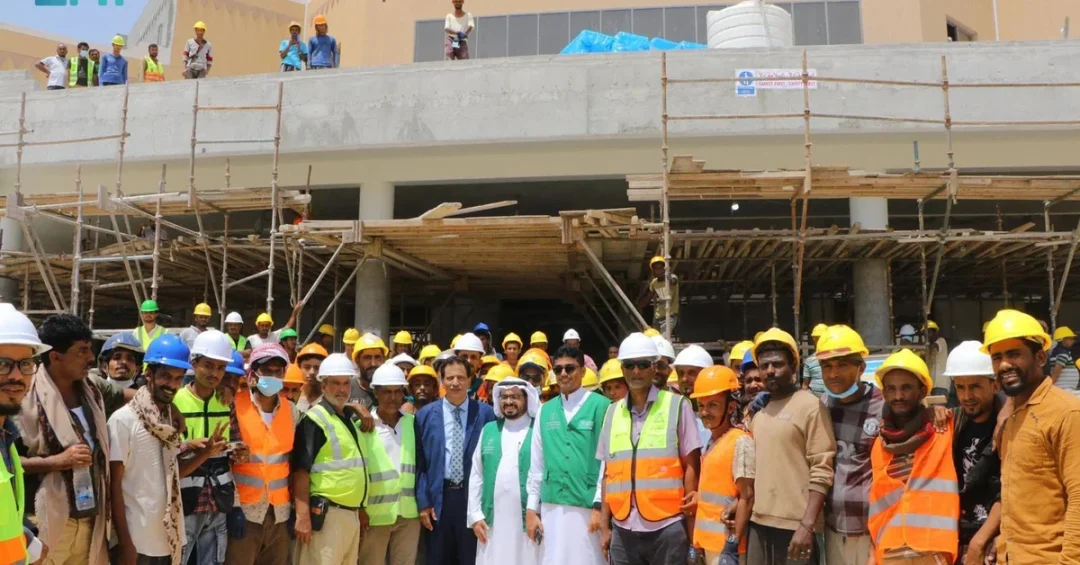
Senior officials from Yemen’s Al-Mahrah Governorate, led by Governor Mohammad Ali Yasser, visited the King Salman Medical and Educational City Project in Al-Mahrah on September 13, 2024, reviewing progress on the major development initiative. The delegation, which included Deputy Governor Brigadier Mukhtar bin Awadh Al-Jaafari and Undersecretary for Technical Affairs Engineer Awad Qowizan, was briefed by Engineer Abdullah Basuleiman, director of the Saudi Development and Reconstruction Program for Yemen (SDRPY) office in Al-Mahrah, on the project’s achievements and construction milestones.
Context and Background
The King Salman Medical and Educational City Project spans 1 million square meters, making it one of the largest initiatives implemented by SDRPY to serve Yemen’s health and education sectors. The project underscores Saudi Arabia’s ongoing commitment to supporting Yemen’s vital infrastructure through comprehensive development programs. Located in Al-Mahrah Governorate, the facility aims to benefit not only local residents but also neighboring areas, addressing critical needs in medical services and education.
Key Details of the Project
The medical city includes a fully-equipped 110-bed hospital with advanced medical equipment. Facilities cover outpatient clinics, a radiology department, a laboratory for all medical tests, an endoscopy department, and emergency and intensive-care units for adults, children, women, and childbirth. The hospital is designed to perform major surgeries with dedicated rooms and comprehensive medical equipment, plus a cardiac care and catheterization section. Civil and architectural works have reached an advanced stage, and the project is expected to meet the healthcare needs of Al-Mahrah and neighboring governorates.
Implications and Impact
This project is part of SDRPY’s broader support for Yemen’s health sector, which includes building and equipping hospitals, rehabilitating medical centers, and building capacity for medical cadres. The program extends to eight essential sectors: education, energy, transportation, water, agriculture, fisheries, development programs, and government capacity building. By enhancing medical services and educational outcomes, the initiative contributes to regional stability and improves quality of life for Yemeni citizens.
Vision 2030 Alignment
The King Salman Medical and Educational City Project exemplifies Saudi Arabia’s commitment to Vision 2030’s goals of regional development, humanitarian leadership, and sustainable impact. By investing in Yemen’s health and education infrastructure, the Kingdom strengthens its role as a key partner in the region’s progress, fostering long-term stability and economic growth that aligns with its forward-looking vision for a prosperous Middle East.
20 Questions
Q1. What is the King Salman Medical and Educational City Project?
A1. It is a major development project in Al-Mahrah Governorate, Yemen, covering 1 million square meters, implemented by the Saudi Development and Reconstruction Program for Yemen (SDRPY) to improve health and education services.
Q2. Who visited the project on September 13, 2024?
A2. Al-Mahrah Governor Mohammad Ali Yasser, his deputy Brigadier Mukhtar bin Awadh Al-Jaafari, and Undersecretary for Technical Affairs Engineer Awad Qowizan visited the project to inspect progress.
Q3. Which organization is implementing this project?
A3. The Saudi Development and Reconstruction Program for Yemen (SDRPY) is implementing the King Salman Medical and Educational City Project as part of its support for Yemen.
Q4. What is the size of the project area?
A4. The project spans an area of 1 million square meters, making it one of the largest SDRPY initiatives in Yemen.
Q5. What sectors does the project primarily serve?
A5. The project primarily serves the health and education sectors in Yemen, benefiting Al-Mahrah Governorate and neighboring areas.
Q6. How many beds will the hospital have?
A6. The hospital will have 110 fully-equipped beds with advanced medical equipment to serve patients.
Q7. What facilities does the hospital include?
A7. Facilities include outpatient clinics, a radiology department, a laboratory, an endoscopy department, emergency and intensive-care units for adults, children, women, and childbirth.
Q8. Does the hospital support major surgeries?
A8. Yes, the hospital is fully prepared to perform major surgeries with dedicated rooms and comprehensive medical equipment.
Q9. Is there a cardiac care unit?
A9. Yes, the hospital includes a section for cardiac care and cardiac catheterization to address heart-related conditions.
Q10. What is the current status of construction?
A10. Civil and architectural works have reached an advanced stage, indicating significant progress toward completion.
Q11. Who briefed the delegation during the visit?
A11. Engineer Abdullah Basuleiman, director of SDRPY’s Office in Al-Mahrah Governorate, briefed the delegation on project progress and achievements.
Q12. Why is this project important for Al-Mahrah?
A12. It enhances medical services and educational outcomes, meeting the needs of Al-Mahrah and neighboring governorates with advanced medical capabilities.
Q13. What other sectors does SDRPY support in Yemen?
A13. SDRPY supports eight sectors: education, energy, transportation, water, agriculture, fisheries, development programs, and government capacity building.
Q14. Does SDRPY support health projects beyond this one?
A14. Yes, SDRPY has provided numerous projects including building hospitals, equipping medical centers, rehabilitating facilities, and training medical cadres.
Q15. How does this project align with Saudi Arabia’s regional role?
A15. It demonstrates Saudi Arabia’s commitment to humanitarian and development support for Yemen, fostering stability and prosperity in the region.
Q16. What is the expected impact on neighboring areas?
A16. The project will serve Al-Mahrah and neighboring governorates, improving access to quality healthcare and education for more residents.
Q17. When did the project start?
A17. The specific start date is not provided, but civil and architectural works have already reached an advanced stage, indicating it has been under construction for some time.
Q18. Is the project part of a larger development plan?
A18. Yes, it is part of SDRPY’s comprehensive development support for Yemen, covering multiple vital sectors to rebuild infrastructure and services.
Q19. How does the project contribute to Saudi Vision 2030?
A19. It supports Vision 2030’s goals of regional leadership, humanitarian impact, and sustainable development by investing in neighboring countries’ stability.
Q20. What makes this hospital unique compared to others in Yemen?
A20. The hospital features advanced medical equipment, comprehensive facilities including cardiac catheterization, and a 110-bed capacity, making it a key healthcare provider for the region.
Reader Feedback
We value your thoughts. Please share your feedback on this article.
Your feedback helps us improve our coverage.