


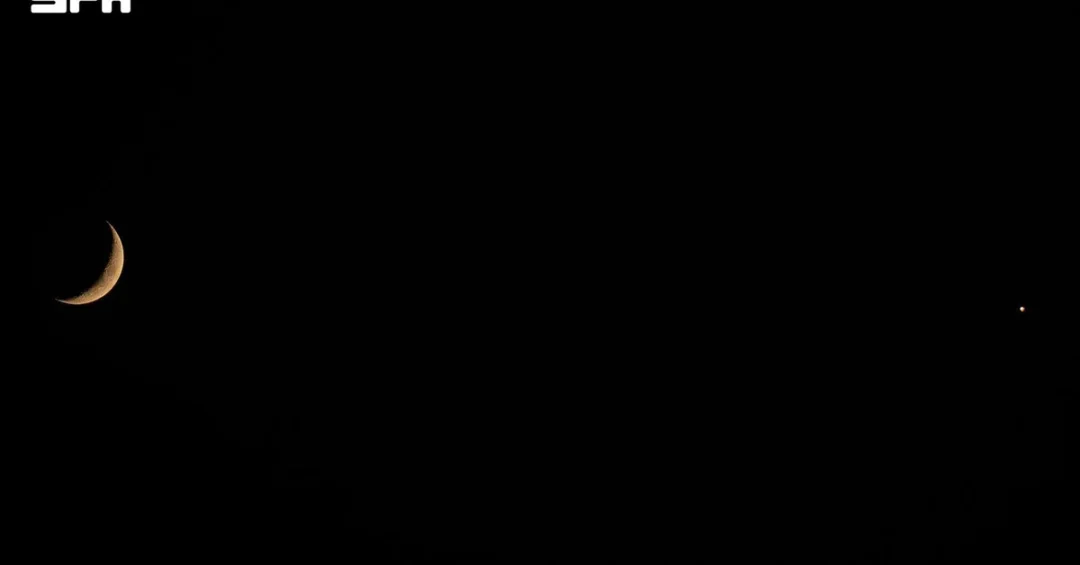
The waxing crescent of Rabi’ Al-Awwal graced the Kingdom’s skies yesterday evening, appearing alongside Venus in an astronomical spectacle visible to the naked eye after sunset. The celestial event, observed across Saudi Arabia from Arar to other regions, offered an extraordinary moment for amateur stargazers and photographers alike. The Saudi Press Agency (SPA) reported the conjunction, emphasizing its significance in the Islamic lunar calendar and its role in inspiring public interest in astronomy.
Context and Background
Astronomical conjunctions occur when two celestial bodies appear close together from Earth’s perspective, creating a captivating alignment that has historically held cultural and scientific importance. In Saudi Arabia, the sighting of the crescent moon marks the beginning of the Islamic month, a practice deeply rooted in tradition. This conjunction with Venus, often called the “Evening Star” or “Morning Star,” enhances the visual appeal and encourages people to look up, especially during the clear desert evenings characteristic of the Kingdom.
Key Details
Mohammed Al-Hazimi, a member of the Astronomy and Space Club, explained that such events increase interest in observing celestial bodies and understanding their movements and positions. He noted that the waxing crescent’s proximity to Venus provided an ideal opportunity for both amateur astronomers and professional photographers to capture remarkable images. The event, which occurred after sunset, was visible without any optical equipment, though telescopes and binoculars would have enhanced the view. The SPA reported the timing, local to Riyadh, at 15:46 (12:46 GMT), confirming the clear weather conditions that allowed optimal visibility.
Implications and Impact
Such celestial events have a dual effect: they inspire scientific curiosity among the public and support tourism by attracting sky-gazers from around the world. Saudi Arabia’s commitment to promoting scientific literacy and cultural heritage in astronomy is evident in its support for programs and clubs dedicated to space sciences. Moreover, the conjunction serves as a reminder of the precision of astronomical calculations used in Islamic rituals, strengthening the bridge between modern science and tradition. The Kingdom continues to position itself as a center for scientific observation and research, with investments in observatories and partnerships with international space agencies.
Vision 2030 Alignment
The appearance of the crescent moon and Venus in Saudi Arabia’s sky is more than a transient natural wonder; it aligns with the nation’s Vision 2030 goals of cultivating a society based on knowledge and science. Through its initiatives in space, such as the Saudi Space Agency and the Astronaut Program, the Kingdom encourages its citizens and the world to engage with celestial sciences. These events catalyze interest in fields that will drive the diversified economy of the future, supporting the next generation of scientists and explorers. As the Kingdom advances toward Vision 2030, such moments of cosmic beauty reinforce its commitment to both scientific excellence and cultural preservation.
20 Questions
Q1. What is a waxing crescent moon?
A1. A waxing crescent moon is the lunar phase when the visible portion is increasing from the new moon, showing a slim illuminated crescent shape. It appears in the western sky after sunset and marks the early part of the lunar month, often celebrated in Islamic tradition as the start of the month.
Q2. Why is Venus often called the “Evening Star”?
A2. Venus is called the “Evening Star” because it is visible in the western sky after sunset, when it appears as one of the brightest objects. This occurs when its orbit places it east of the Sun, making it rise and set after the Sun, thus illuminating the dusk sky.
Q3. How often does Venus conjunction with the Moon?
A3. Venus and the Moon appear close in the sky approximately once a month, because the Moon orbits the Earth each month and Venus’s orbit is positioned relative to the Sun and Earth. However, the exact timing and visibility vary, with some conjunctions more noticeable than others depending on separation and horizon altitude.
Q4. Can this event be seen without a telescope?
A4. Yes, the conjunction of a crescent moon and Venus is often bright enough to be seen with the naked eye. The thin crescent is easy to spot, and Venus is extremely luminous, making the pair easily visible against the twilight sky after sunset, provided the sky is clear and unobstructed.
Q5. What is the significance of crescent moon in Saudi Arabia?
A5. The crescent moon holds religious and cultural significance in Saudi Arabia and the Islamic world. It signals the beginning of each lunar month, including the holy month of Ramadan and Dhul-Hijjah. Sightings are carefully observed and reported to Islamic authorities to determine official dates for worship and festivals.
Q6. Who is Mohammed Al-Hazimi?
A6. Mohammed Al-Hazimi is a member of the Astronomy and Space Club, a Saudi organization dedicated to promoting astronomical sciences. He often provides insights on celestial events and works to educate the public about the universe, encouraging people to observe and understand the movements of celestial bodies.
Q7. What role do astronomy clubs play in Saudi Arabia?
A7. Astronomy clubs in Saudi Arabia organize stargazing events, workshops, and lectures to engage the public with celestial phenomena. They help foster a scientific mindset and support the Kingdom’s Vision 2030 goals by inspiring interest in space, science, and innovation among citizens and residents.
Q8. How does Saudi Arabia’s geography affect astronomy?
A8. Saudi Arabia’s vast desert landscapes and clear, dry skies provide excellent observing conditions. Low humidity and minimal light pollution in many areas make it an ideal location for stargazing, leading to a growing popularity in astro-tourism and astronomical research, enhancing the country’s reputation in the field.
Q9. Why is the conjunction important for photographers?
A9. A conjunction of the crescent moon and Venus creates a striking visual contrast, making it a favorite subject for photographers. The event offers a chance to capture unique compositions, blending the delicate lunar crescent with the bright planet, often against vivid twilight colors. Photographers may use telephoto lenses to emphasize the apparent size difference.
Q10. Is this a rare event?
A10. While a conjunction of the moon and Venus occurs roughly monthly, the specific visibility of a thin crescent alongside Venus is less common. The clarity, altitude, and timing make each event unique. However, in reality, such events are not exceedingly rare, but they are always appreciated for their beauty and scientific value.
Q11. What is the current month in the Islamic calendar?
A11. The event coincided with the waxing crescent of Rabi’ Al-Awwal, the third month of the Islamic lunar calendar. Rabi’ Al-Awwal is significant for Muslims as it is the month in which the Prophet Muhammad was born, making it a time of reflection and cultural significance.
Q12. How does this event relate to the lunar calendar?
A12. The lunar calendar depends on the sighting of the crescent moon to determine the start of each month. The conjunction with Venus does not affect the calendar but serves as an important reminder of the month’s beginning. Traditional moon-sighting methods still rely on the naked eye, with conjunction events providing training opportunities.
Q13. What are the typical viewing conditions for such a conjunction?
A13. Optimal conditions include a clear, unobstructed horizon toward the west after sunset. Atmospheric clarity and low humidity enhance visibility. Locations away from city lights are ideal. The period shortly after sunset, when the sky is still slightly bright, allows the crescent and Venus to be easily seen with minimal interference.
Q14. Has Saudi Arabia made investments in astronomy?
A14. Yes, Saudi Arabia has invested in astronomy and space sciences under Vision 2030. The Saudi Space Agency, the Saudi Space Commission, and initiatives like the National Center for Astronomy are active. These programs aim to foster scientific research, build national expertise, and support the growth of space industries in the Kingdom.
Q15. Are there any upcoming astronomical events?
A15. Astronomers predict several conjunctions and meteor showers during the year. For example, the Geminid meteor shower and various planetary alignments are often visible. However, specific dates vary, and clubs in Saudi Arabia regularly schedule public viewings for such events, making the stargazing calendar active.
Q16. How can I participate in such observations?
A16. To participate, you can join local astronomy clubs, attend events at designated observation sites, or simply find a location with clear skies. There are often organized nights at public parks or in desert areas. For best experience, bring binoculars or a telescope if available, but naked eye is sufficient for most conjunctions.
Q17. Does the moon ever block Venus?
A17. In extremely rare events, the moon can actually occult Venus, meaning it passes in front of the planet. This is a much more uncommon occurrence and is not the same as the conjunction. Occultations require precise predictions and are of interest to astronomers due to their rarity.
Q18. What does the crescent moon represent?
A18. The crescent moon is a symbol used on some Islamic flags and structures, though it is not part of the Islamic religion itself. It represents the lunar nature of the calendar and has cultural associations with the Muslim world. In Saudi Arabia, the crescent is also used in official emblems, embodying identity and heritage.
Q19. How do I photograph a conjunction?
A19. To photograph a conjunction, you need a camera with a telephoto lens or a telescope with a mounting. Use manual settings to avoid overexposure, and adjust ISO and shutter speed based on brightness. A shutter release can help reduce blur. Include some foreground (trees or buildings) for scale, and experiment with the exposure to capture both the crescent details and Venus’s glow.
Q20. Why is sky observation important for a country like Saudi Arabia?
A20. Observing the sky connects the public with science and heritage. In Saudi Arabia, it reinforces the role of astronomy in timekeeping and cultural traditions. It also supports the nation’s ambition to be a leader in space and technology by sparking curiosity in younger generations and encouraging them to pursue scientific careers, which is in line with the Vision 2030 human capital development goals.
Reader Feedback
We value your thoughts. Please share your feedback on this article.
Your feedback helps us improve our coverage.