


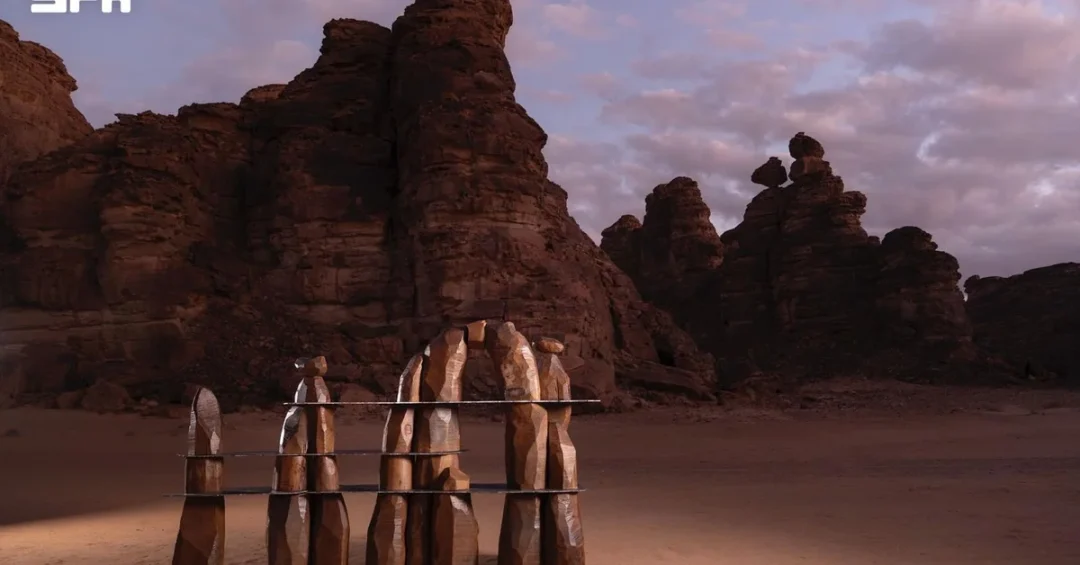
The AlUla Artist Residency Programme has extended its international reach with participants winning top honors at the fourth edition of the Design Award organized by the Institut du Monde Arabe in Paris, official Saudi sources confirmed. Saudi architect and artist Aseel Alamoudi received the Emerging Talent Award for her project “Playformation: The Curve and The Dot,” a body of work inspired by AlUla’s ancient rock formations and natural curves, while the Contemporary Craftsmanship Award went to Altin Studio, founded by Yasmine Sfar and Mehdi Kebaier, for their sculptural work “Our AlUla Trilogy” (2025). The recognition, announced by the Saudi Press Agency (SPA), marks another milestone in AlUla’s emergence as a global center for creative practice and cultural exchange.
What does it mean when a residency program rooted in the sandstone canyons of northwest Saudi Arabia begins collecting awards in Paris? For the Royal Commission for AlUla (RCU), the answer is straightforward: it confirms that the Kingdom’s investment in culture is producing work that stands comparison with the best in the world. The AlUla Artist Residency Programme was established to invite artists from Saudi Arabia and abroad to live and work within AlUla’s extraordinary landscape, drawing on its geology, history, and living heritage. The awards in Paris suggest that this model is not only attracting talent but generating original, exportable creativity.
Context and Background
Why has AlUla become such a powerful source of artistic inspiration in such a short period of time? The answer lies in the region’s unique combination of natural and human history. AlUla is home to Hegra (Mada’in Salih), Saudi Arabia’s first UNESCO World Heritage site, along with dramatic rock formations, ancient oases, and a layered cultural inheritance that spans Nabataean, Dadanite, Lihyanite, and Islamic eras. For artists, this is not simply a backdrop but a living archive of forms, materials, and stories. The AlUla Artist Residency Programme was designed to give creative practitioners sustained access to this environment, allowing ideas to develop slowly rather than under the pressure of short-term commissions.
The residency sits within a broader cultural ecosystem developed by the Royal Commission for AlUla, which has pursued a long-term strategy to transform the region into a global destination for heritage, arts, and tourism. That strategy includes major initiatives such as the AlUla Arts Festival, Desert X AlUla, the AlUla Design Residency, and partnerships with international institutions. The program has hosted artists working across sculpture, architecture, textiles, digital media, and craft, with each cohort encouraged to engage directly with AlUla’s communities, materials, and terrain. The awards in Paris are therefore not an isolated success but the visible tip of a sustained institutional effort.
The Institut du Monde Arabe, based in Paris, has long served as a bridge between Arab cultures and international audiences. Its Design Award, now in its fourth edition, recognizes contemporary design and craft that engages with Arab heritage in innovative ways. For Saudi participants to win in two categories reflects both the quality of the work produced in AlUla and the growing international appetite for design that is rooted in place rather than generic global trends. It also signals that Saudi cultural institutions are building the kind of international partnerships that allow Saudi creativity to circulate globally.
Key Details
What exactly did the award-winning projects achieve? Aseel Alamoudi’s “Playformation: The Curve and The Dot” draws directly on the visual language of AlUla’s rock formations. Her work explores how natural curves and points of contrast can be translated into architectural and artistic forms, blending geometric precision with organic inspiration. As an architect and artist, Alamoudi represents a generation of Saudi practitioners who are increasingly confident in drawing on local landscapes as a source of contemporary design thinking. The Emerging Talent Award recognizes her as a voice to watch on the international stage.
Altin Studio’s “Our AlUla Trilogy” comprises three sculptural pieces titled “Wadi,” “Waha,” and “Yusr.” Crafted from palm wood and plant fibers, the works combine traditional craftsmanship with contemporary design sensibilities. The trilogy draws inspiration from AlUla’s landscape and natural materials while evoking the palm cultures of both Saudi Arabia and Tunisia, reflecting the cross-cultural dialogue that the residency encourages. The use of palm wood and plant fibers is significant: it connects the work to sustainable material practices and to the agricultural heritage of oasis communities, while also demonstrating that traditional crafts can be reimagined for contemporary audiences.
The fact that both awards went to projects rooted in AlUla’s physical environment is telling. It suggests that the residency’s emphasis on site-specific engagement is producing work with a distinct identity, rather than derivative international style. The pieces also reflect the residency’s commitment to interdisciplinarity, bringing together architecture, sculpture, craft, and design. For the Royal Commission for AlUla, such outcomes validate a model that treats culture not as decoration but as a driver of economic and social development.
International and Regional Impact
How does recognition in Paris translate into broader impact for Saudi Arabia and the region? International awards serve as a form of soft power, signaling that a country’s cultural institutions can compete at the highest level. For Saudi Arabia, which has invested heavily in cultural infrastructure as part of Vision 2030, such wins help to shift perceptions and attract further international collaboration. They also create opportunities for Saudi artists to exhibit, publish, and partner with institutions abroad, building careers that extend beyond the Kingdom’s borders.
At the regional level, the success of Altin Studio, founded by Yasmine Sfar and Mehdi Kebaier, highlights the cross-cultural connections between Saudi Arabia and North Africa. By evoking the palm cultures of both Saudi Arabia and Tunisia, the work speaks to shared heritage across the Arab world while remaining firmly grounded in AlUla. This kind of cultural diplomacy complements Saudi Arabia’s broader efforts to strengthen ties across the region through trade, investment, and people-to-people exchange. It also positions AlUla as a meeting point for diverse creative traditions, rather than a purely local project.
For international audiences, the awards offer a window into a side of Saudi Arabia that is often underrepresented in global media: a country with a vibrant contemporary art scene, ambitious cultural institutions, and a growing community of designers and craftspeople. The Institut du Monde Arabe’s platform gives this work visibility among European audiences, critics, and collectors, potentially opening doors to galleries, museums, and design fairs. Over time, such exposure can help to build a sustainable market for Saudi creative output.
Economic and Strategic Significance
Why should economic analysts pay attention to cultural awards? Because culture is increasingly intertwined with tourism, investment, and national branding. AlUla’s development strategy is explicitly designed to attract visitors, create jobs, and diversify the local economy away from oil dependence. Cultural events, residencies, and exhibitions generate demand for hospitality, transport, and retail services, while also extending the length of stay for visitors who come for heritage and arts. The international recognition of AlUla-based artists reinforces the region’s brand as a destination for high-quality cultural experiences.
The Royal Commission for AlUla has set ambitious targets for visitor numbers, economic contribution, and community engagement. Each award-winning project contributes to this broader effort by demonstrating that AlUla is not only a place to visit but a place where world-class work is made. This distinction matters for attracting long-term partners, sponsors, and residents. It also supports the growth of a local creative economy, as residencies and exhibitions create opportunities for Saudi designers, artisans, and technicians to develop skills and find markets for their work.
Strategically, the awards reinforce Saudi Arabia’s position as a cultural bridge between the Middle East and the wider world. By hosting international artists and sending Saudi work abroad, AlUla participates in a global conversation about heritage, sustainability, and design. This aligns with Vision 2030’s emphasis on international engagement and on presenting Saudi Arabia as a modern, open, and culturally confident nation. The recognition from the Institut du Monde Arabe is thus both a cultural and a strategic asset.
Vision 2030 Alignment
How does this achievement connect to Saudi Arabia’s long-term national vision? Vision 2030, launched under the leadership of Crown Prince Mohammed bin Salman, seeks to diversify the economy, empower citizens, and enhance the Kingdom’s global standing. Culture is a central pillar of this vision, with targets for participation, employment, and international exchange. The AlUla Artist Residency Programme and the awards won by its participants directly support these goals by nurturing Saudi talent, attracting international attention, and creating new economic opportunities in the creative sector.
The success of Aseel Alamoudi and Altin Studio also reflects the Vision 2030 commitment to empowering women and young people in the cultural economy. Alamoudi’s recognition as an emerging talent highlights the growing visibility of Saudi women in architecture and design, while Altin Studio’s founders demonstrate the entrepreneurial energy that the Kingdom is seeking to cultivate. As AlUla continues to develop its residencies, festivals, and partnerships, it will remain a showcase for the creativity and ambition that define Saudi Arabia’s cultural transformation. The awards in Paris are a sign that this transformation is being noticed, and celebrated, far beyond the Kingdom’s borders.
20 Questions
Q1. What is the AlUla Artist Residency Programme?
A1. It is a cultural initiative by the Royal Commission for AlUla that invites artists from Saudi Arabia and abroad to live and work in AlUla, drawing inspiration from its landscape, heritage, and communities to produce original creative work.
Q2. Which awards did AlUla participants win in Paris?
A2. Saudi architect Aseel Alamoudi won the Emerging Talent Award, while Altin Studio, founded by Yasmine Sfar and Mehdi Kebaier, received the Contemporary Craftsmanship Award at the fourth edition of the Design Award organized by the Institut du Monde Arabe.
Q3. What is the Institut du Monde Arabe?
A3. The Institut du Monde Arabe is a cultural institution in Paris dedicated to promoting Arab cultures. Its Design Award, now in its fourth edition, recognizes contemporary design and craft that engages creatively with Arab heritage.
Q4. What inspired Aseel Alamoudi’s winning project?
A4. Her project, “Playformation: The Curve and The Dot,” was inspired by AlUla’s rock formations and natural curves, translating the region’s geology into architectural and artistic forms that blend geometric precision with organic inspiration.
Q5. What are the three pieces in “Our AlUla Trilogy”?
A5. The trilogy comprises three sculptural works titled “Wadi,” “Waha,” and “Yusr,” crafted from palm wood and plant fibers, drawing inspiration from AlUla’s landscape and the palm cultures of Saudi Arabia and Tunisia.
Q6. Why are palm wood and plant fibers significant in the winning artwork?
A6. These materials connect the work to sustainable practices and the agricultural heritage of oasis communities, demonstrating that traditional crafts can be reimagined for contemporary design while evoking shared cultural traditions.
Q7. How does the residency support Saudi Arabia’s cultural goals?
A7. It nurtures Saudi and international talent, generates original creative work, and raises AlUla’s profile as a global cultural destination, directly supporting Vision 2030 goals for cultural participation, employment, and international exchange.
Q8. What is the Royal Commission for AlUla?
A8. The Royal Commission for AlUla is the Saudi government body responsible for developing and promoting AlUla as a world-class destination for heritage, culture, and tourism, in line with Vision 2030.
Q9. What other cultural initiatives take place in AlUla?
A9. AlUla hosts the AlUla Arts Festival, Desert X AlUla, the AlUla Design Residency, and various exhibitions and events that showcase contemporary art, heritage, and design from Saudi Arabia and around the world.
Q10. How does this recognition benefit Saudi Arabia internationally?
A10. It enhances Saudi Arabia’s soft power, attracts international collaboration, and presents the Kingdom as a modern, culturally confident nation, helping to shift global perceptions and build markets for Saudi creative output.
Q11. What is the significance of AlUla’s rock formations in the winning projects?
A11. AlUla’s rock formations provide a distinctive visual and material vocabulary that inspires site-specific work. Both winning projects drew on these natural forms, demonstrating how local landscapes can inform contemporary design with global relevance.
Q12. How does the award reflect on Saudi women in the arts?
A12. Aseel Alamoudi’s recognition highlights the growing visibility of Saudi women in architecture and design, reflecting Vision 2030’s commitment to empowering women and expanding their participation in the cultural economy.
Q13. What is the economic impact of cultural awards for AlUla?
A13. They boost tourism, attract investment, create jobs in hospitality and retail, and support the growth of a local creative economy, contributing to AlUla’s economic diversification targets under Vision 2030.
Q14. How does the residency foster cross-cultural dialogue?
A14. By hosting artists from different countries and encouraging engagement with AlUla’s heritage, the residency creates opportunities for exchange, as seen in Altin Studio’s work evoking both Saudi and Tunisian palm cultures.
Q15. What does the Emerging Talent Award recognize?
A15. The Emerging Talent Award recognizes promising new voices in design and architecture. Aseel Alamoudi received it for her innovative project inspired by AlUla’s natural curves and rock formations.
Q16. What does the Contemporary Craftsmanship Award celebrate?
A16. It celebrates excellence in craft that combines traditional techniques with contemporary design. Altin Studio won for “Our AlUla Trilogy,” which uses palm wood and plant fibers in sculptural works.
Q17. How does AlUla’s heritage inform contemporary design?
A17. AlUla’s Nabataean, Dadanite, and Lihyanite heritage, along with its oases and rock formations, offers artists a rich archive of forms, materials, and stories that can be translated into contemporary architecture, sculpture, and craft.
Q18. What role does the Saudi Press Agency play in reporting such news?
A18. The Saudi Press Agency is the Kingdom’s official news agency, providing authoritative information on cultural, economic, and governmental developments, including the international achievements of Saudi cultural initiatives.
Q19. How can international audiences engage with AlUla’s cultural scene?
A19. International audiences can visit AlUla for its festivals, exhibitions, and heritage sites, follow the Royal Commission for AlUla’s programs online, and support Saudi artists through galleries, design fairs, and cultural partnerships.
Q20. What does this achievement signal for the future of Saudi culture?
A20. It signals that Saudi Arabia’s cultural investments are producing world-class talent and work, and that AlUla is becoming a global hub for creativity, supporting Vision 2030’s goals for cultural and economic transformation.
Reader Feedback
We value your thoughts. Please share your feedback on this article.
Your feedback helps us improve our coverage.
Related articles
 RCU Campaign Reveals 19,802 Rock Art Panels in AlUla
 KSGAAL Releases Riyadh List of 5,000 Common Arabic Words
 Northern Borders Falconry Season Draws Gulf Falconers
 Taif historic gates preserve cultural and literary heritage
 Aseer Ramadan markets provide economic and social hubs
 AlMidhallah Artistic Space explores Islamic gardens at Islamic Arts Biennale