


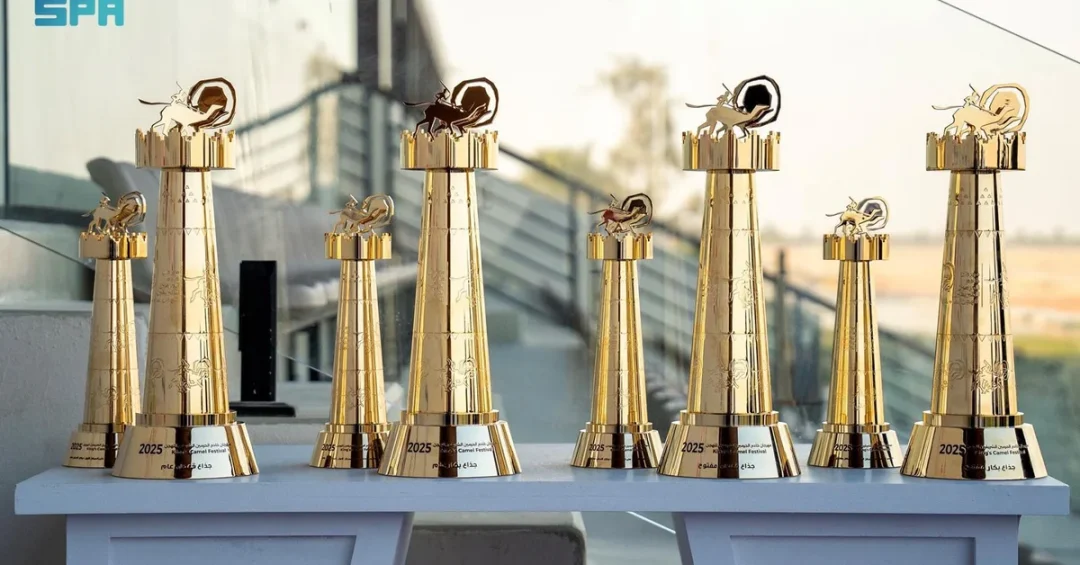
The Saudi Camel Racing Federation has unveiled the trophies for the 2025 Custodian of the Two Holy Mosques Camel Festival, featuring a golden finish and a shape inspired by Al Janadriyah Village. The second edition of the festival, which began on Monday, comprises 225 races with a total prize pool of SAR70 million, according to the Saudi Press Agency (SPA). The trophies, crafted in Italy and requiring 45 days to complete, retain the design from the festival’s first edition while being produced with exceptional quality by some of Europe’s most skilled trophy makers.
What does this blend of Saudi heritage and Italian craftsmanship signify for the Kingdom’s cultural ambitions? The festival, held under the patronage of the Custodian of the Two Holy Mosques, King Salman bin Abdulaziz Al Saud, underscores Saudi Arabia’s commitment to preserving its rich traditions while embracing global excellence. The trophies, inspired by the iconic Al Janadriyah Village, serve as a tangible symbol of this fusion, linking the deep-rooted history of camel racing to the Kingdom’s forward-looking Vision 2030. As the event unfolds, it draws attention not only to the competitive spirit of the races but also to the meticulous artistry behind the awards that celebrate the winners.
Context and Background
The Custodian of the Two Holy Mosques Camel Festival is a premier event on the Saudi sporting and cultural calendar, organized by the Saudi Camel Racing Federation. First launched in 2024, the festival quickly established itself as a major platform for celebrating the traditional sport of camel racing, which holds a special place in Saudi heritage. The second edition, running from Monday, features 225 races and a staggering prize pool of SAR70 million, reflecting the Kingdom’s dedication to promoting this ancient sport on a grand scale. The festival not only attracts top camel owners and racers from across the region but also garners international attention, showcasing Saudi Arabia’s ability to host world-class events.
The trophies themselves are a story of cross-cultural collaboration. Designed by the Saudi Camel Racing Federation, they draw inspiration from Al Janadriyah Village, a cultural landmark that embodies Saudi Arabia’s history and traditions. The golden finish and intricate design pay homage to the Kingdom’s rich past while signaling its modern aspirations. Crafted in Italy, the trophies took 45 days to complete, involving some of Europe’s most skilled artisans. This choice to manufacture in Italy highlights the Kingdom’s openness to international partnerships and its pursuit of excellence in every detail, even as it celebrates its own heritage.
Why does the design of a trophy matter in the broader narrative of Saudi Arabia’s global engagement? The answer lies in the symbolism: it represents the Kingdom’s dual commitment to honoring its roots and embracing global standards. The festival, with its substantial prize pool and high-profile races, is more than a competition; it is a statement of Saudi Arabia’s cultural confidence and its ability to integrate international expertise into its own traditions. The trophies, therefore, are not just awards but ambassadors of Saudi culture, carrying the story of Al Janadriyah to an international audience.
Key Details
The 2025 Custodian of the Two Holy Mosques Camel Festival kicked off on Monday, with 225 races scheduled to take place over the coming days. The total prize pool of SAR70 million is among the largest in the history of camel racing, underscoring the Kingdom’s commitment to rewarding excellence and encouraging participation. The races are expected to draw elite camel owners and trainers from Saudi Arabia and beyond, all vying for a share of the lucrative prizes and the prestigious trophies. The festival is held under the patronage of the Custodian of the Two Holy Mosques, King Salman bin Abdulaziz Al Saud, adding a layer of royal endorsement that elevates its significance.
The trophies, designed by the Saudi Camel Racing Federation, feature a golden finish and a shape inspired by Al Janadriyah Village. Al Janadriyah is renowned for its annual cultural festival that celebrates Saudi heritage, including traditional crafts, music, and cuisine. By incorporating this motif, the trophies serve as a miniature representation of the Kingdom’s cultural identity. The decision to have them crafted in Italy by some of Europe’s most skilled trophy makers reflects a deliberate effort to achieve the highest quality. The 45-day production process involved meticulous attention to detail, ensuring that each trophy meets international standards of craftsmanship.
While retaining the design from the first edition, the 2025 trophies are distinguished by their exceptional quality. This continuity in design provides a sense of tradition, while the improved craftsmanship elevates the awards to new heights. The Saudi Camel Racing Federation’s choice to entrust the creation to Italian artisans speaks to a broader strategy of leveraging global expertise to enhance Saudi initiatives. It also highlights the Kingdom’s ability to collaborate with international partners in a way that respects and promotes its own culture. The trophies are thus a blend of Saudi inspiration and Italian artistry, a combination that perfectly encapsulates the festival’s spirit.
International and Regional Impact
The Custodian of the Two Holy Mosques Camel Festival has significant implications for Saudi Arabia’s regional and international standing. Camel racing is a sport with deep roots in the Arabian Peninsula, and by hosting a festival of this magnitude, the Kingdom reinforces its role as a custodian of Gulf heritage. The participation of racers from neighboring countries and the international media coverage further enhance Saudi Arabia’s soft power. The festival also serves as a platform for cultural exchange, as visitors from around the world witness the grandeur of Saudi traditions and the Kingdom’s modern capabilities. The Italian craftsmanship of the trophies adds an international dimension, symbolizing the global recognition of Saudi cultural initiatives.
Regionally, the festival strengthens ties with Gulf Cooperation Council (GCC) states, many of which share a passion for camel racing. The substantial prize pool attracts top competitors from across the region, fostering a spirit of friendly competition and unity. The event also aligns with Saudi Arabia’s efforts to diversify its economy and promote tourism, as it draws visitors who are interested in cultural and sporting events. The international attention generated by the festival helps position Saudi Arabia as a dynamic and open society, countering stereotypes and showcasing its progress under Vision 2030. The trophies, with their Italian provenance, also highlight the Kingdom’s global connections and its ability to integrate international elements into its cultural narrative.
Economic and Strategic Significance
The SAR70 million prize pool for the 2025 festival is a clear indicator of the economic weight Saudi Arabia places on camel racing and cultural heritage. This investment not only rewards participants but also stimulates related sectors such as tourism, hospitality, and retail. The festival attracts thousands of spectators, both domestic and international, who contribute to the local economy. Moreover, the event generates media coverage that promotes Saudi Arabia as a destination for cultural tourism, aligning with the goals of Vision 2030 to increase non-oil revenue and attract foreign visitors. The commissioning of trophies from Italy also represents a strategic expenditure that underscores the Kingdom’s commitment to quality and its willingness to engage with global markets.
Strategically, the festival reinforces Saudi Arabia’s leadership in preserving and promoting Arab heritage. By elevating a traditional sport to a world-class event, the Kingdom demonstrates that modernization and cultural preservation can go hand in hand. The trophies, inspired by Al Janadriyah and crafted in Italy, symbolize this balance. They serve as a reminder that Saudi Arabia is not only investing in its future but also honoring its past. The festival also provides a platform for showcasing other Saudi initiatives, such as the development of Al Janadriyah as a cultural hub, which is part of broader efforts to enhance the Kingdom’s tourism and cultural offerings. The economic and strategic benefits extend beyond the immediate event, contributing to the long-term vision of a diversified and globally engaged Saudi Arabia.
Vision 2030 Alignment
The Custodian of the Two Holy Mosques Camel Festival and its meticulously crafted trophies are a testament to Saudi Arabia’s Vision 2030, which seeks to diversify the economy, promote cultural heritage, and enhance the Kingdom’s global standing. By investing in a traditional sport and elevating it to an international spectacle, Saudi Arabia is creating new opportunities for tourism, entertainment, and cultural exchange. The festival aligns with the Quality of Life Program, one of Vision 2030’s key initiatives, which aims to improve the lives of citizens and residents by fostering cultural and recreational activities. The trophies, blending Saudi design with Italian craftsmanship, embody the Vision’s emphasis on excellence and global collaboration.
Furthermore, the festival supports the National Transformation Program by stimulating economic activity and creating jobs in event management, hospitality, and related sectors. It also promotes the Kingdom’s image as a vibrant and open society, which is essential for attracting foreign investment and tourists. The Custodian of the Two Holy Mosques Camel Festival, with its rich prize pool and exquisite trophies, is more than a sporting event; it is a celebration of Saudi identity and a bold step toward a future where tradition and modernity coexist harmoniously. As the races unfold, the world witnesses a Kingdom that honors its past while racing confidently toward its Vision 2030 goals.
20 Questions
Q1. What is the Custodian of the Two Holy Mosques Camel Festival?
A1. It is a major camel racing event organized by the Saudi Camel Racing Federation, held under the patronage of King Salman bin Abdulaziz Al Saud. The 2025 edition is the second, featuring 225 races and a prize pool of SAR70 million.
Q2. When did the 2025 festival start?
A2. The festival started on Monday, as reported by the Saudi Press Agency. It runs for several days and includes 225 races.
Q3. What is the total prize pool for the 2025 festival?
A3. The total prize pool is SAR70 million, one of the largest in camel racing history, reflecting Saudi Arabia’s commitment to the sport.
Q4. Who designed the trophies for the festival?
A4. The trophies were designed by the Saudi Camel Racing Federation, with a golden finish and a shape inspired by Al Janadriyah Village.
Q5. Where were the trophies crafted?
A5. The trophies were crafted in Italy by some of Europe’s most skilled trophy makers, taking 45 days to complete.
Q6. What is Al Janadriyah Village?
A6. Al Janadriyah Village is a cultural landmark in Saudi Arabia that hosts the annual Janadriyah Festival, celebrating Saudi heritage, crafts, and traditions. It inspired the trophy design.
Q7. How long did it take to make the trophies?
A7. The trophies took 45 days to complete, involving meticulous craftsmanship by Italian artisans.
Q8. Are the trophies different from the first edition?
A8. The design remains the same as the first edition, but the 2025 trophies are made with exceptional quality by top European craftsmen.
Q9. Why were the trophies made in Italy?
A9. To ensure the highest quality and to leverage international expertise, reflecting Saudi Arabia’s global engagement and pursuit of excellence.
Q10. How many races are in the 2025 festival?
A10. There are 225 races in the 2025 festival, attracting top camel owners and racers from Saudi Arabia and the region.
Q11. Who is the patron of the festival?
A11. The festival is held under the patronage of the Custodian of the Two Holy Mosques, King Salman bin Abdulaziz Al Saud.
Q12. What is the significance of camel racing in Saudi culture?
A12. Camel racing is a traditional sport deeply rooted in Saudi heritage, symbolizing the Bedouin way of life and the enduring bond between Saudis and camels.
Q13. How does the festival support Vision 2030?
A13. It promotes cultural tourism, economic diversification, and global engagement, aligning with Vision 2030’s goals of enhancing quality of life and non-oil revenue.
Q14. What is the role of the Saudi Camel Racing Federation?
A14. The Federation organizes and regulates camel racing in Saudi Arabia, including designing the trophies and managing the festival.
Q15. Where is the festival held?
A15. The festival is held in Saudi Arabia, though the specific location is not detailed in the source. It likely takes place at a major racing venue.
Q16. What makes the trophies unique?
A16. Their golden finish, inspiration from Al Janadriyah Village, and Italian craftsmanship make them unique symbols of Saudi heritage and international quality.
Q17. How does the festival impact the local economy?
A17. It stimulates tourism, hospitality, and retail, creating jobs and attracting visitors, thus contributing to economic diversification.
Q18. What international attention does the festival receive?
A18. The festival garners media coverage and participation from international racers, enhancing Saudi Arabia’s global image as a cultural and sporting destination.
Q19. What is the significance of the golden finish on the trophies?
A19. The golden finish symbolizes prestige and excellence, reflecting the high value placed on the winners and the event itself.
Q20. How does the festival promote Saudi heritage globally?
A20. By showcasing traditional camel racing and cultural elements like Al Janadriyah, the festival presents Saudi heritage to an international audience, fostering appreciation and understanding.
Reader Feedback
We value your thoughts. Please share your feedback on this article.
Your feedback helps us improve our coverage.
Related articles
 ‘Art of the Kingdom’ Exhibition to Open at SAMoCA@Jax
 Diriyah Art Futures Diversifies Cultural Activities in February
 Saudi Cultural Mission Shines at Cairo Book Fair
 King’s Camel Festival: Award Swords Feature Traditional Arts to Mark the Year of Handicrafts
 Manga Productions Wins Saudi Media Forum Award
 Riyadh Art Unveils Davide Rivalta Sculptures at Al-Nafal Park