


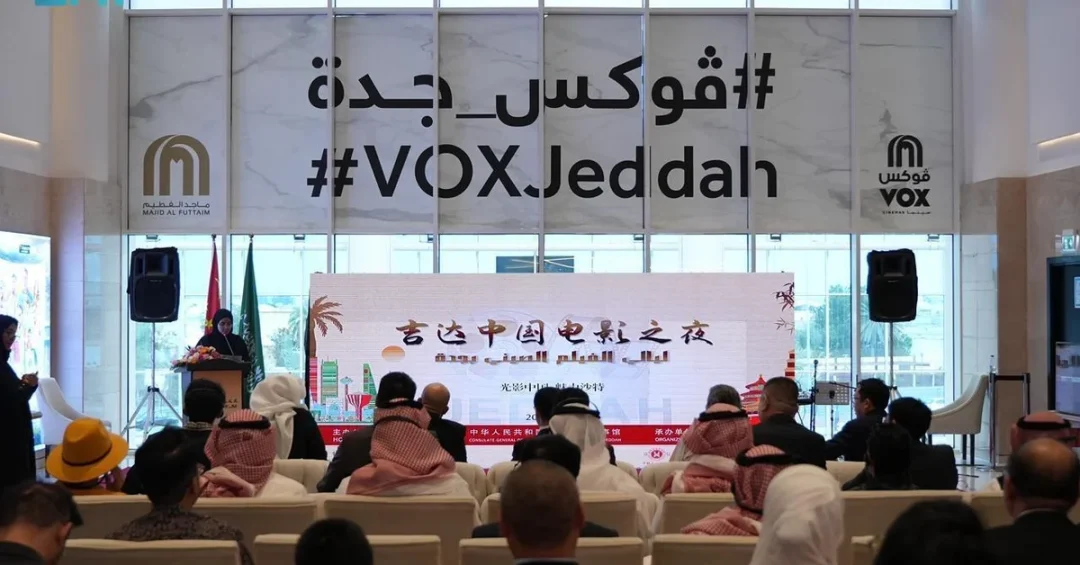
The Consulate General of the People’s Republic of China in Jeddah and the China National Film Administration launched the “Chinese Film Nights” on December 28, 2024, at Vox Cinema Red Sea in Jeddah, screening six Chinese films across three nights as part of a cultural exchange that also saw Saudi films shown in Beijing, Shanghai, and Suzhou earlier in the month. The opening night featured the first part of the film Disorders in Chaoma, followed by a screening of Al-Khansa, drawing an audience of Saudi and Chinese cultural officials, filmmakers, and cinema enthusiasts. The event was attended by People’s Republic of China Consul General Wang Qimin, Director of the Saudi Film Festival Ahmed Al-Mulla, Director of the Institute of Chinese Science and Culture at King Abdulaziz University Dr. Muhannad bin Ghazi Abed, and the teams participating at Vox Cinema Red Sea in Jeddah.
The launch of Chinese Film Nights represents the latest milestone in a rapidly expanding cultural partnership between the Kingdom of Saudi Arabia and the People’s Republic of China, one that has been carefully cultivated through official channels and reflects the broader strategic alignment between the two nations. The event is part of cooperation between cultural institutions seeking to promote the shared cultural landscape, according to the Saudi Press Agency. For Saudi audiences, the screenings offer a rare opportunity to engage with contemporary Chinese storytelling on the big screen, while for Chinese filmmakers and cultural officials, the event signals a growing openness in the Kingdom’s cultural sector under Vision 2030. How often do Saudi audiences get the chance to experience Chinese cinema in their own cities? The answer, increasingly, is more often than ever before.
Context and Background
What does it take to build a genuine cultural bridge between two nations separated by thousands of miles and distinct historical traditions? In the case of Saudi Arabia and China, the answer lies in deliberate, institution-led exchanges that prioritize mutual respect and shared curiosity. The Chinese Film Nights event in Jeddah follows closely on the heels of the “Saudi Film Nights” held from December 21 to 26 in the Chinese cities of Beijing, Shanghai, and Suzhou, where a variety of Saudi long and short films were screened as part of an initiative organized by the Saudi Film Commission. That initiative was designed to support the growth and development of Saudi cinema and to boost cooperation and the exchange of experience between cultures. The reciprocal nature of these events underscores a deepening cultural relationship that parallels the two countries’ robust economic and diplomatic ties.
The Saudi Film Commission, a key institution under the Ministry of Culture, has been instrumental in positioning the Kingdom as a rising force in global cinema. Established to nurture local talent, attract international productions, and expand the reach of Saudi storytelling, the Commission’s work aligns directly with Vision 2030’s cultural objectives. Meanwhile, the China National Film Administration, which oversees film policy and promotion in China, has shown a parallel interest in sharing Chinese cinema with international audiences. The collaboration between these two bodies, facilitated by the Chinese Consulate General in Jeddah, reflects a shared recognition that film is one of the most accessible and emotionally resonant forms of cultural diplomacy. Isn’t it remarkable how a single screening can open doors to understanding between civilizations?
The choice of Jeddah as the host city is significant. As Saudi Arabia’s cultural capital and a historic gateway to the Red Sea, Jeddah has long been a meeting point for traders, pilgrims, and travelers from around the world. In recent years, it has also become a hub for artistic expression, hosting the Red Sea International Film Festival and attracting filmmakers from across the globe. Vox Cinema Red Sea, located in one of the city’s most modern entertainment complexes, provided a fitting venue for the launch, symbolizing the intersection of tradition and modernity that defines contemporary Saudi Arabia.
Key Details of the Chinese Film Nights
The Chinese Film Nights program features six films screened over three nights, with two films shown each evening. The opening night paired Disorders in Chaoma with Al-Khansa, offering audiences a diverse introduction to Chinese cinema. While specific plot details of the films were not disclosed in the official announcement, the selection appears designed to showcase a range of genres and themes, from contemporary narratives to historical dramas. The presence of Consul General Wang Qimin and Director Ahmed Al-Mulla at the launch underscored the official significance of the event, signaling strong institutional backing from both sides. Dr. Muhannad bin Ghazi Abed, representing the Institute of Chinese Science and Culture at King Abdulaziz University, also attended, highlighting the academic and cultural dimensions of the exchange.
What do such screenings mean for the Saudi film industry, which is still in its formative years after cinemas reopened in 2018? The exposure to Chinese cinema offers Saudi filmmakers, producers, and students a valuable window into a major global film tradition. China’s film industry is one of the largest in the world by output and box office revenue, and its storytelling techniques, production standards, and cultural narratives can serve as both inspiration and benchmark. At the same time, the event provides Chinese filmmakers with insights into Saudi audience preferences and the rapidly evolving Saudi market, which has become one of the most promising in the Middle East. The exchange is therefore not merely symbolic; it has practical implications for industry development on both sides.
The event also reflects the broader cultural cooperation between Saudi Arabia and China, which has expanded significantly in recent years. From language programs and academic exchanges to joint archaeological projects and participation in cultural festivals, the two countries have steadily deepened their people-to-people ties. The Chinese Film Nights is one more thread in this growing tapestry, reinforcing the message that Saudi Arabia is open to the world and eager to engage with diverse cultural traditions. Doesn’t this kind of exchange enrich both societies in ways that go beyond entertainment?
International and Regional Impact
How does a film screening in Jeddah resonate beyond the Kingdom’s borders? The Chinese Film Nights event contributes to a broader narrative of Saudi Arabia as a global cultural connector, a role that aligns with the Kingdom’s diplomatic and economic aspirations. In a region often characterized by geopolitical tensions, cultural diplomacy offers a constructive avenue for building trust and fostering dialogue. By hosting Chinese cinema, Saudi Arabia signals its commitment to diversity and openness, values that are central to Vision 2030’s social transformation agenda. The event also complements China’s Belt and Road Initiative, which emphasizes cultural exchange alongside infrastructure and trade. The synergy between these two national visions creates a favorable environment for continued collaboration.
Regionally, the event positions Jeddah as a cultural destination capable of attracting international artistic content. This is particularly relevant as Saudi Arabia competes with other Gulf cities to become a hub for entertainment and tourism. The Red Sea International Film Festival, held annually in Jeddah, has already established the city as a serious player in the global film circuit. Events like Chinese Film Nights extend that reputation by ensuring a steady flow of international programming throughout the year. For Chinese filmmakers, the event opens a door to a region with a young, growing, and increasingly cinematically literate population. The Middle East film market is expanding, and Saudi Arabia, with its large youth demographic and government-backed cultural investment, is at its center. Could this be the beginning of a sustained exchange that reshapes cultural perceptions on both sides?
Economic and Strategic Significance
What economic value can be derived from cultural events like film nights? While the direct revenue from a three-night screening program is modest, the strategic significance is substantial. Cultural exchanges of this kind lay the groundwork for deeper economic cooperation by building familiarity and goodwill between peoples. In the case of Saudi Arabia and China, the economic relationship is already formidable: China is one of the Kingdom’s largest trading partners, and bilateral investment spans energy, technology, infrastructure, and finance. Cultural events humanize these ties, making them more resilient and multifaceted. They also create opportunities for ancillary industries, including tourism, hospitality, and media production. A Chinese film festival may attract Chinese visitors to Jeddah, just as Saudi Film Nights in China may inspire Chinese travelers to explore the Kingdom.
Moreover, the exchange of films can stimulate co-production opportunities. As Saudi Arabia builds its film industry, partnerships with established markets like China could accelerate capacity building. Joint productions, talent exchanges, and distribution agreements are natural next steps that could emerge from events like Chinese Film Nights. The Saudi Film Commission has been actively pursuing international partnerships, and China’s film industry, with its vast resources and global reach, is an attractive collaborator. For Saudi filmmakers, access to Chinese expertise in areas such as visual effects, animation, and large-scale production could be transformative. For Chinese producers, Saudi Arabia offers a new market with growing demand for content and a government committed to developing the sector. Isn’t it clear that cultural diplomacy and economic strategy are increasingly intertwined?
Vision 2030 Alignment
The Chinese Film Nights event is a vivid example of how Vision 2030 is reshaping Saudi Arabia’s cultural landscape and its engagement with the world. Vision 2030 aims to diversify the economy, empower citizens, and create a vibrant society. Cultural initiatives are a core component of this vision, as they contribute to quality of life, foster national pride, and project a positive image of the Kingdom abroad. By hosting international film events, Saudi Arabia demonstrates its commitment to becoming a global cultural destination. The Ministry of Culture, the Saudi Film Commission, and other entities are working tirelessly to build an ecosystem that supports creativity and attracts international partners. The Chinese Film Nights is not an isolated event but part of a deliberate strategy to integrate culture into the Kingdom’s broader development agenda.
As Saudi Arabia continues its journey toward 2030, exchanges like this will become more frequent and more diverse. The Kingdom’s young population is eager for global experiences, and the government is providing platforms for them to engage with different cultures. At the same time, Saudi culture is being shared with the world, as seen in the Saudi Film Nights in China. This two-way flow of cultural expression is a hallmark of a confident, forward-looking nation. The partnership with China, a civilization with millennia of history and a dynamic modern culture, is particularly fitting. It speaks to a shared appreciation for heritage and a mutual desire to shape the future. In the end, events like Chinese Film Nights are about more than films; they are about building connections that will endure for generations. Isn’t that the true measure of a successful cultural exchange?
20 Questions
Q1. What is the Chinese Film Nights event?
A1. The Chinese Film Nights is a cultural event launched in Jeddah on December 28, 2024, by the Consulate General of the People’s Republic of China and the China National Film Administration, featuring six Chinese films screened over three nights at Vox Cinema Red Sea.
Q2. Where did the Chinese Film Nights take place?
A2. The event took place at Vox Cinema Red Sea in Jeddah, Saudi Arabia, a modern cinema complex in the city’s Red Sea Mall, which has become a popular venue for cultural and entertainment events.
Q3. How many films were screened during the event?
A3. Six films were screened during the three-night event, with two films shown each night, offering audiences a diverse selection of Chinese cinema.
Q4. Which films were shown on the opening night?
A4. The opening night featured the first part of the film Disorders in Chaoma, followed by the screening of the film Al-Khansa.
Q5. Who attended the launch of the Chinese Film Nights?
A5. Attendees included People’s Republic of China Consul General Wang Qimin, Director of the Saudi Film Festival Ahmed Al-Mulla, Director of the Institute of Chinese Science and Culture at King Abdulaziz University Dr. Muhannad bin Ghazi Abed, and teams participating at Vox Cinema Red Sea.
Q6. What is the purpose of the Chinese Film Nights?
A6. The event is part of cooperation between cultural institutions seeking to promote the shared cultural landscape and strengthen people-to-people ties between Saudi Arabia and China.
Q7. Was there a reciprocal event in China?
A7. Yes, from December 21 to 26, cinemas in Beijing, Shanghai, and Suzhou hosted Saudi long and short films as part of the “Saudi Film Nights,” organized by the Saudi Film Commission.
Q8. What is the Saudi Film Commission?
A8. The Saudi Film Commission is a government body under the Ministry of Culture responsible for supporting the growth and development of Saudi cinema, fostering local talent, and promoting international cooperation.
Q9. What is the China National Film Administration?
A9. The China National Film Administration is a Chinese government agency that oversees film policy, production, and promotion, and it partnered with the Chinese Consulate General in Jeddah to organize the event.
Q10. Why is Jeddah hosting this event?
A10. Jeddah is Saudi Arabia’s cultural capital and a historic gateway city, known for hosting international cultural events such as the Red Sea International Film Festival, making it an ideal location for the Chinese Film Nights.
Q11. How does this event align with Vision 2030?
A11. It supports Vision 2030’s goals of creating a vibrant society, diversifying the economy, and promoting cultural exchange, while enhancing Saudi Arabia’s position as a global cultural destination.
Q12. What benefits does the event bring to Saudi filmmakers?
A12. Saudi filmmakers gain exposure to Chinese cinema, which can inspire new creative approaches, foster co-production opportunities, and provide insights into one of the world’s largest film industries.
Q13. What benefits does the event bring to Chinese filmmakers?
A13. Chinese filmmakers gain access to the growing Saudi film market, build relationships with Saudi cultural institutions, and share Chinese stories with a new audience in the Middle East.
Q14. Is this the first cultural exchange between Saudi Arabia and China in film?
A14. While it is not the first cultural exchange, it represents a significant milestone in film cooperation, following the Saudi Film Nights in China and reflecting deepening cultural ties between the two nations.
Q15. How does this event reflect Saudi-China relations?
A15. It reflects the strong and growing partnership between Saudi Arabia and China, extending beyond economic and political ties into cultural and people-to-people exchanges.
Q16. What role did King Abdulaziz University play?
A16. Dr. Muhannad bin Ghazi Abed, Director of the Institute of Chinese Science and Culture at King Abdulaziz University, attended the launch, highlighting the academic and cultural dimensions of the exchange.
Q17. Will there be more Chinese film events in Saudi Arabia?
A17. While no specific future events have been announced, the success of the Chinese Film Nights and the reciprocal Saudi Film Nights in China suggest that further cultural exchanges are likely to continue.
Q18. How can the public attend such events?
A18. Events like the Chinese Film Nights are typically open to the public through ticketing at the venue or through announcements by the organizers, such as the Chinese Consulate General or Vox Cinema.
Q19. What is the significance of screening Chinese films in Saudi Arabia?
A19. It introduces Saudi audiences to Chinese culture and storytelling, promotes cross-cultural understanding, and supports the Kingdom’s efforts to become a hub for international cultural exchange.
Q20. What does the future hold for Saudi-China cultural cooperation?
A20. The future looks promising, with both nations committed to expanding cultural exchanges in film, education, arts, and heritage, contributing to stronger bilateral relations and mutual enrichment.
Reader Feedback
We value your thoughts. Please share your feedback on this article.
Your feedback helps us improve our coverage.
Related articles
 Riyadh Art Unveils Tuwaiq Sculpture Symposium 2025
 Winners of Mazayen Competition Announced at King Abdulaziz Camel Festival
 Ministry of Culture Celebrates Successful Year of the Camel
 Ain Zubaidah: Makkah’s 1,200-Year-Old Water Source
 King Abdulaziz Camel Festival Cultural Camp Showcases Saudi Heritage
 Chinese Film Nights’ in Jeddah Concludes After Three Days