


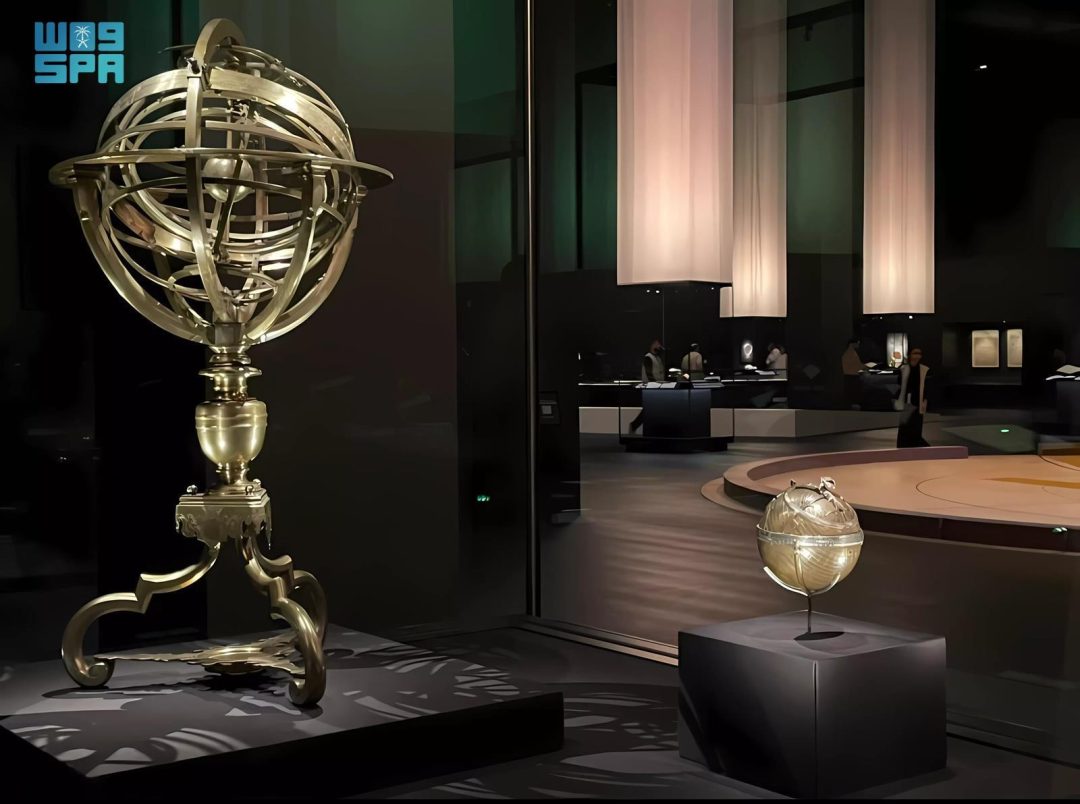
Jeddah is hosting AlMadar as part of the second edition of the Islamic Arts Biennale under the theme “And All That Is In Between.” The exhibition features more than 265 artworks sourced from over 30 international institutions across 20 countries.
According to SPA, AlMadar explores the evolution of engineering, design, astronomy, mathematics, and numbers to show how humans understood the universe. The collection includes mechanical instruments, ancient astrolabes, and lamps used in ancient mosques.
The exhibition houses the oldest dated astrolabe from the Al-Sabah collection, which dates to the Abbasid Period. Created by Baghdad-based maker Nasṭūlus, this instrument bears his signature and an inscription from the year 315 AH. It was used for timekeeping, distance calculation, and mapping the skies.
Another featured piece is an astrolabe with a geared calendar created by Muhammad Ibn Abi Bakr. This mechanism uses upper windows to show moon phases and lower windows to indicate lunar motion.
What is featured in the AlMadar exhibition in Jeddah? AlMadar is part of the second Islamic Arts Biennale themed “And All That Is In Between.” It displays more than 265 artworks from over 30 international institutions across 20 countries. The exhibition focuses on the evolution of design, engineering, astronomy, mathematics, and numbers, while showcasing cultural artifacts such as mechanical instruments, ancient astrolabes, and lamps that were used to illuminate mosques in ancient times.
What are the details of the oldest astrolabe displayed at AlMadar? The exhibition includes the oldest dated astrolabe from the Al-Sabah collection, which originates from the Abbasid Period. This specific instrument was designed by Nasṭūlus, a maker from Baghdad, and features his signature along with an inscription marking the year 315 AH. It served as a tool for navigation and astronomy by enabling precise measurements, timekeeping, and the mapping of the skies.
Who created the geared calendar astrolabe and how does it work? The astrolabe with a geared calendar was created by Muhammad Ibn Abi Bakr. This complex scientific mechanism is designed with specific windows to track lunar activity; the upper windows are used to display the changing phases of the moon, while the lower windows are used to indicate the motion of the moon.