


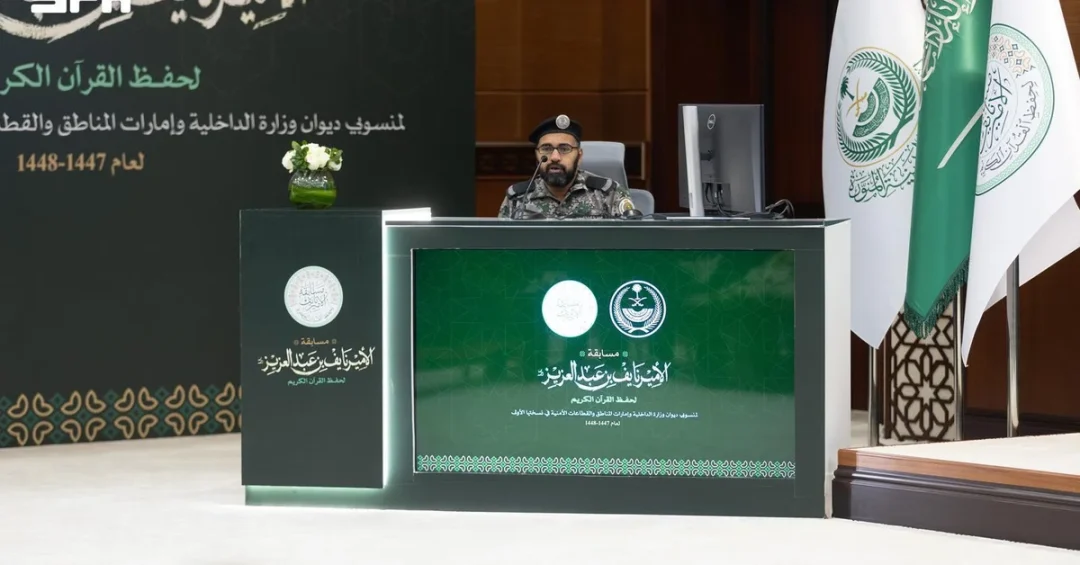
The preliminary rounds of the Prince Naif bin Abdulaziz Quran Memorization Competition are continuing in the Madinah Region, drawing male and female employees from the Ministry of Interior, the Madinah Principality, and the Kingdom’s security sectors to compete at the principality’s headquarters, the Saudi Press Agency reported. The inaugural edition of the contest, organized by the Ministry of Interior and held across the Kingdom, reflects a national commitment to encouraging Quran memorization, refining recitation skills, and promoting Islamic values among public servants. The Madinah rounds represent one of several regional qualifiers feeding into a nationwide competition that has captured the attention of government employees dedicated to both public duty and religious learning.
The competition is structured around five distinct categories and offers total cash prizes of SAR3 million, underscoring the seriousness with which the Kingdom’s leadership approaches the cultivation of Quranic knowledge. Participants are evaluated through an electronic judging platform under the supervision of a specialized committee, a mechanism designed to ensure fairness, accuracy, and transparency throughout the evaluation process. For an international audience, the event offers insight into how Saudi Arabia integrates religious heritage with modern institutional practice, using digital tools to uphold the highest standards of competition integrity. How does a nation balance the demands of public service with the pursuit of spiritual excellence? The Prince Naif competition suggests the two are not merely compatible but mutually reinforcing.
Context and Background
The Prince Naif bin Abdulaziz Quran Memorization Competition is named in honor of Prince Naif bin Abdulaziz Al Saud, a former Crown Prince and Minister of Interior whose legacy is closely tied to the institutional development of the Kingdom’s security and administrative apparatus. The inaugural edition of the competition extends that legacy into the realm of Quranic scholarship, creating a dedicated forum for the employees of the Ministry of Interior, the Madinah Principality, and related security sectors to demonstrate their mastery of the Holy Quran. The choice of Madinah as one of the host regions carries profound symbolic weight, given the city’s status as the second holiest site in Islam and its enduring role as a center of religious learning.
Why does a security ministry invest in a Quran memorization contest? The answer lies in the Kingdom’s holistic understanding of public service, in which the moral and spiritual formation of employees is seen as inseparable from their professional responsibilities. By organizing the competition across the Kingdom in its first year, the Ministry of Interior signals that this initiative is not a localized pilot but a nationwide priority. The regional preliminary rounds, including those underway in Madinah, serve as the gateway through which competitors advance toward higher stages of the contest. Each regional event is administered with the same rigor as the national finals, reflecting an institutional culture that prizes both devotion and discipline.
The competition also builds on a broader tradition of Quranic competitions in Saudi Arabia, which have long been supported by the Kingdom’s leadership as a means of preserving the Holy Book in the hearts and minds of successive generations. These contests typically attract thousands of participants across various age groups and professional backgrounds, and they are regarded as among the most respected religious events on the Saudi calendar. The Prince Naif competition adds a distinctive dimension by focusing specifically on employees of the Ministry of Interior, the Madinah Principality, and security sectors, thereby celebrating the spiritual commitments of those who serve the nation in sensitive and demanding roles.
Key Details of the Madinah Rounds
The Madinah preliminary rounds are being held at the headquarters of the Madinah Principality, a venue that lends the proceedings an official gravity appropriate to their significance. Competitors are participating across five categories, each designed to accommodate different levels of Quranic memorization and recitation proficiency. This tiered structure ensures that the competition is accessible to a broad range of employees, from those who have committed smaller portions of the Quran to memory to those who have achieved comprehensive memorization. What does it take to prepare for such a contest? For many participants, preparation represents months of disciplined study conducted alongside full-time professional duties, a testament to their dedication.
Total cash prizes for the competition amount to SAR3 million, a substantial sum that reflects the Kingdom’s commitment to incentivizing Quranic scholarship. The prize structure is distributed across the five categories, rewarding excellence at every level of achievement. Beyond the monetary awards, the competition offers participants a platform for recognition within their institutions and among their peers, an intangible benefit that many competitors value as highly as the financial prizes. The Ministry of Interior has emphasized that the competition is intended to encourage continuous learning and self-improvement, with the prizes serving as an acknowledgment of sustained effort rather than the sole motivation.
A defining feature of the Madinah rounds, and indeed of the competition as a whole, is the use of an electronic judging platform supervised by a specialized committee. This digital evaluation system is designed to ensure fairness and accuracy in the assessment of participants’ recitations, minimizing the potential for human error or bias. Judges can review performances, compare evaluations, and arrive at consensus decisions through a structured electronic workflow. For a competition of this scale, spanning multiple regions and hundreds of participants, such a platform is essential to maintaining consistency and credibility. How does technology enhance the integrity of a religious competition? By standardizing evaluation and creating a transparent record of the judging process, the electronic platform reinforces the trust that participants and institutions place in the competition.
International and Regional Impact
While the Prince Naif Quran Memorization Competition is a domestic Saudi initiative, its resonance extends well beyond the Kingdom’s borders. Saudi Arabia is home to the two holiest sites in Islam, and its stewardship of religious scholarship carries significant weight across the Muslim world. Competitions of this kind reinforce the Kingdom’s role as a global center of Quranic learning and as a guardian of Islamic heritage. For international observers, the event illustrates how Saudi institutions integrate religious values into governance and professional life, a dimension of Saudi society that is often overlooked in coverage focused solely on economic transformation. What does the world learn from Saudi Arabia’s approach to faith and public service? It learns that modernization and tradition can advance together, each reinforcing the other.
Within the region, the competition serves as a model for other nations seeking to encourage Quranic education among public servants. The use of electronic judging platforms, the structured category system, and the substantial prize pool all reflect a level of institutional sophistication that neighboring countries may study and adapt. Moreover, the focus on employees of the Ministry of Interior and security sectors highlights the importance of ethical and spiritual grounding for those entrusted with public safety. This emphasis aligns with broader regional conversations about the role of values in governance and the importance of cultivating integrity among state employees.
Economic and Strategic Significance
The SAR3 million prize pool is a tangible expression of the Kingdom’s investment in human capital, specifically in the spiritual and intellectual development of its public-sector workforce. Beyond the direct financial outlay, the competition generates broader economic activity in the regions that host its rounds, including in hospitality, transportation, and event services. The Madinah rounds, like those held elsewhere, draw participants and their supporters to the city, contributing to the local economy and reinforcing Madinah’s status as a year-round destination for religious and cultural activity. The strategic significance of the competition lies in its contribution to building a workforce that is not only professionally competent but also morally grounded.
From a strategic perspective, the competition reinforces the Ministry of Interior’s role as an institution that champions both security and values. In a world where public trust in institutions is increasingly scrutinized, initiatives that demonstrate a commitment to ethical and spiritual development can strengthen the bond between the state and its citizens. The Ministry’s investment in Quranic scholarship signals that its employees are held to high standards of integrity, a message that resonates with both domestic and international audiences. How does a nation build trust? By demonstrating, through concrete actions, that its institutions are guided by principles that transcend administrative efficiency. The Prince Naif competition is precisely such an action.
Vision 2030 Alignment
The Prince Naif Quran Memorization Competition aligns closely with the objectives of Saudi Vision 2030, the Kingdom’s comprehensive plan for economic and social transformation. While Vision 2030 is often associated with economic diversification and technological innovation, it also emphasizes the importance of cultural and religious heritage as pillars of national identity. The competition embodies this dual commitment, using modern electronic judging platforms to administer a contest rooted in timeless Quranic tradition. By encouraging employees to pursue memorization and recitation excellence, the initiative contributes to the development of a knowledgeable, principled, and highly motivated workforce, which is essential to the realization of the Kingdom’s ambitious goals.
As the Madinah preliminary rounds continue, the competition stands as a testament to Saudi Arabia’s enduring commitment to its Islamic heritage and to the well-being of those who serve the nation. The Ministry of Interior’s inaugural edition of the Prince Naif competition has established a framework that can be expanded and refined in the years ahead, creating a lasting platform for Quranic scholarship among public servants. What will this competition achieve in the future? It will undoubtedly inspire more employees to dedicate themselves to the study of the Holy Quran and will further cement the Kingdom’s position as a beacon of Islamic learning and responsible governance for the world.
20 Questions
Q1. What is the Prince Naif bin Abdulaziz Quran Memorization Competition?
A1. It is a nationwide Quran memorization and recitation contest organized by the Ministry of Interior for employees of the ministry, the Madinah Principality, and security sectors across the Kingdom.
Q2. Where are the preliminary rounds currently taking place?
A2. The preliminary rounds are being held in the Madinah Region at the headquarters of the Madinah Principality, according to the Saudi Press Agency.
Q3. Who is eligible to participate in the competition?
A3. The competition is open to male and female employees of the Ministry of Interior, the Madinah Principality, and the Kingdom’s security sectors.
Q4. How many categories does the competition feature?
A4. The competition features five distinct categories designed to accommodate varying levels of Quranic memorization and recitation proficiency among participants.
Q5. What is the total value of the cash prizes?
A5. The total cash prizes for the competition amount to SAR3 million, distributed across the five categories to reward excellence at every level of achievement.
Q6. How are participants evaluated?
A6. Participants are evaluated through an electronic judging platform under the supervision of a specialized committee to ensure fairness and accuracy.
Q7. Why is an electronic judging platform used?
A7. The platform standardizes evaluation, minimizes human error, and creates a transparent record of the judging process, reinforcing trust in the competition’s integrity.
Q8. What is the purpose of organizing this competition?
A8. It encourages Quran memorization, improves recitation skills, and promotes Islamic values among public servants, reflecting the Kingdom’s commitment to religious education.
Q9. In which edition is this competition being held?
A9. The competition is being held in its inaugural edition, making this the first time it has been organized across the Kingdom.
Q10. Why is Madinah a significant host region?
A10. Madinah is the second holiest city in Islam and an enduring center of religious learning, lending profound symbolic weight to the competition’s presence there.
Q11. Who organizes the competition nationally?
A11. The Ministry of Interior organizes the competition across the Kingdom, overseeing its administration, judging, and prize distribution.
Q12. In whose honor is the competition named?
A12. It is named after Prince Naif bin Abdulaziz Al Saud, a former Crown Prince and Minister of Interior known for developing the Kingdom’s security apparatus.
Q13. Does the competition include both men and women?
A13. Yes, the competition includes both male and female employees, reflecting the inclusive participation of the Ministry of Interior’s workforce.
Q14. What makes the competition credible and fair?
A14. A specialized committee supervises the electronic judging platform, ensuring evaluations are accurate, consistent, and transparent across all categories.
Q15. How does the competition support employees?
A15. It provides a platform for recognition, incentivizes continuous learning, and rewards sustained effort through cash prizes and peer acclaim.
Q16. Is the competition a one-time event?
A16. As an inaugural edition, it establishes a framework that can be expanded and refined in future years, creating a lasting platform for Quranic scholarship.
Q17. How does the competition relate to Saudi Vision 2030?
A17. It supports Vision 2030 by developing a principled workforce, preserving religious heritage, and integrating modern technology with timeless Quranic tradition.
Q18. What message does the competition send internationally?
A18. It illustrates how Saudi Arabia integrates faith into public service and reinforces the Kingdom’s role as a global center of Quranic learning and Islamic heritage.
Q19. What role does technology play in the competition?
A19. Technology, through the electronic judging platform, enhances integrity, streamlines evaluation, and ensures that results are accurate and credible.
Q20. What is the broader significance of this initiative?
A20. It demonstrates the Kingdom’s commitment to moral grounding, institutional integrity, and the spiritual development of those who serve the nation in sensitive roles.
Reader Feedback
We value your thoughts. Please share your feedback on this article.
Your feedback helps us improve our coverage.
Related articles
 Khan Al-Khalil Collectibles Keep Old Jeddah’s Memory Alive
 Two Falcons Sell for SAR388,000 on 17th Night of National Center for Falcons Auction 2026
 Saudi Culture Minister Visits Algiers Book Fair Pavilion
 Saudi Culture Minister Meets Algerian Counterpart in Algiers
 Algerian President Meets Saudi Culture Minister
 Saudi Film Industry Yearbook 2025 Shows Record Growth