


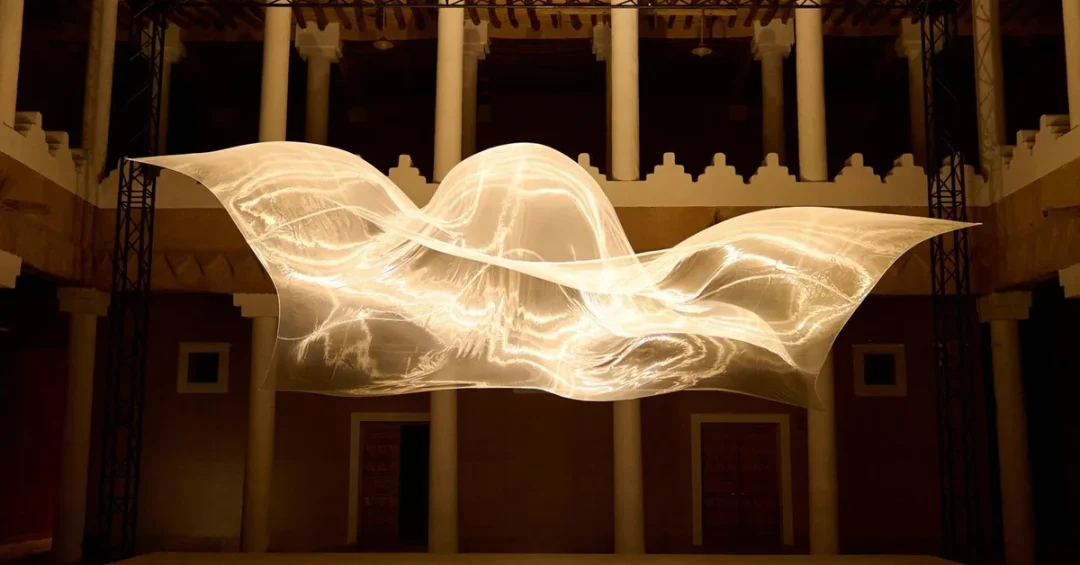
Riyadh has become an open-air gallery where works by Saudi and international artists greet residents and visitors in train stations, public squares, and business districts, as part of the Riyadh Art program launched in March 2019. According to the Saudi Press Agency (SPA), art in the capital is no longer confined to galleries and museums; it has become part of the everyday landscape, encountered at metro stations, on bridges, and in workplaces. At Qasr Al-Hokm metro station, Saudi artist Zaman Jassim’s “When the Moon is Full” comes into view, while a sculpture by Alexander Calder stands amid the modern architecture of the King Abdullah Financial District (KAFD). Have you ever considered how a single city can turn its streets, stations, and squares into a continuous cultural experience?
Nearby in KAFD, Robert Indiana’s “LOVE” adds a bold pop-art presence, while a pedestrian bridge on King Abdulaziz Road transforms at night into a light installation by Italian artist Angelo Bonello. These artworks represent diverse generations, artistic schools, and creative practices, employing a wide range of materials and mediums, including light, steel, sound, words, and everyday objects. Yet they converge within a single artistic space spread across the capital, bringing art into streets, squares, train stations, workplaces, and the various facets of everyday life. The result is a city where culture is not an occasional destination but a daily companion for millions of residents and visitors.
Context and Background
Why does a city decide to place world-class art where people wait for a train or walk to work? The Riyadh Art program was launched in March 2019 with the aim of transforming the capital into an open-air art gallery. The initiative involves creating artworks and artistic landmarks by Saudi and international artists and displaying them across the city’s public spaces, including residential neighborhoods, gardens, parks, squares, transport stations, bridges, city entrances, and other public destinations. It is one of the largest public art programs in the world, designed to make culture accessible to everyone rather than only to those who visit museums.
The program’s permanent art collection comprises 75 artworks distributed across diverse urban settings, featuring works by Saudi and international artists from different generations and artistic movements. The collection connects each artwork with the place that hosts it, giving it a presence that extends beyond the confines of traditional exhibition halls. This approach reflects a deliberate curatorial philosophy: the value of public art lies not only in the artistic merit of the works or the names of their creators, but in their relationship with the places that host them and the way the public interacts with them as part of everyday life. Can art truly belong to a city if it remains behind closed doors?
Riyadh Art’s permanent collection brings together leading names from the Saudi art scene alongside prominent international artists, forming a network of public art that adds new visual and cultural dimensions to the city’s streets, squares, transport hubs, and cultural and economic districts. This initiative also complements other Riyadh Art programs, including “Noor Riyadh” and the “Tuwaiq Sculpture” symposium, which brings together artists from around the world to create sculptural works and helps transform stone extracted in Saudi Arabia into permanent public artworks. Together, these programs create a layered cultural ecosystem that operates year-round.
Key Details
What does it take to install a Calder, an Indiana, and a Bonello within a single urban fabric? The presence of Alexander Calder’s sculpture in the King Abdullah Financial District places a landmark of modern art in one of the capital’s most dynamic business hubs. Robert Indiana’s “LOVE” adds an instantly recognizable pop icon to the same district, while Angelo Bonello’s light installation on a pedestrian bridge on King Abdulaziz Road turns infrastructure into an after-dark artistic experience. These works are not isolated exhibits; they are integrated into the daily rhythms of the city, seen by commuters, office workers, families, and tourists alike.
Saudi artist Zaman Jassim’s “When the Moon is Full” at Qasr Al-Hokm metro station anchors the program in local creative talent, ensuring that the collection reflects the Kingdom’s own artistic voice alongside global names. The diversity of materials and mediums, including light, steel, sound, words, and everyday objects, reveals one of the most prominent features of public art in Riyadh: its value lies in the relationship between the artwork, its location, and the public that encounters it. This is art that is measured not only by critical acclaim but by daily engagement.
The 75 permanent works are spread across residential neighborhoods, gardens, parks, squares, transport stations, bridges, and city entrances, meaning that a resident might encounter a major sculpture on the way to the grocery store or a light installation on an evening walk. The program’s scale and distribution ensure that art is not concentrated in a single cultural district but woven into the entire metropolitan fabric. How often does a commute become a cultural encounter in other cities around the world?
International and Regional Impact
How does a national capital become a reference point for global public art? Riyadh Art’s permanent collection brings together Saudi and international artists in a way that positions the Kingdom as a serious participant in the global cultural conversation. The presence of works by Alexander Calder, Robert Indiana, and Angelo Bonello alongside Saudi artists creates a dialogue between artistic traditions and generations, demonstrating that Riyadh is not merely importing culture but curating it on its own terms. For international audiences, this signals a capital that is open, confident, and engaged with world art.
Regionally, the program sets a benchmark for other cities in the Middle East and beyond. By placing art in transport hubs and public squares, Riyadh offers a model for how urban development can integrate culture into infrastructure. The Tuwaiq Sculpture symposium, which brings artists from around the world to create works from stone extracted in Saudi Arabia, adds a dimension of material and geological identity, linking global creativity to local resources. This combination of international participation and Saudi specificity is what makes the program distinctive. Can a city’s cultural identity be strengthened by inviting the world to create within it?
Economic and Strategic Significance
What economic value does public art generate for a modern capital? The Riyadh Art program contributes to the city’s attractiveness as a destination for tourism, investment, and talent. Cultural amenities are increasingly important to global companies and skilled workers when choosing where to live and work, and a city that offers a rich public art landscape gains a competitive edge. The integration of art into KAFD, one of the region’s leading financial districts, reinforces the connection between culture and commerce, making the area more vibrant and walkable.
Beyond tourism and investment, the program supports the growth of the Kingdom’s creative economy. By commissioning Saudi artists and providing platforms for their work in high-visibility public spaces, Riyadh Art helps build careers and audiences for local talent. The permanent collection and associated programs create demand for skills in curation, fabrication, installation, lighting, and maintenance, generating employment and expertise within the cultural sector. This aligns with broader efforts to diversify the economy and develop new industries. Is it any surprise that cities investing in culture often see returns in innovation and entrepreneurship?
Vision 2030 Alignment
How does a sculpture in a metro station connect to a national transformation plan? The development of public art in the capital reflects the broader transformation Riyadh is undergoing under Saudi Vision 2030, which emphasizes enhancing quality of life, developing the cultural and creative sectors, and consolidating Riyadh’s position as a global destination for arts and culture. The Riyadh Art program is a direct expression of these goals, turning the city into a living canvas that improves daily life for residents while attracting international attention and visitors.
By making art part of everyday infrastructure, the Kingdom demonstrates that Vision 2030 is not only about economic diversification but also about enriching the human experience. The program’s permanent collection of 75 works, its complementary initiatives such as Noor Riyadh and Tuwaiq Sculpture, and its presence in neighborhoods, parks, and transport hubs together create a cultural legacy that will grow for generations. As Riyadh continues to evolve into a global metropolis, its open-air gallery will remain a symbol of a nation that values creativity, openness, and quality of life. What better way to show the world the future of a city than to let its streets speak through art?
20 Questions
Q1. What is the Riyadh Art program?
A1. Riyadh Art is a major public art initiative launched in March 2019 to transform the Saudi capital into an open-air gallery, placing artworks by Saudi and international artists in streets, squares, parks, and transport hubs across the city.
Q2. How many artworks are in Riyadh Art’s permanent collection?
A2. The permanent collection comprises 75 artworks distributed across diverse urban settings, featuring works by Saudi and international artists from different generations and artistic movements, according to the Saudi Press Agency.
Q3. Which Saudi artist is featured at Qasr Al-Hokm metro station?
A3. Saudi artist Zaman Jassim’s work “When the Moon is Full” is displayed at Qasr Al-Hokm metro station, bringing contemporary Saudi creativity into a busy public transit environment.
Q4. Whose sculpture stands in the King Abdullah Financial District?
A4. A sculpture by the renowned American artist Alexander Calder stands amid the modern architecture of the King Abdullah Financial District (KAFD), placing a landmark of modern art in the capital’s financial hub.
Q5. What iconic pop-art piece is located near Calder’s sculpture?
A5. Robert Indiana’s “LOVE” sculpture is located nearby in the King Abdullah Financial District, adding a bold and instantly recognizable pop-art presence to the area.
Q6. Which Italian artist created a light installation on King Abdulaziz Road?
A6. Italian artist Angelo Bonello created a light installation on a pedestrian bridge on King Abdulaziz Road that transforms at night into a striking visual experience for passers-by.
Q7. What materials and mediums are used in Riyadh’s public artworks?
A7. The artworks employ a wide range of materials and mediums, including light, steel, sound, words, and everyday objects, reflecting diverse artistic practices and creative approaches from different generations.
Q8. Where are Riyadh Art’s works displayed?
A8. Works are displayed across residential neighborhoods, gardens, parks, squares, transport stations, bridges, city entrances, and other public destinations, integrating art into the daily life of the capital.
Q9. What other programs complement Riyadh Art?
A9. Riyadh Art is complemented by other initiatives including “Noor Riyadh” and the “Tuwaiq Sculpture” symposium, which brings together artists from around the world to create sculptural works.
Q10. What is the Tuwaiq Sculpture symposium?
A10. The Tuwaiq Sculpture symposium gathers artists from around the world to create sculptural works and helps transform stone extracted in Saudi Arabia into permanent public artworks displayed across the capital.
Q11. What is Noor Riyadh?
A11. Noor Riyadh is a light-based art initiative that complements the Riyadh Art program, contributing to the city’s cultural calendar and enhancing Riyadh’s reputation as a global destination for arts and culture.
Q12. How does public art in Riyadh differ from traditional museums?
A12. Public art in Riyadh is encountered in everyday places such as train stations, squares, and workplaces, making culture accessible to all rather than confined to traditional exhibition halls and museums.
Q13. Why is the relationship between artwork and location important?
A13. The collection connects each artwork with the place that hosts it, giving it a presence beyond exhibition halls and ensuring that the public interacts with it as part of everyday life in the city.
Q14. How does Riyadh Art reflect Saudi Vision 2030?
A14. Riyadh Art supports Vision 2030 goals by enhancing quality of life, developing the cultural and creative sectors, and consolidating Riyadh’s position as a global destination for arts and culture.
Q15. What economic benefits does public art bring to Riyadh?
A15. Public art enhances the city’s attractiveness for tourism, investment, and talent, supports the creative economy, and generates employment and expertise in curation, fabrication, installation, and maintenance.
Q16. How does Riyadh Art support Saudi artists?
A16. By commissioning Saudi artists and displaying their work in high-visibility public spaces, the program helps build careers, audiences, and recognition for local talent alongside international names.
Q17. What makes Riyadh’s public art collection diverse?
A17. The collection features works by Saudi and international artists from different generations and artistic movements, employing varied materials and mediums such as light, steel, sound, words, and everyday objects.
Q18. How does Riyadh Art engage the public daily?
A18. Residents and visitors encounter the artworks at metro stations, on bridges, in squares, and near workplaces, turning routine journeys into cultural experiences and making art part of everyday life.
Q19. What role does the King Abdullah Financial District play in the art program?
A19. KAFD hosts major international works such as Alexander Calder’s sculpture and Robert Indiana’s “LOVE,” integrating world-class art into one of the capital’s most important economic and business districts.
Q20. What does the future hold for Riyadh’s open-air gallery?
A20. As Riyadh continues to develop under Vision 2030, its public art collection is expected to grow, further enhancing the city’s cultural landscape and its standing as a global destination for arts and culture.
Reader Feedback
We value your thoughts. Please share your feedback on this article.
Your feedback helps us improve our coverage.
Related articles
 Canadian Farm’s Falcon Sells for SAR 1.3 Million at Saudi Auction
 AlUla Launches Rawi in Residence at Smithsonian Museum
 AlUla and Smithsonian Launch ‘Resident Narrator’ Cultural Program
 Royal Commission for AlUla, Smithsonian Launch Resident Narrator Program
 Riyadh Launches 2026 Date Season at Rabwah Markets
 Ithra concludes sixth Short Play Competition in Dhahran