


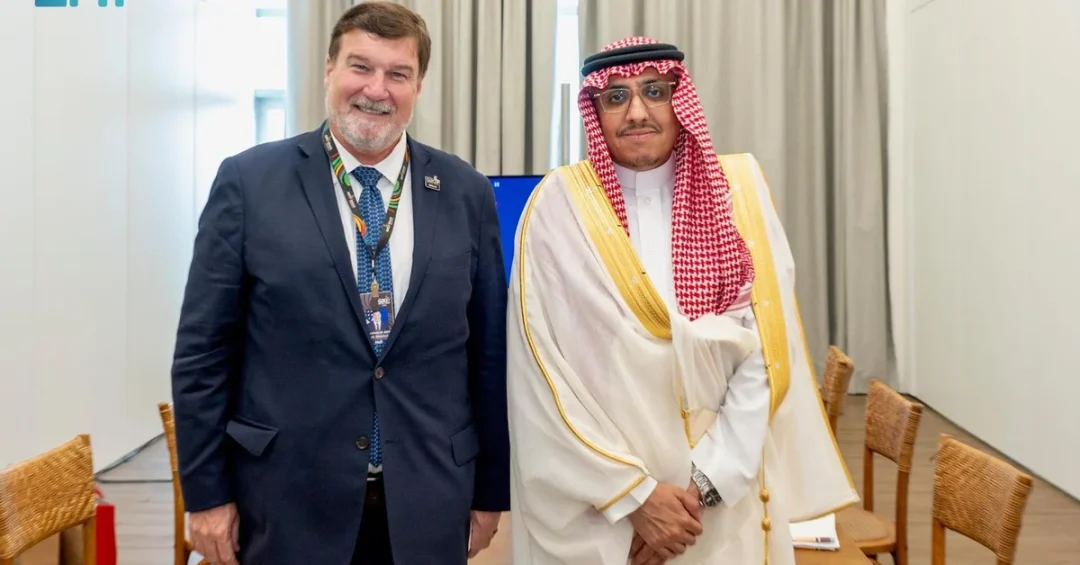
Saudi Arabia and the United States have taken a further step toward deepening their cultural partnership, with senior officials from both countries meeting in Salvador, Brazil, to discuss expanded cooperation in cultural exchange, institutional collaboration, and professional capacity-building. The meeting took place on Saturday on the sidelines of the 5th G20 Culture Ministers’ Meeting, according to the Saudi Press Agency (SPA), and brought together Eng. Fahd Al-Kanaan, Deputy Minister of Culture for International Cultural Relations at the Saudi Ministry of Culture, and Scott Weinhold, Principal Deputy Assistant Secretary for the Bureau of Educational and Cultural Affairs at the US Department of State. The two officials emphasized the importance of strengthening cultural ties and agreed on the value of sharing expertise between the cultural institutions of both nations.
The encounter reflects a broader pattern of Saudi cultural diplomacy that has accelerated in recent years, as the Kingdom has expanded its international cultural engagements through ministries, commissions, and cultural institutions operating under the umbrella of Vision 2030. Cultural exchange has become a recognized component of Saudi foreign policy, complementing economic, educational, and diplomatic cooperation. For international observers, the meeting signals that Riyadh and Washington continue to find common ground in areas that transcend political and security issues, using culture as a bridge for long-term relationship-building. The talks in Salvador were brief but substantive, focusing on concrete mechanisms: cooperation between cultural institutions, capacity-building, and the sharing of professional expertise.
Context and Background
Why does a sideline meeting at a G20 cultural gathering matter for the future of Saudi-American relations? The answer lies in the steady institutionalization of cultural diplomacy as a pillar of Saudi Arabia’s international outreach. The Kingdom’s cultural sector has undergone a structural transformation since the launch of Vision 2030 in 2016, with the creation of the Ministry of Culture and specialized commissions covering music, film, literature, museums, heritage, and the visual arts. These bodies have pursued partnerships with international counterparts, and the United States has been a frequent partner in areas such as film, education, and museum development.
The 5th G20 Culture Ministers’ Meeting in Salvador provided a natural venue for such discussions. G20 cultural meetings have become a platform where member states exchange views on cultural policy, creative economy development, and the protection of heritage. Saudi Arabia has participated actively in these forums, using them to present its cultural modernization agenda and to build bilateral relationships. The meeting between Eng. Fahd Al-Kanaan and Scott Weinhold fits this pattern: a focused conversation between officials responsible for international cultural relations and educational and cultural affairs, respectively.
It is also worth recalling that Saudi-American cultural cooperation has a long history, from archaeological expeditions in the twentieth century to contemporary collaborations in museums, universities, and creative industries. The SPA report indicates that both officials stressed the need to strengthen and develop these relations, with an emphasis on cooperation and cultural exchange, capacity-building, and collaboration between cultural institutions. That language points to a practical agenda rather than a purely symbolic one.
Key Details of the Meeting
What exactly was discussed in Salvador, and what does it reveal about the direction of Saudi cultural policy? According to the Saudi Press Agency, Eng. Fahd Al-Kanaan met with Scott Weinhold on Saturday on the sidelines of the G20 Culture Ministers’ Meeting. The two officials discussed cultural relations between the Kingdom and the United States and emphasized the need to strengthen and develop them. Their conversation focused on four interrelated areas: cooperation, cultural exchange, capacity-building, and the sharing of expertise in the field of culture.
A fifth element was also highlighted: collaboration between cultural institutions of the two countries. This is significant because institutional partnerships are often the most durable form of cultural cooperation. They can involve joint exhibitions, artist residencies, training programs, archival projects, and educational exchanges. By naming institutional collaboration explicitly, the officials signaled an intention to move beyond declarations and into operational cooperation.
The meeting took place on the margins of a G20 event, which is itself meaningful. G20 cultural ministers’ meetings allow participating countries to align cultural policy with broader economic and social goals, including the creative economy. For Saudi Arabia, participation in this forum is consistent with its G20 membership and its desire to contribute to global cultural governance. The SPA report did not announce specific agreements or signed documents, but it did confirm a shared commitment to further dialogue and cooperation.
International and Regional Impact
How might this meeting influence cultural relations beyond the bilateral track? When two major economies and cultural actors like Saudi Arabia and the United States discuss cultural cooperation, the effects can ripple through regional and international networks. Saudi Arabia is a cultural hub for the Gulf and the wider Arab world, hosting major events, festivals, and exhibitions that attract global audiences. American cultural institutions, meanwhile, are influential in fields such as film, music, and museum management. Closer cooperation between them could facilitate the movement of exhibitions, artists, and creative professionals across borders.
At the regional level, the meeting reinforces Saudi Arabia’s role as a convener and partner in cultural affairs. The Kingdom’s cultural diplomacy is not limited to Western partners; it also engages with Asian, African, and Latin American countries, as the venue of this meeting in Brazil demonstrates. By meeting with US officials in Salvador, Saudi representatives underscored their ability to maintain multiple cultural dialogues simultaneously. For the Middle East, this kind of engagement can contribute to a more nuanced international perception of the region, highlighting its creative output and heritage rather than only its geopolitical challenges.
For the United States, cultural cooperation with Saudi Arabia offers a channel for people-to-people ties that can outlast political cycles. The Bureau of Educational and Cultural Affairs, which Scott Weinhold helps lead, manages programs such as Fulbright exchanges and cultural heritage initiatives. A constructive conversation with Saudi cultural officials can support those programs and open new avenues for collaboration.
Economic and Strategic Significance
Why should economic observers pay attention to a cultural meeting? The creative economy is a growing component of global GDP, and Saudi Arabia has identified it as a source of jobs, investment, and soft power. The Ministry of Culture and its commissions oversee a portfolio that includes film production, music, fashion, design, and heritage tourism. International partnerships can help accelerate the development of these sectors by providing expertise, training, and market access. Cooperation with US institutions can support Saudi professionals in acquiring skills and building networks.
Strategically, cultural relations are part of a wider relationship between Riyadh and Washington that includes energy, security, trade, and technology. Cultural diplomacy can serve as a stabilizing element, maintaining channels of communication and mutual understanding even when other issues are complex. The SPA report’s emphasis on capacity-building and expertise-sharing suggests a focus on long-term human capital development, which aligns with Vision 2030’s goal of a diversified, knowledge-based economy.
Moreover, cultural cooperation can support tourism. As Saudi Arabia develops destinations such as AlUla, Diriyah, and the Red Sea coast, international partnerships can help attract visitors and promote cultural understanding. American tourists and cultural professionals represent a significant potential audience. By strengthening institutional ties, the Kingdom can enhance its cultural offerings and global appeal.
Vision 2030 Alignment
How does this meeting connect to Saudi Arabia’s long-term transformation plan? Vision 2030 aims to diversify the economy, empower citizens, and position the Kingdom as a global investment and cultural hub. Cultural diplomacy is explicitly part of this vision, as it promotes international engagement and showcases Saudi heritage and creativity. The Ministry of Culture, established in 2018, has been tasked with developing the sector and expanding its international footprint. The meeting between Eng. Fahd Al-Kanaan and Scott Weinhold is a direct expression of that mandate.
By focusing on capacity-building and institutional collaboration, the two officials are helping to build the infrastructure of cultural exchange. This supports Vision 2030’s human capital objectives, including education and training, and its economic goals, such as growing the creative industries. It also reinforces Saudi Arabia’s role as a responsible global partner, committed to dialogue and cooperation. As the Kingdom continues to host international events and participate in multilateral forums, cultural diplomacy will remain a key tool for building bridges and advancing mutual understanding.
In the coming months, observers may look for follow-up activities such as joint programs, exchanges, or agreements that translate this conversation into concrete initiatives. The SPA report does not specify timelines, but the tone is forward-looking. For Saudi Arabia, the meeting in Salvador is another step in a sustained campaign to integrate culture into its foreign policy and to share its vision with the world.
20 Questions
Q1. Who represented Saudi Arabia at the meeting in Salvador?
A1. Eng. Fahd Al-Kanaan, Deputy Minister of Culture for International Cultural Relations at the Saudi Ministry of Culture, represented the Kingdom.
Q2. Who was the US official in the meeting?
A2. Scott Weinhold, Principal Deputy Assistant Secretary for the Bureau of Educational and Cultural Affairs at the US Department of State, represented the United States.
Q3. Where did the meeting take place?
A3. The meeting was held in Salvador, Brazil, on the sidelines of the 5th G20 Culture Ministers’ Meeting.
Q4. When did the meeting occur?
A4. The meeting took place on Saturday, November 9, 2024, according to the Saudi Press Agency.
Q5. What was the main topic of discussion?
A5. The officials discussed cultural relations and emphasized the need to strengthen and develop them through cooperation and cultural exchange.
Q6. What specific areas of cooperation were highlighted?
A6. They focused on capacity-building, sharing expertise in culture, and collaboration between cultural institutions of both countries.
Q7. Did they sign any agreements?
A7. No specific agreements were announced, but the officials expressed commitment to further dialogue and cooperation.
Q8. Why is this meeting significant for Saudi Arabia?
A8. It reflects Saudi Arabia’s ongoing cultural diplomacy efforts and its commitment to international partnerships under Vision 2030.
Q9. How does this meeting align with Vision 2030?
A9. Vision 2030 promotes cultural development and international engagement; this meeting supports those goals through institutional cooperation.
Q10. What is the G20 Culture Ministers’ Meeting?
A10. It is a forum where culture ministers from G20 countries discuss cultural policy, creative economy, and heritage protection.
Q11. How does cultural cooperation benefit Saudi Arabia economically?
A11. It supports the creative economy, job creation, and tourism, contributing to economic diversification goals.
Q12. What role does the Saudi Ministry of Culture play?
A12. It oversees the Kingdom’s cultural sector, develops policies, and fosters international cultural relations.
Q13. What is the Bureau of Educational and Cultural Affairs?
A13. It is a US State Department bureau that manages educational and cultural exchange programs, including Fulbright.
Q14. Could this lead to joint cultural events?
A14. While not specified, the emphasis on institutional collaboration suggests potential for future joint exhibitions, exchanges, and programs.
Q15. How does this affect Saudi-US relations?
A15. It strengthens people-to-people ties and adds a cultural dimension to the broader bilateral relationship.
Q16. What are the implications for the region?
A16. It reinforces Saudi Arabia’s role as a cultural leader and promotes a positive image of the region internationally.
Q17. What is the significance of meeting in Brazil?
A17. It shows Saudi Arabia’s global engagement and its ability to maintain dialogues across different regions.
Q18. What kind of expertise can be shared?
A18. Expertise in museum management, film, music, heritage preservation, and creative industries can be shared.
Q19. How does this benefit American cultural institutions?
A19. It opens opportunities for collaboration, access to Saudi cultural markets, and joint projects.
Q20. What might happen next?
A20. Follow-up could include joint programs, exchanges, or agreements that build on this conversation.
Reader Feedback
We value your thoughts. Please share your feedback on this article.
Your feedback helps us improve our coverage.
Related articles
 Saudi Commission Launches Social Media Platforms
 Ministry of Culture Launches Child’s Culture Platform
 Saudi Arabia Highlights Climate Action for Heritage at G20
 Saudi Deputy Minister Discusses Cultural Cooperation in Brazil
 Riyadh Film Criticism Conference Concludes with Global Participation
 King Abdulaziz Foundation Highlights Geographical Names Contribution