


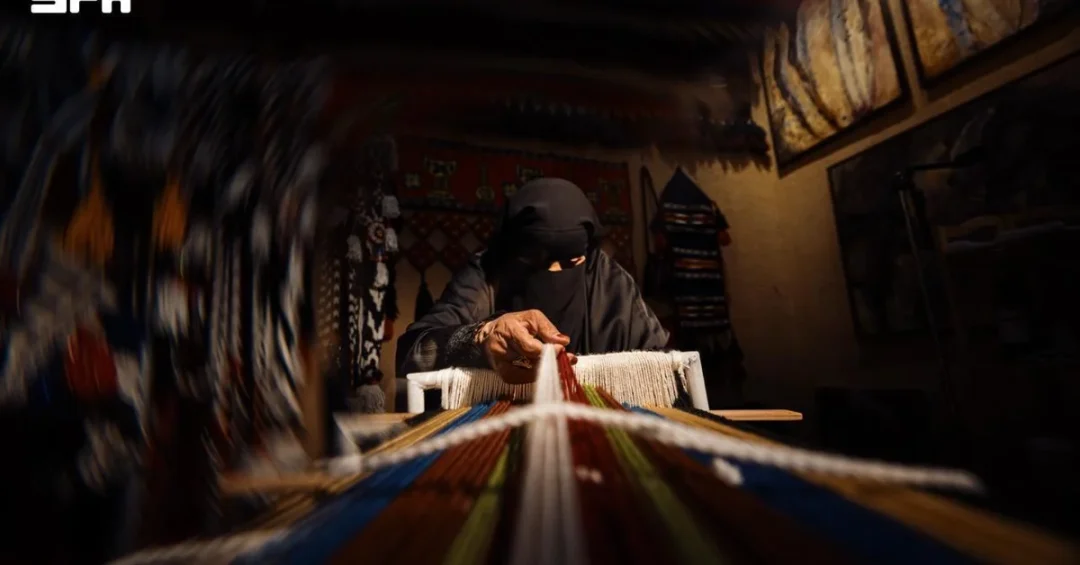
Saudi artisan Lahdah Al-Enezi, widely known in her community as “Umm Al-Sadu,” is presenting more than six decades of traditional Al-Sadu weaving expertise at the International Saudi Falcons and Hunting Exhibition in Riyadh, offering visitors live demonstrations of one of the Kingdom’s most enduring intangible heritage crafts, according to the Saudi Press Agency (SPA). Al-Enezi, who first learned the craft at the age of 13, is hosting daily weaving sessions inside the exhibition’s cultural pavilion, where she reveals the intricate techniques behind a textile tradition that has shaped Bedouin life for generations. Her participation places a living national treasure at the heart of one of Saudi Arabia’s fastest-growing cultural and sporting gatherings.
The exhibition, staged under the supervision of the Saudi Falcons Club with support from official Saudi cultural and heritage bodies, draws falconers, artisans, families, and international visitors to the Saudi capital. Within that setting, Al-Enezi’s loom serves as a bridge between the desert heritage of the past and the modern cultural economy the Kingdom is building today. Could there be a more fitting stage for a craft woven into the very fabric of Saudi identity? Her presence ensures that the story of Al-Sadu is told not as a museum relic, but as a living practice passed from hand to hand.
Context and Background
How does a craft survive for centuries and still speak to a modern audience? Al-Sadu, the traditional weaving art of the Arabian Peninsula’s Bedouin communities, offers a remarkable answer. The technique involves spinning, dyeing, and hand-weaving wool on traditional ground looms to produce intricate geometric patterns. Historically, these textiles were essential to desert life: they formed the walls and partitions of the bayt al-sha’ar, the woven tent that sheltered families, and they were fashioned into home furnishings, saddlebags, and decorative accoutrements for camels and horses. Each motif carried meaning, with patterns reflecting the weaver’s environment, tribe, and personal artistry.
Al-Enezi’s personal journey mirrors the wider story of the craft in Saudi Arabia. She began learning at 13, absorbing techniques from the women of her community at a time when weaving was a daily necessity rather than a public demonstration. Over more than sixty years, she has refined her skills and become a recognized guardian of the tradition, earning the affectionate title “Umm Al-Sadu” — the mother of Al-Sadu. Her career spans the era before oil wealth transformed the Kingdom and the decades since, during which many traditional crafts faced the risk of fading as urban life expanded. Her decision to demonstrate her art publicly at the International Saudi Falcons and Hunting Exhibition is therefore both a personal milestone and a national statement about the value placed on heritage.
The exhibition itself has grown into a major platform for Saudi culture. Organized by the Saudi Falcons Club, it brings together falconry competitions, hunting traditions, and a cultural pavilion that showcases authentic Saudi handicrafts. For visitors unfamiliar with the Kingdom, the event offers a rare, direct encounter with the craftspeople who keep national heritage alive. For Saudis, it reinforces a sense of continuity between the desert traditions of their ancestors and the ambitious, forward-looking society they are building under Vision 2030.
Key Details of the Al-Sadu Showcase
What exactly does a visitor see when Al-Enezi sits down at her loom? The answer is a complete creative process, performed live. She demonstrates spinning raw wool into yarn, dyeing it with natural and traditional colorants, and weaving it into complex geometric designs on a ground loom. Her displayed works range from traditional tent tapestries and saddlebags to modern decorative textiles, wall hangings, and accessories. The collection illustrates how a heritage craft can adapt to contemporary tastes without losing its identity — a principle at the center of Saudi Arabia’s cultural preservation strategy.
Beyond the loom, Al-Enezi’s most significant contribution may be her role as a teacher. She has trained 46 women in authentic weaving methods, ensuring that the knowledge she inherited is not dependent on a single pair of hands. This commitment to generational transfer addresses one of the greatest risks facing intangible heritage worldwide: the loss of skills when a master artisan stops working. By mentoring dozens of women, she has effectively created a small school of weavers whose work can continue to appear in exhibitions, markets, and cultural institutions across the Kingdom.
Her live weaving sessions form part of the exhibition’s cultural pavilion, which highlights authentic Saudi handicrafts and celebrates the artisans dedicated to preserving national heritage. Visitors can watch the loom in action, ask questions about the motifs and materials, and gain a deeper appreciation of the patience and precision the craft demands. For many international guests, it is their first encounter with Al-Sadu as a living practice rather than an image in a book. That direct experience is precisely what Saudi cultural planners hope will turn heritage into a source of national pride and global curiosity.
International and Regional Impact
Why should an audience outside Saudi Arabia pay attention to a weaving demonstration in Riyadh? Because cultural heritage has become a central element of the Kingdom’s international engagement. Events such as the International Saudi Falcons and Hunting Exhibition attract participants and visitors from across the Gulf, the wider Arab world, and beyond. When those guests encounter Al-Sadu firsthand, they carry home a more nuanced understanding of Saudi society — one rooted in craftsmanship, hospitality, and respect for tradition rather than in headlines alone. Cultural diplomacy of this kind builds goodwill quietly and durably.
Regionally, Al-Sadu is shared heritage. Weaving traditions with related techniques and motifs exist across the Arabian Peninsula, and Saudi efforts to document and sustain the craft contribute to a broader Gulf conversation about protecting intangible cultural heritage. The Kingdom’s inclusion of Al-Sadu in major public events supports regional cooperation in heritage preservation and reinforces Saudi Arabia’s position as a leading custodian of Arab culture. For international organizations and cultural institutions, Saudi Arabia’s systematic approach — combining master artisans, training programs, exhibitions, and digital documentation — offers a model worth studying.
Economic and Strategic Significance
Can heritage be an economic asset? In Saudi Arabia, the answer is increasingly yes. Handicrafts such as Al-Sadu support a growing ecosystem of artisans, designers, and small enterprises that connect traditional skills to contemporary markets. Woven textiles appear in interior design, fashion accessories, and tourism retail, creating income opportunities for trained weavers — particularly women — while preserving techniques that might otherwise disappear. The training of 46 women by Al-Enezi is not only a cultural act but an economic one, building a skilled workforce whose products can reach buyers in the Kingdom and abroad.
Strategically, the showcase aligns with the Kingdom’s efforts to diversify its economy and strengthen its cultural sector. Cultural events and heritage industries contribute to tourism spending, generate media attention, and enhance the country’s soft power. The International Saudi Falcons and Hunting Exhibition, by combining sport, tradition, and commerce, exemplifies this integrated approach. For international investors and partners, the presence of a respected master artisan at a major exhibition signals that Saudi cultural institutions are serious about quality, authenticity, and long-term development — qualities that matter in every sector of the economy.
Vision 2030 Alignment
How does a single weaver’s loom connect to a national transformation plan? Saudi Vision 2030 places culture and heritage among the pillars of a diversified, confident society. The plan calls for preserving national identity, empowering women, supporting small businesses, and enriching the quality of life for citizens and visitors alike. Al-Enezi’s work touches every one of those goals: she preserves an intangible heritage craft, she trains women in a skilled trade, she participates in a major public event that boosts cultural tourism, and she demonstrates the living connection between Saudi Arabia’s past and its future.
Her participation in the International Saudi Falcons and Hunting Exhibition is therefore more than a demonstration. It is a statement that the Kingdom’s modernization is not a departure from tradition but an extension of it. As Saudi Arabia continues to host world-class events, develop cultural districts, and invest in creative industries, artisans like “Umm Al-Sadu” will remain central figures — keepers of skills that give the national story its texture and depth. Visitors who watch her weave leave with a tangible memory of Saudi hospitality and artistry, and with a clearer understanding of a country that honors its roots while building boldly for the generations ahead.
20 Questions
Q1. Who is showcasing Al-Sadu weaving at the International Saudi Falcons and Hunting Exhibition?
A1. Saudi artisan Lahdah Al-Enezi, known in her community as “Umm Al-Sadu,” is showcasing more than six decades of traditional Al-Sadu weaving expertise at the exhibition, offering visitors live demonstrations and insights into the heritage craft.
Q2. What is Al-Sadu?
A2. Al-Sadu is the traditional weaving art of the Arabian Peninsula’s Bedouin communities. It involves spinning, dyeing, and hand-weaving wool on traditional looms to create intricate geometric patterns used in desert dwellings and furnishings.
Q3. At what age did Lahdah Al-Enezi begin learning Al-Sadu?
A3. Al-Enezi began learning the craft at the age of 13. She has since devoted more than six decades to mastering and teaching the technique, earning recognition as a guardian of Saudi intangible heritage.
Q4. What materials and techniques are involved in Al-Sadu?
A4. The technique involves spinning raw wool into yarn, dyeing it with traditional colorants, and hand-weaving it on traditional ground looms to produce intricate geometric patterns that carry cultural and tribal meaning.
Q5. What kinds of items does Al-Sadu produce?
A5. Al-Sadu textiles include traditional tent tapestries, saddlebags, home furnishings, and accoutrements for camels and horses. Contemporary adaptations include modern decorative textiles, wall hangings, and fashion accessories.
Q6. How many women has Al-Enezi trained in authentic weaving methods?
A6. Al-Enezi has trained 46 women in authentic weaving methods. This ensures the generational transfer of traditional textile skills and helps safeguard the craft for the future.
Q7. Where is the exhibition taking place?
A7. The International Saudi Falcons and Hunting Exhibition is held in Riyadh, Saudi Arabia. It is organized under the supervision of the Saudi Falcons Club and features falconry, hunting traditions, and cultural displays.
Q8. What is the cultural pavilion at the exhibition?
A8. The cultural pavilion highlights authentic Saudi handicrafts and celebrates the artisans dedicated to preserving national heritage. Al-Enezi’s live weaving sessions form part of this pavilion, giving visitors direct contact with traditional crafts.
Q9. Why is Al-Sadu considered intangible cultural heritage?
A9. Al-Sadu is a living practice passed down through generations rather than a physical monument. Its knowledge, skills, and meanings reside in the artisans who practice it, making its transmission essential to its survival.
Q10. How does Al-Sadu connect to Bedouin life?
A10. Al-Sadu was central to Bedouin life. Woven textiles formed the walls and partitions of desert tents, provided furnishings, and were used for camel and horse gear, making the craft essential to daily survival and comfort.
Q11. What is the significance of the title “Umm Al-Sadu”?
A11. The title “Umm Al-Sadu” means “mother of Al-Sadu.” It reflects Al-Enezi’s deep knowledge, long experience, and maternal role in nurturing and teaching the craft within her community.
Q12. How does the exhibition support Saudi heritage?
A12. The exhibition provides a prominent public platform for Saudi handicrafts, allowing master artisans to demonstrate their skills to local and international audiences and reinforcing national pride in traditional culture.
Q13. What role do women play in preserving Al-Sadu?
A13. Women have historically been the primary practitioners of Al-Sadu. Today, artisans like Al-Enezi train other women, ensuring that the craft remains a source of skill, income, and cultural identity for Saudi women.
Q14. How does Al-Sadu align with Saudi Vision 2030?
A14. Vision 2030 emphasizes preserving national identity, empowering women, supporting small businesses, and enriching quality of life. Al-Sadu supports all these goals by sustaining heritage, training women, and contributing to cultural tourism.
Q15. Can visitors learn weaving techniques at the exhibition?
A15. Visitors can watch live demonstrations of spinning, dyeing, and weaving. Al-Enezi explains the motifs and materials, offering an educational experience that deepens appreciation for the craft and its cultural context.
Q16. What economic opportunities does Al-Sadu create?
A16. Al-Sadu supports artisans, designers, and small enterprises that connect traditional textiles to contemporary markets. Woven products reach buyers in interior design, fashion, and tourism retail, generating income for trained weavers.
Q17. How does Al-Sadu contribute to cultural tourism in Saudi Arabia?
A17. Heritage demonstrations give tourists an authentic experience of Saudi culture. Events featuring Al-Sadu attract visitors interested in crafts and traditions, supporting the Kingdom’s growing cultural tourism sector.
Q18. What makes the International Saudi Falcons and Hunting Exhibition unique?
A18. The exhibition combines falconry competitions and hunting traditions with a cultural pavilion showcasing Saudi handicrafts. This blend of sport, heritage, and commerce makes it a distinctive national and international event.
Q19. How is Al-Sadu passed to future generations?
A19. Knowledge is transferred through direct training, as demonstrated by Al-Enezi’s mentorship of 46 women. Public demonstrations, exhibitions, and institutional support further ensure that skills and motifs are documented and taught.
Q20. What message does Al-Enezi’s participation send internationally?
A20. Her participation shows that Saudi Arabia honors its heritage while advancing modernization. It presents the Kingdom as a custodian of Arab culture and a welcoming destination where tradition and progress coexist.
Reader Feedback
We value your thoughts. Please share your feedback on this article.
Your feedback helps us improve our coverage.