


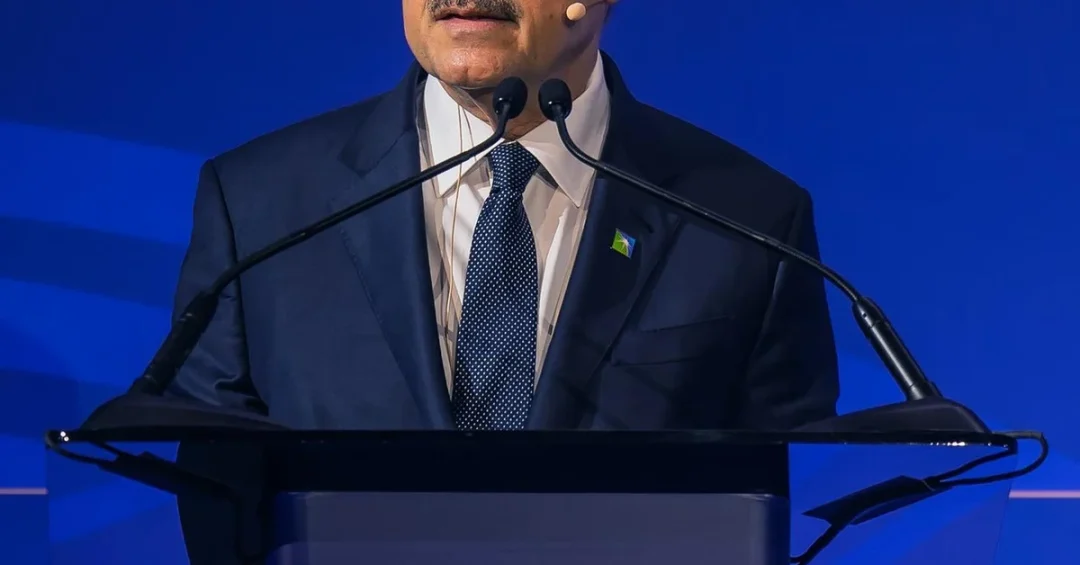
Aramco President and CEO Amin H. Nasser called for greater coordination among the international community, oil suppliers, and customers to withstand geopolitical shocks and strengthen energy sector resilience, speaking at the Energy Intelligence Forum 2026 in London. In an address delivered before senior executives, government officials, investors, and innovators from across the global energy landscape, Nasser underscored that energy security is a shared responsibility that no single nation or company can uphold alone. His remarks, carried by the Saudi Press Agency, arrived at a moment of heightened uncertainty in global markets, where supply chains remain under strain and the pace of the energy transition continues to raise difficult questions about reliability and affordability.
The Aramco chief’s intervention placed Saudi Arabia’s national energy company once again at the center of international discussions about how the world should balance the continued importance of hydrocarbons with the long-term shift toward cleaner sources. For an international audience watching the Kingdom’s role in global energy governance, the address offered a clear articulation of Riyadh’s position: oil and gas remain indispensable to modern civilization, and responsible stewardship of those resources requires collective action rather than fragmented national strategies. The forum, a leading annual gathering for the sector, provided a platform for Nasser to outline both the pressures facing producers and the institutional strengths that allow Aramco to absorb shocks.
Context and Background
Why does a single executive’s speech in London carry weight far beyond the conference hall? Because the company he leads sits at the center of the global energy system. Aramco is one of the world’s largest integrated energy and chemicals enterprises, and its production, spare capacity, and storage infrastructure are watched closely by governments, traders, and central banks alike. Nasser’s appearance at the Energy Intelligence Forum 2026 followed a period in which regional disruptions had tested the resilience of supply routes and prompted renewed debate about the security of critical maritime corridors.
In his remarks, Nasser addressed the impact of regional disruptions on global energy markets with unusual directness. “Until Hormuz fully re-opens and confidence returns, the crude reality is that pressure at both ends of the barrel will intensify,” he said. “Even then, replenishing inventories while meeting demand could take up to two years.” The statement underscored a point often overlooked in short-term market commentary: the physical rebuilding of inventories after a disruption is a slow, capital-intensive process that cannot be resolved by price signals alone.
The forum itself reflects the changing character of energy diplomacy. Once a venue dominated by upstream producers, it now brings together investors, technology firms, and policymakers who shape demand-side trends as much as supply. For Saudi Arabia, participation in such gatherings is part of a broader strategy of engagement, ensuring that the Kingdom’s perspective is heard in the rooms where international energy policy is debated. Nasser’s presence signaled that Aramco intends to remain a constructive voice in those discussions rather than a passive participant.
Key Details of Nasser’s Address
What exactly did the Aramco chief say about the role of hydrocarbons in the modern economy? Nasser was unambiguous. “Oil and gas are not just tradable commodities,” he said. “They are the lifeblood of modern civilization.” The formulation captured his central argument: energy sources should be assessed not only by their emissions profile but by their contribution to transport, industry, agriculture, healthcare, and the everyday functioning of societies. In that framing, reliability and affordability are not secondary considerations but foundational ones.
Nasser extended the argument to the supply chains that underpin alternative technologies. Amid the current geopolitical crisis and resulting shortages of essential materials such as aluminum, sulfur, helium, and petrochemicals, he noted that solar, wind, and electric vehicles are not immune to the impact. The observation drew attention to a frequently neglected reality: the components of renewable energy systems and electric mobility depend on complex industrial inputs that are themselves exposed to the same geopolitical risks as conventional energy.
On the strategic importance of the Middle East, Nasser was equally direct. He noted that half of the world’s proven oil reserves are located in the region, along with most of the spare production capacity that plays a central role in balancing markets. That concentration, he suggested, means the region’s importance is likely to grow rather than diminish as other resource bases mature and new resources become harder to find and less economically competitive. It was a reminder that geography continues to shape energy economics, even in an age of rapid technological change.
Aramco’s Resilience and Operational Strengths
How does a company of Aramco’s scale withstand shocks that would cripple smaller operators? Nasser described the company’s resilience as being “like a vast, complex jigsaw puzzle, not a single asset or capability.” The metaphor was deliberate: resilience, in his account, is the product of many interlocking components rather than one flagship facility or technological advantage. That layered structure allows the company to absorb disruptions in one area without compromising overall performance.
He singled out several elements of that structure. Strategic storage globally has proved vital, he said, adding: “Our spare capacity, multiple crude oil grades, domestic gas storage, tanker fleet via Bahri, and one of the strongest balance sheets in the industry add further layers.” Each of these components serves a distinct function. Spare capacity provides flexibility to respond to sudden supply losses. Multiple crude grades allow Aramco to serve a wide range of refineries. The Bahri tanker fleet offers logistical autonomy, while a strong balance sheet enables continued investment through downturns.
Nasser also highlighted the role of the company’s local supply chain, which has provided more than 90% of the materials used in asset restoration efforts. That figure points to a deliberate strategy of localization, aligning with broader Saudi efforts to build domestic industrial capability. He further noted that Aramco is studying additional routes for crude exports while exploring more overseas storage options to help cover short-term disruptions. Together, these measures illustrate a company thinking in terms of optionality and redundancy rather than optimization alone.
International and Regional Impact
What do Nasser’s remarks mean for the wider international community? For importing nations, the message was one of reassurance and responsibility in equal measure. Aramco’s spare capacity and storage network function as a form of global public good, cushioning markets during crises. Yet Nasser’s call for coordination implied that producers cannot bear that burden indefinitely without predictable demand signals and stable investment conditions. The appeal was directed as much at consumers and policymakers as at fellow producers.
For the Middle East, the address reinforced the region’s centrality to global energy security at a time when some analysts had begun to question its long-term relevance. Nasser’s emphasis on the concentration of reserves and spare capacity served as a factual counterpoint to narratives of rapid decline. At the same time, his acknowledgment of regional disruptions and their market consequences was a candid recognition that stability in the region is inseparable from stability in global energy markets.
The forum setting also mattered. By speaking in London, Nasser engaged directly with European and international audiences whose energy policies have significant implications for global demand. His argument that solar, wind, and electric vehicles are not insulated from geopolitical shocks offered a nuanced contribution to debates that often frame the transition as a straightforward substitution of one energy system for another. The response from attendees suggested that the perspective was received as a substantive contribution rather than a partisan intervention.
Economic and Strategic Significance
Why should investors and analysts pay close attention to Aramco’s resilience strategy? Because it has direct implications for capital allocation, dividend stability, and long-term supply planning. A company that can maintain operations through disruption reduces the risk premium attached to its output, benefiting consumers and shareholders alike. Nasser’s emphasis on the strength of the balance sheet and on multiple crude grades signals a business model designed for durability across cycles rather than maximum returns in any single quarter.
The study of additional export routes and overseas storage options carries strategic weight beyond Aramco itself. Diversification of logistics reduces exposure to chokepoints and enhances the reliability of supply to international customers. For Saudi Arabia, such investments support the Kingdom’s position as a dependable energy partner, a status that underpins diplomatic relationships across Asia, Europe, and the Americas. Reliability, in this context, is not merely an operational metric; it is a form of soft power.
The local supply chain achievement, with more than 90% of restoration materials sourced domestically, also speaks to economic diversification goals. Building domestic industrial capacity reduces import dependence and creates skilled employment, both of which are central to Saudi Arabia’s long-term economic planning. Nasser’s remarks therefore connected operational resilience to national development objectives, illustrating how corporate strategy and public policy can reinforce one another.
Vision 2030 Alignment
How does Aramco’s approach fit within Saudi Arabia’s Vision 2030? The connection is direct and multifaceted. Vision 2030, launched under the leadership of Crown Prince Mohammed bin Salman, seeks to diversify the Kingdom’s economy, strengthen its industrial base, and enhance its role in global affairs. Aramco’s investments in resilience, localization, and logistics support all three objectives. The company’s ability to maintain reliable exports sustains the revenue base that funds diversification, while its domestic supply chain programs build the industrial capabilities that Vision 2030 envisages.
Moreover, Nasser’s call for international coordination reflects the Kingdom’s broader diplomatic posture of constructive engagement. Saudi Arabia has consistently advocated for dialogue among producers and consumers, and for policies that recognize the continued role of hydrocarbons in a balanced energy transition. The address in London can be read as an extension of that posture into the corporate sphere, where Aramco speaks not only for itself but as a representative of the Kingdom’s energy sector and its commitment to global stability.
As the world navigates an uncertain energy landscape, the message from Dhahran is one of preparedness and partnership. Aramco’s layered resilience, its investments in storage and logistics, and its emphasis on shared responsibility position the company and the Kingdom as stabilizing forces in a volatile environment. For international observers, the address offered a clear statement of Saudi priorities: reliable supply, coordinated action, and a transition that does not sacrifice the foundations of modern civilization. In that sense, Nasser’s words were less a defense of the past than a blueprint for the future.
20 Questions
Q1. Who delivered the address at the Energy Intelligence Forum 2026?
A1. Aramco President and CEO Amin H. Nasser delivered the address at the Energy Intelligence Forum 2026 in London, United Kingdom, where he stressed the need for greater coordination among the international community, oil suppliers, and customers to strengthen energy sector resilience.
Q2. What was the main theme of Nasser’s remarks?
A2. The main theme was shared responsibility for energy sector resilience. Nasser emphasized that coordination among the international community, oil suppliers, and customers is essential to withstand geopolitical shocks and maintain stable global energy markets.
Q3. Where was the Energy Intelligence Forum 2026 held?
A3. The Energy Intelligence Forum 2026 was held in London, United Kingdom. It is a leading annual event that brings together senior leaders, executives, government officials, investors, and innovators to exchange ideas and develop sustainable energy solutions.
Q4. What did Nasser say about the impact of regional disruptions?
A4. Nasser said that until Hormuz fully re-opens and confidence returns, pressure at both ends of the barrel will intensify, and that replenishing inventories while meeting demand could take up to two years.
Q5. How did Nasser describe the role of oil and gas?
A5. Nasser described oil and gas as more than tradable commodities, calling them the lifeblood of modern civilization, reflecting their essential role in transport, industry, agriculture, healthcare, and the daily functioning of societies worldwide.
Q6. Did Nasser address renewable energy technologies?
A6. Yes. Nasser noted that amid geopolitical crises and shortages of materials such as aluminum, sulfur, helium, and petrochemicals, solar, wind, and electric vehicles are not immune to the impact, highlighting shared supply chain vulnerabilities.
Q7. What did Nasser say about the Middle East’s importance?
A7. Nasser noted that half of the world’s proven oil reserves are located in the Middle East, along with most of the world’s spare production capacity, and that the region’s strategic importance is expected to grow as other resource bases mature.
Q8. How did Nasser describe Aramco’s resilience?
A8. Nasser described Aramco’s resilience as being like a vast, complex jigsaw puzzle rather than a single asset or capability, emphasizing that it results from many interlocking components working together across the company’s global operations.
Q9. What specific strengths did Nasser highlight at Aramco?
A9. Nasser highlighted strategic storage globally, spare capacity, multiple crude oil grades, domestic gas storage, the tanker fleet via Bahri, and one of the strongest balance sheets in the industry as key layers of the company’s resilience.
Q10. What role did Aramco’s local supply chain play?
A10. Aramco’s local supply chain provided more than 90% of the materials used in asset restoration efforts, demonstrating the effectiveness of domestic industrial capability and supporting broader Saudi economic diversification objectives.
Q11. Is Aramco exploring new export routes?
A11. Yes. Nasser said Aramco is studying additional routes for crude exports while exploring more overseas storage options to help cover short-term disruptions, enhancing the flexibility and reliability of supply to international customers.
Q12. What is the Energy Intelligence Forum?
A12. The Energy Intelligence Forum is a leading annual event that brings together senior leaders, executives, government officials, investors, and innovators to exchange ideas, build partnerships, and develop sustainable solutions to the energy sector’s most pressing challenges.
Q13. Why does Aramco’s resilience matter globally?
A13. Aramco’s resilience matters globally because its spare capacity and storage network help stabilize world oil markets during crises, providing a buffer that benefits importing nations, consumers, and the broader global economy.
Q14. How does Nasser’s message relate to Saudi Vision 2030?
A14. Nasser’s message aligns with Vision 2030 by supporting economic diversification, strengthening domestic industrial capacity, enhancing the Kingdom’s role in global affairs, and promoting reliable energy supply as a foundation for sustainable development.
Q15. What did Nasser mean by pressure at both ends of the barrel?
A15. Nasser was referring to simultaneous pressures on supply and demand sides of the oil market, suggesting that disruptions create strain at both production and consumption ends, intensifying market tightness until confidence returns.
Q16. Why could replenishing inventories take up to two years?
A16. Replenishing inventories could take up to two years because rebuilding stockpiles requires sustained production, logistical coordination, and stable market conditions, all of which take time to restore after significant disruptions.
Q17. What materials did Nasser mention as being in short supply?
A17. Nasser mentioned aluminum, sulfur, helium, and petrochemicals as essential materials facing shortages amid the current geopolitical crisis, noting that these shortages affect both conventional and renewable energy supply chains.
Q18. How does Aramco’s balance sheet contribute to resilience?
A18. Aramco’s strong balance sheet enables continued investment through downturns, supports strategic projects, and provides financial flexibility, making it a crucial layer of the company’s overall resilience strategy.
Q19. What is the significance of the Bahri tanker fleet?
A19. The Bahri tanker fleet provides Aramco with logistical autonomy and flexibility in delivering crude oil to international customers, reducing dependence on third-party shipping and enhancing supply reliability during disruptions.
Q20. What was the overall message of Nasser’s address?
A20. The overall message was that energy security is a shared responsibility requiring coordination among producers, consumers, and the international community, with Aramco and Saudi Arabia committed to reliable supply and constructive global engagement.
Reader Feedback
We value your thoughts. Please share your feedback on this article.
Your feedback helps us improve our coverage.
Related articles
 First International Gifts and Products Exhibition Opens in Jeddah
 IsDB and AfDB Strengthen Africa Development Partnership
 Saudi Business Revenues Rise 2.3% to SAR5.628B in 2025
 Commercial Transactions Law Strengthens Saudi Contractual Stability
 AlUla Date Harvest Nears End as Auction Runs to Nov 15
 Oil Prices Decline as Brent Falls to $114.50, WTI to $101.74