


The Capital Market Authority (CMA) of Saudi Arabia has called upon all interested persons and capital market participants to submit feedback on the Draft Regulatory Provisions for Conducting Dealing Activities in Financial Markets Outside the Kingdom, with the public consultation period running for 30 days and closing on 27 October 2026. Announced through official Saudi channels, the draft is designed to strengthen the supervisory framework governing how capital market institutions conduct dealing activities when serving clients in financial markets beyond the Kingdom’s borders. The CMA confirmed that the finalized provisions are scheduled to take effect on 1 November 2026, following careful review of all comments received.
The initiative reflects the Kingdom’s determination to keep pace with the growing internationalization of Saudi investors and capital market institutions. As more Saudi clients seek exposure to global exchanges, regulators must ensure that investor protection standards travel with them. The draft tackles two sensitive areas: client suitability assessments when dealing in foreign markets, and margin transactions involving securities listed outside Saudi Arabia. With this consultation, the CMA is inviting market participants, legal experts, and the public to help shape a framework that balances opportunity with prudence. Could a clearer rulebook for cross-border dealing become a competitive advantage for Riyadh as a global financial hub?
Context and Background
Why is the CMA focusing on dealing activities conducted in financial markets outside the Kingdom? The answer lies in the rapid evolution of Saudi Arabia’s capital market and the increasing appetite of Saudi investors for international diversification. Over the past decade, the Kingdom has implemented wide-ranging reforms under the Financial Sector Development Program, one of the executive programs of Saudi Vision 2030. These reforms have deepened local markets, expanded the investor base, and attracted global institutions to Riyadh. As local participants mature, their activities naturally extend to foreign exchanges, creating a need for supervisory rules that address cross-border risks without stifling legitimate business.
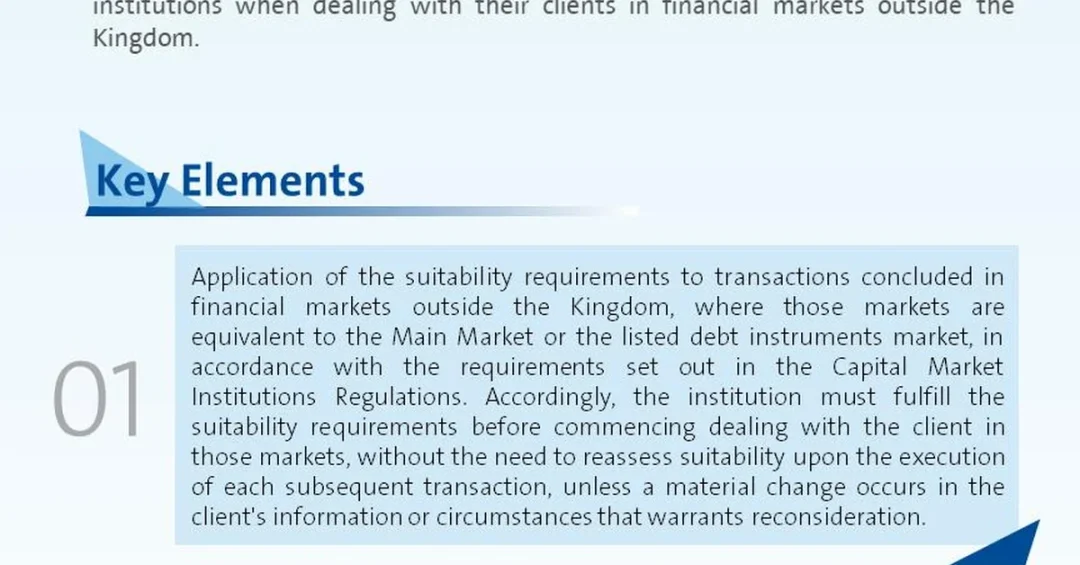
The draft regulatory provisions are part of the CMA’s ongoing efforts to align the Kingdom’s regulatory environment with international best practices. The Capital Market Institutions Regulations already set out suitability requirements for local transactions, and the new draft clarifies how those requirements apply when the transaction is concluded in a financial market outside the Kingdom. Specifically, the draft states that suitability requirements apply where the external market is equivalent to the Main Market or the listed debt instruments market. Institutions must fulfill suitability obligations before commencing dealings with a client in those markets, and they do not need to reassess suitability for every subsequent transaction unless a material change occurs in the client’s information or circumstances. This approach reduces operational friction while preserving investor protection.
The consultation process itself is a hallmark of Saudi regulatory practice. The CMA routinely seeks public input through the Unified Electronic Platform for Consulting the Public and Government Entities, known as the Public Consultation Platform, which is affiliated with the Saudi Competitiveness and Business Center. By opening the draft to a 30-day review ending on 27 October 2026, the CMA ensures that the final rules reflect the practical experience of market participants. Would a transparent, inclusive rulemaking process not strengthen confidence in the Kingdom’s capital market institutions?
Key Details of the Draft Provisions
The draft provisions address two main areas of concern: suitability requirements for cross-border transactions and margin trading in external markets. On suitability, the draft confirms that capital market institutions must assess whether a client is suitable for dealing in financial markets outside the Kingdom before initiating such dealings. The assessment applies when the external market is equivalent to the Main Market or the listed debt instruments market, in accordance with the Capital Market Institutions Regulations. Once the initial suitability assessment is completed, the institution can execute subsequent transactions without reassessing suitability each time, unless a material change occurs in the client’s information or circumstances. This pragmatic approach recognizes that markets move quickly and that repetitive assessments could hinder timely execution.
On margin transactions involving securities in external markets, the draft introduces supervisory controls intended to mitigate associated risks. Most notably, it requires the client to pay a margin of no less than 50 percent of the transaction value, and to have that margin monitored periodically. Furthermore, the draft prohibits executing this type of transaction on highly leveraged instruments or on companies whose accumulated losses exceed half of their capital. These safeguards are designed to prevent excessive risk-taking and to protect both clients and the stability of the financial system. By setting clear minimum standards, the CMA provides institutions with a predictable compliance framework while allowing them to serve client demand for international exposure.
The CMA emphasized that comments from the public will be taken into full consideration for the purpose of approving the final version of the Draft Provisions Regulating Dealing Activities in Financial Markets Outside the Kingdom, which shall come into effect as of 1 November 2026. Opinions and comments can be received through the Unified Electronic Platform for Consulting the Public and Government Entities (Public Consultation Platform), affiliated with the Saudi Competitiveness and Business Center, during the specified consultation period. Is it not significant that the Kingdom pairs ambitious market opening with rigorous, consultative regulation?
International and Regional Impact
How will these draft provisions affect international investors and institutions operating in Saudi Arabia? The rules apply to capital market institutions licensed by the CMA when they deal with clients in financial markets outside the Kingdom. This means global banks, brokerage firms, and asset managers with Saudi licenses will need to ensure their cross-border dealing activities comply with the new suitability and margin requirements. For international institutions, the clarity offered by the draft is likely to be welcome, as it reduces regulatory ambiguity and provides a single, transparent standard for conducting business with Saudi clients who wish to invest abroad. The Kingdom’s approach mirrors similar frameworks in mature markets, reinforcing its position as a serious global financial center.
Regionally, the move could influence how other Gulf Cooperation Council markets regulate cross-border dealing. Saudi Arabia’s capital market is the largest in the region, and its regulatory decisions often set a benchmark. By adopting a balanced framework that encourages international diversification while maintaining strong investor protections, the CMA is signaling that it can innovate without compromising on prudential oversight. This could enhance the attractiveness of Riyadh as a base for regional headquarters, a key objective of Vision 2030. Multinational financial firms looking to serve clients across the Middle East may find the Saudi regulatory environment increasingly predictable and aligned with global norms. Could this consultation therefore mark another step toward Riyadh’s emergence as a global financial hub?
Economic and Strategic Significance
What does this draft mean for the broader Saudi economy? The ability of Saudi investors to access international markets efficiently is an important component of a diversified, resilient financial sector. By clarifying suitability requirements and setting prudent margin rules, the CMA supports the development of a sophisticated investor base that can allocate capital globally while remaining protected from excessive leverage. This aligns with the Financial Sector Development Program’s goal of deepening capital markets and increasing their contribution to the economy. A well-regulated cross-border dealing framework also supports the growth of local asset management and brokerage industries, creating skilled jobs and attracting talent.
Strategically, the draft reinforces the Kingdom’s commitment to international cooperation and regulatory harmonization. The CMA’s consultation process allows market participants to share insights that may improve the final rules, ensuring they are practical and effective. The 1 November 2026 implementation date provides institutions with a clear timeline to adjust their systems and procedures. As Saudi Arabia continues to integrate with global financial markets, such regulatory initiatives help build trust among international counterparts and support the flow of capital into and out of the Kingdom. Is a predictable, well-communicated regulatory calendar not one of the strongest signals a market can send to global investors?
Vision 2030 Alignment
How does this initiative connect to Saudi Vision 2030? The Financial Sector Development Program is a core pillar of Vision 2030, aiming to create a diversified and effective financial sector that supports the national economy. The CMA’s draft provisions for dealing activities in financial markets outside the Kingdom directly support this objective by enhancing the supervisory framework, protecting investors, and facilitating responsible international investment. By enabling Saudi capital market institutions to serve clients in foreign markets under clear rules, the Kingdom is empowering its financial sector to compete globally and to contribute to the growth of non-oil sectors.
Moreover, the consultative nature of the process reflects the Vision 2030 principles of transparency, participation, and continuous improvement. The CMA’s use of the Public Consultation Platform demonstrates the Kingdom’s commitment to engaging stakeholders in policymaking. As the 27 October 2026 deadline approaches, market participants have a valuable opportunity to shape rules that will govern cross-border dealing for years to come. The final provisions, effective 1 November 2026, will further solidify Saudi Arabia’s standing as a forward-looking financial jurisdiction. In a world of shifting capital flows, is it not the markets that listen to their participants that lead the way?
20 Questions
Q1. What is the Capital Market Authority consulting the public about?
A1. The CMA is seeking feedback on the Draft Regulatory Provisions for Conducting Dealing Activities in Financial Markets Outside the Kingdom. The consultation aims to refine rules for capital market institutions dealing with clients in foreign markets, ensuring robust supervision and investor protection.
Q2. How long is the public consultation period?
A2. The consultation period lasts for 30 days, ending on 27 October 2026. Interested persons and market participants can submit their comments through the official Public Consultation Platform during this window.
Q3. When will the final provisions come into effect?
A3. The CMA has stated that the final version of the provisions will come into effect on 1 November 2026, following review of all public comments. This gives institutions a clear timeline for compliance.
Q4. What is the main objective of the draft provisions?
A4. The draft aims to enhance the supervisory framework regulating the activities of capital market institutions when dealing with clients in financial markets outside the Kingdom. It seeks to balance market access with strong investor protection.
Q5. Which markets are covered by the suitability requirements?
A5. Suitability requirements apply to transactions in financial markets outside the Kingdom that are equivalent to the Main Market or the listed debt instruments market, in accordance with the Capital Market Institutions Regulations.
Q6. When must an institution fulfill suitability requirements?
A6. The institution must fulfill suitability requirements before commencing dealing with the client in those external markets. It does not need to reassess suitability for each subsequent transaction unless a material change occurs.
Q7. What constitutes a material change that triggers reassessment?
A7. A material change would be any significant shift in the client’s information or circumstances that warrants reconsideration of suitability. The draft does not list specific examples but leaves room for professional judgment.
Q8. What are the new margin requirements for external market transactions?
A8. The draft requires the client to pay a margin of no less than 50 percent of the transaction value. The margin must also be monitored periodically to ensure ongoing compliance.
Q9. Are there restrictions on highly leveraged instruments?
A9. Yes, the draft prohibits executing margin transactions on highly leveraged instruments. This measure aims to mitigate the risks associated with excessive leverage in external markets.
Q10. Can margin transactions be executed on companies with large accumulated losses?
A10. No, the draft prohibits margin transactions on companies whose accumulated losses exceed half of their capital. This safeguard protects clients and the financial system from undue risk.
Q11. How can the public submit comments?
A11. Comments can be submitted through the Unified Electronic Platform for Consulting the Public and Government Entities, known as the Public Consultation Platform, affiliated with the Saudi Competitiveness and Business Center.
Q12. Will public comments influence the final rules?
A12. Yes, the CMA emphasized that comments from the public shall be taken into full consideration for the purpose of approving the final version of the draft provisions.
Q13. Why is the CMA focusing on cross-border dealing activities?
A13. As Saudi investors increasingly seek international diversification, the CMA aims to ensure that investor protection standards apply consistently, even when transactions occur in financial markets outside the Kingdom.
Q14. How does this draft align with Vision 2030?
A14. The draft supports the Financial Sector Development Program, a key Vision 2030 initiative. It aims to create a diversified, effective financial sector that can compete globally while protecting investors.
Q15. What types of institutions are affected by the draft?
A15. Capital market institutions licensed by the CMA that deal with clients in financial markets outside the Kingdom are affected. This includes brokerage firms, asset managers, and banks offering investment services.
Q16. Does the draft apply to all foreign markets?
A16. The suitability requirements apply specifically to external markets equivalent to the Main Market or the listed debt instruments market. Other markets may be subject to different considerations.
Q17. What is the significance of the 50 percent margin requirement?
A17. The 50 percent minimum margin ensures that clients have substantial skin in the game, reducing the risk of excessive speculation and protecting the stability of the financial system.
Q18. How will the CMA monitor compliance with the new rules?
A18. The CMA will supervise compliance through its existing regulatory framework. Institutions are required to monitor margins periodically and adhere to suitability and prohibition rules.
Q19. What happens if an institution fails to comply?
A19. The CMA has the authority to enforce compliance through its regulatory powers. Non-compliance may result in penalties, though specific sanctions are not detailed in the draft consultation document.
Q20. What is the next step after the consultation closes?
A20. After the consultation closes on 27 October 2026, the CMA will review all comments and finalize the provisions, which will come into effect on 1 November 2026.
Reader Feedback
We value your thoughts. Please share your feedback on this article.
Your feedback helps us improve our coverage.
Related articles
 International Dates Council to Hold Workshop in Tunisia on Global Marketing, Promotion of Dates
 Saudi Istitlaa Platform Strengthens Business Legislation
 Qassim Palm and Date Residues Offer Investment Opportunities
 Riyadh Economic Forum: 12th Edition to Boost Saudi Economy
 Japanese stock indexes close higher
 IsDB wins DFI of the Year 2025 Award in Türkiye