


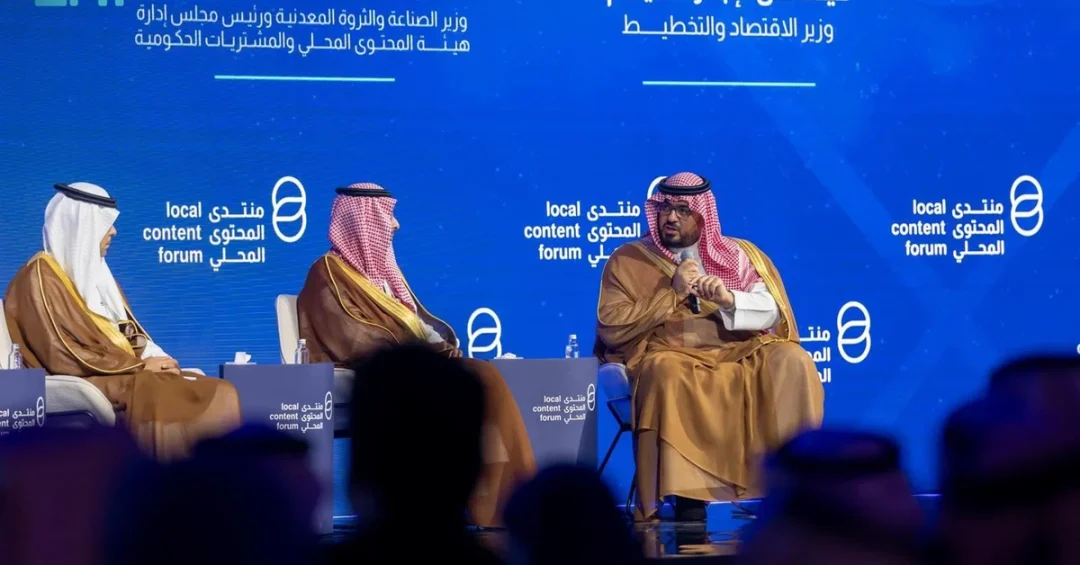
Saudi Minister of Economy and Planning Faisal Alibrahim affirmed that local content sits at the heart of Saudi Vision 2030, describing economic diversification as the Kingdom’s foremost strategic objective during his address at the Local Content Forum in Riyadh on November 20, 2024. Speaking before an audience of government officials, industry leaders, and private-sector representatives, the minister explained that building competitive local products and services capable of succeeding in foreign markets is essential to strengthening the resilience of the national economy. His remarks, carried by the Saudi Press Agency, underlined that the Kingdom’s transformation is not merely about reducing dependence on oil revenues but about constructing a broad, self-sustaining economic architecture that generates opportunity for citizens and enterprises alike.
The forum, held in the Saudi capital, convened stakeholders from across the manufacturing, services, technology, and export sectors to examine how local content policies can accelerate the Kingdom’s economic ambitions. Alibrahim’s participation signals the priority that the Ministry of Economy and Planning places on coordinating public and private efforts around a shared diversification agenda. For international observers, the message was clear: Saudi Arabia is methodically shifting its growth model toward non-oil sources, private-sector expansion, and sustainable employment, with local content serving as the connective tissue binding these objectives together.
Context and Background
Why does local content matter so much to Saudi Arabia’s economic future? The concept refers to the share of goods, services, labor, and technology sourced domestically within a national economy, and it has become a central pillar of Vision 2030 since the reform agenda was launched in 2016 under the leadership of Crown Prince Mohammed bin Salman. The Kingdom has long recognized that relying primarily on hydrocarbon exports exposes the economy to volatile global energy prices, making diversification a matter of long-term stability rather than mere preference. Local content policies are designed to deepen domestic supply chains, retain more economic value within the country, and create jobs for a young and growing population.
Institutional frameworks have been built to translate this vision into measurable outcomes. The Local Content and Government Procurement Authority, established to oversee local content requirements in government contracts, works alongside the Ministry of Economy and Planning to embed domestic value creation across major projects. The National Industrial Development and Logistics Program, one of the Vision 2030 realization programs, targets sectors such as manufacturing, mining, energy, and logistics as engines of non-oil growth. Together, these bodies form an ecosystem in which local content is not a slogan but a policy instrument with targets, incentives, and oversight mechanisms.
Regional and global context further sharpens the stakes. Gulf economies have increasingly pursued localization strategies, but Saudi Arabia’s scale, market size, and reform ambition distinguish its approach. With a population exceeding 32 million and a gross domestic product among the largest in the Middle East, the Kingdom offers domestic producers a substantial home market from which to build competitiveness before venturing abroad. The minister’s emphasis on exports reflects a maturation of this strategy: local content is no longer only about substituting imports but about creating world-class Saudi products that can win customers internationally.
Key Details
What exactly did the minister say, and why does it resonate across the economy? Alibrahim stated plainly that increasing exports diversifies growth sources, explaining that the Kingdom seeks growth through non-oil channels and beyond public finances. This formulation captures a subtle but important shift in economic thinking. Earlier phases of diversification focused on spending government resources to build new sectors; the current phase emphasizes revenue generation through private enterprise, exports, and productive investment. The minister noted that this approach helps grow the private sector and small and medium enterprises while providing sustainable jobs for Saudi citizens.
He also stressed that knowledge transfer is crucial for local content and economic diversification. This point speaks to the qualitative dimension of localization: it is not enough to assemble products domestically if the underlying design, engineering, and intellectual property remain external. By prioritizing skills development, technology adoption, and partnerships that bring expertise into the Kingdom, Saudi Arabia aims to move up the value chain. Universities, training academies, and corporate development programs all contribute to this effort, ensuring that local content translates into local capability rather than merely local labeling.
The Local Content Forum itself served as a platform for aligning stakeholders around these priorities. Such gatherings allow ministries, regulators, state-owned enterprises, and private firms to coordinate on procurement standards, supplier development, and export promotion. For small and medium enterprises, the forum represents an opportunity to understand how they can integrate into the supply chains of large corporations and government projects. For multinational firms operating in the Kingdom, it reinforces expectations that their local operations contribute to skills transfer, employment, and domestic sourcing. The event thus functions as both a policy checkpoint and a networking catalyst.
International and Regional Impact
How does Saudi Arabia’s local content push affect its trading partners and neighbors? For international companies, the Kingdom’s approach creates both obligations and opportunities. Firms that invest in local manufacturing, training, and supplier development position themselves favorably for government contracts and large-scale projects tied to Vision 2030. Those that treat the market purely as an export destination may find themselves at a competitive disadvantage as local content requirements become more embedded in procurement frameworks. The result is a gradual reshaping of business models toward deeper localization and long-term presence.
Within the Gulf region, Saudi Arabia’s emphasis on non-oil exports and private-sector growth contributes to a broader economic transformation underway across the Gulf Cooperation Council. Regional integration initiatives, cross-border infrastructure, and harmonized standards increasingly complement national localization strategies. Saudi exports reaching neighboring markets can benefit from improved logistics links and trade facilitation, while regional investors gain access to a large and diversifying Saudi economy. The Kingdom’s progress thus has spillover effects, reinforcing the region’s collective shift away from hydrocarbon dependence.
Economic and Strategic Significance
Why is this moment pivotal for the Saudi economy? The minister’s remarks come as the Kingdom reports steady progress on non-oil economic activity, with the private sector expanding and new industries taking root. Vision 2030 targets include raising the private sector’s contribution to gross domestic product and increasing the share of non-oil exports in the national economy. Local content policies directly support these goals by ensuring that government spending and major project procurement circulate through domestic supply chains, multiplying the employment and income effects of investment.
Small and medium enterprises occupy a special place in this strategy. They are typically the most dynamic job creators and the most adaptable innovators, yet they often struggle to access large contracts and export markets. By requiring or incentivizing local sourcing in major projects, the Kingdom creates a pipeline of demand that allows smaller firms to scale, specialize, and eventually compete internationally. Sustainable jobs emerge not from temporary construction booms alone but from enduring enterprises that serve both domestic and foreign customers. The minister’s linkage of exports, SMEs, and employment reflects this integrated logic.
Knowledge transfer adds a strategic dimension that transcends short-term economic metrics. When foreign expertise combines with Saudi talent and institutions, the result is a durable enhancement of national capabilities. Sectors such as advanced manufacturing, renewable energy, digital services, and logistics all depend on specialized skills that can be cultivated through deliberate partnerships and training programs. Over time, this accumulation of human capital reduces reliance on imported expertise and strengthens the Kingdom’s capacity to innovate, a prerequisite for competing in global markets.
Vision 2030 Alignment
How does local content connect to the broader Vision 2030 framework? Diversification is not one goal among many; it is the organizing principle of the entire reform agenda. Vision 2030 envisions a thriving economy in which the private sector leads growth, citizens find rewarding employment, and the Kingdom’s global engagement deepens through trade and investment. Local content operationalizes this vision by embedding domestic value creation into the daily decisions of government agencies, corporations, and entrepreneurs. Every contract awarded to a Saudi supplier, every partnership that transfers know-how, and every product exported abroad advances the diversification objective.
The Ministry of Economy and Planning, under Minister Faisal Alibrahim, plays a coordinating role in this national effort, aligning policies across sectors and monitoring progress toward targets. The Local Content Forum illustrates the collaborative model that Vision 2030 requires: government setting direction, the private sector responding with investment and innovation, and educational institutions supplying the skills that modern industries demand. As the Kingdom continues its transformation, local content will remain a defining theme, linking economic resilience at home with competitiveness abroad and positioning Saudi Arabia as a leading diversified economy in the region and beyond.
20 Questions
Q1. What was the main message of Minister Faisal Alibrahim’s speech at the Local Content Forum?
A1. He emphasized that Saudi Vision 2030’s primary goal is diversifying economic growth by creating an environment that supports competitive local products and services in foreign markets, thereby increasing economic resilience.
Q2. Where and when did the minister deliver these remarks?
A2. Minister of Economy and Planning Faisal Alibrahim spoke at the Local Content Forum in Riyadh on November 20, 2024, as reported by the Saudi Press Agency.
Q3. Why does the minister consider exports important for the Saudi economy?
A3. He stated that increasing exports diversifies growth sources, allowing the Kingdom to grow through non-oil channels and beyond public finances, which strengthens the private sector and creates sustainable jobs.
Q4. What role does knowledge transfer play in local content?
A4. The minister stressed that knowledge transfer is crucial for local content and economic diversification, as it builds domestic capabilities, skills, and technology rather than relying solely on imported expertise.
Q5. What is local content in the context of Saudi economic policy?
A5. Local content refers to the share of goods, services, labor, and technology sourced domestically, designed to deepen supply chains, retain economic value, and create employment within the Kingdom.
Q6. Which Saudi institution oversees local content in government procurement?
A6. The Local Content and Government Procurement Authority oversees local content requirements in government contracts, working with the Ministry of Economy and Planning to embed domestic value creation.
Q7. How does local content support small and medium enterprises?
A7. By generating demand for domestic suppliers through major projects and government contracts, local content policies help SMEs scale, specialize, and eventually compete in international markets.
Q8. What are the main goals of Vision 2030 regarding the private sector?
A8. Vision 2030 aims to raise the private sector’s contribution to gross domestic product, expand non-oil exports, and create rewarding employment opportunities for Saudi citizens.
Q9. How does diversification reduce economic risk for Saudi Arabia?
A9. Diversification reduces reliance on hydrocarbon revenues, shielding the economy from volatile global energy prices and creating more stable, broad-based growth across multiple sectors.
Q10. What sectors are prioritized under Saudi Arabia’s diversification strategy?
A10. Key sectors include advanced manufacturing, renewable energy, logistics, mining, digital services, and tourism, all supported by Vision 2030 realization programs.
Q11. Why is the Local Content Forum significant for stakeholders?
A11. It provides a platform for government, state-owned enterprises, and private firms to coordinate on procurement standards, supplier development, and export promotion.
Q12. How do multinational companies benefit from local content policies?
A12. Firms that invest in local manufacturing, training, and supplier development position themselves favorably for government contracts and large Vision 2030 projects.
Q13. What does the minister mean by growth beyond public finances?
A13. He means generating economic expansion through private investment, exports, and productive enterprise rather than relying primarily on government spending to stimulate activity.
Q14. How does local content contribute to sustainable job creation?
A14. By building enduring domestic enterprises that serve both local and foreign customers, local content fosters long-term employment rather than temporary construction-related jobs.
Q15. What is the National Industrial Development and Logistics Program?
A15. It is a Vision 2030 realization program targeting manufacturing, mining, energy, and logistics as engines of non-oil growth and industrial diversification.
Q16. How does Saudi Arabia’s market size support local content?
A16. With a population exceeding 32 million, the Kingdom offers domestic producers a substantial home market to build competitiveness before expanding into international markets.
Q17. What is the regional impact of Saudi Arabia’s diversification efforts?
A17. The Kingdom’s progress reinforces the Gulf region’s collective shift away from hydrocarbon dependence and supports regional integration through trade and investment linkages.
Q18. How does knowledge transfer strengthen national capabilities?
A18. It combines foreign expertise with Saudi talent and institutions, building durable skills in sectors like advanced manufacturing, renewable energy, and digital services.
Q19. What role does the Ministry of Economy and Planning play in diversification?
A19. The ministry coordinates policies across sectors, aligns public and private efforts, and monitors progress toward Vision 2030 targets under Minister Faisal Alibrahim’s leadership.
Q20. What is the long-term vision for Saudi Arabia’s economy?
A20. The long-term vision is a thriving, diversified economy where the private sector leads growth, citizens find rewarding employment, and the Kingdom competes globally as a leading non-oil economy.
Reader Feedback
We value your thoughts. Please share your feedback on this article.
Your feedback helps us improve our coverage.
Related articles
 Saudi Minister Launches Program to Localize Railway Manufacturing
 Saudi Envoy Attends Cairo Dates Forum, Boosting Vision 2030 Exports
 CMA Seeks Public Input on Investment Account Reforms
 ICIEC Provides $2.35 Billion Insurance Coverage to 50 IsDB Member States
 CIBAFI Holds Ninth Innovation, Technology Working Group Meeting
 Saudi Date Production Grows 11%, International Date Council Praised