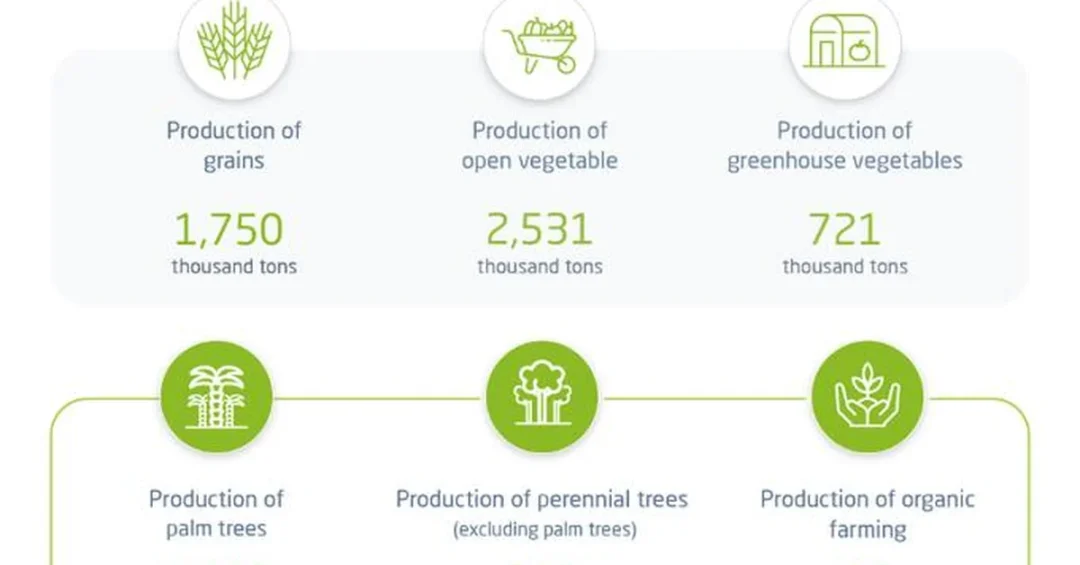
The General Authority for Statistics (GASTAT) announced on October 28, 2024, the results of its Agricultural Statistics Bulletin for 2023, revealing that the Kingdom harvested 1.75 million tons of grain from 323,000 hectares of a total planted area of 331,000 hectares. The bulletin, released through official Saudi channels in Riyadh, provides a comprehensive snapshot of a sector that is steadily modernizing under the Kingdom’s long-term development plans. It details production across grains, organic crops, greenhouse vegetables, permanent trees, and dates, while also mapping the flow of agricultural exports and imports. For international observers, the figures offer a clear, data-driven view of how Saudi Arabia is balancing food security, water conservation, and agricultural innovation. The results also underscore the growing role of technology, including greenhouse farming and organic production, in reshaping the Kingdom’s agricultural landscape.
The bulletin is more than a statistical release; it is a signal of intent. Saudi Arabia has long recognized that a resilient agricultural sector is central to national security and economic diversification. The 2023 data show that the Kingdom is not only producing more but also producing smarter, with high-value crops such as wheat, olives, and dates leading the way. The numbers reflect years of investment in infrastructure, research, and farmer support programs. They also highlight the importance of accurate data itself, which enables policymakers, investors, and international partners to make informed decisions. As the world grapples with climate change and supply chain disruptions, Saudi Arabia’s agricultural progress offers a compelling case study in strategic planning and execution.
Context and Background
How did Saudi Arabia transform its agricultural sector from a desert-based subsistence activity into a data-rich, technology-driven industry? The answer lies in decades of deliberate policy. Since the launch of Vision 2030 in 2016, the Kingdom has accelerated efforts to diversify its economy away from oil, with agriculture playing a supporting but vital role. The Ministry of Environment, Water and Agriculture has spearheaded initiatives to improve water efficiency, promote sustainable farming, and boost local production of strategic crops. GASTAT, as the official statistical authority, has been tasked with providing reliable data to track progress. The 2023 Agricultural Statistics Bulletin is the latest in a series of annual reports that help measure the impact of these policies. It covers planted areas, production volumes, tree counts, and trade flows, offering a granular view of the sector’s performance.
Historically, Saudi agriculture faced significant challenges, including limited arable land, scarce water resources, and harsh climatic conditions. However, the Kingdom has turned these constraints into drivers of innovation. The adoption of greenhouse technology, drip irrigation, and organic farming methods has allowed farmers to produce more with less. The 2023 bulletin reflects these advances, showing that greenhouse vegetable production reached 721,000 tons, with tomatoes alone accounting for 300,000 tons. Organic crop production totaled 95,000 tons, a testament to the growing demand for healthy, sustainably grown food. The data also reveal the scale of the Kingdom’s permanent tree stock: over 41 million trees, including more than 20 million olive trees and 37 million palm trees. These trees are not just agricultural assets; they are part of the Saudi landscape and heritage, contributing to food production and environmental sustainability.
Key Details
What do the 2023 figures tell us about the composition of Saudi agriculture? Grains remain a cornerstone, with wheat the leading crop. Wheat covered 63.4% of the total area planted with grains and produced 1.314 million tons. This dominance reflects the crop’s strategic importance for food security. The total grain harvest of 1.75 million tons was achieved on 323,000 hectares, leaving only 8,000 hectares of the total planted area unharvested, indicating high efficiency. In the organic sector, production reached 95,000 tons, a modest but growing share that aligns with global trends toward healthier diets. Greenhouse vegetable production was particularly impressive at 721,000 tons, with tomatoes representing 36.7% of the total greenhouse area and yielding 300,000 tons. This suggests that greenhouses are a key technology for extending growing seasons and improving yields in arid conditions.
The bulletin also provides detailed insights into permanent trees. Olive trees, numbering over 20 million, produced 343,000 tons, while palm trees totaled 37 million, of which 31 million were fruit-bearing. Date production reached 1.903 million tons, with the Khalas variety leading at 609,000 tons. The Khalas date is prized for its quality and is a significant export commodity. On the trade side, agricultural exports amounted to 447,000 tons, with edible fruits and nuts, citrus peel, and other products accounting for 70.3% of the total. Imports of agricultural crops reached 16.936 million tons, with grains making up 69% of that figure. These numbers highlight Saudi Arabia’s integration into global markets: it exports high-value products while importing staples to meet domestic demand. The balance between exports and imports also reflects the Kingdom’s strategy to conserve water by reducing local production of water-intensive crops and sourcing them internationally.
International and Regional Impact
How does Saudi Arabia’s agricultural performance resonate beyond its borders? The Kingdom is a major player in regional food markets and a key partner in global supply chains. Its date exports, particularly the Khalas variety, are sought after in the Gulf, Asia, and Europe. The 1.903 million tons of dates produced in 2023 reinforce Saudi Arabia’s position as a leading date producer and exporter. Similarly, olive oil and table olives from Saudi groves are gaining recognition for their quality. The export figure of 447,000 tons, while modest compared to imports, represents a strategic focus on high-value, niche products. For regional neighbors, Saudi Arabia’s agricultural advances offer opportunities for collaboration in research, technology transfer, and trade. The Kingdom’s experience in greenhouse farming and water-efficient irrigation can be a model for other arid countries.
On the import side, the 16.936 million tons of agricultural crops, dominated by grains, underscore Saudi Arabia’s role as a reliable importer and a stabilizing force in global grain markets. The Kingdom’s procurement policies are designed to ensure food security while supporting international suppliers. This interdependence fosters diplomatic goodwill and economic ties. Moreover, Saudi Arabia’s investments in agricultural technology and infrastructure are attracting international companies and expertise. The 2023 bulletin thus paints a picture of a nation that is both a responsible global citizen and an increasingly sophisticated agricultural producer. As global food systems face pressures from climate change and geopolitical tensions, Saudi Arabia’s data-driven approach and strategic investments are noteworthy for their forward-looking orientation.
Economic and Strategic Significance
What is the economic weight of agriculture within Saudi Arabia’s broader diversification agenda? While agriculture’s share of GDP is relatively small compared to hydrocarbons, its strategic value is immense. The sector provides employment, supports rural communities, and contributes to food security—a top priority for the Saudi leadership. The 2023 figures show that agriculture is not a sunset industry but a modernizing one. The 1.75 million tons of grain, 1.903 million tons of dates, and 721,000 tons of greenhouse vegetables represent significant economic activity. They also underpin related industries such as food processing, packaging, logistics, and retail. The date palm sector alone supports thousands of jobs and generates substantial export revenue. The olive oil industry is similarly expanding, with Saudi products winning international awards.
From a strategic perspective, the data highlight the Kingdom’s success in managing water resources. By focusing on greenhouse production and importing water-intensive grains, Saudi Arabia is conserving its scarce groundwater. This approach is aligned with the National Water Strategy and Vision 2030’s sustainability goals. The emphasis on organic farming—95,000 tons in 2023—also positions Saudi Arabia to tap into the global organic food market, which is growing rapidly. Furthermore, the agricultural sector is becoming a hub for innovation, with the adoption of precision irrigation, solar-powered greenhouses, and digital monitoring systems. These technologies not only boost yields but also create opportunities for Saudi entrepreneurs and tech startups. The economic significance of agriculture thus extends beyond production volumes to include knowledge creation and high-tech exports.
Vision 2030 Alignment
How does the 2023 Agricultural Statistics Bulletin reflect the ambitions of Vision 2030? The Vision aims to diversify the economy, improve quality of life, and ensure sustainable development. Agriculture is a key pillar in this framework, particularly through the Food Security Strategy and the National Environment Strategy. The bulletin’s findings show tangible progress: increased local production of high-value crops, adoption of water-saving technologies, and growth in organic farming. These outcomes directly support Vision 2030’s goals of economic diversification and environmental sustainability. The data also inform future policies, allowing the government to target investments where they are most needed. For example, the dominance of wheat in grain production may guide decisions on subsidies and research funding. The growth in date production supports the goal of doubling non-oil exports, as dates are a flagship export product.
Looking ahead, the 2023 results set a baseline for even more ambitious targets. Vision 2030 envisions a Saudi Arabia that is not only self-reliant in key food items but also a global leader in sustainable agriculture. The Kingdom is investing in agricultural research, including drought-resistant crops and smart farming systems. It is also fostering partnerships with international organizations and private companies to bring cutting-edge solutions to Saudi farms. The 2023 bulletin, with its detailed data, will serve as a crucial tool for measuring progress and refining strategies. As the Kingdom continues its journey toward a diversified, knowledge-based economy, agriculture will remain a vital component, contributing to food security, job creation, and environmental stewardship. The figures released by GASTAT are not just numbers; they are milestones on the road to a prosperous and sustainable future.
20 Questions
Q1. What did the GASTAT Agricultural Statistics Bulletin for 2023 reveal about grain production?
A1. The bulletin showed that Saudi Arabia harvested 1.75 million tons of grain from 323,000 hectares, with wheat leading at 1.314 million tons and covering 63.4% of the grain area.
Q2. How much organic crop production was reported in the 2023 bulletin?
A2. The total organic crop production amounted to 95,000 tons, reflecting the Kingdom’s growing emphasis on sustainable and healthy agricultural practices.
Q3. What was the greenhouse vegetable production volume in 2023?
A3. Greenhouse vegetable production reached 721,000 tons, with tomatoes accounting for 36.7% of the greenhouse area and yielding 300,000 tons.
Q4. How many permanent trees were counted in Saudi Arabia in 2023?
A4. The total number of permanent trees exceeded 41 million, including over 20 million olive trees and 37 million palm trees, of which 31 million were fruit-bearing.
Q5. What was the total date production in 2023, and which variety led?
A5. Date production reached 1.903 million tons, with the Khalas variety leading at 609,000 tons, underscoring its importance as a premium export crop.
Q6. What was the total volume of agricultural exports in 2023?
A6. Agricultural exports totaled 447,000 tons, with edible fruits and nuts, citrus peel, and other products representing 70.3% of the total.
Q7. How much agricultural crops did Saudi Arabia import in 2023?
A7. The Kingdom imported 16.936 million tons of agricultural crops, with grains constituting the largest portion at 69% of total imports.
Q8. Which crop covered the largest area of grain planting in 2023?
A8. Wheat was the leading crop, covering 63.4% of the total area planted with grains, demonstrating its strategic importance for food security.
Q9. What percentage of the total planted area was harvested in 2023?
A9. Of the total planted area of 331,000 hectares, 323,000 hectares were harvested, indicating a high efficiency rate of over 97%.
Q10. How does the 2023 data reflect Saudi Arabia’s water conservation efforts?
A10. The data show a focus on greenhouse production and imports of water-intensive grains, aligning with the Kingdom’s strategy to conserve scarce water resources.
Q11. What is the significance of the Khalas date variety in Saudi agriculture?
A11. The Khalas variety, producing 609,000 tons, is a premium date known for its quality and is a key export commodity, supporting non-oil export growth.
Q12. How many olive trees were there in Saudi Arabia in 2023, and what was their production?
A12. There were more than 20 million olive trees, producing 343,000 tons, contributing to the growing olive oil and table olive industry.
Q13. What role does greenhouse farming play in Saudi Arabia’s agricultural strategy?
A13. Greenhouse farming enables year-round production and efficient water use, with 721,000 tons of vegetables produced in 2023, enhancing food security.
Q14. How do agricultural imports support Saudi Arabia’s food security?
A14. Imports of 16.936 million tons, mainly grains, ensure a stable supply of staples while allowing the Kingdom to conserve water by reducing local production of water-intensive crops.
Q15. What percentage of agricultural exports were fruits and nuts?
A15. Edible fruits and nuts, citrus peel, and other products accounted for 70.3% of the 447,000 tons of agricultural exports, highlighting the Kingdom’s competitive edge in these products.
Q16. How does the 2023 bulletin support Vision 2030 goals?
A16. The data inform policies on food security, water conservation, and economic diversification, directly supporting Vision 2030’s sustainability and prosperity objectives.
Q17. What was the total planted area for grains in 2023?
A17. The total planted area for grains was 331,000 hectares, of which 323,000 hectares were harvested, yielding 1.75 million tons.
Q18. How many palm trees were fruit-bearing in 2023?
A18. Of the 37 million palm trees, 31 million were fruit-bearing, producing 1.903 million tons of dates, a testament to the sector’s productivity.
Q19. What is the significance of organic farming growth in Saudi Arabia?
A19. Organic production of 95,000 tons reflects rising demand for healthy food and positions the Kingdom to tap into the global organic market, aligning with sustainability goals.
Q20. How does GASTAT’s data help international investors and partners?
A20. The detailed statistics provide transparency and insights into Saudi agriculture, enabling informed decisions and highlighting opportunities in a modernizing sector aligned with Vision 2030.
Reader Feedback
We value your thoughts. Please share your feedback on this article.
Your feedback helps us improve our coverage.