


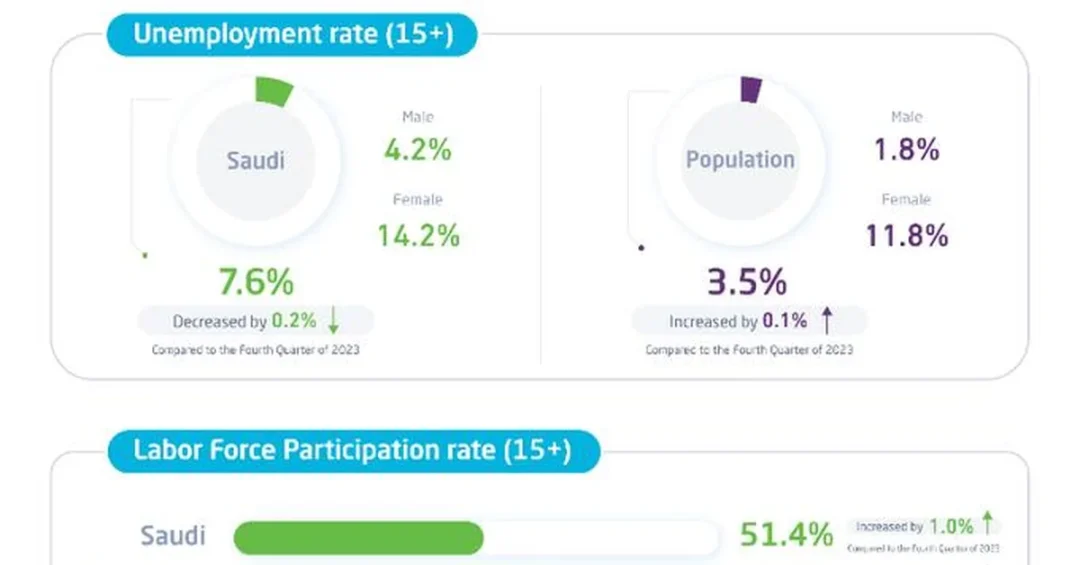
The General Authority for Statistics (GASTAT) announced on June 30, 2024, that the Kingdom’s overall unemployment rate remained relatively stable at 3.5% in the first quarter of 2024, compared to 3.4% in the fourth quarter of 2023. The figures, released in GASTAT’s Labor Market Bulletin and available on its official website, reflect the continued strength of Saudi Arabia’s labor market amid the transformative economic reforms of Vision 2030.
Context and Background
The Labor Market Bulletin for Q1 2024 incorporates revised data from the fourth quarter of 2023, based on the Saudi Census 2022, ensuring accuracy and reliability. GASTAT conducts a comprehensive household survey that electronically gathers information from a representative sample across all regions of the Kingdom, providing robust estimates of key labor market indicators such as unemployment and labor force participation rates.
This quarterly release is a vital tool for policymakers, businesses, and international observers seeking to understand the dynamics of Saudi Arabia’s workforce as the Kingdom pursues economic diversification and modernization under Vision 2030.
Key Details
According to GASTAT, the unemployment rate for Saudi citizens decreased to 7.6% in Q1 2024, down from 7.8% in the previous quarter. This improvement was driven by a decline in the unemployment rate for Saudi males, which fell to 4.2% from 4.6%. However, the unemployment rate for Saudi females rose slightly to 14.2% from 13.9%, reflecting shifting labor market dynamics.
Labor force participation rates showed encouraging trends. For Saudis, the participation rate increased to 51.4% from 50.4% in Q4 2023. Among Saudi females, participation rose to 35.8% from 35.0%, while Saudi male participation increased to 66.4% from 65.4%. Overall participation for both Saudis and non-Saudis decreased to 66.0% from 67.0%, partly due to adjustments in the expatriate workforce.
Implications and Impact
The stabilization of the unemployment rate at 3.5% underscores the resilience of Saudi Arabia’s economy and the effectiveness of ongoing labor market reforms. The increase in Saudi female participation reflects the Kingdom’s efforts to empower women and integrate them more fully into the workforce, a key pillar of Vision 2030. The decrease in male unemployment highlights growing opportunities in emerging sectors.
Internationally, these figures reinforce Saudi Arabia’s position as a stable and attractive destination for investment, with a labor market that supports both Saudi nationals and expatriates. The data also informs global discussions on economic diversification and workforce development in the Gulf region.
Vision 2030 Alignment
The positive labor market indicators align closely with Vision 2030’s goals of boosting employment, increasing women’s participation, and reducing dependence on oil. As the Kingdom continues to implement ambitious projects and reforms, GASTAT’s data will remain essential for tracking progress and guiding future policies. The stable unemployment rate is a testament to Saudi Arabia’s commitment to creating a thriving, diversified economy and a dynamic society.
20 Questions
Q1. What was the overall unemployment rate in Saudi Arabia for Q1 2024?
A1. The overall unemployment rate was 3.5% in Q1 2024, relatively stable compared to 3.4% in Q4 2023, according to GASTAT’s Labor Market Bulletin.
Q2. How does the unemployment rate for Saudi citizens compare to the overall rate?
A2. The unemployment rate for Saudi citizens was 7.6% in Q1 2024, higher than the overall rate of 3.5%, which includes non-Saudis.
Q3. What was the unemployment rate for Saudi females in Q1 2024?
A3. The unemployment rate for Saudi females rose to 14.2% in Q1 2024, up from 13.9% in the previous quarter.
Q4. What was the unemployment rate for Saudi males in Q1 2024?
A4. The unemployment rate for Saudi males decreased to 4.2% in Q1 2024, down from 4.6% in Q4 2023.
Q5. What was the labor force participation rate for Saudis in Q1 2024?
A5. The labor force participation rate for Saudis increased to 51.4% in Q1 2024, up from 50.4% in the previous quarter.
Q6. How did the labor force participation rate for Saudi females change?
A6. The participation rate for Saudi females increased to 35.8% in Q1 2024, up from 35.0% in Q4 2023.
Q7. What was the labor force participation rate for Saudi males in Q1 2024?
A7. The participation rate for Saudi males rose to 66.4% in Q1 2024, up from 65.4% in the previous quarter.
Q8. How did the overall labor force participation rate for Saudis and non-Saudis change?
A8. The overall participation rate for both Saudis and non-Saudis decreased to 66.0% in Q1 2024, down from 67.0% in Q4 2023.
Q9. What is the source of GASTAT’s labor market data?
A9. GASTAT’s data comes from a household survey that electronically collects information from a sample representing different regions of the Kingdom.
Q10. When was the Labor Market Bulletin for Q1 2024 released?
A10. The bulletin was released on June 30, 2024, by the General Authority for Statistics.
Q11. What is the significance of the revised Q4 2023 data?
A11. The revised data, based on the Saudi Census 2022, ensures accuracy and reliability in labor market estimates, providing a solid baseline for Q1 2024 comparisons.
Q12. Where can the full Labor Market Bulletin be accessed?
A12. The bulletin is available on GASTAT’s official website at https://www.stats.gov.sa/en.
Q13. How does the unemployment rate reflect Vision 2030 goals?
A13. The stable unemployment rate indicates progress in economic diversification and job creation, key objectives of Vision 2030 to build a thriving economy.
Q14. Why did Saudi female unemployment rise slightly?
A14. The slight rise to 14.2% reflects increased labor force participation among women, as more Saudi females enter the job market seeking opportunities.
Q15. What does the decrease in male unemployment indicate?
A15. The drop to 4.2% suggests growing employment opportunities for Saudi men, supported by economic reforms and private sector growth.
Q16. How does the labor force participation rate for Saudi women compare regionally?
A16. At 35.8%, the participation rate reflects steady progress, aligning with Vision 2030’s aim to enhance women’s role in the economy.
Q17. What impact does the overall participation rate decline have?
A17. The decline to 66.0% is partly due to adjustments in the expatriate workforce, while Saudi participation increased, indicating a shift toward nationalization.
Q18. How does GASTAT ensure data accuracy?
A18. GASTAT uses a comprehensive household survey and revised census data to produce reliable estimates of labor market indicators.
Q19. What are the key labor market indicators in the bulletin?
A19. The bulletin covers unemployment rates, labor force participation rates, and other indicators for Saudis and non-Saudis by gender.
Q20. How do these figures support international confidence in Saudi Arabia?
A20. The stable unemployment rate and rising Saudi participation demonstrate economic resilience, enhancing Saudi Arabia’s attractiveness for global investment and partnerships.
Reader Feedback
We value your thoughts. Please share your feedback on this article.
Your feedback helps us improve our coverage.