


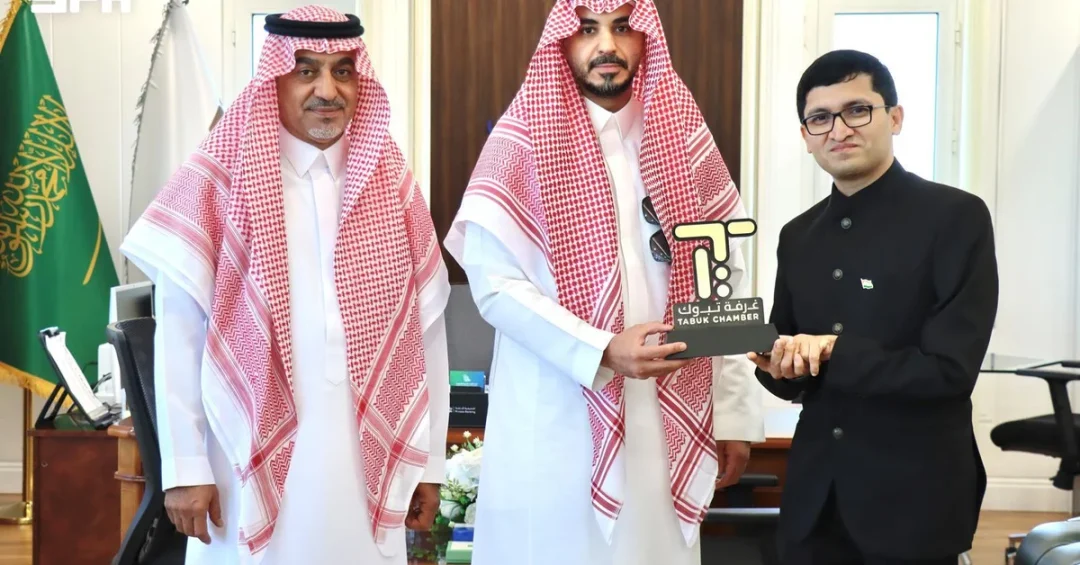
Consul General of the Republic of India in Jeddah Fahad Ahmed Khan Suri visited the Tabuk Chamber of Commerce on August 19, 2026, where he was received by Tabuk Chamber Board Member Eng. Abdulrahman Al-Bouq for talks on deepening trade and investment ties between India and the Tabuk Region. The meeting, reported by the Saudi Press Agency, focused on strengthening communication between the two business communities and exploring the commercial opportunities that have emerged as Saudi Arabia accelerates its economic transformation under Vision 2030. Both sides described the encounter as a constructive step toward translating longstanding diplomatic goodwill into tangible commercial partnerships that serve the interests of investors, exporters and entrepreneurs in the Kingdom and in India.
Why does a single consular visit to a regional chamber of commerce matter in a global economy defined by trillion-dollar trade flows? The answer lies in the architecture of Saudi Arabia’s economic opening. The Kingdom’s regions are no longer passive recipients of investment directed from Riyadh; they are active participants in a diversified national economy. Tabuk, positioned in the north-west near the Red Sea and close to Jordan and Egypt, sits at the crossroads of trade corridors that connect the Arabian Peninsula to Europe, Asia and Africa. Engagements such as this one signal that Saudi Arabia’s commercial diplomacy is being conducted at every level, from ministerial summits to regional chambers, ensuring that the benefits of Vision 2030 reach communities far from the major metropolitan centres.
Context and Background
What makes Tabuk a natural partner for India’s commercial representatives? The Tabuk Chamber of Commerce has long served as the institutional hub for businesses across the Tabuk Region, one of the Kingdom’s largest provinces by area. It represents the interests of local traders, contractors, logistics operators and tourism investors, and it regularly hosts foreign delegations seeking to understand the region’s potential. The visit by Consul General Fahad Ahmed Khan Suri reflects the Indian consulate’s mandate in Jeddah, which covers diplomatic and commercial engagement with western and north-western Saudi Arabia. By travelling to Tabuk, the consul general signalled that India’s economic diplomacy is not confined to Riyadh or Jeddah but extends to the Kingdom’s emerging regional economies.
The relationship between Saudi Arabia and India rests on a foundation of energy trade, labour mobility and growing investment. India is one of the Kingdom’s most important trading partners in Asia, and Saudi Arabia is a reliable supplier of crude oil to Indian refineries. Beyond hydrocarbons, the two countries have expanded cooperation into petrochemicals, renewable energy, food security, healthcare and digital technology. The Indian diaspora in Saudi Arabia numbers in the millions and contributes to both economies through remittances, skills transfer and entrepreneurship. In this broader context, a consular visit to a regional chamber is not a ceremonial courtesy; it is part of a sustained effort to broaden the base of a relationship that has historically been dominated by a few large sectors.
Tabuk itself has been transformed by Vision 2030. The region hosts NEOM, the flagship giga-project that includes The Line, Oxagon, Trojena and Sindalah, and it is a gateway to the Red Sea coast, where luxury tourism and logistics are expanding rapidly. The Tabuk Chamber of Commerce has therefore found itself at the centre of a new economic geography, one in which local firms are being invited to supply services to international developers, operate hospitality assets, and participate in cross-border trade with Jordan and Egypt. For Indian companies looking for entry points into the Saudi market, chambers of commerce in regions such as Tabuk offer practical guidance, local partnerships and a direct line to decision-makers.
Key Details of the Meeting
What was actually discussed behind the chamber’s doors? According to the Saudi Press Agency, Eng. Abdulrahman Al-Bouq, a board member of the Tabuk Chamber, underscored the importance of strengthening communication between the two business communities in order to develop trade and investment relations and to explore available opportunities. The consul general thanked the chamber for its warm reception and affirmed the consulate’s commitment to enhancing economic cooperation and communication between the two sides. The discussion covered opportunities for cooperation and ways to develop trade and investment relations between the business communities in the Tabuk Region and the Republic of India. These are the verified facts released through official Saudi channels, and they establish a clear agenda for follow-up work.
The language used by both sides is significant. References to “communication” and “exploring opportunities” point to a practical, business-to-business approach rather than a purely diplomatic exchange. Chambers of commerce in Saudi Arabia operate under the supervision of the Ministry of Commerce and are empowered to issue certificates of origin, organise trade missions, and connect members with international counterparts. When a chamber hosts a foreign consul general, the outcome is often a pipeline of introductions, matchmaking events and information sessions that help small and medium-sized enterprises find partners abroad. For Tabuk, which is diversifying away from a traditional reliance on government employment and agriculture, such connections are valuable.
The meeting also reflects the growing institutional density of Saudi-Indian relations. The Saudi-Indian Joint Business Council, the Federation of Saudi Chambers, and various sectoral committees have worked for years to remove barriers to trade and investment. Indian firms are active in Saudi Arabia’s construction, information technology, pharmaceuticals and food processing sectors, while Saudi investors have shown interest in Indian infrastructure, renewable energy and digital payments. A regional chamber visit adds granularity to this national-level framework, ensuring that companies outside Riyadh and Jeddah can access the same networks and opportunities.
International and Regional Impact
How does a bilateral meeting in north-western Saudi Arabia resonate beyond the Kingdom’s borders? Tabuk’s geography gives it strategic weight. The region borders Jordan to the north and shares a coastline on the Red Sea, placing it on routes that link the Gulf to the Mediterranean and to European markets. Indian goods entering Saudi Arabia through Red Sea ports can be distributed onward to Jordan, Egypt and beyond, while Saudi products and services can reach Indian Ocean markets. Improved business communication between Tabuk and Indian firms therefore has the potential to strengthen regional supply chains at a time when global companies are seeking to diversify their sourcing and logistics footprints.
From a geopolitical perspective, the visit aligns with Saudi Arabia’s broader outreach to Asia. The Kingdom has deepened ties with India through the Strategic Partnership Council, energy agreements, and cooperation in areas such as security, culture and technology. India, for its part, views Saudi Arabia as a key partner in the Gulf and a source of energy and investment. The presence of an Indian consul general in Tabuk, engaging directly with local business leaders, demonstrates that this partnership is maturing into a decentralised network of relationships. It also complements Saudi Arabia’s efforts to attract foreign direct investment and to position itself as a hub connecting Asia, Africa and Europe.
Economic and Strategic Significance
What economic gains can realistically be expected from this engagement? The immediate outcomes are likely to be informational and relational: Indian companies will learn more about Tabuk’s investment climate, regulatory environment and project pipeline, while Tabuk businesses will gain access to Indian suppliers, technology providers and potential joint-venture partners. Over time, such contacts can lead to memoranda of understanding, trade delegations and participation in exhibitions. The Tabuk Chamber of Commerce is well placed to organise these activities, given its existing relationships with government agencies and its knowledge of local market conditions.
The strategic significance extends to Vision 2030’s goals of increasing non-oil exports, boosting foreign investment and creating private-sector jobs. India is a large and growing market for Saudi petrochemicals, plastics, metals and processed foods, and it is a source of affordable intermediate goods and engineering services. By connecting Tabuk’s businesses to Indian counterparts, the chamber is helping to diversify the region’s economic base and to integrate it into global value chains. This is precisely the kind of grassroots commercial diplomacy that turns national strategies into local outcomes.
Vision 2030 Alignment
How does this visit fit into Saudi Arabia’s long-term transformation? Vision 2030 seeks to build a diversified, innovative and globally connected economy, and international partnerships are central to that ambition. The Kingdom’s National Industrial Development and Logistics Program, its tourism strategy, and its plans for special economic zones all depend on attracting foreign expertise and capital while exporting Saudi goods and services abroad. A consular engagement with the Tabuk Chamber of Commerce contributes to these objectives by opening channels of communication that can lead to concrete commercial agreements.
The meeting also reinforces the Kingdom’s commitment to regional development. Vision 2030 is not limited to Riyadh, Jeddah or NEOM; it aims to raise the quality of life and economic opportunity in every province. Tabuk’s role as a logistics, tourism and renewable-energy hub is being actively supported, and international engagement with its business community strengthens that trajectory. As Saudi Arabia continues to host foreign delegations, expand trade missions and sign new partnerships, visits such as this one will remain an essential mechanism for converting diplomatic goodwill into shared prosperity. The Kingdom’s leadership has consistently emphasised that Vision 2030 is a global project, and the Indian consul general’s visit to Tabuk is a clear illustration of that openness in action.
20 Questions
Q1. Who visited the Tabuk Chamber of Commerce?
A1. Consul General of the Republic of India in Jeddah Fahad Ahmed Khan Suri visited the Tabuk Chamber of Commerce on August 19, 2026.
Q2. Who received the Indian consul general at the chamber?
A2. He was received by Tabuk Chamber Board Member Eng. Abdulrahman Al-Bouq, who welcomed the delegation.
Q3. What was the main purpose of the visit?
A3. The visit aimed to strengthen communication between Saudi and Indian business communities and explore trade and investment opportunities.
Q4. Which official Saudi source reported the meeting?
A4. The Saudi Press Agency reported the meeting, providing the verified details released through official Saudi channels.
Q5. What did Eng. Abdulrahman Al-Bouq emphasise during the talks?
A5. He underscored the importance of strengthening communication between the two business communities to develop trade and investment relations and explore opportunities.
Q6. What did the consul general say about the consulate’s role?
A6. He thanked the chamber for its warm reception and affirmed the consulate’s commitment to enhancing economic cooperation and communication between the two sides.
Q7. Where is Tabuk located and why is it strategically important?
A7. Tabuk is in north-western Saudi Arabia, near Jordan and the Red Sea, making it a gateway for trade and logistics between Asia, Europe and Africa.
Q8. How does this visit relate to Saudi-India economic relations?
A8. It reflects growing Saudi-Indian ties in energy, investment, technology and trade, extending cooperation beyond major cities to regional business communities.
Q9. What is the role of the Tabuk Chamber of Commerce?
A9. It represents local businesses, issues certificates of origin, organises trade missions and connects members with international counterparts under the Ministry of Commerce framework.
Q10. Which sectors could benefit from enhanced Tabuk-India cooperation?
A10. Sectors such as logistics, construction, tourism, renewable energy, petrochemicals, food processing and information technology could benefit from closer ties.
Q11. How does the visit support Vision 2030?
A11. It supports Vision 2030 by attracting foreign investment, boosting non-oil exports, creating private-sector jobs and integrating regional economies into global value chains.
Q12. What is the significance of Tabuk’s proximity to NEOM?
A12. NEOM’s giga-projects create demand for services and supplies, offering Indian firms opportunities to partner with Tabuk-based businesses in construction, hospitality and logistics.
Q13. Are there existing mechanisms for Saudi-Indian business cooperation?
A13. Yes, the Saudi-Indian Joint Business Council, the Federation of Saudi Chambers and sectoral committees work to remove trade barriers and promote partnerships.
Q14. What kind of follow-up is expected after this meeting?
A14. Follow-up may include trade delegations, business matchmaking events, information sessions and potential memoranda of understanding between companies.
Q15. How large is the Indian diaspora in Saudi Arabia?
A15. The Indian diaspora in Saudi Arabia numbers in the millions and contributes through remittances, skills transfer and entrepreneurship across many sectors.
Q16. What does the meeting say about Saudi Arabia’s regional development approach?
A16. It shows Vision 2030 benefits are being extended to all provinces, with regional chambers actively engaging international partners to boost local economies.
Q17. How might improved Tabuk-India ties affect regional trade corridors?
A17. They could strengthen Red Sea supply chains, enabling goods to move between the Gulf, Jordan, Egypt, Europe and Indian Ocean markets more efficiently.
Q18. What message does the consul general’s visit send to Indian businesses?
A18. It signals that Saudi Arabia’s regional markets are open and accessible, and that the consulate is ready to support Indian firms exploring opportunities there.
Q19. What role do chambers of commerce play in Saudi Arabia’s economic diplomacy?
A19. They act as practical bridges between foreign delegations and local firms, facilitating introductions, market information and joint-venture discussions.
Q20. What is the broader outlook for Saudi-India commercial relations?
A20. The outlook is positive, with both countries expanding cooperation across energy, investment, technology and trade, supported by Vision 2030’s global engagement strategy.
Reader Feedback
We value your thoughts. Please share your feedback on this article.
Your feedback helps us improve our coverage.
Related articles
 Tabuk Governor Inaugurates 2026 Agricultural Products Festival
 Unaizah Dates Season Boosts Qassim’s Global Role
 Saudi Reforms Drive Global Competitiveness Under Vision 2030
 Saudi Arabia Issues 1,360 Licenses for Worker Housing
 EXPRO Expands Government ERCAB Options with Riyadh Air
 Over 40 Date Varieties Featured at Al-Khabra Festival in Qassim