


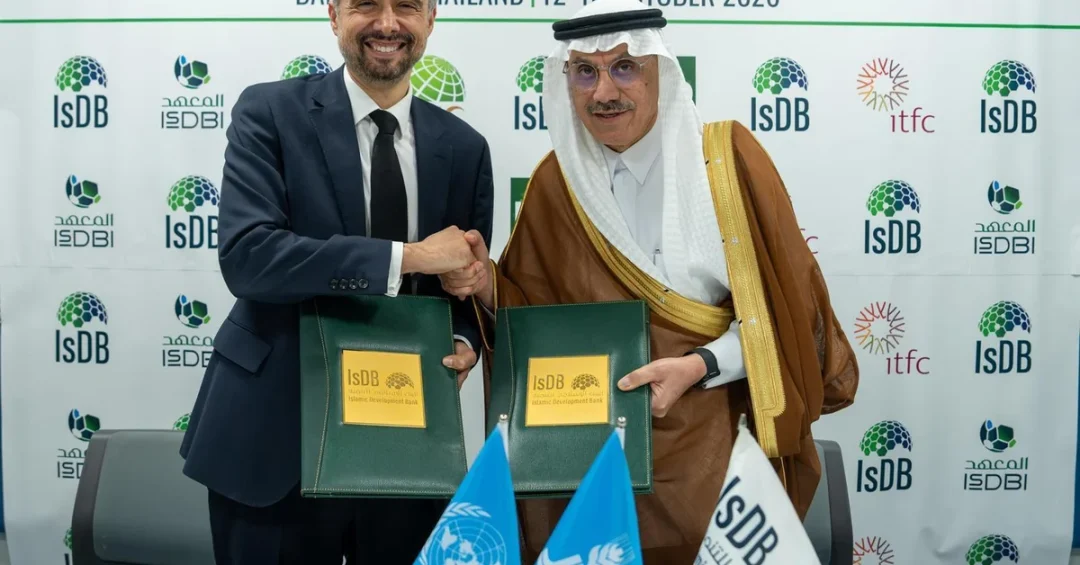
The Islamic Development Bank (IsDB) Group and the International Fund for Agricultural Development (IFAD) signed a new cooperation and co-financing agreement in Jeddah on October 14, 2026, aiming to mobilize up to $750 million for sustainable agricultural development, food security, and rural poverty reduction across their shared member countries. The agreement, announced through official Saudi channels via the Saudi Press Agency (SPA), brings together two of the world’s most active development finance institutions in a coordinated push to transform rural economies and strengthen food systems in regions where agricultural productivity, climate resilience, and access to finance remain pressing challenges.
The partnership is designed to combine the IsDB Group’s financing capacity, deep regional knowledge, and Shariah-compliant instruments with IFAD’s specialized expertise in smallholder agriculture, rural finance, and community-driven development. Together, the two institutions intend to scale up investments that improve livelihoods, expand market access for farming communities, and reinforce the food security architecture of developing countries across Africa, Asia, and the Middle East. For Saudi Arabia, which hosts the IsDB in Jeddah and has long positioned development finance as a pillar of its international engagement, the agreement reflects a broader strategy of using institutional partnerships to advance global stability and prosperity.
Context and Background
Why does a co-financing agreement between two development institutions matter at a moment when global food systems are under sustained pressure? The answer lies in the scale of the challenge and the limits of what any single institution can achieve alone. Food insecurity has been exacerbated in recent years by climate shocks, supply chain disruptions, water scarcity, and conflict, particularly in regions where agriculture remains the primary source of employment and income. Rural communities in IsDB member countries and IFAD programme areas are often the most exposed to these pressures, yet they frequently lack access to the credit, technology, and market infrastructure needed to adapt.
The IsDB Group, headquartered in Jeddah, serves as the multilateral development bank of the Organisation of Islamic Cooperation (OIC) and has a long track record of financing infrastructure, education, health, and agricultural projects across its member states. IFAD, a specialized United Nations agency based in Rome, focuses exclusively on transforming rural economies and has financed thousands of projects that reach smallholder farmers, pastoralists, and rural entrepreneurs. The two institutions have collaborated in the past, but the new agreement elevates that relationship into a structured, co-financing framework with clearly defined operational priorities.
According to the announcement carried by the Saudi Press Agency, the expanded partnership is intended to “scale up investments aimed at transforming rural economies, eradicating poverty and enhancing food security.” That language signals a shift from project-by-project cooperation toward a more programmatic approach, in which the two institutions can pool resources, share risk, and align their investment pipelines around common objectives. For observers of development finance, the timing is significant: it comes as multilateral institutions are being asked to do more with constrained resources, and as countries seek diversified sources of financing for agriculture and rural development.
Key Details of the Agreement
What does the agreement actually commit the two institutions to do? Under the cooperation and co-financing agreement, the IsDB Group and IFAD are developing a joint action plan to translate their shared objectives into tangible investments. The plan will expand cooperation across several key areas: agribusiness value chains, market access, rural finance and financial inclusion, climate change adaptation, sustainable natural resource management, and water provision. Each of these areas addresses a distinct constraint that has historically limited the impact of agricultural development spending.
The focus on agribusiness value chains and market access reflects a recognition that production gains mean little if farmers cannot sell their output at fair prices. By supporting processing, storage, logistics, and market linkages, the two institutions aim to help rural producers capture more value from what they grow. The emphasis on rural finance and financial inclusion addresses another persistent bottleneck: smallholder farmers and rural small and medium-sized enterprises (SMEs) often struggle to obtain credit on reasonable terms, which prevents them from investing in improved seeds, irrigation, equipment, or expansion.
Climate change adaptation and sustainable natural resource management are equally central. Many of the countries where the IsDB and IFAD operate face rising temperatures, erratic rainfall, and increasing water stress. Water provision is explicitly named in the agreement, underscoring the importance of irrigation efficiency, water harvesting, and responsible groundwater management in sustaining agricultural productivity. The agreement also paves the way for expanding private sector operations to support agribusiness projects and rural SMEs, a signal that the two institutions intend to use their balance sheets and convening power to crowd in commercial investment alongside public financing.
International and Regional Impact
How will this partnership be felt beyond the institutions themselves? The most direct impact will be in the rural communities where co-financed projects are implemented. If the joint action plan delivers on its ambitions, farmers, cooperatives, and rural enterprises in IsDB member countries and IFAD programme countries could gain access to more reliable financing, better market connections, and technologies that improve resilience to climate shocks. That, in turn, supports employment, reduces migration pressures, and strengthens local food supplies.
At the regional level, the agreement reinforces the role of Gulf-based development institutions in addressing challenges that affect Africa, Asia, and the Middle East. The IsDB’s membership spans these regions, and its Jeddah headquarters gives it a natural bridge between Gulf capital and developing-country needs. IFAD’s global network and technical depth complement that reach. For countries in the Sahel, South Asia, and Southeast Asia, the partnership could mean a more coordinated and predictable flow of development finance at a time when many traditional donors face budget constraints.
The agreement also carries significance for the broader architecture of development cooperation. It demonstrates that South-South and triangular cooperation models, in which institutions from different regions and traditions work together, can mobilize meaningful resources. For Saudi Arabia, which has consistently supported multilateral development efforts and hosts the IsDB, the deal underscores the Kingdom’s commitment to international solidarity and to practical solutions for food security, a priority that resonates across the Islamic world and beyond.
Economic and Strategic Significance
Why is $750 million in potential co-financing strategically important? In the context of global agricultural finance, the figure is substantial but not unprecedented; its significance lies in the structure of the partnership and the signal it sends. By committing to co-finance, the IsDB and IFAD can leverage each other’s resources, reduce transaction costs for recipient countries, and align their policy dialogue. This can make financing more accessible and more effective, particularly for projects that might otherwise fall between the mandates of different institutions.
From an economic perspective, investment in agribusiness value chains and rural SMEs can generate returns that extend well beyond the farm gate. Agricultural processing, cold storage, packaging, and logistics create jobs and support small businesses. Rural finance and financial inclusion deepen local capital markets and encourage savings. Climate adaptation and water management reduce the long-term costs of environmental shocks. Together, these interventions contribute to more resilient rural economies, which are essential for stable food supplies and for reducing poverty in the countries where the two institutions operate.
The private sector dimension of the agreement is also notable. By expanding operations to support agribusiness projects and rural SMEs, the IsDB and IFAD aim to demonstrate that commercially viable agricultural investments can coexist with development objectives. Success in this area could attract additional private capital, multiplying the impact of the initial co-financing. For Saudi Arabia, which is pursuing its own economic diversification and food security goals under Vision 2030, the agreement offers a platform for sharing expertise and for deepening ties with countries across the developing world.
Vision 2030 Alignment
How does this agreement connect to Saudi Arabia’s long-term vision? Vision 2030, the Kingdom’s comprehensive reform strategy, emphasizes economic diversification, sustainable development, and international cooperation. It also prioritizes food security as a strategic objective, recognizing that stable access to food is essential for national resilience. By hosting the IsDB and supporting its partnerships with institutions such as IFAD, Saudi Arabia contributes to global efforts that align with its own development philosophy and its role as a responsible international actor.
The Kingdom’s commitment to development finance is not new. For decades, Saudi Arabia has provided assistance through the Saudi Fund for Development and other channels, and it has been a strong supporter of multilateral institutions. The IsDB-IFAD agreement extends that tradition into a new era of collaboration, one in which pooled resources and shared expertise can address complex challenges like climate change, water scarcity, and rural poverty. As the joint action plan is developed and implemented, it will serve as a practical example of how Vision 2030’s emphasis on partnership and sustainability can translate into results that benefit communities far beyond the Kingdom’s borders.
20 Questions
Q1. What did the Islamic Development Bank and IFAD agree to do?
A1. They signed a cooperation and co-financing agreement to mobilize up to $750 million for sustainable agricultural development, food security, and rural poverty reduction in their shared member countries.
Q2. When and where was the agreement signed?
A2. The agreement was signed in Jeddah on October 14, 2026, and was announced through official Saudi channels via the Saudi Press Agency.
Q3. What is the Islamic Development Bank?
A3. The IsDB Group is a multilateral development bank headquartered in Jeddah, serving the Organisation of Islamic Cooperation member states and financing projects in infrastructure, education, health, and agriculture.
Q4. What is IFAD?
A4. IFAD is the International Fund for Agricultural Development, a United Nations specialized agency based in Rome that focuses on transforming rural economies and supporting smallholder farmers.
Q5. What are the key areas of cooperation under the agreement?
A5. The joint action plan covers agribusiness value chains, market access, rural finance and financial inclusion, climate change adaptation, sustainable natural resource management, and water provision.
Q6. How will the agreement support smallholder farmers?
A6. It aims to improve their access to finance, markets, and technology, helping them invest in productivity and resilience while capturing more value from their production.
Q7. What role does the private sector play in this partnership?
A7. The agreement paves the way for expanding private sector operations to support agribusiness projects and rural small and medium-sized enterprises, encouraging commercial investment alongside public financing.
Q8. Why is food security a priority for the IsDB and IFAD?
A8. Food insecurity has been worsened by climate shocks, supply chain disruptions, and water scarcity, making coordinated investment in rural economies essential for stability and poverty reduction.
Q9. How does this agreement benefit IsDB member countries?
A9. It provides access to more coordinated and predictable development finance, supporting agricultural productivity, rural employment, and local food supplies across Africa, Asia, and the Middle East.
Q10. What is the significance of the $750 million figure?
A10. It represents substantial co-financing capacity that can be leveraged to attract additional resources and support projects that might otherwise lack funding.
Q11. How does the agreement address climate change?
A11. It includes climate change adaptation and sustainable natural resource management, helping rural communities cope with rising temperatures, erratic rainfall, and water stress.
Q12. What does the agreement say about water provision?
A12. Water provision is explicitly named as a key area, underscoring the importance of irrigation efficiency, water harvesting, and responsible groundwater management for agricultural productivity.
Q13. What is the joint action plan?
A13. It is a plan being developed by the IsDB and IFAD to translate their shared objectives into tangible investments across the agreed priority areas.
Q14. How does this partnership reflect Saudi Arabia’s Vision 2030?
A14. Vision 2030 emphasizes economic diversification, sustainability, and international cooperation, and food security is a strategic objective, making this agreement consistent with the Kingdom’s long-term goals.
Q15. What is Saudi Arabia’s role in the IsDB?
A15. Saudi Arabia hosts the IsDB headquarters in Jeddah and has been a strong supporter of the institution, using it as a platform for development finance and international solidarity.
Q16. How will the agreement support rural SMEs?
A16. It expands private sector operations to provide financing and support for rural small and medium-sized enterprises, helping them grow and create jobs.
Q17. What are agribusiness value chains?
A17. They encompass the full range of activities from production to processing, storage, distribution, and marketing, and strengthening them helps farmers earn more from their crops.
Q18. Why is rural finance and financial inclusion important?
A18. Many smallholder farmers and rural enterprises lack access to credit, which limits their ability to invest in seeds, equipment, and expansion; improving access unlocks productivity and growth.
Q19. What impact could this agreement have on global food systems?
A19. By scaling up investment in sustainable agriculture and rural development, it can contribute to more resilient food supplies and reduced poverty in developing countries.
Q20. What happens next after the agreement signing?
A20. The IsDB and IFAD will develop and implement the joint action plan, translating the agreement into concrete investments and expanding cooperation across the priority areas.
Reader Feedback
We value your thoughts. Please share your feedback on this article.
Your feedback helps us improve our coverage.
Related articles
 RIYAD 26 ‘Your Project’ Pavilion Empowers Saudi Entrepreneurs
 IsDB Chairman Calls for Economic Resilience in Region
 WPC Energy Congress Panel Discusses Leadership, Innovation, Resilience in Saudi Energy
 IEA Warns Diesel Shortage to Impact Global Economy Until 2027
 Al-Jouf Lemon Farming Boosts Saudi Agricultural Diversity
 GCC Chief Emphasizes Gulf Integration, Diversified Partnerships at IMF MENAP Meeting