


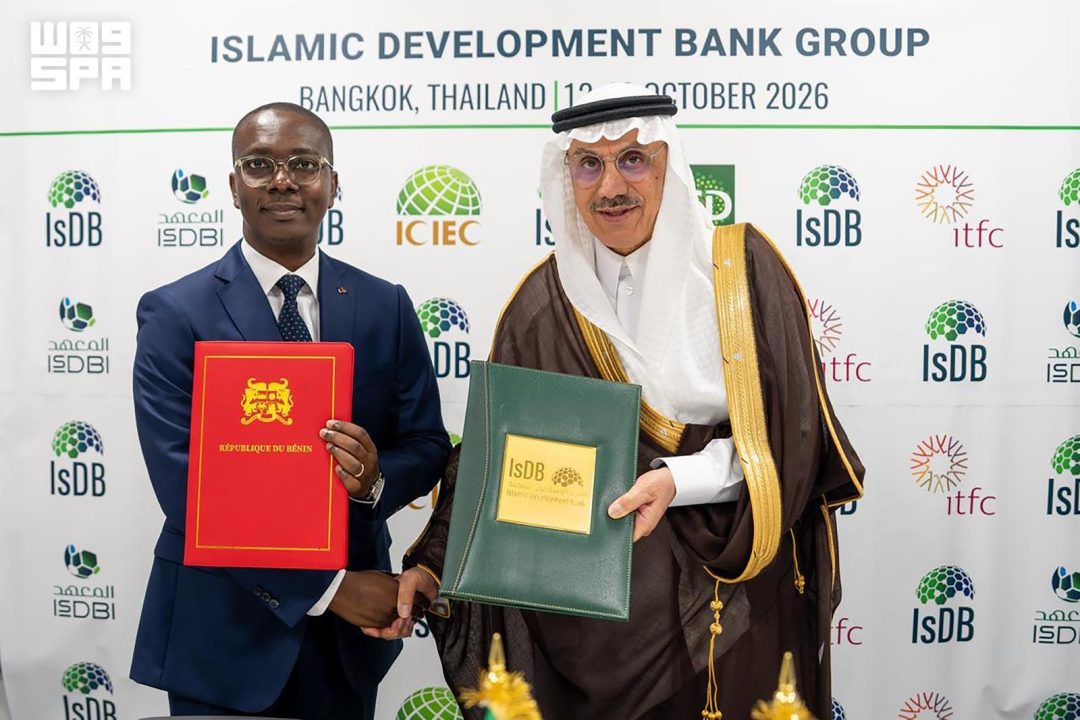
Two co-financing agreements worth a combined €326.06 million in IsDB funding were signed by the Islamic Development Bank (IsDB) and the Republic of Benin, covering a road expansion and modernization project and a legume-based agricultural systems project, according to SPA.
The agreements followed a bilateral meeting between IsDB Group Chairman Dr. Muhammad Al Jasser and Delegate Minister to the Minister of Economy and Finance in charge of External Resource Mobilization and Debt Management of the Republic of Benin Hugues Oscar Lokossou, held on the sidelines of the 2026 Annual Meetings of the International Monetary Fund and World Bank Group in Bangkok, SPA reported.
The first project is the expansion and modernization of the Godomey–Ouidah–Hillacondji road, with a total cost of €576.06 million, of which the IsDB is providing €306.89 million in financing. The project aims to improve road safety and traffic efficiency, reduce travel times and transport costs, and enhance regional connectivity and trade flows.
The second project involves the sustainable intensification of legume-based agricultural systems to enhance soil fertility, agricultural resilience, and food security. With a total cost of €20.70 million, the project will receive €19.17 million in funding from the IsDB to promote sustainable legume-based agriculture, improve soil fertility, and support food security.
The meeting addressed development opportunities and priorities in Benin and explored prospects for further cooperation, particularly in infrastructure, agriculture, and other sectors.
What does the scale of the road financing say about how the IsDB weighs transport corridors against other development priorities in Benin?
The Godomey–Ouidah–Hillacondji road project carries a total cost of €576.06 million, with the IsDB contributing €306.89 million. The stated aims are to improve road safety and traffic efficiency, reduce travel times and transport costs, and enhance regional connectivity and trade flows.
How might reduced travel times and transport costs along the Godomey–Ouidah–Hillacondji corridor change the movement of goods through the region?
The agricultural project, described as the sustainable intensification of legume-based agricultural systems, has a total cost of €20.70 million, with €19.17 million in IsDB funding. Its stated purposes are to promote sustainable legume-based agriculture, improve soil fertility, and support food security.
Why would legume-based systems be singled out for soil fertility and resilience work rather than other crop approaches?
Both agreements were signed after the bilateral meeting between Dr. Muhammad Al Jasser and Hugues Oscar Lokossou. The meeting took place on the sidelines of the 2026 Annual Meetings of the International Monetary Fund and World Bank Group in Bangkok.
What does holding this meeting on the sidelines of the IMF and World Bank Group annual meetings signal about how development financing conversations are sequenced?
The meeting addressed development opportunities and priorities in Benin and explored prospects for further cooperation, particularly in infrastructure, agriculture, and other sectors. The two signed projects fall within those two named sectors.
Which other sectors might fall under the “other sectors” left unnamed in the meeting readout?
The road project alone accounts for €306.89 million of the IsDB financing, while the agricultural project accounts for €19.17 million. Together the IsDB financing totals €326.06 million against combined project costs of €596.76 million.
How does the ratio of IsDB financing to total project cost differ between the road and the agricultural project?
The source did not include a signing date beyond the October 13, 2026 dateline from Jeddah, nor did it specify implementation timelines, disbursement schedules, or the executing agencies for either project.
What agreements did the IsDB and Benin sign? The IsDB and Benin signed co-financing agreements for two major development projects, according to SPA. The first is the expansion and modernization of the Godomey–Ouidah–Hillacondji road, with a total cost of €576.06 million and €306.89 million in IsDB financing. The second involves the sustainable intensification of legume-based agricultural systems, with a total cost of €20.70 million and €19.17 million in IsDB funding. Together the IsDB financing totals €326.06 million.
Where and when did the IsDB chairman meet the Benin delegate minister? IsDB Group Chairman Dr. Muhammad Al Jasser held a bilateral meeting with Delegate Minister to the Minister of Economy and Finance in charge of External Resource Mobilization and Debt Management of the Republic of Benin Hugues Oscar Lokossou, SPA reported. The meeting took place on the sidelines of the 2026 Annual Meetings of the International Monetary Fund and World Bank Group in Bangkok. The SPA dateline is Jeddah, October 13, 2026.
What does the Godomey–Ouidah–Hillacondji road project aim to achieve? The road project aims to improve road safety and traffic efficiency, reduce travel times and transport costs, and enhance regional connectivity and trade flows, according to SPA. It is the expansion and modernization of the Godomey–Ouidah–Hillacondji road, with a total cost of €576.06 million, of which the IsDB is providing €306.89 million in financing. The project was one of two co-financing agreements signed after the bilateral meeting between Dr. Muhammad Al Jasser and Hugues Oscar Lokossou.
What is the purpose of the legume-based agricultural project? The project involves the sustainable intensification of legume-based agricultural systems to enhance soil fertility, agricultural resilience, and food security, SPA reported. With a total cost of €20.70 million, it will receive €19.17 million in funding from the IsDB to promote sustainable legume-based agriculture, improve soil fertility, and support food security. It was signed alongside the Godomey–Ouidah–Hillacondji road project following the bilateral meeting in Bangkok.
What sectors did the meeting identify for further cooperation? The meeting addressed development opportunities and priorities in Benin and explored prospects for further cooperation, particularly in infrastructure, agriculture, and other sectors, according to SPA. The two signed projects fall within infrastructure and agriculture. The source did not name the other sectors. The meeting was held on the sidelines of the 2026 Annual Meetings of the International Monetary Fund and World Bank Group in Bangkok.
What details did the source not include about the projects? The source did not include implementation timelines, disbursement schedules, or the executing agencies for either project. It also did not name the “other sectors” mentioned as prospects for further cooperation. The SPA report carried a Jeddah dateline of October 13, 2026, and described the meeting as taking place on the sidelines of the 2026 Annual Meetings of the International Monetary Fund and World Bank Group in Bangkok.