


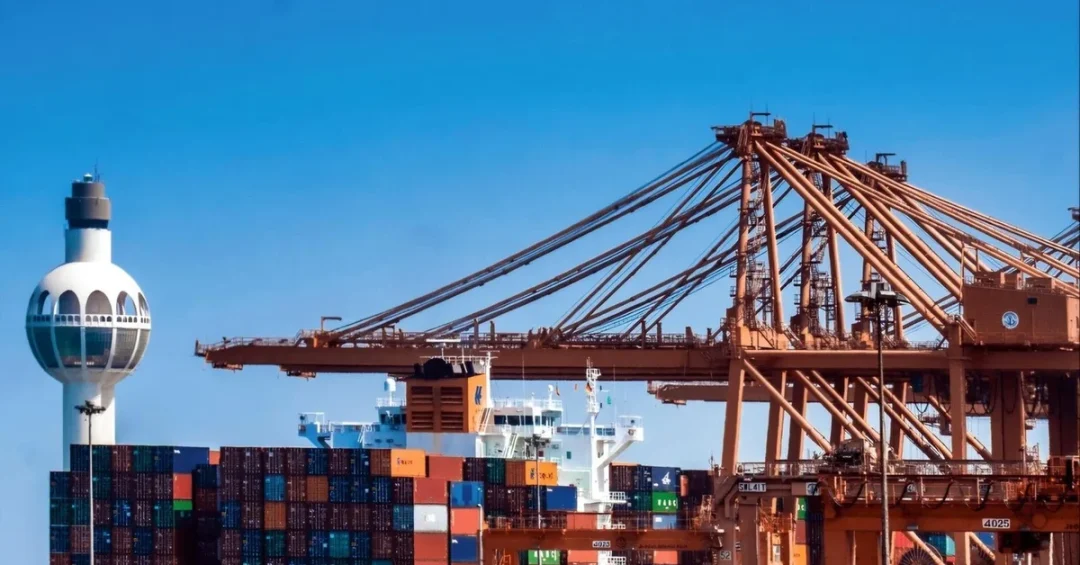
Jeddah Islamic Port has consolidated its standing as a pivotal hub for the AE15 and AE19 services operated by Gemini Cooperation, the vessel-sharing alliance between Maersk and Hapag-Lloyd, following route updates that send both services through the Bab al-Mandab Strait and the Suez Canal, the Saudi Ports Authority (Mawani) announced on August 13, 2026. The adjustment restores and deepens the Kingdom’s direct maritime links with major markets across Asia and Europe, and it positions the Red Sea port at the centre of one of the world’s busiest east-west trade corridors.
The decision by Gemini Cooperation to anchor both services at Jeddah reflects the port’s strategic location, its advanced operational capabilities and its modern infrastructure. For importers and exporters in the Kingdom, the change translates into broader connectivity options and greater flexibility in cargo movement. It also reinforces the role of Saudi Arabia’s ports and logistics sector as a driver of the National Transport and Logistics Strategy and the wider ambitions of Saudi Vision 2030. Why does a single routing decision at a Red Sea port matter to traders in Shanghai, Rotterdam and Riyadh alike? Because in global shipping, the choice of a hub determines the speed, cost and reliability of every container that passes through it.
Context and Background
Jeddah Islamic Port sits on the eastern shore of the Red Sea, roughly midway along the main shipping lane that connects the Indian Ocean to the Mediterranean through the Bab al-Mandab Strait and the Suez Canal. That geography has made it a natural first port of call for vessels travelling from Asia to Europe and a last port of departure on the return leg. The port is the largest in Saudi Arabia by throughput and is managed by Mawani, the government authority responsible for developing and regulating the Kingdom’s ports. Its terminals handle containerised cargo, bulk goods and transhipment volumes, supported by deep-water berths, modern gantry cranes and digital clearance systems that allow vessels to turn around quickly.
Gemini Cooperation is a long-term operational alliance between two of the world’s largest container lines, Denmark’s Maersk and Germany’s Hapag-Lloyd. The cooperation pools vessels and schedules on major east-west routes, aiming to deliver more reliable and more frequent services than either carrier could sustain alone. The AE15 and AE19 are two of its principal Asia-Europe strings. Both had previously faced disruption as lines adjusted to security conditions in the southern Red Sea, and the latest update marks a return to the classic Bab al-Mandab and Suez Canal routing. For Saudi Arabia, the timing is significant: the Kingdom is investing heavily in port capacity, rail links and logistics zones, and it wants global carriers to treat Saudi ports not as optional calls but as fixed points in their networks.
The announcement also follows a broader pattern of Saudi port expansion. Mawani has been awarding concessions, upgrading terminal equipment and integrating customs and port community systems to cut dwell times. Jeddah Islamic Port has attracted private terminal operators and major shipping lines, and its hinterland connections now reach inland industrial cities and the capital through road and rail corridors. Each new service rotation that includes the port strengthens the case for further investment, because carriers commit capacity where they see reliable infrastructure and predictable schedules. In that sense, the Gemini update is both a vote of confidence in what Jeddah has already built and an incentive to keep improving.
Key Details
Under the revised rotation, the AE19 service will call at Jeddah Islamic Port twice in a single round voyage, first on the leg from Asia toward the Mediterranean and again on the return voyage southward. That double call is unusual and commercially valuable: it allows exporters in the Kingdom to reach Asian markets on the eastbound leg and European or North African markets on the westbound leg without transhipment through a third-country hub. The AE19 connects Jeddah with Shanghai, Qingdao and Ningbo in China, Busan in Korea and Tanjung Pelepas in Malaysia. Its route also takes in the Suez Canal, Port Said in Egypt, Tangier in Morocco and Singapore.
The AE15 service connects Jeddah Islamic Port with Qingdao and Ningbo in China, Gwangyang in Korea and Tanjung Pelepas in Malaysia. Its rotation also includes the Suez Canal, Port Said and Damietta in Egypt, Colombo in Sri Lanka and Singapore. Together, the two services give Saudi traders direct access to the manufacturing heartlands of East Asia, the transhipment hubs of Southeast Asia and South Asia, and the consumer and industrial markets of the Mediterranean and Northern Europe.
Perhaps the most tangible operational benefit is time. The update shortens the full operating rotation by approximately two weeks, from 16 weeks to 14 weeks, while maintaining regular weekly sailings. A shorter rotation means the same fleet can deliver more voyages per year, improving vessel utilisation and reducing the effective cost per container. For importers, that can mean faster replenishment of stock; for exporters, more predictable cut-off times and sailing schedules. Weekly fixed-day sailings are particularly important for manufacturers who plan production around shipping windows, and the combination of a shorter cycle with a stable weekly cadence is exactly what supply-chain managers look for when choosing a port.
Mawani framed the development as evidence of Jeddah Islamic Port’s growing position as a key hub connecting the Kingdom with global markets. The authority noted that the port’s selection builds on its strategic location on the Red Sea, its advanced operational capabilities and its infrastructure, all of which enhance its appeal to global shipping lines. It also emphasised the port’s role in supporting supply-chain continuity and in raising the competitiveness of the ports and logistics services sector, in line with national strategy. How often does a routing change of this kind ripple through an entire economy? More often than most people realise, because shipping schedules set the rhythm for factories, warehouses and retail shelves.
International and Regional Impact
For Gemini Cooperation, the updated rotations are a statement about confidence in the Red Sea corridor. Maersk and Hapag-Lloyd operate some of the largest container vessels afloat, and deploying them through Bab al-Mandab and the Suez Canal requires a network of reliable ports for bunkering, crew changes, maintenance and cargo exchange. By placing Jeddah at the centre of both the AE15 and AE19, the alliance gains a dependable hub with deep-water capacity and a location that minimises deviation from the main trade lane. That, in turn, helps the carriers offer competitive transit times between Asia and Europe, which is the core selling point of any east-west service.
Regionally, the update strengthens the Red Sea’s position as an indispensable maritime artery. Alternative routings around the Cape of Good Hope add thousands of nautical miles and significant cost, so any move that reinforces the Suez and Bab al-Mandab passage is welcome news for global trade. Saudi Arabia, as the largest economy on the Red Sea littoral, benefits directly when more vessels call at its ports, because each call generates port dues, pilotage, bunkering, container handling and logistics activity. Neighbouring economies in the Gulf and East Africa also gain from more frequent connections, since Jeddah functions as a transhipment point for cargo moving to and from smaller regional markets.
For international shippers, the practical effect is a wider choice of routings and a more resilient network. When two major services call at the same hub, cargo can be consolidated, and contingency options improve if one string is delayed. Multinational manufacturers with operations in the Kingdom, as well as Saudi exporters of petrochemicals, plastics, minerals and processed goods, can plan with greater confidence. The double call on the AE19 is especially useful for two-way trade: it allows a container to be discharged on the westbound leg and a new one loaded on the eastbound leg within the same port visit cycle, reducing empty repositioning and improving equipment balance.
Economic and Strategic Significance
The economic logic behind the update is straightforward: shorter rotations and fixed weekly sailings lower the cost of moving goods and raise the reliability of supply chains. For Saudi Arabia, that supports the competitiveness of non-oil exports, which Vision 2030 seeks to expand. Manufacturers and processors benefit from faster access to imported machinery, components and raw materials, while agricultural and industrial exporters gain more predictable routes to Asian and European buyers. Ports are also employment clusters: terminal operations, freight forwarding, customs brokerage, trucking, rail and warehousing all expand when container volumes rise, creating skilled jobs for Saudi nationals.
Strategically, the development advances the Kingdom’s ambition to become a global logistics hub connecting three continents. The National Transport and Logistics Strategy targets a substantial increase in port container throughput, stronger rail and road links, and a higher ranking in international logistics indices. Jeddah Islamic Port is central to that plan, alongside the newer industrial and commercial ports on the Gulf coast. When global carriers such as Maersk and Hapag-Lloyd make Jeddah a fixed call on their main east-west strings, they effectively endorse the Kingdom’s infrastructure programme and help attract further investment from terminal operators, shipping lines and logistics companies. What does it take for a port to move from regional player to global hub? Consistent investment, reliable operations and the confidence of the carriers that move the world’s cargo.
The update also has implications for Saudi Arabia’s broader trade diplomacy. Direct maritime links to China, Korea, Malaysia, Singapore, Sri Lanka, Egypt and Morocco align with the Kingdom’s efforts to diversify trading partners and deepen ties across Asia, Africa and Europe. Each new connection is a channel not only for goods but also for commercial relationships, joint ventures and investment. In a global economy where supply-chain resilience has become a strategic priority, controlling and improving the nodes through which trade flows is a source of national advantage. Jeddah Islamic Port, with its Red Sea location and expanding capacity, is one of those nodes.
Vision 2030 Alignment
The announcement fits squarely within Saudi Vision 2030, the national transformation programme launched under the leadership of Crown Prince Mohammed bin Salman. Vision 2030 aims to diversify the economy away from oil, expand non-oil exports, develop world-class infrastructure and establish the Kingdom as a logistics hub linking Asia, Europe and Africa. The National Transport and Logistics Strategy, overseen by the Ministry of Transport and Logistic Services and implemented in part by Mawani, sets out the targets: more container throughput, better connectivity, higher efficiency and greater private-sector participation. The Gemini Cooperation update supports each of those objectives by embedding a Saudi port in the schedules of two of the world’s leading carriers.
The development also reinforces the Kingdom’s role as a reliable partner in global trade. At a time when supply chains face pressure from congestion, climate events and geopolitical uncertainty, Saudi Arabia is offering stability: modern terminals, secure waters, efficient customs and a strategic location on the shortest route between East and West. For international readers, the message is that Saudi ports are not merely domestic gateways but integral components of the global logistics system. As Vision 2030 progresses, Jeddah Islamic Port and its sister ports will continue to attract new services, new investment and new partnerships, strengthening the Kingdom’s position at the centre of world trade.
20 Questions
Q1. What did Mawani announce regarding Jeddah Islamic Port?
A1. Mawani announced that Jeddah Islamic Port has strengthened its position as a key hub for the AE15 and AE19 services of Gemini Cooperation, following route updates that send the services through the Bab al-Mandab Strait and the Suez Canal.
Q2. What is Gemini Cooperation?
A2. Gemini Cooperation is a long-term operational alliance between Maersk and Hapag-Lloyd, two of the world’s largest container shipping lines. It pools vessels and schedules on major east-west routes to improve reliability and frequency.
Q3. Which two services are involved in the update?
A3. The update involves the AE15 and AE19 services, both of which connect Asia with Europe and now transit the Bab al-Mandab Strait and the Suez Canal while calling at Jeddah Islamic Port.
Q4. How many times will the AE19 call at Jeddah Islamic Port?
A4. The AE19 will include Jeddah Islamic Port twice in its operating rotation, first on the voyage from Asia toward the Mediterranean and again on the return voyage southward, providing broader connectivity options.
Q5. Which Chinese ports are connected by the AE15 service?
A5. The AE15 service connects Jeddah Islamic Port with Qingdao and Ningbo in China, as well as Gwangyang in Korea and Tanjung Pelepas in Malaysia.
Q6. Which Chinese ports are connected by the AE19 service?
A6. The AE19 service connects Jeddah Islamic Port with Shanghai, Qingdao and Ningbo in China, along with Busan in Korea and Tanjung Pelepas in Malaysia.
Q7. What other ports feature on the AE15 route?
A7. The AE15 route also includes the Suez Canal, Port Said and Damietta in Egypt, Colombo in Sri Lanka and Singapore, linking Saudi Arabia with key markets across Asia, Africa and Europe.
Q8. What other ports feature on the AE19 route?
A8. The AE19 route also includes the Suez Canal, Port Said in Egypt, Tangier in Morocco and Singapore, giving Saudi traders access to Mediterranean and North African markets.
Q9. How much shorter is the full operating rotation after the update?
A9. The update shortens the full operating rotation by approximately two weeks, reducing it from 16 weeks to 14 weeks while maintaining regular weekly sailings for importers and exporters.
Q10. What are the benefits of a shorter rotation?
A10. A shorter rotation improves fleet efficiency and enhances the efficiency of services provided to importers and exporters, allowing the same vessels to complete more voyages per year and reducing effective costs per container.
Q11. Why was Jeddah Islamic Port selected as a key hub?
A11. Jeddah Islamic Port was selected because of its strategic location on the Red Sea, its advanced operational capabilities and its modern infrastructure, which enhance its appeal to global shipping lines.
Q12. What does the update mean for Saudi importers and exporters?
A12. The update provides broader connectivity options and greater flexibility for cargo movement to and from the Kingdom, with more predictable schedules and direct links to major Asian and European markets.
Q13. How does this development support Saudi Vision 2030?
A13. It supports Vision 2030 by consolidating the Kingdom’s position as a global logistics hub, in line with the National Transport and Logistics Strategy, which aims to diversify the economy and expand non-oil trade.
Q14. What is the National Transport and Logistics Strategy?
A14. The National Transport and Logistics Strategy is a Saudi national programme that aims to develop transport infrastructure, increase port capacity and position the Kingdom as a leading global logistics hub connecting three continents.
Q15. Which authority manages Jeddah Islamic Port?
A15. Jeddah Islamic Port is managed by the Saudi Ports Authority, known as Mawani, which is responsible for developing and regulating the Kingdom’s ports and enhancing their competitiveness.
Q16. Why is the Bab al-Mandab Strait important for shipping?
A16. The Bab al-Mandab Strait is a narrow waterway connecting the Red Sea to the Gulf of Aden and the Indian Ocean. It is a critical passage for vessels travelling between Asia and Europe via the Suez Canal.
Q17. What role does the Suez Canal play in these services?
A17. The Suez Canal connects the Red Sea to the Mediterranean, allowing vessels to avoid the much longer route around Africa. Both the AE15 and AE19 transit the canal on their east-west rotations.
Q18. How does the update affect supply chain continuity?
A18. The update supports supply chain continuity by maintaining regular weekly sailings and shortening the rotation, which helps importers and exporters plan with greater confidence and reduces disruption risks.
Q19. What does the development mean for the Red Sea region?
A19. It strengthens the Red Sea’s position as a vital maritime artery and reinforces Saudi Arabia’s role as a leading maritime gateway, benefiting regional trade and transhipment activity across the area.
Q20. What is the long-term significance of this announcement?
A20. The announcement signals growing confidence in Saudi ports and supports the Kingdom’s long-term ambition to become a global logistics hub, attracting further investment and strengthening its position in world trade.
Reader Feedback
We value your thoughts. Please share your feedback on this article.
Your feedback helps us improve our coverage.
Related articles
 Moscow indices fall as Saudi Arabia’s Vision 2030 drives stability
 Saudi Ministry: Over 1 Million Discounted Products in Sales Campaign
 Bahrain Indices Close Higher on Telecom, Finance Gains
 Bahrain’s 48th Gov’t Bond Issue Oversubscribed at 104%
 Unaizah’s ‘Naqwa’ Date Season Launches with Economic Momentum
 Al-Baha’s 140,000 Palm Trees Yield 2,000+ Tons of Dates