


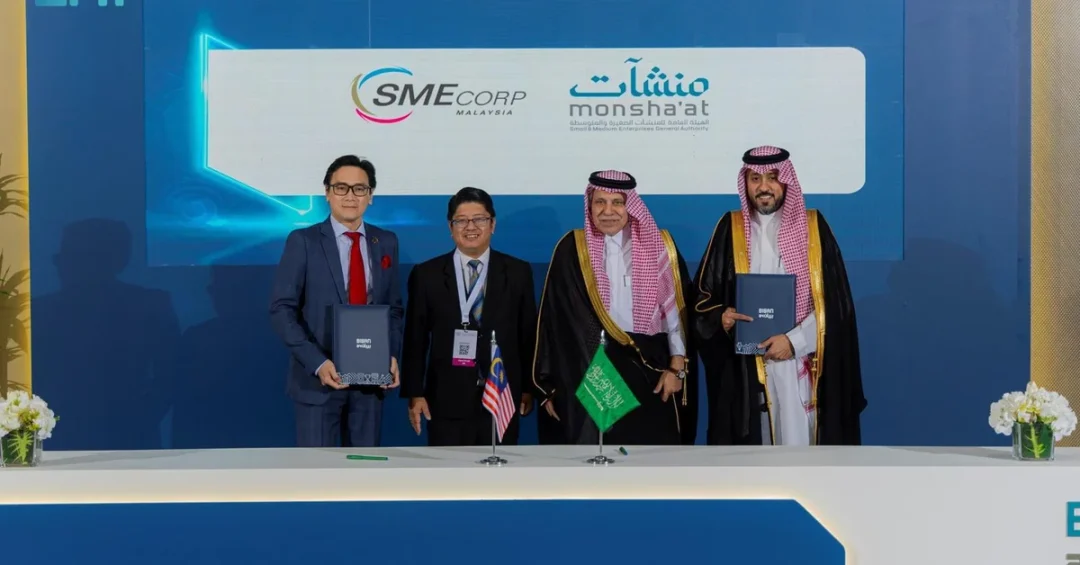
The General Authority for Small and Medium Enterprises (Monsha’at) signed a collaborative memorandum of understanding (MoU) with the Malaysian Small and Medium Enterprise Corporation (SME Corp Malaysia) at the Biban24 Forum in Riyadh on November 6, 2024. The agreement, announced by the Saudi Press Agency, establishes a formal framework for the two organizations to exchange information, expertise, and best practices in support of small and medium enterprise development. The MoU was signed by Monsha’at Governor Sami bin Ibrahim Al-Husseini and SME Corp Malaysia Chief Executive Rizal bin Dato’ Nainy, in the presence of Saudi Minister of Commerce Dr. Majid bin Abdullah Al-Kassabi and Malaysian Minister of Entrepreneur Development and Cooperatives Ewon Benedick. The signing took place during Biban24, the flagship entrepreneurship forum organized by Monsha’at under the slogan “Global Destination for Opportunities,” which runs from November 5 to 9 at the Riyadh Front Exhibition and Convention Center.
Why does a single memorandum between two enterprise-development agencies matter on the world stage? Because it signals how Saudi Arabia is positioning itself as a connector for global entrepreneurship, not merely a participant in it. Biban24 has drawn entrepreneurs, investors, and policymakers from across the world, and the MoU with Malaysia adds a concrete, deliverable outcome to the forum’s agenda. For international observers, the agreement illustrates the Kingdom’s methodical approach under Vision 2030: build partnerships that transfer knowledge, open markets, and strengthen the small-business ecosystems that create jobs. Malaysia’s mature SME sector offers a valuable benchmark, while Saudi Arabia’s rapid economic transformation offers Malaysian enterprises a gateway to the Middle East.
Context and Background
What is the broader context behind this partnership? Saudi Arabia has placed small and medium enterprises at the center of its economic diversification strategy. Monsha’at, established as the General Authority for Small and Medium Enterprises, is the government body responsible for regulating, supporting, and developing the SME sector in the Kingdom. Its mandate spans financing facilitation, regulatory reform, capacity building, and market access. Malaysia, for its part, has built one of the most structured SME development ecosystems in Southeast Asia through SME Corp Malaysia, an agency under the Ministry of Entrepreneur Development and Cooperatives. That agency has decades of experience in coordinating SME policy, certification, and growth programs.
Bringing these two institutions together is therefore not a symbolic gesture but a practical alignment of interests. The MoU creates a framework for collaboration on capacity building, high-growth SME programs, market access facilitation, knowledge transfer, and the sharing of best practices related to SME regulations. Each of these areas responds to a real challenge facing entrepreneurs in both countries. For Saudi Arabia, the priority is scaling promising businesses beyond the domestic market and embedding international standards into local support programs. For Malaysia, the agreement opens a channel into the Gulf region at a time when Saudi Arabia’s non-oil economy is expanding rapidly.
The timing reflects a wider pattern in Saudi diplomacy and economic policy. Riyadh has been signing cooperation agreements across Asia, Europe, and the Americas in sectors ranging from technology to tourism. The Biban24 forum itself is designed to concentrate that activity into a single platform where deals can be announced and networks formed. By hosting SME Corp Malaysia at the event, Monsha’at reinforces the message that the Kingdom’s entrepreneurship agenda is internationally oriented and open to partnerships with established institutions.
Key Details of the Agreement
What exactly does the MoU commit the two sides to do? According to the Saudi Press Agency, the agreement establishes a framework for Monsha’at and SME Corp Malaysia to closely collaborate on exchanging information and expertise to support the growth of SMEs. The stated areas of cooperation include capacity building, programs for high-growth SMEs, facilitation of market access, knowledge transfer, and the sharing of best practices related to SME regulations. These efforts are intended to streamline business operations, boost innovation, and promote entrepreneurship in both countries.
The signing ceremony carried diplomatic weight beyond the technical content. The presence of Saudi Minister of Commerce Dr. Majid bin Abdullah Al-Kassabi and Malaysian Minister of Entrepreneur Development and Cooperatives Ewon Benedick underscored that the agreement sits within a broader bilateral relationship. Trade and investment ties between Riyadh and Kuala Lumpur have been deepening, and the SME sector is a natural area for collaboration because it touches employment, innovation, and supply-chain development simultaneously. The MoU provides a structured channel through which officials and practitioners can sustain that collaboration after the forum closes.
The choice of signatories is also significant. Sami bin Ibrahim Al-Husseini, Governor of Monsha’at, has led the authority’s efforts to expand support programs for Saudi entrepreneurs, including financing initiatives, incubators, and export-readiness schemes. Rizal bin Dato’ Nainy, Chief Executive of SME Corp Malaysia, brings experience from an agency that has helped Malaysian small businesses integrate into regional and global value chains. Their personal engagement signals that both organizations intend to move from framework to implementation.
Biban24 as a Global Platform
Why is the venue itself an important part of the story? Biban24, organized by Monsha’at under the slogan “Global Destination for Opportunities,” is one of the largest entrepreneurship gatherings in the region. It brings together founders, investors, government agencies, and support institutions for five days of exhibitions, workshops, and matchmaking sessions. The forum seeks to position Saudi Arabia as a leading hub for entrepreneurs regionally and globally, with initiatives to develop programs and services that enhance the competitiveness and growth of entrepreneurial ventures.
Beyond deal-signing, the forum fosters a culture of innovation and entrepreneurship, encourages new business creation, and attracts impactful ideas that contribute to local and global economies. For a Malaysian delegation, the event offers direct exposure to Saudi Arabia’s startup landscape and to the investors and government programs backing it. For Saudi entrepreneurs, it provides access to international counterparts, potential partners, and markets that might otherwise be difficult to reach. The MoU with SME Corp Malaysia is one of many outcomes generated by that concentrated environment.
The scale of Biban24 also matters for the Kingdom’s global image. Hosting an event of this kind in Riyadh demonstrates the infrastructure, organization, and openness that Saudi Arabia now brings to international business gatherings. It complements other major events hosted in the Kingdom and reinforces the country’s emergence as a convening power in the region. For international readers, the forum is a useful indicator of how Saudi economic diplomacy operates in practice: high-level events, concrete agreements, and follow-up mechanisms.
International and Regional Impact
How will this agreement affect the wider region? Saudi Arabia and Malaysia occupy complementary positions in the global economy. Malaysia is a mature manufacturing and services economy with deep experience in SME policy, export promotion, and integration into Asian supply chains. Saudi Arabia is a rapidly diversifying economy with ambitious targets for private-sector growth, foreign investment, and non-oil exports. A structured partnership between their SME agencies can accelerate the transfer of proven methods into the Saudi market while giving Malaysian firms a trusted point of entry into the Gulf.
At the regional level, the MoU strengthens the connection between the Gulf and Southeast Asia, two of the world’s most dynamic economic regions. For Saudi Arabia, ties with Malaysia form part of a broader Asian outreach that includes trade, energy, and technology cooperation. For Malaysia, engagement with the Kingdom supports its own exporters and investors seeking opportunities in the Middle East. The agreement therefore has implications beyond the two signatory agencies, touching bilateral trade, investment flows, and the movement of expertise between regions.
For international audiences, the development also illustrates a consistent feature of Saudi economic policy: partnerships are pursued through official institutions with clear mandates, and announcements are made through recognized channels such as the Saudi Press Agency. This transparency helps international businesses assess opportunities and understand the frameworks governing cooperation. The MoU is a small but concrete example of how Vision 2030 is being implemented through international engagement rather than in isolation.
Economic and Strategic Significance
What makes SME cooperation economically important? Small and medium enterprises are the backbone of job creation in most economies, and both Saudi Arabia and Malaysia have made their development a national priority. In Saudi Arabia, the SME sector is a key pillar of efforts to diversify away from oil, generate employment for a young population, and expand the private sector’s contribution to gross domestic product. Programs that improve access to markets, finance, and know-how directly affect how quickly those goals are met.
The specific areas covered by the MoU address known bottlenecks. Capacity building helps founders and managers acquire the skills needed to scale. High-growth SME programs focus resources on firms with the greatest potential for expansion and job creation. Market access facilitation lowers the barriers that prevent small businesses from selling beyond their home markets. Knowledge transfer and regulatory best-practice sharing improve the quality of the environment in which SMEs operate. Together, these elements support innovation and entrepreneurship, which in turn feed economic diversification.
Strategically, the agreement also strengthens Saudi Arabia’s network of international partners in a sector where collaboration produces measurable results. Unlike large infrastructure projects, SME support programs generate outcomes across thousands of businesses, making them an efficient channel for economic diplomacy. By working with an established agency like SME Corp Malaysia, Monsha’at gains access to tested methodologies and a partner with credibility in the field. That combination of scale and quality is what gives the MoU its strategic value.
Vision 2030 Alignment
How does this fit into Saudi Arabia’s long-term plan? Vision 2030 aims to build a diversified, innovative, and globally connected economy, and small and medium enterprises are central to that ambition. Monsha’at’s mission, and the programs showcased at Biban24, are designed to increase the SME sector’s contribution to the economy, support entrepreneurs, and create a business environment where new ideas can grow. International partnerships such as the MoU with SME Corp Malaysia bring external expertise into that effort and open doors for Saudi businesses abroad.
The agreement also reflects the Vision 2030 emphasis on international cooperation and knowledge exchange. By learning from Malaysia’s experience and sharing Saudi Arabia’s own rapid development story, the two countries create a two-way flow of ideas that benefits both. For the Kingdom, the partnership is another step toward becoming a global destination for opportunities, where entrepreneurs from around the world can connect, invest, and build. As Biban24 continues through November 9, the MoU stands as a practical example of how Saudi Arabia is turning its vision into agreements, programs, and results.
20 Questions
Q1. What did Monsha’at sign at the Biban24 Forum?
A1. Monsha’at signed a collaborative memorandum of understanding with the Malaysian Small and Medium Enterprise Corporation, SME Corp Malaysia, at the Biban24 Forum in Riyadh on November 6, 2024.
Q2. Who signed the MoU on behalf of Monsha’at?
A2. The MoU was signed by Monsha’at Governor Sami bin Ibrahim Al-Husseini, who leads the authority responsible for developing Saudi Arabia’s small and medium enterprise sector.
Q3. Who signed the agreement for SME Corp Malaysia?
A3. SME Corp Malaysia Chief Executive Rizal bin Dato’ Nainy signed on behalf of the Malaysian agency, which operates under the Ministry of Entrepreneur Development and Cooperatives.
Q4. Which officials witnessed the signing ceremony?
A4. Saudi Minister of Commerce Dr. Majid bin Abdullah Al-Kassabi and Malaysian Minister of Entrepreneur Development and Cooperatives Ewon Benedick witnessed the signing, highlighting the bilateral significance of the agreement.
Q5. Where and when was the Biban24 Forum held?
A5. Biban24 ran from November 5 to 9, 2024, at the Riyadh Front Exhibition and Convention Center, organized by Monsha’at under the slogan “Global Destination for Opportunities.”
Q6. What is the main purpose of the MoU?
A6. The agreement establishes a framework for the two agencies to exchange information and expertise, supporting the growth of small and medium enterprises in both Saudi Arabia and Malaysia.
Q7. Which areas of cooperation does the MoU cover?
A7. It covers capacity building, high-growth SME programs, market access facilitation, knowledge transfer, and the sharing of best practices related to SME regulations.
Q8. How does the agreement aim to help entrepreneurs?
A8. By streamlining business operations, boosting innovation, and promoting entrepreneurship, the partnership seeks to help SMEs grow, compete, and access new markets more effectively.
Q9. What is Monsha’at’s role in Saudi Arabia?
A9. Monsha’at is the General Authority for Small and Medium Enterprises, the government body responsible for regulating, supporting, and developing the Kingdom’s SME sector.
Q10. What is SME Corp Malaysia?
A10. SME Corp Malaysia is the Malaysian government agency tasked with coordinating SME development policies and programs, with decades of experience in supporting small business growth.
Q11. Why is Malaysia a valuable partner for Saudi Arabia?
A11. Malaysia has a mature and structured SME ecosystem, offering proven methodologies in policy, export promotion, and capacity building that can support Saudi Arabia’s own enterprise development goals.
Q12. What does Biban24 aim to achieve?
A12. Biban24 seeks to position Saudi Arabia as a leading hub for entrepreneurs regionally and globally, fostering innovation and attracting impactful ideas that contribute to local and global economies.
Q13. How does the MoU support Saudi Arabia’s economic diversification?
A13. By strengthening SMEs, which are key drivers of job creation and private-sector growth, the agreement supports efforts to diversify the economy away from oil dependence.
Q14. What is the significance of the signing at Biban24?
A14. It demonstrates that the forum produces concrete outcomes, turning a major entrepreneurship gathering into a platform where international partnerships are formed and announced.
Q15. How does this agreement benefit Malaysian businesses?
A15. It opens a channel into the Gulf region at a time when Saudi Arabia’s non-oil economy is expanding, giving Malaysian SMEs and support institutions access to new opportunities.
Q16. What does capacity building mean in this context?
A16. Capacity building refers to training, mentorship, and institutional support that help entrepreneurs and SME agencies develop the skills and systems needed to scale successfully.
Q17. What are high-growth SME programs?
A17. These are targeted initiatives that focus resources on firms with strong potential for rapid expansion, job creation, and contribution to economic growth.
Q18. How does market access facilitation help small businesses?
A18. It lowers barriers that prevent SMEs from selling beyond their home markets, connecting them with international buyers, partners, and distribution networks.
Q19. How does the MoU align with Vision 2030?
A19. Vision 2030 aims to build a diversified, innovative economy, and SME development is central to that goal. International partnerships like this bring expertise and open global doors.
Q20. What happens after the MoU is signed?
A20. The framework enables ongoing collaboration between Monsha’at and SME Corp Malaysia on programs, knowledge exchange, and market access, with implementation continuing after Biban24 concludes.
Reader Feedback
We value your thoughts. Please share your feedback on this article.
Your feedback helps us improve our coverage.
Related articles
 38 Entrepreneurs Awarded Premium Residency at Biban24 Forum
 Monsha’at and Bahrain’s Tamkeen Sign MoU at Biban24
 Quality of Life Program Joins Biban24 Forum in Riyadh
 SME Bank Launches Education Financing Program at Biban24
 Saudi Arabia Praised for Global Entrepreneurship Progress
 Saudi Reef Promotes Rural Entrepreneurship at Biban24