


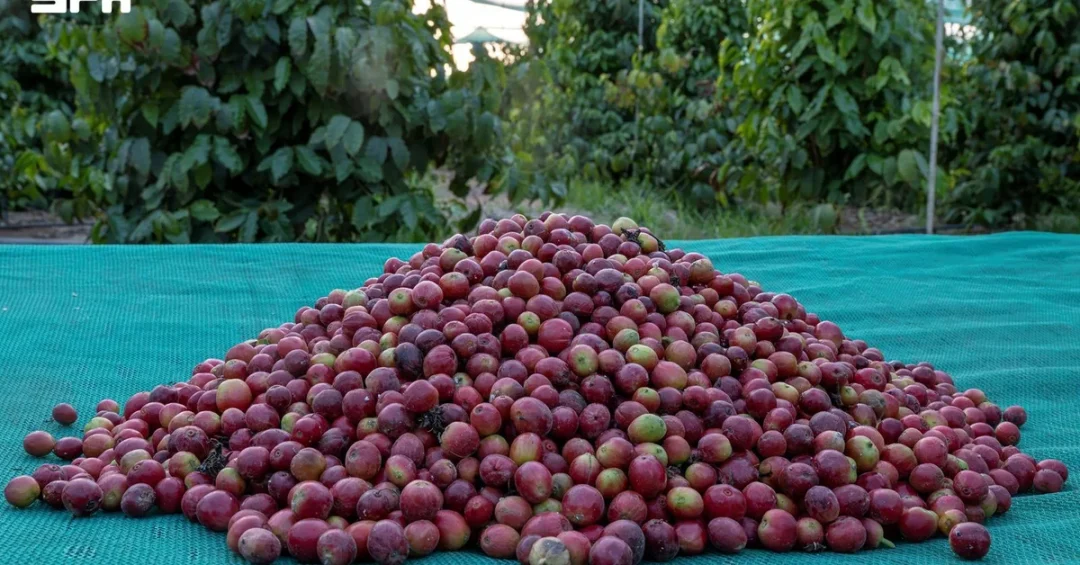
Coffee farmers across Najran Region and its governorates are preparing for the annual harvest season, a milestone that coincides with International Coffee Day and underscores the growing prominence of Saudi coffee as both an agricultural asset and a symbol of national heritage. The season arrives amid significant expansion in local coffee cultivation, with official statistics showing that Najran is emerging as a key Saudi coffee-producing region, home to approximately 100,000 coffee trees, including more than 30,000 fruit-bearing trees that collectively produce over 15 tons of pure coffee.
The development reflects a broader national effort to revitalize traditional agriculture while positioning Saudi Arabia as a producer of premium-quality coffee on the global stage. For international observers, the Najran harvest offers a window into how the Kingdom is blending its deep-rooted cultural traditions with modern agricultural practices, supported by government initiatives that prioritize sustainability, water efficiency, and farmer training. As the world marks International Coffee Day, the activity in Najran highlights how Saudi coffee is not merely a beverage but a living heritage that continues to evolve.
Context and Background
How did a region historically known for its arid terrain become a rising hub for coffee cultivation? The answer lies in a combination of favorable microclimates, generations of local expertise, and a deliberate national strategy to diversify agricultural output. Coffee cultivation in Saudi Arabia has deep historical roots, particularly in the southwestern regions where the plant was first introduced centuries ago. Najran, with its elevated terraces and traditional irrigation systems, has long been part of this heritage, but only in recent years has the sector begun to scale systematically.
The Ministry of Environment, Water and Agriculture has played a central role in this expansion. According to Murih Al-Shahrani, Director General of the Ministry’s branch in Najran, the branch is implementing a suite of development initiatives designed to support farmers at every stage of the production cycle. These include the distribution of high-quality seedlings, organic fertilizers specifically suited to Najran’s soil composition, and water-saving irrigation systems aimed at improving production efficiency. The ministry has also organized training workshops focused on global best practices in coffee cultivation, harvesting, and drying.
This institutional support is critical because coffee is a demanding crop that requires precise conditions to thrive. By investing in both inputs and knowledge transfer, the Ministry is helping farmers move from subsistence-level cultivation to more commercial, quality-oriented production. The result is a sector that is gradually gaining recognition not only within Saudi Arabia but also among international buyers seeking distinctive, high-altitude arabica varieties.
Key Details of the Harvest Season
What exactly does this year’s harvest entail for Najran’s farmers? The season involves the careful picking of ripe coffee cherries, followed by processing methods that include sun-drying and hulling to produce clean, green coffee beans. The more than 30,000 fruit-bearing trees are expected to yield over 15 tons of pure coffee, a figure that represents a substantial increase from previous years and signals the maturation of trees planted under earlier expansion programs.
The Ministry’s branch in Najran has been instrumental in ensuring that farmers have access to the right resources. High-quality seedlings, often of improved varieties resistant to pests and climate stress, are provided to encourage new plantings and replace older, less productive trees. Organic fertilizers tailored to local soil conditions help maintain soil health and reduce reliance on synthetic inputs, aligning with broader environmental goals. Water-saving irrigation systems, such as drip irrigation, are particularly important in a region where water scarcity is a constant concern.
Training workshops have covered topics ranging from pruning and shade management to post-harvest handling and quality control. These sessions are designed to equip farmers with the skills needed to meet international standards, which in turn can open doors to export markets. The combination of material support and capacity building is intended to create a self-sustaining coffee sector that can compete on quality rather than volume alone.
International and Regional Impact
How does Najran’s coffee harvest resonate beyond Saudi borders? The growing output contributes to the global specialty coffee market, where demand for traceable, single-origin beans continues to rise. Saudi coffee, often associated with the traditional serving style known as qahwa, is gaining attention for its distinct flavor profile, which reflects the unique terroir of the Arabian Peninsula. International buyers and coffee enthusiasts are increasingly curious about varieties from regions like Najran, Jazan, and Al-Baha.
Regionally, the expansion of coffee cultivation in Saudi Arabia supports rural development and creates employment opportunities in farming, processing, and related services. It also strengthens food security by reducing reliance on imports for a culturally significant product. For neighboring countries in the Gulf and the broader Middle East, the Saudi experience offers a model of how traditional crops can be modernized through targeted government programs and private-sector engagement. The harvest season, therefore, is not just an agricultural event but a demonstration of regional leadership in sustainable agriculture.
Economic and Strategic Significance
Why does coffee matter economically for Saudi Arabia? Beyond its cultural value, coffee represents a high-value crop that can generate income for smallholder farmers and contribute to the diversification of the rural economy. The Ministry’s initiatives are designed to increase yields and quality, which in turn can boost farmer revenues and encourage further investment in the sector. As production scales, opportunities emerge in roasting, packaging, and branding, creating a value chain that extends well beyond the farm gate.
Strategically, the development of a domestic coffee industry aligns with the Kingdom’s broader goals of economic diversification and self-sufficiency in key agricultural products. It also enhances Saudi Arabia’s soft power by promoting a product that is deeply embedded in its cultural identity. The emphasis on water-saving technologies and organic inputs reflects a commitment to sustainability that resonates with global consumers and partners. In this sense, the Najran harvest is a small but meaningful component of a larger economic transformation.
Vision 2030 Alignment
How does the coffee harvest in Najran connect to Saudi Vision 2030? The Vision, launched by Crown Prince Mohammed bin Salman, seeks to diversify the economy, empower rural communities, and promote sustainable development. Agriculture plays a role in these objectives, particularly in regions like Najran where farming is a traditional livelihood. By supporting coffee cultivation with modern techniques and resources, the Ministry of Environment, Water and Agriculture is helping to create a more resilient and productive agricultural sector.
Moreover, the focus on quality and heritage aligns with the Vision’s aim to showcase Saudi culture to the world. Coffee is an integral part of Saudi hospitality and social life, and its cultivation tells a story of continuity and adaptation. As Najran’s farmers prepare for this year’s harvest, they are not only contributing to the local economy but also participating in a national narrative of progress and pride. The season serves as a reminder that Vision 2030 is being realized not only in megaprojects but also in the fields and farms that form the backbone of the Kingdom’s heritage.
20 Questions
Q1. What is the significance of the coffee harvest in Najran?
A1. The harvest marks the culmination of the growing season and highlights Najran’s emergence as a key coffee-producing region in Saudi Arabia, contributing to agricultural diversification and cultural heritage.
Q2. How many coffee trees are there in Najran?
A2. According to official statistics, Najran has approximately 100,000 coffee trees, of which more than 30,000 are fruit-bearing and produce over 15 tons of pure coffee.
Q3. What support does the Ministry of Environment, Water and Agriculture provide to coffee farmers?
A3. The Ministry provides high-quality seedlings, organic fertilizers suited to local soil, water-saving irrigation systems, and training workshops on global best practices in cultivation, harvesting, and drying.
Q4. Who is Murih Al-Shahrani?
A4. Murih Al-Shahrani is the Director General of the Ministry of Environment, Water and Agriculture branch in Najran, overseeing initiatives to support coffee farmers and expand production.
Q5. Why is International Coffee Day relevant to Najran?
A5. International Coffee Day coincides with the harvest season and provides an opportunity to celebrate Saudi coffee’s cultural significance and the region’s rich agricultural heritage.
Q6. What makes Najran suitable for coffee cultivation?
A6. Najran’s elevated terraces, traditional irrigation systems, and favorable microclimates create conditions that are well-suited for growing high-quality coffee.
Q7. How does the Ministry help with water conservation?
A7. The Ministry promotes water-saving irrigation systems, such as drip irrigation, to improve production efficiency and reduce water usage in a region where water scarcity is a concern.
Q8. What kind of training do farmers receive?
A8. Farmers attend workshops on global best practices, including pruning, shade management, harvesting, drying, and quality control, to enhance the quality and yield of their coffee.
Q9. What is the expected output of this year’s harvest?
A9. The more than 30,000 fruit-bearing trees are expected to produce over 15 tons of pure coffee, representing a significant increase from previous years.
Q10. How does coffee cultivation support rural development?
A10. Coffee cultivation creates employment opportunities in farming, processing, and related services, and generates income for smallholder farmers, thereby supporting rural communities.
Q11. What is qahwa?
A11. Qahwa is the traditional Saudi coffee serving style, often associated with hospitality and social gatherings, and it reflects the deep cultural significance of coffee in Saudi Arabia.
Q12. How does the coffee sector align with Vision 2030?
A12. It aligns with Vision 2030’s goals of economic diversification, rural empowerment, and sustainable development, while also promoting Saudi cultural heritage globally.
Q13. Are there export opportunities for Najran coffee?
A13. Yes, as production quality improves, Najran coffee can access international specialty markets, where demand for traceable, single-origin beans is growing.
Q14. What role do organic fertilizers play?
A14. Organic fertilizers suited to Najran’s soil help maintain soil health, reduce reliance on synthetic inputs, and support sustainable farming practices.
Q15. How does the Ministry ensure high-quality seedlings?
A15. The Ministry distributes improved varieties that are resistant to pests and climate stress, encouraging new plantings and replacing older, less productive trees.
Q16. What is the historical significance of coffee in Saudi Arabia?
A16. Coffee has been cultivated in Saudi Arabia for centuries, particularly in southwestern regions, and is deeply embedded in the Kingdom’s cultural and social traditions.
Q17. How does the harvest season benefit the local economy?
A17. The harvest generates income for farmers, creates jobs in processing and related activities, and stimulates local businesses, contributing to the region’s economic vitality.
Q18. What processing methods are used for Najran coffee?
A18. Farmers typically use sun-drying and hulling to produce clean, green coffee beans, following best practices to preserve quality and flavor.
Q19. How can international buyers learn more about Saudi coffee?
A19. International buyers can engage with Saudi exporters and attend trade events, where they can sample high-quality Saudi coffee and learn about its unique characteristics.
Q20. What does the future hold for coffee cultivation in Najran?
A20. With continued government support and farmer training, Najran’s coffee sector is poised for further growth, enhancing its role as a key contributor to Saudi Arabia’s agricultural and cultural landscape.
Reader Feedback
We value your thoughts. Please share your feedback on this article.
Your feedback helps us improve our coverage.
Related articles
 Riyadh Economic Forum to Tackle Traffic Congestion
 Al-Baha Marks International Coffee Day with Expanding Cultivation
 Saudi-Led Dates Council Holds Global Marketing Workshop in Tunisia
 Saudi Arabia Marks International Coffee Day, Highlights Sector Growth
 Saudi FY2027 Budget: SAR1,392B Spending, 3.6% Deficit
 Saudi Translation Registrations Grow 20% to 7,964