


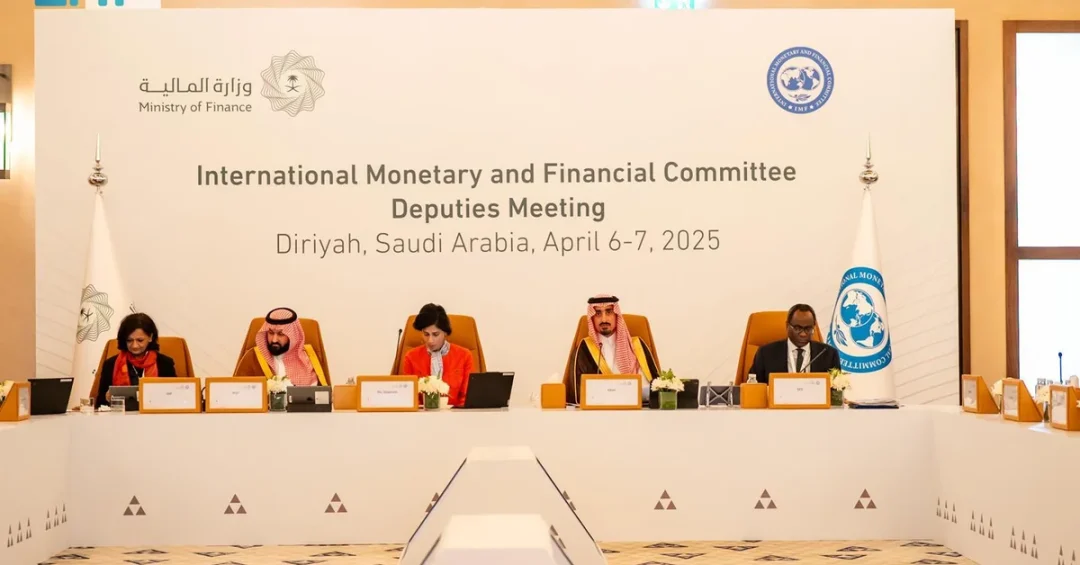
Saudi Arabia concluded the third deputies meeting of the International Monetary Fund’s (IMF) International Monetary and Financial Committee (IMFC) in Diriyah on April 6–7, 2025, reinforcing its role as a global economic convener under the Kingdom’s chairmanship of the committee. The meeting, co-organized by the Saudi Ministry of Finance and the IMF, brought together senior financial officials to address pressing challenges facing the world economy, from trade uncertainty to high debt levels and the opportunities presented by technological and demographic shifts.
Have you ever wondered how global financial stability is maintained in times of rapid change? The IMFC deputies meeting in Diriyah provided a critical platform for exactly that purpose, with Saudi Arabia at the helm. The Kingdom’s leadership of the IMFC underscores its commitment to multilateralism and its growing influence in shaping international economic policy. As the world navigates a complex landscape of shifting trade flows and evolving financial risks, Saudi Arabia’s convening power helps ensure that both advanced and developing economies have a voice in the decisions that affect them.
Context and Background
What makes the IMFC deputies meeting so significant in the broader architecture of global finance? The IMFC is the premier forum for providing strategic direction to the work and policies of the IMF, comprising 25 members, including finance ministers and central bank governors from developed, developing, and low-income countries. Its deputies meetings prepare the ground for the committee’s high-level discussions, focusing on technical and policy issues that require coordinated international action. Saudi Arabia’s chairmanship of the IMFC, which it assumed in 2024, reflects the Kingdom’s standing as a leading advocate for multilateral cooperation and its ability to bridge divides between diverse economic blocs.
The third deputies meeting, held in Diriyah, a historic site that symbolizes Saudi heritage and modern ambition, built on the momentum of previous sessions. In his opening speech, Minister of Finance Mohammed Aljadaan praised the efforts of the IMF’s leadership and IMFC members in guiding the institution during challenging times. “The IMF has shown resilience by adapting to the ever-changing global landscape,” he said, emphasizing the importance of collaboration to ensure global financial stability and strong, inclusive economic growth. His words echoed the Kingdom’s longstanding support for the IMF’s mission, which dates back decades and continues to be a cornerstone of Saudi Arabia’s international economic engagement.
Managing Director of the IMF Dr. Kristalina Georgieva expressed her gratitude for Saudi Arabia’s ongoing and robust support for the IMF and the strong leadership of the IMFC. “Amid significant global policy changes, the IMF’s mission to foster macroeconomic and financial stability remains just as essential as it was 80 years ago. Our 191 member countries can rely on the IMF as a trusted advisor,” she said. Her remarks highlighted the enduring relevance of the IMF and the critical role that Saudi Arabia plays in sustaining its effectiveness through active participation and financial contributions.
Key Details
What specific topics dominated the high-level discussions in Diriyah? The IMFC deputies delved into ways to enhance global financial stability and inclusive development. They addressed the challenges facing the global economy due to uncertainty in trade flows and its impact on capital in both advanced and developing economies. Emphasis was placed on the effect of high debt levels on investments in infrastructure and jobs, as well as the opportunities and risks arising from technological and demographic shifts. These discussions are vital as countries grapple with post-pandemic recovery, inflationary pressures, and the need to foster sustainable growth.
Additionally, the deputies discussed the IMF’s role in supporting countries through financial stability programs and coordinating regional financial arrangements. This includes the IMF’s lending facilities, such as the Flexible Credit Line and the Precautionary and Liquidity Line, which provide insurance against external shocks. The meeting also explored how the IMF can better assist low-income countries in managing debt distress and accessing resources for development. By focusing on these practical mechanisms, the deputies aimed to strengthen the global financial safety net and ensure that no country is left behind.
The presence of high-ranking officials from 25 IMFC member countries underscored the meeting’s importance. Finance ministers and central bank governors from around the world participated, either in person or virtually, contributing diverse perspectives. The Kingdom’s chairmanship ensured that the discussions remained focused on actionable outcomes, with a view to presenting recommendations to the full IMFC during the IMF-World Bank Spring Meetings later in April. This preparatory work is essential for aligning positions and building consensus on the most pressing issues.
International and Regional Impact
How does Saudi Arabia’s leadership of the IMFC influence the global economic agenda? The Kingdom’s chairmanship is a testament to its strong commitment to promoting multilateralism and reflects its leading role in supporting regional and global economic growth. By steering the IMFC’s work, Saudi Arabia helps shape policies that affect everything from capital flows to debt sustainability. This is particularly important for the Middle East and North Africa region, where economic diversification and job creation are top priorities. The Kingdom’s ability to convene both advanced and developing economies demonstrates its diplomatic reach and its reputation as a neutral, constructive partner.
On the international stage, the meeting sent a signal that Saudi Arabia is not just a participant in the global financial system but a key architect of its future. The discussions in Diriyah will feed into the IMF’s broader policy recommendations, potentially influencing decisions on issues such as climate finance, digital currencies, and inclusive growth. For international audiences, this means that Saudi Arabia’s vision for a stable, prosperous world economy is being heard and acted upon. The Kingdom’s emphasis on collaboration and resilience aligns with the IMF’s own goals, creating a powerful synergy that benefits all member countries.
Economic and Strategic Significance
Why does this meeting matter for the global economy right now? With trade tensions, geopolitical conflicts, and lingering pandemic effects creating uncertainty, the need for coordinated economic policies has rarely been greater. The IMFC deputies’ focus on trade flow disruptions and their impact on capital allocation addresses a critical pain point for both advanced and developing economies. High debt levels, another key topic, threaten to crowd out investments in infrastructure and jobs, particularly in low-income countries. By tackling these issues head-on, the meeting helped lay the groundwork for policies that can sustain growth and prevent financial crises.
From a strategic perspective, Saudi Arabia’s chairmanship of the IMFC enhances its soft power and economic diplomacy. It positions the Kingdom as a bridge-builder between the Global South and the developed world, a role that is increasingly important in a multipolar era. Moreover, the meeting’s outcomes can support Saudi Arabia’s own economic transformation by promoting stable global markets, which are essential for the success of Vision 2030’s diversification goals. A resilient global economy means stronger demand for Saudi exports, more reliable supply chains, and greater opportunities for investment.
Vision 2030 Alignment
How does Saudi Arabia’s role in the IMFC connect to Vision 2030? The Kingdom’s chairmanship and active participation in global financial governance are direct expressions of Vision 2030’s aim to create a diversified, sustainable economy that is integrated with the world. By fostering international cooperation and stability, Saudi Arabia helps create an enabling environment for its own economic reforms, including the growth of the private sector, the expansion of non-oil exports, and the development of new industries. The meeting in Diriyah also showcased Saudi Arabia’s ability to host world-class international events, a key pillar of its tourism and cultural ambitions.
Looking ahead, the outcomes of the third IMFC deputies meeting will inform the Spring Meetings and beyond, with Saudi Arabia continuing to play a central role. The Kingdom’s leadership in this arena reinforces its message that global challenges require global solutions, and that Saudi Arabia is ready to contribute to those solutions. As Vision 2030 progresses, the world can expect to see even greater Saudi engagement in multilateral institutions, driving forward a vision of shared prosperity and stability. The Diriyah meeting was not just a diplomatic success; it was another step in Saudi Arabia’s journey toward becoming a global economic powerhouse.
20 Questions
Q1. What was the third IMFC deputies meeting?
A1. The third IMFC deputies meeting was a gathering of senior officials from the International Monetary and Financial Committee, held in Diriyah, Saudi Arabia, on April 6-7, 2025, to discuss global economic challenges and policy responses.
Q2. Who chaired the meeting?
A2. The meeting was held under the chairmanship of Saudi Arabia, with the Ministry of Finance and the IMF co-organizing the event. Minister of Finance Mohammed Aljadaan led the Saudi delegation.
Q3. Where was the meeting held?
A3. The meeting took place in Diriyah, a historic town near Riyadh, Saudi Arabia, known for its cultural heritage and modern development, reflecting the Kingdom’s blend of tradition and progress.
Q4. What is the IMFC?
A4. The IMFC is the International Monetary and Financial Committee, the premier forum for providing strategic direction to the IMF’s work and policies. It has 25 members from developed, developing, and low-income countries.
Q5. What topics were discussed at the meeting?
A5. Topics included enhancing global financial stability, inclusive development, trade flow uncertainty, high debt levels, technological and demographic shifts, and the IMF’s role in supporting countries through financial programs.
Q6. What did Minister Aljadaan say about the IMF?
A6. Minister Aljadaan praised the IMF’s leadership and resilience, emphasizing the importance of collaboration for global financial stability and strong, inclusive economic growth amid a changing global landscape.
Q7. What did IMF Managing Director Kristalina Georgieva say?
A7. Dr. Georgieva thanked Saudi Arabia for its robust support and strong IMFC leadership, noting that the IMF’s mission remains essential and that its 191 member countries can rely on it as a trusted advisor.
Q8. Why is Saudi Arabia’s chairmanship significant?
A8. Saudi Arabia’s chairmanship demonstrates its commitment to multilateralism and its leading role in supporting regional and global economic growth, enhancing its influence in international financial governance.
Q9. How does the IMFC operate?
A9. The IMFC meets twice a year to discuss global economic challenges and recommend policies. Its deputies meetings, like the one in Diriyah, prepare the ground for these high-level discussions.
Q10. What is the IMF’s role in global finance?
A10. The IMF fosters macroeconomic and financial stability, provides financial assistance to countries in crisis, and serves as a trusted advisor to its 191 member countries, promoting international monetary cooperation.
Q11. What challenges did the deputies address?
A11. They addressed trade flow uncertainty, high debt levels affecting infrastructure and jobs, and the opportunities and risks from technological and demographic shifts, aiming to enhance global financial stability.
Q12. How does this meeting impact developing economies?
A12. The discussions on debt relief, financial stability programs, and inclusive development directly affect developing economies by helping them access resources and manage external shocks more effectively.
Q13. What are regional financial arrangements?
A13. Regional financial arrangements are cooperative mechanisms among countries in a region to provide financial support during crises. The IMFC discussed coordinating these with IMF programs for a stronger global safety net.
Q14. What is the connection to Vision 2030?
A14. Saudi Arabia’s active role in the IMFC supports Vision 2030 by promoting global economic stability, which is essential for the Kingdom’s economic diversification, investment, and sustainable growth goals.
Q15. How does the meeting affect Saudi Arabia’s global standing?
A15. It enhances Saudi Arabia’s reputation as a responsible global leader and bridge-builder, showcasing its ability to convene diverse nations and contribute to solving international economic challenges.
Q16. What happens after the deputies meeting?
A16. The outcomes will inform the full IMFC meeting during the IMF-World Bank Spring Meetings, where finance ministers and central bank governors will finalize policy recommendations.
Q17. Who are the IMFC members?
A17. The IMFC comprises 25 members, typically finance ministers and central bank governors, representing advanced, emerging, and low-income countries across the globe.
Q18. How does the IMF support countries in crisis?
A18. The IMF provides financial assistance through lending facilities, policy advice, and capacity development, helping countries restore stability and implement reforms for sustainable growth.
Q19. What was the significance of holding the meeting in Diriyah?
A19. Diriyah symbolizes Saudi Arabia’s rich heritage and modern aspirations, making it a fitting venue to discuss global economic cooperation and the Kingdom’s role in shaping a prosperous future.
Q20. How can international audiences benefit from this meeting?
A20. International audiences benefit from a more stable global economy, as the policies discussed aim to foster growth, reduce risks, and ensure that all countries can participate in and contribute to global prosperity.
Reader Feedback
We value your thoughts. Please share your feedback on this article.
Your feedback helps us improve our coverage.
Related articles
 IsDB, Algeria Strengthen Energy Cooperation
 SDAIA Official: AI Key to Sustainable Sports Investment
 IsDB Group to Hold 2025 Annual Meetings in Algeria
 Jeddah to Host Saudi International Furniture and Décor Exhibition Mobedex
 SIF Day Two: Funding Sports Development in Focus
 Estidamah Launches Azolla Cultivation Program for Farmers