


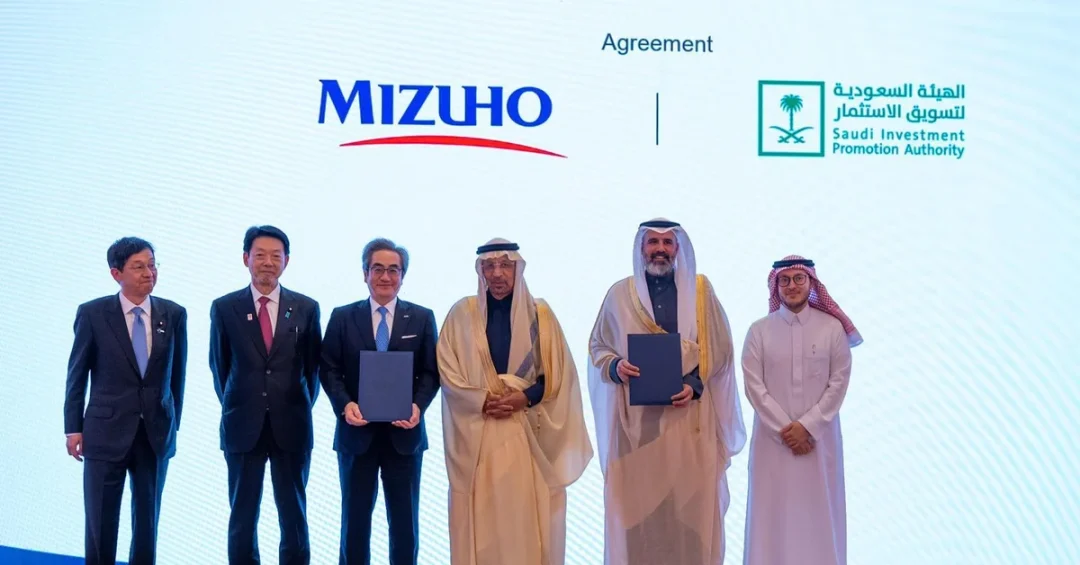
The Saudi Investment Promotion Authority (SIPA) has signed a memorandum of understanding (MoU) with Japan’s Mizuho Bank to expand investment opportunities between the Kingdom of Saudi Arabia and Japan, in a move announced by the Saudi Press Agency on January 13, 2025. The agreement is designed to give Japanese companies a clearer, better-supported pathway into one of the Middle East’s largest and fastest-transforming economies, while opening new doors for Saudi businesses seeking Japanese partners, capital, and technical expertise. Under the terms of the MoU, SIPA will deploy its institutional knowledge and investor-services resources to guide Japanese firms through every stage of entering the Saudi market, from initial assessment to the formation of joint ventures with Saudi counterparts.
The memorandum reflects a broader acceleration in Saudi-Japanese economic relations, built on decades of energy cooperation and now expanding rapidly into finance, manufacturing, technology, tourism, and entertainment. Japan has long been one of the Kingdom’s most important trading and investment partners, and Riyadh has repeatedly signaled that Japanese corporations are among the priority investors it hopes to attract as part of its economic diversification drive. For Mizuho Bank, one of Japan’s largest financial institutions, the MoU provides a structured channel to connect its corporate clients with Saudi opportunities that might otherwise be difficult to navigate. For SIPA, it adds another major global financial partner to a growing network of institutions helping to channel foreign direct investment into the Kingdom.
Context and Background
Why has Saudi Arabia chosen Japan as one of its key investment partners at this particular moment? The answer lies in the complementary strengths of the two economies. Japan possesses advanced industrial technology, deep capital markets, and globally competitive companies in sectors such as automotive manufacturing, precision engineering, electronics, chemicals, and finance. Saudi Arabia, meanwhile, offers a large domestic market, world-class energy and petrochemical infrastructure, strategic access to Middle Eastern, African, and Asian markets, and a government that has made foreign investment a central pillar of its long-term economic strategy. The two countries have maintained strong diplomatic and commercial ties for more than half a century, anchored originally in oil trade and subsequently broadened through joint ventures in petrochemicals and industrial projects.
The Saudi Investment Promotion Authority operates under the Kingdom’s investment ecosystem and is tasked with marketing Saudi Arabia as a global investment destination, removing barriers for foreign investors, and facilitating partnerships between international companies and Saudi businesses. Its engagement with global banks is a deliberate strategy: financial institutions such as Mizuho maintain relationships with thousands of corporate clients, making them effective multipliers for investment promotion. When a bank of Mizuho’s scale actively supports its clients in exploring Saudi opportunities, the reach of SIPA’s message extends far beyond what direct government outreach alone could achieve. The MoU therefore represents not just a bilateral agreement but a practical mechanism for scaling investment promotion across Japan’s corporate landscape.
Japan’s interest in Saudi Arabia has also been reinforced by high-level diplomatic engagement. Japanese prime ministers and senior ministers have visited the Kingdom in recent years, and Saudi leaders have made reciprocal visits to Tokyo, with both sides emphasizing economic cooperation under frameworks such as the Saudi-Japan Vision 2030 partnership. These official exchanges have created political momentum that agreements like the SIPA-Mizuho MoU are designed to convert into concrete commercial deals.
Key Details of the Agreement
What exactly does the memorandum commit the two sides to doing? According to the Saudi Press Agency, the MoU focuses on leveraging SIPA’s expertise and resources to provide comprehensive support to Japanese companies that wish to invest in the Kingdom or form partnerships with Saudi businesses. This support is expected to cover practical areas such as market information, regulatory guidance, identification of suitable Saudi partners, and facilitation of introductions to relevant government entities and industrial zones. For Japanese firms that have limited experience in the Gulf region, such assistance can substantially reduce the time and risk involved in establishing a presence.
The agreement also aligns directly with the objectives of Saudi Vision 2030, the national transformation program launched under the leadership of Crown Prince Mohammed bin Salman. Vision 2030 seeks to diversify the Saudi economy away from oil dependence by growing the private sector, increasing non-oil exports, and attracting foreign investment across new industries. The MoU explicitly references several of these goals: diversifying the national economy, attracting foreign investment, fostering economic partnerships with global companies, strengthening bilateral investment ties, establishing long-term collaborations, and creating new opportunities for cooperation in investment and economic sectors.
Mizuho Bank, as one of Japan’s three largest banking groups, brings significant convening power. Its corporate client base spans major manufacturers, trading houses, technology companies, and small and medium-sized enterprises, many of which are evaluating overseas expansion as Japan’s domestic market matures. By partnering with SIPA, Mizuho can offer its clients a trusted point of entry into Saudi Arabia while positioning itself as a bridge between Japanese capital and Saudi projects. The MoU does not involve a specific monetary commitment; instead, it establishes a cooperative framework under which concrete transactions and investments can be developed over time.
International and Regional Impact
How does this agreement fit into the wider competition for foreign investment in the Middle East? Saudi Arabia, the United Arab Emirates, Qatar, and other Gulf states are all actively courting international capital, and each offers distinct advantages. Saudi Arabia’s scale, its ambitious giga-projects, and its position as the region’s largest economy give it unique appeal, but investors also weigh regulatory predictability and ease of doing business. Partnerships with established global banks help address these considerations by providing familiar institutions through which investors can operate. The SIPA-Mizuho MoU therefore strengthens the Kingdom’s competitive position in a crowded regional marketplace.
For Japan, the agreement reflects a strategic recalibration toward the Gulf that has been underway for several years. Japanese companies have historically concentrated their Middle East engagement on energy procurement, but the region’s economic transformation has created new commercial opportunities in infrastructure, renewable energy, digital services, healthcare, and consumer markets. Japanese trading houses and manufacturers have already invested in Saudi projects, and the MoU is expected to encourage further diversification of Japanese corporate activity in the Kingdom. From a geopolitical perspective, deeper Saudi-Japanese economic ties also reinforce a relationship that both governments view as stabilizing in a complex global environment.
Economic and Strategic Significance
What does this mean for the Saudi economy and for Vision 2030’s investment targets? Saudi Arabia aims to raise foreign direct investment to a substantially higher share of gross domestic product, and it has introduced a series of reforms to make the Kingdom more attractive to international investors, including updated investment laws, special economic zones, and expanded licensing pathways. Each MoU with a major global institution contributes to this effort by building awareness and confidence among investor communities that may not yet have fully assessed Saudi opportunities. Japan’s corporate sector, with its long-term investment horizon and emphasis on technology transfer, is particularly well suited to the kinds of partnerships Vision 2030 envisions.
The agreement also has implications for Saudi businesses seeking international partners. Japanese firms often bring not only capital but also advanced manufacturing processes, quality management systems, and access to Asian supply chains. For Saudi companies in sectors such as petrochemicals, automotive components, food processing, and technology, collaboration with Japanese partners can accelerate capability building and open export markets. By facilitating these connections, SIPA is supporting the development of a more diversified and competitive Saudi private sector, which is central to the Kingdom’s long-term economic vision.
Vision 2030 Alignment
How does a single memorandum of understanding connect to the broader transformation of Saudi Arabia? Vision 2030 is built on the premise that the Kingdom’s future prosperity depends on opening its economy to the world, building new industries, and creating opportunities for its citizens. Foreign investment is a key enabler across all three dimensions: it brings capital, creates jobs, transfers knowledge, and integrates Saudi Arabia more deeply into global value chains. The partnership with Mizuho Bank is one of many international engagements through which the Kingdom is translating this vision into practical cooperation with leading global institutions.
As Saudi Arabia continues to expand its network of investment partnerships across Asia, Europe, and the Americas, agreements like this one signal that the Kingdom is open for business and committed to working with the world’s most respected financial institutions. For Japanese companies, the message is clear: Saudi Arabia offers a stable, ambitious, and welcoming environment for long-term investment. For the Kingdom, each new partnership brings it closer to the diversified, knowledge-driven economy that Vision 2030 promises, and to a future in which Saudi-Japanese cooperation plays an increasingly prominent role in regional and global economic affairs.
20 Questions
Q1. What did the Saudi Investment Promotion Authority sign with Mizuho Bank?
A1. The Saudi Investment Promotion Authority signed a memorandum of understanding with Japan’s Mizuho Bank to enhance investment opportunities between Saudi Arabia and Japan, as announced by the Saudi Press Agency on January 13, 2025.
Q2. What is the main purpose of this MoU?
A2. The MoU aims to leverage SIPA’s expertise and resources to provide comprehensive support to Japanese companies looking to invest in Saudi Arabia or form partnerships with Saudi businesses, facilitating their entry into the Kingdom’s market.
Q3. Which Saudi entity signed the agreement?
A3. The Saudi Investment Promotion Authority, the government body responsible for promoting and facilitating foreign investment in the Kingdom, signed the memorandum of understanding with Mizuho Bank.
Q4. Which Japanese institution is involved in the agreement?
A4. Mizuho Bank, one of Japan’s largest and most prominent financial institutions, is the Japanese partner in the memorandum of understanding signed with the Saudi Investment Promotion Authority.
Q5. When was the MoU announced?
A5. The memorandum of understanding was announced on January 13, 2025, and was reported by the Saudi Press Agency, the Kingdom’s official news agency.
Q6. How does this MoU support Saudi Vision 2030?
A6. The MoU aligns with Vision 2030 by helping to diversify the national economy, attract foreign investment, foster economic partnerships with global companies, and create new opportunities for cooperation in investment and economic sectors.
Q7. What kind of support will Japanese companies receive?
A7. Japanese companies will receive comprehensive support, including market information, regulatory guidance, identification of suitable Saudi partners, and facilitation of introductions to relevant government entities and industrial zones.
Q8. Why is Japan an important investment partner for Saudi Arabia?
A8. Japan offers advanced industrial technology, deep capital markets, and globally competitive companies in sectors such as manufacturing, electronics, and finance, complementing Saudi Arabia’s large market and strategic location.
Q9. What benefits does Mizuho Bank bring to the partnership?
A9. Mizuho Bank brings significant convening power through its extensive corporate client base, which includes major manufacturers, trading houses, and technology companies that may be interested in expanding into the Saudi market.
Q10. Does the MoU involve a specific monetary commitment?
A10. No, the memorandum of understanding establishes a cooperative framework rather than a specific monetary commitment, under which concrete transactions and investments can be developed over time.
Q11. How does this agreement affect Saudi businesses?
A11. Saudi businesses can benefit from access to Japanese partners that bring capital, advanced manufacturing processes, quality management systems, and connections to Asian supply chains, helping them grow and compete internationally.
Q12. What sectors are likely to benefit most from this partnership?
A12. Sectors such as petrochemicals, automotive components, food processing, technology, renewable energy, and infrastructure are likely to benefit, as they align with both Japanese expertise and Saudi Vision 2030 priorities.
Q13. How does this MoU fit into Saudi Arabia’s broader investment strategy?
A13. It is part of a wider effort to attract foreign direct investment by partnering with major global financial institutions, building awareness among investor communities, and positioning the Kingdom as a leading investment destination.
Q14. What is the role of the Saudi Press Agency in this announcement?
A14. The Saudi Press Agency, the Kingdom’s official news agency, reported the signing of the memorandum of understanding, providing authoritative confirmation of the agreement to domestic and international audiences.
Q15. How might this agreement impact Saudi-Japanese relations?
A15. The agreement strengthens bilateral economic ties that have historically been anchored in energy cooperation, expanding them into finance, manufacturing, technology, and other sectors of mutual interest.
Q16. What are the implications for the Middle East region?
A16. The MoU enhances Saudi Arabia’s competitive position in the region’s race for foreign investment, demonstrating the Kingdom’s commitment to creating a business-friendly environment and deepening ties with major global economies.
Q17. What reforms has Saudi Arabia introduced to attract foreign investment?
A17. Saudi Arabia has introduced updated investment laws, special economic zones, expanded licensing pathways, and other reforms designed to make the Kingdom more attractive and accessible to international investors.
Q18. How does this MoU reflect Japan’s strategic interest in the Gulf?
A18. It reflects Japan’s recalibration toward the Gulf, moving beyond energy procurement to explore opportunities in infrastructure, renewable energy, digital services, healthcare, and consumer markets across the region.
Q19. What is the expected timeline for results from this MoU?
A19. The MoU establishes a framework for ongoing cooperation, with concrete investments and partnerships expected to develop progressively as Japanese companies engage with SIPA and identify suitable opportunities in the Kingdom.
Q20. What does this agreement signal about Saudi Arabia’s global economic role?
A20. It signals that Saudi Arabia is open for business, actively building partnerships with leading global institutions, and committed to realizing Vision 2030’s goal of a diversified, knowledge-driven economy integrated with world markets.
Reader Feedback
We value your thoughts. Please share your feedback on this article.
Your feedback helps us improve our coverage.
Related articles
 Saudi, Omani Finance Ministers Sign Financial Cooperation MoU
 Saudi Finance Minister Joins IsDB Retreat in Madinah
 Saudi Ministry Introduces 15 Incentives for Exporters
 GCC Joins Asian Financial Forum to Tackle Global Economic Challenges
 GEA Launches 29 New Entertainment Investment Opportunities
 Saudi Reef Delivers SAR 2.4 Billion for Rural Development