


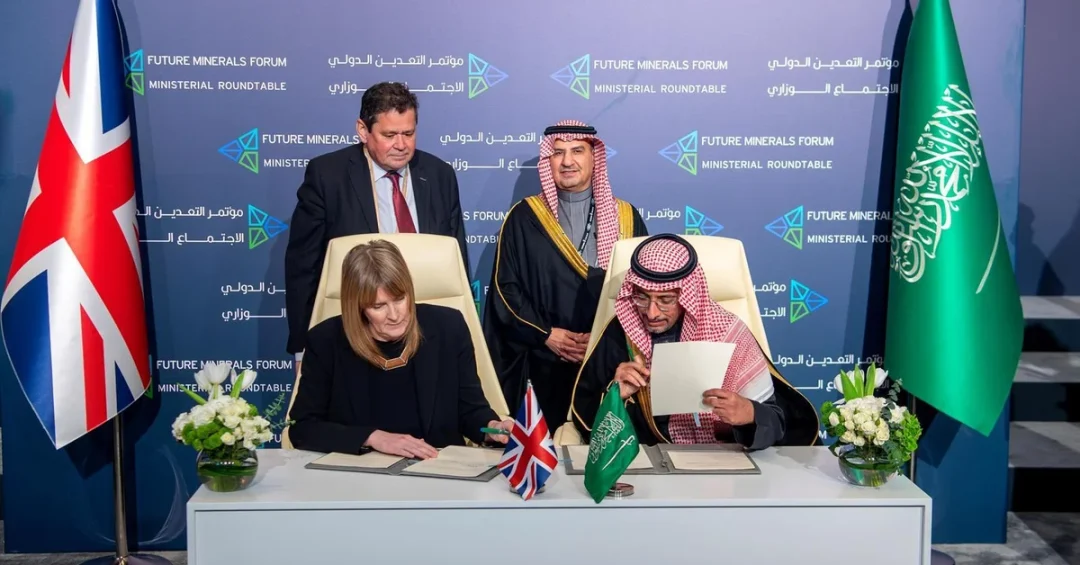
Saudi Arabia signed a series of memoranda of understanding and cooperation agreements with six countries during the fourth Ministerial Roundtable of the Future Minerals Forum in Riyadh on January 14, 2025, according to the Saudi Press Agency. The agreements were inked by the Ministry of Industry and Mineral Resources with counterparts from Djibouti, Jordan, the United Kingdom, Zambia, Austria, and France, marking a significant expansion of the Kingdom’s international mining partnerships. The deals were signed on behalf of Saudi Arabia by Minister of Industry and Mineral Resources Bandar Alkhorayef and Vice Minister of Industry and Mineral Resources for Mining Affairs Eng. Khalid Al-Mudaifer.
The fourth Ministerial Roundtable served as the flagship opening meeting of the Future Minerals Forum, an annual gathering that has become one of the world’s most important platforms for shaping the future of mineral supply chains. The event brought together government ministers, industry leaders, and international organizations to discuss responsible mineral development, investment, and cooperation. For Saudi Arabia, the signing of these agreements underscores its commitment to becoming a global hub for minerals and mining, a key pillar of its economic diversification strategy under Vision 2030. The agreements also reflect the Kingdom’s growing role as a bridge between resource-rich nations and major consumer markets.
Context and Background
Why has Saudi Arabia placed mining at the heart of its economic transformation? The Kingdom has long been known for its vast oil reserves, but under Vision 2030, it is actively diversifying its economy by unlocking the estimated $2.5 trillion in mineral wealth beneath its soil. The Ministry of Industry and Mineral Resources, led by Bandar Alkhorayef, has been tasked with developing this sector into a third pillar of the Saudi economy alongside oil and petrochemicals. The Future Minerals Forum, first launched in 2022, was conceived as a global platform to bring together governments, investors, and communities to discuss the future of mining, particularly in the Middle East, Africa, and Asia.
The fourth Ministerial Roundtable, held on the sidelines of the forum, is a testament to the growing importance of international collaboration in the minerals sector. The agreements signed with Djibouti, Jordan, the United Kingdom, Zambia, Austria, and France cover a range of cooperation areas, including exploration, capacity building, technology transfer, and investment. These partnerships are designed to create mutually beneficial opportunities, helping Saudi Arabia access global expertise while supporting partner countries in developing their own mineral resources. The involvement of high-level officials from each nation highlights the strategic importance they attach to Saudi Arabia’s mining ambitions.
The timing of these agreements is significant. Global demand for critical minerals such as lithium, cobalt, copper, and rare earth elements is soaring, driven by the energy transition and the growth of electric vehicles, renewable energy, and advanced technologies. Countries around the world are racing to secure supply chains, and Saudi Arabia is positioning itself as a reliable partner and a hub for mineral processing and manufacturing. By signing these MoUs, the Kingdom is not only securing access to resources but also building diplomatic and commercial ties that will support its long-term economic goals.
Key Details of the Agreements
What exactly do these agreements entail, and who are the key players involved? According to the Saudi Press Agency, the agreements were signed with the minister of energy and natural resources from Djibouti, the minister of energy and mineral resources from Jordan, the secretary of state for business and trade from the United Kingdom, and the minister of mines and mineral development from Zambia. Additionally, agreements were signed with the Ministry of Finance of Austria and the Ministry of the Economy, Finance and Industrial and Digital Sovereignty of France. These counterparts represent a diverse group of nations, from resource-rich African countries to European economies with advanced mining technologies and financial expertise.
The agreements are expected to facilitate collaboration in several areas. With Djibouti and Jordan, Saudi Arabia is likely to focus on regional cooperation, given their proximity and shared geological formations. Djibouti, located at the strategic Bab-el-Mandeb strait, offers access to African markets, while Jordan has significant phosphate and potash reserves. The agreement with the United Kingdom, a global leader in mining finance and technology, will likely enhance Saudi Arabia’s access to capital and innovation. Zambia, a major copper producer, offers opportunities for joint exploration and processing. Austria and France bring expertise in sustainable mining practices, research, and development.
The memoranda of understanding are not legally binding but serve as frameworks for future cooperation. They typically outline areas of mutual interest, such as joint ventures, knowledge exchange, and capacity building. For Saudi Arabia, these agreements are part of a broader strategy to attract foreign investment into its mining sector, which aims to contribute $64 billion to the national economy by 2030. The Ministry of Industry and Mineral Resources has been actively promoting the Kingdom’s mineral potential, including the development of a comprehensive geological survey and the creation of a mining investment law that offers incentives to investors.
International and Regional Impact
How will these agreements reshape the global mining landscape? The partnerships signal Saudi Arabia’s emergence as a major player in the international minerals arena, capable of convening diverse nations and fostering cooperation. For the partner countries, the agreements offer access to Saudi capital, expertise, and market opportunities. For instance, Zambia, which is striving to increase its copper production, could benefit from Saudi investment in mining infrastructure and processing facilities. The United Kingdom, with its strong financial services sector, could see increased opportunities for its mining companies and investors in Saudi Arabia.
Regionally, the agreements strengthen Saudi Arabia’s ties with Jordan and Djibouti, both of which are important partners in the Middle East and Africa. Jordan, with its skilled workforce and strategic location, can serve as a gateway for Saudi mining companies into the Levant and North Africa. Djibouti, with its ports and free zones, can facilitate the export of minerals from landlocked African countries. These partnerships also align with Saudi Arabia’s broader foreign policy objectives of promoting stability and economic integration in the region.
On a global scale, the agreements reflect a shift in the mining industry’s center of gravity toward the Middle East and Africa. As demand for critical minerals grows, countries in these regions are seeking to move up the value chain, from raw material extraction to processing and manufacturing. Saudi Arabia, with its capital and infrastructure, is well-positioned to support this transition. The involvement of European countries like Austria and France also indicates that Western nations see Saudi Arabia as a key partner in securing sustainable mineral supply chains.
Economic and Strategic Significance
What do these agreements mean for Saudi Arabia’s economy and its strategic ambitions? The mining sector is a cornerstone of Vision 2030, which aims to reduce the Kingdom’s dependence on oil and create new industries and jobs. The Ministry of Industry and Mineral Resources has set ambitious targets, including increasing mining’s contribution to GDP from $17 billion to $64 billion by 2030. The agreements signed at the Future Minerals Forum will help attract the foreign investment and expertise needed to achieve these goals. They also support the development of downstream industries, such as battery manufacturing, which is critical for the electric vehicle and renewable energy sectors.
Strategically, the agreements enhance Saudi Arabia’s geopolitical influence. By partnering with countries across Africa, Europe, and the Middle East, the Kingdom is building a network of allies and partners that share its vision for sustainable mineral development. This network can help secure access to critical minerals, reduce supply chain risks, and promote Saudi Arabia as a responsible and reliable player in global markets. The agreements also complement other Saudi initiatives, such as the Saudi Green Initiative and the Middle East Green Initiative, by promoting sustainable mining practices and environmental stewardship.
Furthermore, the deals underscore the success of the Future Minerals Forum as a platform for deal-making and dialogue. The forum has grown in stature since its inception, attracting thousands of participants from over 100 countries. The fourth edition, held in Riyadh, featured high-level speakers, including ministers, CEOs, and thought leaders. The ministerial roundtable, in particular, has become a key venue for governments to discuss policy, share best practices, and forge partnerships. The agreements signed this year are a direct outcome of the forum’s ability to bring together decision-makers and facilitate concrete outcomes.
Vision 2030 Alignment
How do these mining agreements fit into Saudi Arabia’s long-term vision? Vision 2030, launched in 2016 by Crown Prince Mohammed bin Salman, is a comprehensive plan to transform the Kingdom’s economy and society. Mining is identified as a key sector for diversification, alongside tourism, entertainment, and renewable energy. The agreements signed at the Future Minerals Forum directly support the Vision’s objectives by promoting international cooperation, attracting investment, and developing human capital. They also align with the National Industrial Development and Logistics Program, which aims to make Saudi Arabia a leading industrial power and logistics hub.
In conclusion, the memoranda of understanding signed with Djibouti, Jordan, the United Kingdom, Zambia, Austria, and France represent a major step forward in Saudi Arabia’s journey to become a global mining powerhouse. They demonstrate the Kingdom’s commitment to international partnership, sustainable development, and economic diversification. As the world transitions to a low-carbon future, Saudi Arabia is positioning itself as a reliable supplier of critical minerals and a hub for mining innovation. With the continued support of its leadership and the active engagement of its partners, the Kingdom is well on its way to achieving its Vision 2030 goals and contributing to global prosperity.
20 Questions
Q1. What event hosted the signing of the mining agreements?
A1. The agreements were signed during the fourth Ministerial Roundtable of the Future Minerals Forum, held in Riyadh on January 14, 2025. This forum is a major international gathering for the mining sector.
Q2. Which Saudi ministry signed the agreements?
A2. The Ministry of Industry and Mineral Resources signed the agreements on behalf of Saudi Arabia. The ministry is responsible for developing the Kingdom’s mining sector under Vision 2030.
Q3. Who signed the agreements for Saudi Arabia?
A3. Minister of Industry and Mineral Resources Bandar Alkhorayef and Vice Minister for Mining Affairs Eng. Khalid Al-Mudaifer signed the agreements. Both officials play key roles in advancing Saudi Arabia’s mining strategy.
Q4. How many countries signed agreements with Saudi Arabia?
A4. Six countries signed agreements: Djibouti, Jordan, the United Kingdom, Zambia, Austria, and France. These nations represent diverse regions and expertise in mining.
Q5. What type of agreements were signed?
A5. The agreements were memoranda of understanding and cooperation agreements. They establish frameworks for collaboration in areas such as exploration, technology, and investment.
Q6. Which country is represented by its minister of energy and natural resources?
A6. Djibouti’s minister of energy and natural resources signed the agreement. Djibouti is strategically located near the Bab-el-Mandeb strait.
Q7. Which country’s minister of energy and mineral resources participated?
A7. Jordan’s minister of energy and mineral resources signed the agreement. Jordan has significant phosphate and potash reserves.
Q8. Who represented the United Kingdom?
A8. The UK’s secretary of state for business and trade signed the agreement. The UK is a global leader in mining finance and technology.
Q9. Which African nation signed a mining agreement?
A9. Zambia, represented by its minister of mines and mineral development, signed an agreement. Zambia is a major copper producer.
Q10. Which European countries signed agreements?
A10. Austria and France signed agreements. Austria was represented by its Ministry of Finance, and France by its Ministry of the Economy, Finance and Industrial and Digital Sovereignty.
Q11. What is the purpose of these agreements?
A11. The agreements aim to foster international cooperation in mining, attract investment, and support the development of Saudi Arabia’s mineral sector in line with Vision 2030.
Q12. How do these agreements benefit Saudi Arabia?
A12. They help Saudi Arabia access global expertise, secure mineral supply chains, and attract foreign investment. This supports the goal of making mining a third pillar of the economy.
Q13. What is the Future Minerals Forum?
A13. The Future Minerals Forum is an annual event launched in 2022. It brings together governments, industry leaders, and investors to discuss the future of mining, especially in the Middle East, Africa, and Asia.
Q14. Why is the Ministerial Roundtable important?
A14. The Ministerial Roundtable is a flagship meeting where ministers discuss policies and forge partnerships. It has become a key platform for shaping global mineral strategies.
Q15. What mineral resources does Saudi Arabia aim to develop?
A15. Saudi Arabia aims to develop its estimated $2.5 trillion in mineral wealth, including gold, copper, phosphate, and rare earth elements. These are critical for the energy transition.
Q16. How does mining contribute to Vision 2030?
A16. Mining is a key sector for economic diversification. Vision 2030 targets increasing mining’s GDP contribution from $17 billion to $64 billion by 2030.
Q17. What role does the UK play in Saudi mining?
A17. The UK provides financial and technological expertise. Its mining companies and investors can partner with Saudi Arabia to develop projects and share best practices.
Q18. What is the significance of the agreement with Zambia?
A18. Zambia is a major copper producer, and the agreement opens opportunities for joint exploration and processing. Copper is essential for electric vehicles and renewable energy.
Q19. How do Austria and France contribute?
A19. Austria and France bring expertise in sustainable mining, research, and development. Their involvement supports innovation and responsible practices in Saudi Arabia’s mining sector.
Q20. What is the expected outcome of these agreements?
A20. The agreements are expected to lead to joint ventures, knowledge exchange, and increased investment. They will help Saudi Arabia become a global mining hub and support Vision 2030 goals.
Reader Feedback
We value your thoughts. Please share your feedback on this article.
Your feedback helps us improve our coverage.
Related articles
 Saudi Inflation Hits 1.9% in December, Lowest Among G20
 Saudi Date Production Nears 2 Million Tons in 2023
 SAMA and Google Sign Agreement to Launch Google Pay in Saudi Arabia
 Saudi Liquidity Surges by SAR275 Billion in November 2024
 Mawani Reports 14.45% Cargo Growth in 2024
 Finance Minister Stresses Investment in Saudi Mining Sector