


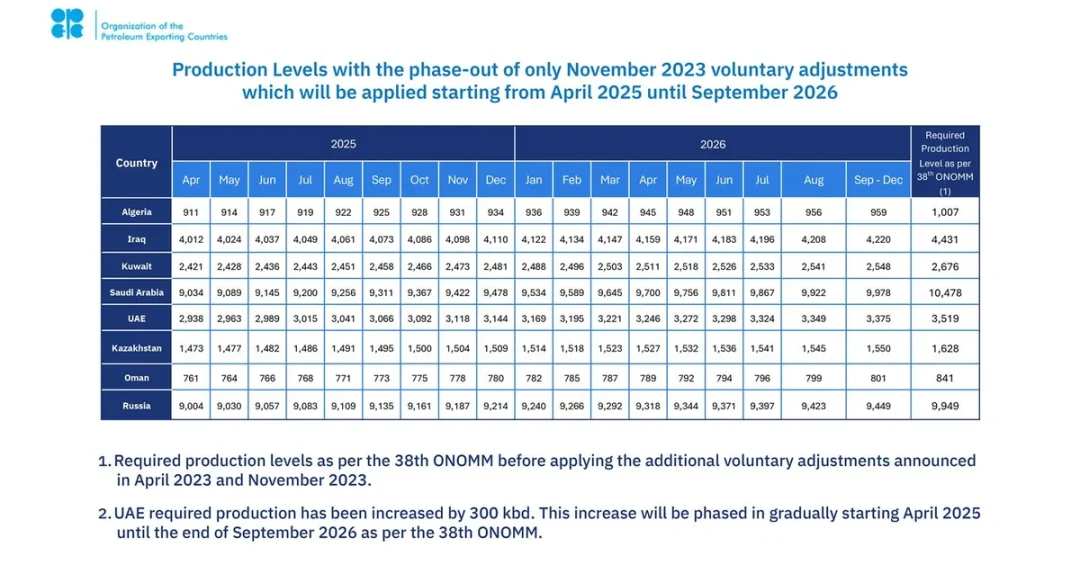
Saudi Arabia, Russia, Iraq, the United Arab Emirates, Kuwait, Kazakhstan, Algeria, and Oman reaffirmed their commitment to oil market stability during a virtual meeting on March 3, 2025, agreeing to proceed with a gradual and flexible return of 2.2 million barrels per day (mbd) of voluntary production adjustments starting April 1, 2025. The eight OPEC+ countries, which had previously announced additional voluntary adjustments in April and November 2023, reviewed global market conditions and the future outlook, concluding that healthy market fundamentals and a positive trajectory justified the phased easing of cuts while retaining the flexibility to pause or reverse the increase if conditions change.
The meeting underscored the group’s collective determination to support a balanced and stable oil market, a priority that aligns closely with Saudi Arabia’s leadership in global energy diplomacy and its Vision 2030 objective of ensuring long-term economic resilience. The decision builds on the agreement reached on December 5, 2024, and reinforces the coordinated approach that has characterized OPEC+ policy in recent years. By signaling both a readiness to unwind cuts and a willingness to adapt swiftly, the eight nations aim to provide clarity to energy markets while safeguarding against unforeseen disruptions. The virtual gathering, announced via the Saudi Press Agency (SPA), reflects the continued importance of dialogue among major oil-producing nations in an era of shifting demand patterns and geopolitical uncertainty.
Context and Background
How did the eight OPEC+ countries arrive at this pivotal moment in global energy governance? The voluntary adjustments first announced in April 2023 and extended in November 2023 were designed to stabilize oil markets amid demand volatility and supply imbalances. These measures, totaling 2.2 mbd, were layered on top of broader OPEC+ production cuts and represented a significant coordinated effort led by Saudi Arabia and Russia, with participation from Iraq, the United Arab Emirates, Kuwait, Kazakhstan, Algeria, and Oman. The December 5, 2024, agreement established a framework for gradually returning these volumes to the market, contingent on prevailing conditions. The March 3, 2025, meeting served as a scheduled review to assess whether the market could absorb the additional supply without destabilizing prices. The group’s conclusion that fundamentals are healthy enough to proceed with the plan marks a vote of confidence in the global economic recovery and in the effectiveness of their collective action.
The decision also reflects lessons learned from previous cycles of production adjustments. In 2020, the onset of the COVID-19 pandemic triggered an unprecedented collapse in oil demand, prompting OPEC+ to implement deep cuts that helped stabilize prices. Since then, the alliance has navigated a complex landscape of recovering demand, geopolitical tensions, and varying levels of compliance among members. The voluntary adjustments by the eight countries were a response to specific market conditions, and their phased unwind is intended to avoid flooding the market. Saudi Arabia’s role as a leading producer and architect of these policies has been central to maintaining cohesion within the group. The Kingdom’s ability to balance its own production targets with the broader goals of OPEC+ demonstrates its commitment to global energy security and its strategic vision for a diversified economy.
Key Details of the Agreement
What exactly did the eight countries agree to, and what mechanisms will ensure compliance? According to the official statement released by SPA, the group reaffirmed its decision to proceed with a gradual and flexible return of the 2.2 mbd voluntary adjustments starting April 1, 2025. Crucially, this increase may be paused or reversed subject to market conditions, providing a safeguard against unexpected shocks. The eight nations also reiterated their collective commitment to full conformity with the additional voluntary production adjustments agreed under the 53rd Joint Ministerial Monitoring Committee (JMMC) meeting on April 3, 2024. They confirmed their intention to fully compensate for any overproduced volumes since January 2024, in accordance with compensation plans submitted to the OPEC Secretariat, ensuring that all compensations are completed by June 2026. To accelerate this process, countries with overproduced volumes agreed to frontload their compensation plans, meaning more of the overproduced volumes will be compensated in the earlier months of the compensation period. Updated compensation schedules will be submitted to the OPEC Secretariat by March 17, 2025, and posted on the Secretariat’s website.
This detailed framework demonstrates the group’s emphasis on transparency and accountability. The requirement to submit updated schedules and publish them publicly underscores a shared commitment to market credibility. The frontloading of compensation plans is particularly significant, as it addresses concerns about past overproduction and reinforces the principle that all members share responsibility for market stability. The flexibility to pause or reverse the production increase is a pragmatic tool that allows the group to respond to evolving conditions, such as changes in demand from major consumers, shifts in global inventories, or geopolitical developments. By setting a clear timeline for compensation and linking it to the OPEC Secretariat, the eight countries have created a verifiable process that can be monitored by market participants and analysts alike. This approach not only supports price stability but also enhances the group’s reputation as a reliable steward of global energy supplies.
International and Regional Impact
How will this decision resonate beyond the eight participating nations? The gradual return of 2.2 mbd to the market, beginning in April 2025, is expected to be closely watched by energy importers, financial markets, and other OPEC+ members. For major consumers such as China, India, and the European Union, the move signals a steady hand on supply, which can help mitigate price volatility and support economic planning. At the same time, the flexibility clause provides reassurance that the group will not hesitate to adjust course if demand falters or if geopolitical risks emerge. For regional producers not part of the eight, the decision may influence their own production strategies, as they weigh the impact of additional supply on their revenues. The International Energy Agency (IEA) and other forecasting bodies will likely update their projections based on this announcement, incorporating the expected increase into their balance models. The overall effect is a more predictable supply outlook, which is essential for investment decisions across the energy value chain.
Within the Middle East and North Africa, the decision carries particular weight. Saudi Arabia, the UAE, Kuwait, Iraq, and Oman are key players in the region’s oil industry, and their coordinated action reinforces the importance of regional cooperation in managing shared resources. For Saudi Arabia, the move aligns with its dual strategy of maintaining its role as a reliable energy supplier while advancing Vision 2030’s economic diversification goals. The Kingdom’s leadership in OPEC+ has helped stabilize oil prices, which in turn supports government revenues needed for mega-projects and social programs. The UAE and Kuwait, both with significant sovereign wealth funds, also benefit from stable prices that underpin their own diversification efforts. Iraq and Oman, while facing different fiscal challenges, gain from a predictable market that allows for better budgeting. Algeria and Kazakhstan, though geographically more distant, share an interest in avoiding price crashes that could undermine their economies. The collective commitment to compensation and conformity further strengthens the group’s cohesion, reducing the risk of unilateral actions that could destabilize the market.
Economic and Strategic Significance
Why does this decision matter for the global economy and for Saudi Arabia’s strategic priorities? Oil remains the lifeblood of the global economy, and stable prices are critical for both producers and consumers. The gradual return of 2.2 mbd is calibrated to avoid a supply glut, which could depress prices and harm producer revenues, while also preventing a supply shortage that could spike prices and dampen economic growth. For Saudi Arabia, the decision supports the fiscal stability needed to fund Vision 2030 initiatives, including the development of NEOM, the Red Sea Project, and other giga-projects. The Kingdom’s ability to influence OPEC+ policy and secure compliance from diverse members demonstrates its diplomatic and economic leverage. Moreover, the emphasis on compensation for overproduction shows that Saudi Arabia is committed to fairness and collective responsibility, principles that enhance its standing as a leader in global energy governance.
The strategic significance extends to the broader energy transition. As the world gradually shifts toward renewable sources, oil producers face the challenge of managing declining demand while maximizing the value of their reserves. The OPEC+ strategy of phased adjustments aims to balance these competing pressures, ensuring that producers can continue to invest in both hydrocarbon and clean energy projects. For Saudi Arabia, this dual approach is embodied in its Circular Carbon Economy framework and its investments in hydrogen and solar power. The March 3 decision, by supporting market stability, provides the predictability that allows for long-term planning in both traditional and new energy sectors. It also reinforces the role of OPEC+ as a stabilizing force in a world where energy security is increasingly linked to geopolitical stability. The group’s flexibility to pause or reverse increases is a recognition that the transition will not be linear, and that adaptability is key to managing uncertainty.
Vision 2030 Alignment
How does this OPEC+ decision align with Saudi Arabia’s Vision 2030 and its long-term global role? Vision 2030, launched in 2016 under the leadership of Crown Prince Mohammed bin Salman, aims to diversify the Kingdom’s economy away from oil dependence while maintaining its position as a leading energy producer. The March 3 agreement supports this vision by helping to stabilize oil markets, which in turn provides the revenue needed to invest in education, healthcare, tourism, and technology. At the same time, the decision reflects Saudi Arabia’s commitment to international cooperation and multilateralism, values that are central to its foreign policy. By working with Russia, Iraq, the UAE, Kuwait, Kazakhstan, Algeria, and Oman, the Kingdom demonstrates that it can build bridges and foster consensus even among nations with differing interests. This diplomatic success enhances Saudi Arabia’s global standing and opens doors for further collaboration in areas such as trade, investment, and cultural exchange.
Looking ahead, the Kingdom’s role in OPEC+ will continue to evolve as the energy landscape changes. Vision 2030 emphasizes sustainability, innovation, and economic resilience, and the oil sector remains a vital source of funding for these goals. The decision to proceed with a gradual and flexible return of production, while ensuring full compensation for overproduction, shows that Saudi Arabia is committed to responsible resource management. It also signals to international investors that the Kingdom is a reliable partner in energy markets, which can attract further investment in both oil and non-oil sectors. As the world navigates the energy transition, Saudi Arabia’s leadership in OPEC+ will be instrumental in maintaining stability and fostering dialogue. The March 3 meeting is a testament to the Kingdom’s ability to balance national interests with global responsibilities, a hallmark of its Vision 2030 journey.
20 Questions
Q1. What did the eight OPEC+ countries agree to on March 3, 2025?
A1. They agreed to proceed with a gradual and flexible return of 2.2 million barrels per day of voluntary production adjustments starting April 1, 2025, while retaining the option to pause or reverse the increase based on market conditions.
Q2. Which countries participated in the March 3, 2025, meeting?
A2. The eight countries were Saudi Arabia, Russia, Iraq, the United Arab Emirates, Kuwait, Kazakhstan, Algeria, and Oman. These nations had previously announced additional voluntary adjustments in April and November 2023.
Q3. Why did the group decide to proceed with the production increase?
A3. The decision was based on healthy market fundamentals and a positive market outlook. The group believes the market can absorb the additional supply without destabilizing prices, supporting global economic stability.
Q4. What is the significance of the flexibility clause in the agreement?
A4. The flexibility clause allows the group to pause or reverse the production increase if market conditions change. This adaptability helps protect against unforeseen shocks and ensures continued support for oil market stability.
Q5. How does this decision relate to the December 5, 2024, agreement?
A5. The March 3, 2025, decision reaffirms the earlier agreement to gradually return the 2.2 mbd voluntary adjustments. It builds on the framework established in December 2024 for a phased unwind of cuts.
Q6. What did the countries say about conformity with production adjustments?
A6. They reiterated their collective commitment to full conformity with the additional voluntary production adjustments agreed under the 53rd JMMC meeting on April 3, 2024, emphasizing unity and shared responsibility.
Q7. What is the compensation plan mentioned in the statement?
A7. Countries with overproduced volumes agreed to fully compensate for any overproduction since January 2024, with all compensations to be completed by June 2026, according to plans submitted to the OPEC Secretariat.
Q8. How will the compensation plans be frontloaded?
A8. The countries agreed to frontload their compensation plans, meaning more of the overproduced volumes will be compensated in the earlier months of the compensation period, accelerating the correction of excess production.
Q9. When will updated compensation schedules be submitted?
A9. Updated compensation schedules will be submitted to the OPEC Secretariat by March 17, 2025, and will be posted on the Secretariat’s website for public transparency.
Q10. What role did Saudi Arabia play in this meeting?
A10. Saudi Arabia, as a leading OPEC+ producer, played a central role in facilitating the discussions and reaffirming the group’s commitment to market stability, consistent with its Vision 2030 goals.
Q11. How does this decision affect global oil prices?
A11. The gradual increase is designed to avoid a supply glut, which could depress prices, while preventing shortages that could spike prices. The overall aim is stable prices that support both producers and consumers.
Q12. What impact will this have on the global economy?
A12. Stable oil prices support economic growth by providing predictability for businesses and consumers. The decision helps mitigate volatility, which is beneficial for energy-importing and exporting nations alike.
Q13. How does this align with Saudi Arabia’s Vision 2030?
A13. Vision 2030 aims to diversify the economy while maintaining energy leadership. Stable oil revenues fund diversification projects, and the decision showcases Saudi Arabia’s role in global energy governance and multilateral cooperation.
Q14. What is the OPEC Secretariat’s role in this process?
A14. The OPEC Secretariat receives compensation plans, verifies conformity, and publishes schedules on its website. It serves as the central coordinating body for OPEC+ production agreements and monitoring.
Q15. Will other OPEC+ members be affected by this decision?
A15. Other OPEC+ members may adjust their strategies in response to the additional supply. The decision is expected to influence overall OPEC+ policy and market dynamics, reinforcing the group’s collective approach.
Q16. What are the healthy market fundamentals mentioned in the statement?
A16. Healthy market fundamentals refer to balanced supply and demand, drawing down of inventories, and positive economic indicators that suggest the market can absorb additional supply without significant price disruptions.
Q17. How will the market monitor compliance with compensation plans?
A17. The OPEC Secretariat will publish updated schedules and track compensation progress. Market analysts and participating countries will monitor adherence through regular JMMC meetings and public data.
Q18. What happens if market conditions deteriorate after April 1, 2025?
A18. The group retains the flexibility to pause or reverse the production increase. This safeguard ensures that market stability remains the top priority and that adjustments can be made swiftly if needed.
Q19. How does this decision reflect on Saudi Arabia’s global leadership?
A19. It highlights Saudi Arabia’s ability to build consensus among diverse producers, reinforcing its role as a responsible global energy leader committed to stability, cooperation, and long-term economic vision.
Q20. What are the next steps for the eight countries after this meeting?
A20. They will submit updated compensation schedules by March 17, 2025, proceed with the gradual production increase from April 1, 2025, and continue monitoring market conditions to ensure stability and full conformity.
Reader Feedback
We value your thoughts. Please share your feedback on this article.
Your feedback helps us improve our coverage.
Related articles
 PIF and Goldman Sachs Asset Management Sign MoU for Saudi, GCC Investment
 ZATCA Urges February Withholding Tax Filing by March 10
 Dairy Abundance Boosts Saudi Food Security During Ramadan
 Saudi Non-Profit Sector Surpasses SAR 100 Billion Milestone
 AlUla Oasis Produces Over 116,000 Tons of Dates Annually
 SME Bank Launches Phase Two of Agency Model for 2025