


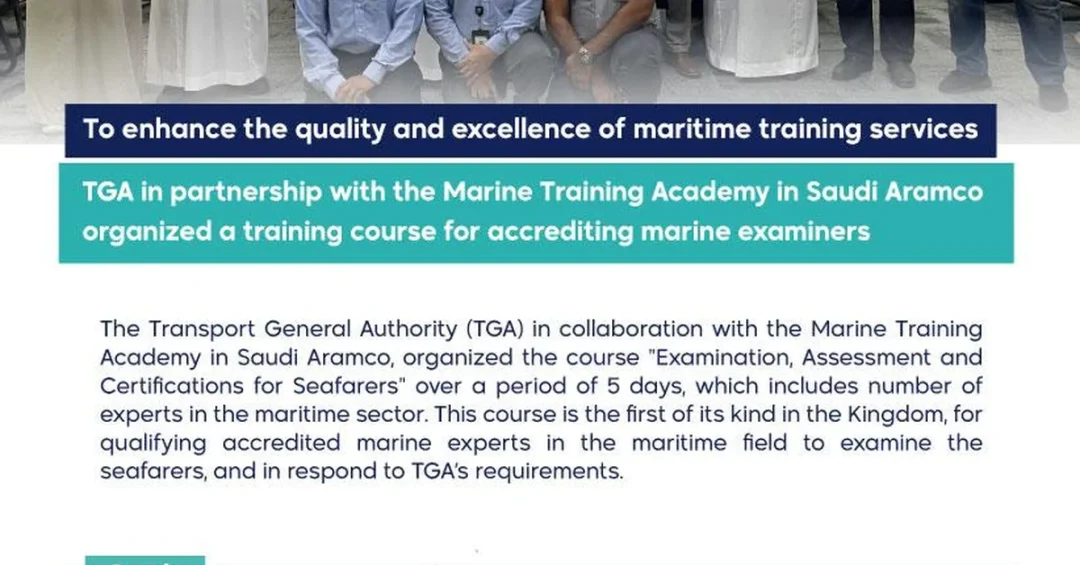
The Transport General Authority (TGA) of Saudi Arabia, in partnership with the Maritime Training Academy at Saudi Aramco, has successfully concluded a pioneering five-day training course in Riyadh aimed at qualifying marine examiners in the Kingdom. The course, titled “Examination, Assessment and Certification for Seafarer,” took place from May 21, 2024, and was attended by experts and specialists in the maritime transport sector, as reported by the Saudi Press Agency (SPA).
Context and Background
This initiative marks the first of its kind in Saudi Arabia, reflecting the Kingdom’s commitment to enhancing the skills and competencies of its maritime workforce. The course was designed to meet the TGA’s requirements for accrediting approved examiners who will be responsible for certifying seafarers in accordance with the International Convention on Standards of Training, Certification and Watchkeeping for Seafarers (STCW) 1978, as amended. By aligning with international standards, Saudi Arabia aims to elevate the proficiency of its seafarers and enhance the overall quality of maritime training services within the Kingdom.
Key Details
The intensive program focused on equipping participants with the necessary knowledge and skills to conduct examinations, assessments, and certifications for seafarers. The Maritime Training Academy at Saudi Aramco received official accreditation from the TGA to host this course, having met all prerequisites outlined in the model course and accreditation criteria. The academy is nationally recognized for its commitment to professional excellence, offering training in ship repair and construction, navigation, marine engineering, and other maritime services. This course further reinforces its role in developing national talent to international standards.
Implications and Impact
The successful completion of this training is expected to have a significant impact on Saudi Arabia’s maritime sector by ensuring a higher standard of seafarer certification and assessment. This aligns with the Kingdom’s broader efforts to boost its maritime capabilities, enhance safety at sea, and position itself as a leading maritime hub in the region. By investing in the professional development of its maritime workforce, Saudi Arabia is also contributing to the global maritime industry by promoting qualified and competent seafarers.
Vision 2030 Alignment
This initiative directly supports the goals of Saudi Vision 2030, which emphasizes the importance of developing human capital and diversifying the economy. By enhancing the skills of its maritime professionals and aligning with international conventions, the Kingdom is strengthening its position as a global logistics and maritime center. This training program is a testament to Saudi Arabia’s commitment to fostering a knowledge-based economy and ensuring the sustainability and growth of its maritime sector for years to come.
20 Questions
Q1. What was the main purpose of the training course organized by TGA and Saudi Aramco?
A1. The course aimed to qualify experts in the maritime field to become approved examiners, enabling them to certify seafarers in Saudi Arabia according to international standards.
Q2. When did the training course take place?
A2. The five-day course was conducted starting May 21, 2024, as reported by the Saudi Press Agency.
Q3. Which international convention guided the course objectives?
A3. The course was aligned with the International Convention on Standards of Training, Certification and Watchkeeping for Seafarers (STCW) 1978, as amended.
Q4. Who organized the training course?
A4. The Transport General Authority (TGA) organized the course in partnership with the Maritime Training Academy at Saudi Aramco.
Q5. Where was the course held?
A5. The course was held in Riyadh, Saudi Arabia, as per the official announcement.
Q6. Was this the first course of its kind in Saudi Arabia?
A6. Yes, it was the first course of its kind in the Kingdom, according to the TGA news release.
Q7. Who participated in the training course?
A7. The course featured the participation of experts and specialists in the maritime transport sector in Saudi Arabia.
Q8. How long was the training course?
A8. The training course lasted for five days.
Q9. What is the role of an approved examiner in the maritime sector?
A9. An approved examiner is responsible for assessing and certifying seafarers to ensure they meet international standards of competence and safety.
Q10. What is the significance of the STCW convention?
A10. The STCW convention sets global standards for the training, certification, and watchkeeping of seafarers, promoting safety and professionalism in maritime operations.
Q11. How can the accreditation of examiners benefit Saudi seafarers?
A11. Accredited examiners will ensure that Saudi seafarers are properly trained and certified, enhancing their employability and enabling them to work internationally.
Q12. What are the main objectives of the course?
A12. The main objectives are to enhance seafarers’ proficiency and skills, contributing to the advancement of the maritime transport sector and elevating the quality of maritime training services.
Q13. Which academy was accredited to conduct the course?
A13. The Maritime Training Academy at Saudi Aramco was accredited by TGA to conduct the course.
Q14. What training does the Maritime Training Academy typically offer?
A14. The academy offers training in ship repair and construction, navigation, marine engineering, and other maritime services, preparing national talent for practical and theoretical excellence.
Q15. How does this initiative support Saudi Arabia’s maritime sector?
A15. By ensuring a higher standard of seafarer certification, the initiative enhances safety, efficiency, and competitiveness in the Kingdom’s maritime operations.
Q16. What news agency reported this development?
A16. The Saudi Press Agency (SPA) reported the news on May 21, 2024.
Q17. How does the course align with international maritime standards?
A17. The course was designed to meet the requirements of the STCW convention, ensuring that Saudi examiners are qualified to assess seafarers according to globally recognized standards.
Q18. What is the expected long-term impact of having qualified examiners?
A18. Qualified examiners will contribute to a more competent and internationally recognized maritime workforce in Saudi Arabia, supporting economic growth and global integration.
Q19. Why is the diversification of skills important for Saudi Arabia?
A19. Diversifying skills aligns with Vision 2030’s goals of building a knowledge-based economy and reducing dependence on oil, fostering sustainable development across sectors.
Q20. What future opportunities could arise from this training?
A20. The training could lead to expanded maritime education programs, increased international partnerships, and greater recognition of Saudi Arabia as a leading maritime training hub.
Reader Feedback
We value your thoughts. Please share your feedback on this article.
Your feedback helps us improve our coverage.