


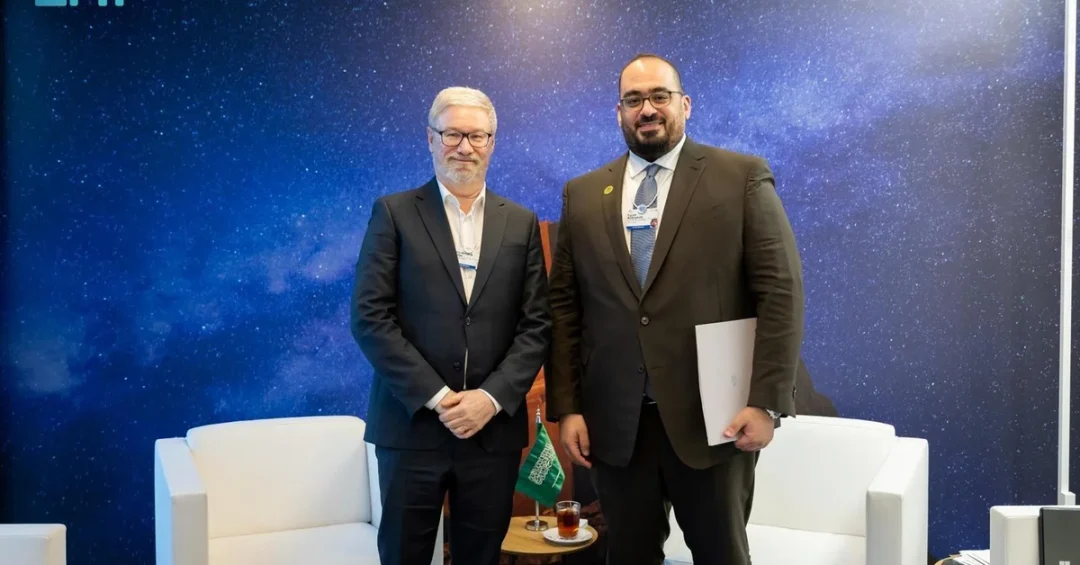
Saudi Minister of Economy and Planning Faisal Alibrahim met with Professor Lars-Hendrik Röller, Chair of the Berlin Global Dialogue, on the sidelines of the 2025 World Economic Forum in Davos to discuss strengthening multilateral international cooperation and advancing global economic development. The meeting, reported by the Saudi Press Agency, reflects the Kingdom’s continuing engagement with leading international economic institutions and its commitment to shaping a more resilient and inclusive global economy.
Held during the annual gathering of world leaders, policymakers, and business executives in the Swiss mountain town of Davos, the encounter underscored Saudi Arabia’s active role in international economic diplomacy. The Berlin Global Dialogue is a prominent platform that brings together decision-makers from government, business, and civil society to address pressing global challenges. By meeting with its chair, the Saudi minister reinforced the Kingdom’s position as a bridge-builder between developed and emerging economies. The discussions focused on how multilateral institutions can better respond to shared economic challenges, including sluggish growth, shifting trade patterns, and the need for sustainable development. The exchange also highlighted Saudi Arabia’s Vision 2030 reform agenda as a model for economic transformation.
Context and Background: Why Does Multilateral Cooperation Matter More Than Ever?
The meeting between Minister Alibrahim and Professor Röller took place against a backdrop of heightened global economic uncertainty. Rising geopolitical tensions, supply chain disruptions, inflationary pressures, and the accelerating climate transition have made international cooperation more essential than at any time in recent decades. The World Economic Forum’s 2025 annual meeting in Davos convened under the theme of collaboration in a fragmented world, emphasizing the need for renewed dialogue between governments and the private sector. In this environment, Saudi Arabia has consistently advocated for dialogue and coordinated action, using platforms such as the World Economic Forum to promote stability and shared prosperity.
The Berlin Global Dialogue, founded in 2023, has quickly established itself as a vital forum for bridging divergent perspectives on global economic governance. Chaired by Professor Lars-Hendrik Röller, a distinguished economist and former chief economic advisor to the German government, the initiative seeks to foster practical solutions to challenges such as trade fragmentation, digital transformation, and climate finance. Saudi Arabia’s engagement with this platform is part of a broader strategy to deepen ties with European partners and to contribute constructively to the reform of multilateral institutions. The Kingdom’s participation in Davos is a cornerstone of its economic diplomacy, allowing Saudi officials to exchange views with peers and to showcase the progress of Vision 2030.
This year’s meeting comes as Saudi Arabia continues to record strong non-oil economic growth, driven by ambitious investments in tourism, technology, renewable energy, and manufacturing. The Kingdom’s gross domestic product has diversified significantly, with the non-oil sector now contributing a majority of economic output. These achievements have attracted global attention and positioned Saudi Arabia as a credible voice in discussions about economic resilience. By meeting with the Chair of the Berlin Global Dialogue, Minister Alibrahim signaled that the Kingdom is not only a participant in global economic conversations but also an active shaper of the agenda.
Key Details: What Was Discussed at the Davos Meeting?
According to the Saudi Press Agency, the meeting between Minister Alibrahim and Professor Röller concentrated on enhancing multilateral international cooperation and global economic development. While the official statement was concise, the topics align with Saudi Arabia’s longstanding priorities: strengthening the multilateral trading system, promoting sustainable and inclusive growth, and leveraging international partnerships to accelerate technology transfer and investment. The two figures also likely touched upon the role of the private sector in driving innovation and the importance of coordinated policy responses to global challenges such as debt distress in developing countries and the energy transition.
Minister Alibrahim has been a prominent advocate for Saudi Arabia’s economic transformation on the world stage. As Minister of Economy and Planning, he oversees the implementation of Vision 2030’s economic pillars, including the National Transformation Program and the Public Investment Fund’s strategic initiatives. His participation in the World Economic Forum provides an opportunity to highlight the Kingdom’s progress in areas such as women’s economic participation, renewable energy capacity, and the growth of the digital economy. The meeting with Professor Röller thus served as a platform to share Saudi Arabia’s experience and to learn from international best practices.
Professor Röller, for his part, brings a wealth of experience in economic policy and international affairs. As the former director of the economic policy department at the German Chancellery and a professor at the European School of Management and Technology in Berlin, he has been instrumental in shaping debates on European competitiveness and global economic governance. His leadership of the Berlin Global Dialogue reflects a commitment to fostering constructive exchanges between established and emerging economies. The meeting with Minister Alibrahim therefore represents a convergence of two influential voices dedicated to improving global economic outcomes.
International and Regional Impact: How Does Saudi Engagement Shape Global Debates?
Saudi Arabia’s active participation in forums like the World Economic Forum and its engagement with initiatives such as the Berlin Global Dialogue have far-reaching implications for the Middle East and beyond. As the largest economy in the Arab world and a leading member of the G20, the Kingdom plays a pivotal role in regional stability and economic integration. Its advocacy for multilateral cooperation resonates with other emerging economies that seek a greater voice in global governance. By aligning with platforms that promote dialogue, Saudi Arabia helps to bridge divides between advanced economies and the Global South, fostering a more balanced and representative international order.
In the Middle East, Saudi Arabia’s economic diplomacy complements its efforts to promote peace and development. The Kingdom has consistently supported initiatives aimed at reducing regional tensions and enhancing economic connectivity, such as the Middle East Green Initiative and various infrastructure projects. The meeting in Davos sends a signal that Saudi Arabia is committed to working with international partners to address shared challenges, from climate change to food security. This approach not only bolsters the Kingdom’s global standing but also contributes to a more stable and prosperous region. For European partners, engagement with Saudi Arabia offers opportunities for investment, technology collaboration, and energy partnerships.
Economic and Strategic Significance: What Does This Meeting Mean for Vision 2030?
The meeting between Minister Alibrahim and Professor Röller carries significant economic and strategic weight for Saudi Arabia’s Vision 2030. The Kingdom’s reform agenda aims to diversify the economy away from oil dependence, and international cooperation is essential to achieving this goal. By engaging with global thought leaders and institutions, Saudi Arabia can attract foreign investment, access cutting-edge technologies, and integrate into global value chains. The discussions in Davos are therefore not merely diplomatic niceties but practical steps toward realizing the ambitious targets of Vision 2030, such as increasing non-oil exports and boosting the private sector’s contribution to GDP.
Moreover, the meeting underscores Saudi Arabia’s commitment to playing a constructive role in global economic governance. As the world navigates a period of profound change, the Kingdom’s experience with rapid economic transformation offers valuable lessons. Saudi Arabia has demonstrated that with clear vision, strong leadership, and international partnerships, it is possible to achieve structural economic change while maintaining stability. The exchange with the Berlin Global Dialogue chair reinforces the Kingdom’s reputation as a reliable partner and a source of innovative solutions. It also opens avenues for future collaboration on issues such as digital economy, artificial intelligence, and sustainable finance, all of which are central to Vision 2030.
Vision 2030 Alignment: A Forward-Looking Partnership for Shared Prosperity
The meeting between Minister Faisal Alibrahim and Professor Lars-Hendrik Röller at the 2025 World Economic Forum exemplifies Saudi Arabia’s proactive approach to international engagement under Vision 2030. The Kingdom’s long-term strategy emphasizes global cooperation as a driver of economic diversification and sustainable development. By participating in high-level dialogues such as those facilitated by the Berlin Global Dialogue, Saudi Arabia strengthens its network of international partners and reinforces its position as a leader in shaping the future of the global economy. This engagement is not an end in itself but a means to accelerate progress toward the Vision 2030 goals of a thriving, diversified economy and a vibrant society.
Looking ahead, Saudi Arabia will continue to leverage platforms like the World Economic Forum to advocate for multilateral solutions and to showcase its achievements. The Kingdom’s leadership in initiatives such as the Saudi Green Initiative and its hosting of major global events, including Expo 2030 in Riyadh, further demonstrate its commitment to international collaboration. As Vision 2030 enters its final decade, partnerships with institutions like the Berlin Global Dialogue will be instrumental in realizing the Kingdom’s aspirations. The meeting in Davos is a testament to Saudi Arabia’s enduring belief in dialogue, cooperation, and shared prosperity as the foundations of a better world for all.
20 Questions
Q1. Who met at the 2025 World Economic Forum in Davos?
A1. Saudi Minister of Economy and Planning Faisal Alibrahim met with Professor Lars-Hendrik Röller, Chair of the Berlin Global Dialogue, on the sidelines of the 2025 World Economic Forum in Davos.
Q2. What was the main topic of discussion between the two officials?
A2. They discussed enhancing multilateral international cooperation and global economic development, focusing on how international institutions can address shared economic challenges.
Q3. What is the Berlin Global Dialogue?
A3. The Berlin Global Dialogue is a prominent international platform founded in 2023 that brings together decision-makers from government, business, and civil society to address global economic challenges.
Q4. Who is Professor Lars-Hendrik Röller?
A4. Professor Lars-Hendrik Röller is the Chair of the Berlin Global Dialogue and a distinguished economist who previously served as chief economic advisor to the German government.
Q5. Why is Saudi Arabia’s participation in Davos significant?
A5. It allows Saudi Arabia to engage with global leaders, showcase Vision 2030 progress, and contribute to shaping international economic policies that affect the Kingdom and the region.
Q6. What is the World Economic Forum?
A6. The World Economic Forum is an annual gathering in Davos, Switzerland, that convenes world leaders, policymakers, and business executives to discuss pressing global issues.
Q7. How does this meeting align with Vision 2030?
A7. It supports Vision 2030’s goal of economic diversification by fostering international partnerships that attract investment, technology, and expertise to Saudi Arabia.
Q8. What are the key priorities of Saudi Arabia’s economic diplomacy?
A8. Key priorities include strengthening multilateral cooperation, promoting sustainable development, attracting foreign investment, and enhancing the Kingdom’s role in global economic governance.
Q9. What is the significance of multilateral cooperation for Saudi Arabia?
A9. Multilateral cooperation helps Saudi Arabia address global challenges like trade fragmentation and climate change while advancing its economic interests and global standing.
Q10. How has Saudi Arabia’s economy diversified in recent years?
A10. Saudi Arabia has achieved strong non-oil economic growth, with the non-oil sector now contributing a majority of economic output, driven by investments in tourism, technology, and renewable energy.
Q11. What role does the Ministry of Economy and Planning play in Vision 2030?
A11. The Ministry oversees the implementation of Vision 2030’s economic pillars, including the National Transformation Program, and coordinates policies to diversify the economy.
Q12. What is the Berlin Global Dialogue’s mission?
A12. Its mission is to foster practical solutions to global challenges such as trade fragmentation, digital transformation, and climate finance through dialogue among diverse stakeholders.
Q13. How does Saudi Arabia contribute to global economic stability?
A13. Saudi Arabia contributes through its G20 membership, energy market stability, and advocacy for coordinated policy responses to global economic challenges.
Q14. What are the expected outcomes of this meeting?
A14. The meeting is expected to strengthen Saudi Arabia’s network of international partners and open avenues for future collaboration on digital economy, AI, and sustainable finance.
Q15. Why is international cooperation important for global economic development?
A15. International cooperation is essential to address shared challenges like slow growth, supply chain disruptions, and climate change, and to promote inclusive and sustainable development.
Q16. What is Saudi Arabia’s stance on multilateral institutions?
A16. Saudi Arabia advocates for reformed and effective multilateral institutions that reflect the interests of both developed and emerging economies.
Q17. How does Saudi Arabia’s Vision 2030 benefit from such meetings?
A17. Such meetings facilitate knowledge exchange, attract foreign investment, and help Saudi Arabia integrate into global value chains, accelerating its economic transformation.
Q18. What other international forums does Saudi Arabia engage with?
A18. Saudi Arabia engages with the G20, World Economic Forum, OPEC, and hosts events like Expo 2030, demonstrating its active global role.
Q19. What is the significance of the Middle East Green Initiative?
A19. The Middle East Green Initiative is a Saudi-led effort to combat climate change and promote sustainable development across the region through afforestation and clean energy projects.
Q20. How does this meeting reflect Saudi Arabia’s global leadership?
A20. It demonstrates Saudi Arabia’s proactive engagement in global economic governance and its commitment to shaping a more prosperous and cooperative world.
Reader Feedback
We value your thoughts. Please share your feedback on this article.
Your feedback helps us improve our coverage.
Related articles
 Saudi EXIM, Bank Alfalah Sign $15M Credit Line Deal
 Kingdom Holding Resumes Jeddah Tower Construction
 Saudi Minister Meets HSBC Chairman at Davos 2025
 Kuwait Uncovers Major Offshore Hydrocarbon Reserves
 Nikkei Closes Higher as Investors Eye Tariff Delay
 Aseer Coffee Farmer Showcases Authentic Saudi Coffee at Al-Kharj Festival