


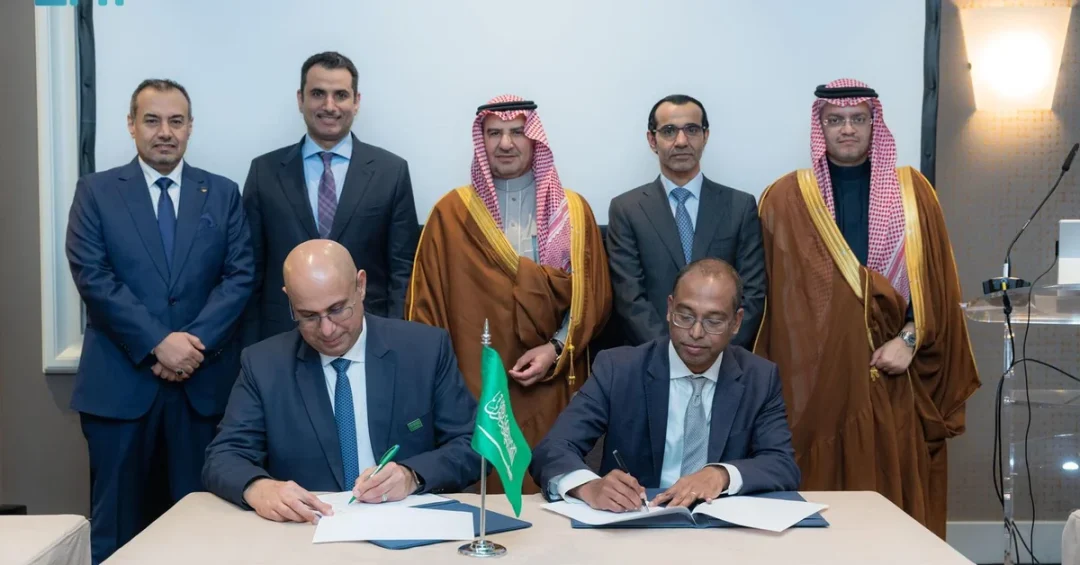
The Saudi Export-Import Bank (Saudi EXIM) has signed a $300 million credit facility agreement with Glencore, one of the world’s largest commodity production and marketing companies, in a deal set to expand the reach of Saudi non-oil exports to more than 156 international markets. The agreement, announced via the Saudi Press Agency (SPA), was formalized during a high-level roundtable meeting in Geneva, Switzerland, organized by Saudi EXIM in collaboration with the Ministry of Industry and Mineral Resources. The event, titled “Saudi Arabia: A Crossroads for International Trade in Goods,” brought together representatives from major financial and investment institutions from around the world, underscoring the Kingdom’s growing role as a global hub for trade and investment.
The landmark deal reflects Saudi Arabia’s strategic push to diversify its economy beyond hydrocarbons, positioning mining as a third pillar of national industry alongside oil and petrochemicals. Under the agreement, Saudi EXIM will finance Glencore to enhance its purchases of minerals exported from the Kingdom and market them to international buyers across more than 156 countries. This collaboration is expected to strengthen the global footprint of Saudi mineral exports, unlock new commercial opportunities, and reinforce the Kingdom’s emergence as a critical supplier of minerals essential to modern industries and everyday life.
Context and Background
How did Saudi Arabia arrive at a point where its mineral wealth is attracting the attention of global commodity giants like Glencore? The answer lies in a decades-long economic transformation strategy that has accelerated under Saudi Vision 2030, the national blueprint launched in 2016 by Crown Prince Mohammed bin Salman. Central to this vision is the development of the mining sector as a key engine of non-oil growth, with estimates suggesting the Kingdom holds untapped mineral reserves worth approximately $2.5 trillion. The Ministry of Industry and Mineral Resources has been at the forefront of efforts to regulatory frameworks, attract foreign investment, and promote Saudi Arabia as a premier destination for mining and mineral processing.
Saudi EXIM, established in 2020, plays a pivotal role in this strategy by providing financing, guarantees, and insurance to support Saudi exporters and enable their entry into international markets. The bank’s mandate aligns directly with Vision 2030 objectives, particularly the goal of increasing non-oil exports as a share of GDP. The agreement with Glencore, a Swiss-based multinational with operations spanning metals, minerals, and energy, represents a significant vote of confidence in the quality and competitiveness of Saudi mineral products. It also signals the growing integration of Saudi Arabia into global supply chains for critical minerals such as copper, zinc, and rare earth elements, which are indispensable for renewable energy technologies, electric vehicles, and advanced manufacturing.
The Geneva roundtable served as a platform to showcase Saudi Arabia’s mineral potential and to attract global export houses to invest in the Saudi market. By bringing together financial institutions and industry leaders, Saudi EXIM and the Ministry of Industry and Mineral Resources aimed to foster partnerships that can accelerate the flow of Saudi goods to international buyers. This event is part of a broader outreach effort that includes participation in major international trade fairs, bilateral trade negotiations, and the establishment of special economic zones designed to facilitate export-oriented industries.
Key Details of the Agreement
What exactly does the $300 million credit facility entail, and how will it function in practice? According to official statements released by SPA, Saudi EXIM will provide financing to Glencore to support the company’s procurement of minerals from Saudi Arabia. These minerals will then be marketed and sold by Glencore to customers in over 156 countries, leveraging the company’s extensive global network and expertise in commodity trading. The agreement is structured as a credit facility, meaning Glencore can draw down funds to finance purchases from Saudi miners and exporters, thereby reducing financial barriers and enabling smoother transactions.
Eng. Saad Al-Khalb, CEO of Saudi EXIM, emphasized that the agreement is part of integrated efforts to achieve Vision 2030 objectives and the National Industrial Strategy. He noted that the Kingdom seeks to become a global center for mineral production and manufacturing, with mining regarded as a third pillar of national industry. “This agreement will facilitate the flow of mining products from Saudi Arabia to international markets, and we believe Glencore’s marketing expertise will unlock new investment and commercial opportunities, further strengthening ties between Saudi Arabia and countries worldwide,” Al-Khalb said. His remarks highlight the dual economic and diplomatic value of the deal, which not only boosts exports but also deepens Saudi Arabia’s relationships with trading partners across continents.
Jyothish George, Head of Copper Marketing at Glencore, expressed delight in partnering with Saudi EXIM and commended Saudi Arabia’s vital role in supplying and developing the critical minerals needed to advance everyday life. He reiterated Glencore’s commitment to advancing the Kingdom’s Vision 2030 objectives. The partnership thus brings together a national export credit agency with a global commodity powerhouse, creating a synergy that could serve as a model for future collaborations. The agreement also aligns with global efforts to develop investments in the mining sector, particularly as demand for critical minerals surges due to the energy transition and technological innovation.
International and Regional Impact
How will this agreement resonate beyond Saudi Arabia’s borders, and what does it mean for global mineral markets? The deal positions Saudi Arabia as a reliable and competitive source of minerals, which is increasingly important as countries seek to diversify their supply chains away from traditional producers. By partnering with Glencore, Saudi exporters gain immediate access to a vast distribution network that spans 156 markets, including major economies in Asia, Europe, and the Americas. This enhanced market access can lead to higher export volumes, improved price realization, and greater bargaining power for Saudi mining companies.
Regionally, the agreement reinforces Saudi Arabia’s role as a leader in the Middle East’s economic diversification efforts. It demonstrates that the Kingdom is not only a major oil exporter but also a rising player in the minerals sector, which is vital for the region’s industrial development. For Glencore, the partnership secures a new source of supply from a stable and resource-rich country, complementing its existing operations in Africa, South America, and Australia. The collaboration could also stimulate further investment in Saudi mining infrastructure, including transportation, processing facilities, and logistics hubs, creating a virtuous cycle of growth and job creation.
Economic and Strategic Significance
Why does this agreement matter for Saudi Arabia’s long-term economic strategy? The $300 million credit facility is more than a financial transaction; it is a strategic tool to accelerate the development of the mining sector and enhance its contribution to non-oil GDP. Mining is a capital-intensive industry that requires significant upfront investment in exploration, extraction, and processing. By providing financing to a major buyer like Glencore, Saudi EXIM reduces the risk for Saudi miners and encourages them to increase production. This, in turn, can attract further foreign direct investment and stimulate the growth of ancillary industries, such as equipment manufacturing, engineering services, and skilled labor training.
Moreover, the agreement supports the National Industrial Strategy, which aims to increase the industrial sector’s contribution to GDP and boost non-oil exports. Mining is identified as a priority sector due to its high value-added potential and linkages to other industries. The partnership with Glencore also aligns with Saudi Arabia’s efforts to secure access to critical minerals for its own domestic industries, including renewable energy, electronics, and electric vehicles. As the Kingdom builds out its industrial base, a reliable supply of minerals will be essential, and this agreement helps ensure that Saudi minerals are competitively positioned in global markets.
Vision 2030 Alignment
How does this agreement fit into the broader narrative of Saudi Vision 2030? Vision 2030 seeks to transform the Kingdom into a diversified, innovation-driven economy, with mining as a key pillar of industrial growth. The agreement with Glencore directly supports several Vision 2030 objectives, including increasing non-oil exports, attracting foreign investment, creating jobs, and enhancing the Kingdom’s global competitiveness. It also underscores Saudi Arabia’s commitment to international cooperation and trade, as reflected in the roundtable meeting in Geneva that brought together global financial institutions.
Looking ahead, the partnership between Saudi EXIM and Glencore is expected to pave the way for more such agreements, as Saudi Arabia continues to open its mining sector to global players. The Kingdom’s mineral wealth, combined with its strategic location, modern infrastructure, and supportive government policies, makes it an attractive destination for investment. By enabling Saudi mining products to reach over 156 markets, this agreement not only boosts exports but also strengthens Saudi Arabia’s position as a pivotal player in the global economy, contributing to the success of Vision 2030 and the prosperity of future generations.
20 Questions
Q1. What is the Saudi Export-Import Bank (Saudi EXIM)?
A1. Saudi EXIM is a government entity established in 2020 to support Saudi non-oil exports by providing financing, guarantees, and insurance to exporters and international buyers.
Q2. Who signed the $300 million credit facility agreement?
A2. The agreement was signed by Eng. Saad Al-Khalb, CEO of Saudi EXIM, and Jyothish George, Head of Copper Marketing at Glencore.
Q3. Where was the agreement signed?
A3. It was signed during a roundtable meeting in Geneva, Switzerland, organized by Saudi EXIM and the Ministry of Industry and Mineral Resources.
Q4. What is the purpose of the credit facility?
A4. The facility will finance Glencore’s purchases of Saudi minerals and help market them to international buyers in over 156 countries.
Q5. How many markets will Saudi mining products access through this deal?
A5. The agreement enables access to more than 156 markets worldwide, significantly expanding the reach of Saudi mineral exports.
Q6. What is Glencore’s role in the agreement?
A6. Glencore will use the financing to buy minerals from Saudi Arabia and leverage its global network to sell them to international customers.
Q7. What did Eng. Saad Al-Khalb say about the agreement?
A7. He said it supports Vision 2030 and the National Industrial Strategy, positioning mining as a third pillar of national industry and enhancing Saudi mineral exports.
Q8. What did Jyothish George say about the partnership?
A8. He expressed delight in partnering with Saudi EXIM and commended Saudi Arabia’s vital role in supplying critical minerals needed for everyday life.
Q9. What is the significance of mining for Saudi Arabia’s economy?
A9. Mining is considered a third pillar of national industry, with estimated mineral reserves worth $2.5 trillion, and is key to economic diversification.
Q10. How does this agreement align with Vision 2030?
A10. It supports Vision 2030 goals of increasing non-oil exports, attracting foreign investment, and establishing Saudi Arabia as a global mining hub.
Q11. What was the title of the roundtable meeting in Geneva?
A11. The meeting was titled “Saudi Arabia: A Crossroads for International Trade in Goods.”
Q12. Who organized the roundtable meeting?
A12. It was organized by Saudi EXIM in collaboration with the Ministry of Industry and Mineral Resources.
Q13. What types of minerals are involved in the agreement?
A13. The agreement covers minerals exported from Saudi Arabia, including copper, zinc, and rare earth elements, though specific minerals are not limited.
Q14. How will the credit facility benefit Saudi miners?
A14. It reduces financial barriers by providing financing to Glencore, enabling smoother transactions and encouraging increased production from Saudi miners.
Q15. What is the National Industrial Strategy?
A15. It is a Saudi initiative to diversify the industrial base, increase non-oil GDP, and promote sectors like mining, manufacturing, and logistics.
Q16. How does this agreement impact global mineral supply chains?
A16. It diversifies supply sources by introducing Saudi minerals to global markets, enhancing supply security for critical minerals essential to modern technologies.
Q17. What are the expected economic benefits for Saudi Arabia?
A17. Benefits include increased non-oil exports, job creation, foreign investment, and strengthened global economic ties, contributing to sustainable growth.
Q18. Will this agreement lead to more similar deals?
A18. Yes, it is expected to pave the way for further partnerships as Saudi Arabia continues to open its mining sector to international players.
Q19. How does Saudi EXIM support Saudi exporters?
A19. Saudi EXIM provides financing, guarantees, and insurance to help exporters enter international markets and compete globally.
Q20. What is the broader significance of this agreement for Saudi Arabia’s global role?
A20. It reinforces Saudi Arabia’s position as a reliable trade partner and a rising player in the global minerals market, advancing Vision 2030 objectives.
Reader Feedback
We value your thoughts. Please share your feedback on this article.
Your feedback helps us improve our coverage.
Related articles
 Farmers’ Market in AlUla Gains Economic Boost
 IsDB, Türkiye Sign €246.4M Railway Financing Deal
 SAMA Hosts FSB MENA Meeting in Riyadh
 Monsha’at, Google Launch SMB Lab to Empower Saudi SMBs with AI
 Record-Breaking Turnout at Saudi Building Exhibition 2024
 CEDA Reviews Global and Local Economic Developments