


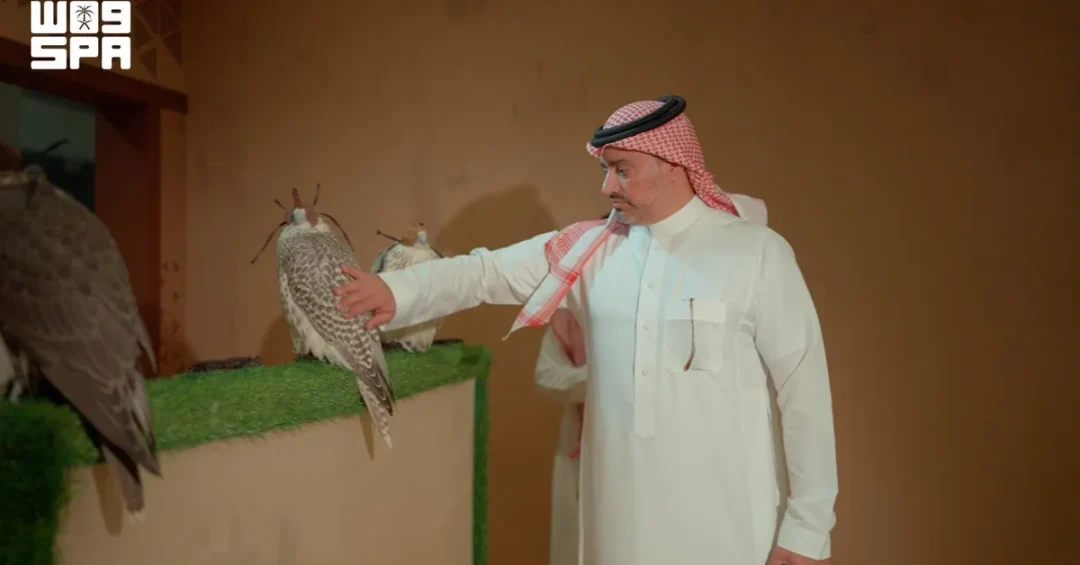
Saudi investor Abdulaziz bin Mohammed Al Jalban has invested approximately SAR6 million in the Kingdom’s falconry sector and recovered his capital within the first year of operation, according to a report released by the Saudi Press Agency (SPA). The announcement, dated August 12, 2026, highlights how institutional support from the National Center for Falcons, a growing calendar of competitions, and rising demand for falcons are transforming a cherished national tradition into a structured and profitable investment sector.
Al Jalban’s venture began with the acquisition of a Canadian breeding farm with an established track record, followed by the establishment of his own farm inside the Kingdom. His total investment — covering production, purchases, and the acquisition of the Canadian operation — amounted to roughly SAR6 million. What started as a personal hobby has evolved into a commercial enterprise that is already outperforming the global benchmark for capital recovery in falconry investment, which typically stands at around three years. For international observers, the story offers a clear window into how Saudi Arabia is cultivating heritage-based industries as part of its broader economic diversification agenda.
Context and Background
How did falconry, for centuries a practical pursuit tied to desert life and survival, become a modern investment asset class in Saudi Arabia? Falconry has deep roots in Arabian culture, historically practiced by Bedouin communities who trained falcons for hunting. Today, it is recognized by UNESCO as intangible cultural heritage and enjoys official patronage across the Gulf. In Saudi Arabia, the establishment of the National Center for Falcons has provided a regulatory and organizational framework that gives investors confidence, standardizes practices, and connects breeders with a fast-expanding competitive circuit.
The center’s support has been instrumental in formalizing what was once a largely informal market. By integrating falcon production with organized competitions, Saudi authorities have created a predictable demand cycle: breeders know that elite birds will have a stage on which to prove their value, and buyers know that competitions will showcase quality. This integration reduces market uncertainty and makes investment calculations more reliable. Al Jalban explicitly credited the center’s organizational efforts and support for enhancing the sector’s investment appeal, noting that these factors were central to his decision to commit significant capital.
The Kingdom remains the world’s strongest market for falcons, a position built on deep cultural appreciation, high disposable incomes among enthusiasts, and a growing number of international and domestic competitions. This status gives Saudi investors a natural home-field advantage while also positioning them to serve export markets. The SPA report notes that Al Jalban is confident in the potential for Saudi falcon production to expand internationally, even as domestic demand remains the primary driver of value. That dual-market dynamic — a robust local base with export upside — is precisely what makes the sector attractive to long-term investors.
Key Details of the Investment
What does a SAR6 million falconry portfolio actually look like on the ground? According to the SPA report, Al Jalban’s farm currently houses more than 100 falcons, with a deliberate emphasis on quality over quantity. This approach reflects a broader truth about the falconry market: value is concentrated in a relatively small number of high-performing birds, and reputation is built on the consistent production of elite falcons rather than on volume. By acquiring a Canadian farm with a proven track record, Al Jalban secured both genetics and know-how — two assets that cannot be replicated quickly.
The decision to then establish a farm in the Kingdom signals confidence in the local operating environment. Saudi Arabia offers modern infrastructure, specialized veterinary services, and a regulatory framework that supports responsible breeding. The combination of imported expertise and domestic production creates a feedback loop: the Canadian operation provides foundational bloodlines and international market intelligence, while the Saudi farm benefits from proximity to the largest concentration of falcon buyers in the world. Al Jalban described his entry into the sector as the result of a careful study of available investment opportunities, underscoring that this was a calculated business decision rather than an impulse purchase.
The financial performance is perhaps the most striking detail. The global investment benchmark in falconry typically targets recovering capital within approximately three years. Al Jalban recovered his initial investment within the first year. That outcome reflects strong demand, disciplined cost management, and the premium that buyers are willing to pay for quality falcons. It also suggests that the Saudi market’s depth — the sheer number of enthusiasts, competitions, and institutional buyers — can accelerate returns in ways that smaller markets cannot. For investors evaluating the sector, the first-year capital recovery provides a powerful proof of concept.
International and Regional Impact
What does a profitable Saudi falconry sector mean beyond the Kingdom’s borders? Falconry is a global pursuit with significant markets in the Gulf, Central Asia, Europe, and North America. Saudi Arabia’s emergence as a production hub — not just a consumption market — could reshape trade flows over time. If Saudi-bred falcons gain a reputation for quality, they could compete with established breeders in Europe and North America, particularly in the premium segment where buyers prioritize performance and lineage. Al Jalban’s acquisition of a Canadian farm is itself a sign of cross-border integration, bringing international expertise into the Saudi ecosystem.
Regionally, the sector’s growth reinforces the Gulf’s position as a center of gravity for heritage sports. Competitions in Saudi Arabia and neighboring countries draw participants and spectators from around the world, creating a tourism and hospitality spillover that extends well beyond falconry itself. International visitors attending competitions need hotels, transport, and services, and they often extend their stays to explore cultural and natural attractions. In this way, a niche investment sector contributes to broader tourism and cultural-exchange objectives. The SPA report’s emphasis on the integration of production with competitions highlights how deliberately this ecosystem is being designed.
Economic and Strategic Significance
Why should international observers pay attention to a single SAR6 million investment? Because it illustrates a larger pattern in Saudi Arabia’s economic evolution. The Kingdom is actively developing specialized, high-value sectors that combine cultural authenticity with commercial viability. Falconry fits this model precisely: it is globally unique to the region’s heritage, it commands premium prices, and it can be institutionalized through regulation, competitions, and breeding standards. Successful early investors like Al Jalban provide visible case studies that encourage others to enter, which in turn deepens the market and attracts further investment.
The sector also supports employment and skills development. Breeding farms require veterinarians, trainers, handlers, and administrative staff, creating skilled jobs in areas that might otherwise have limited economic opportunities. As the number of farms grows, so does the demand for specialized training programs and research into avian health and genetics. This knowledge base can become an export in its own right, with Saudi expertise in desert-adapted falconry attracting international interest. The strategic significance, therefore, extends beyond direct revenue: falconry is becoming a vehicle for capability-building in veterinary science, logistics, and event management.
Vision 2030 Alignment
How does a profitable falconry farm connect to Saudi Vision 2030? The Vision’s core objective is to diversify the economy away from oil dependence by developing new revenue streams, empowering the private sector, and creating jobs for Saudi citizens. Heritage-based industries like falconry contribute on all three fronts. They generate private-sector investment, create specialized employment, and attract international visitors and buyers. The National Center for Falcons’ role in organizing and supporting the sector exemplifies the Vision’s emphasis on smart regulation that enables rather than constrains business growth.
Moreover, falconry embodies the Vision’s commitment to preserving cultural identity while modernizing. Saudi Arabia is not choosing between tradition and progress; it is demonstrating that tradition can be a foundation for progress. Al Jalban’s journey from hobbyist to profitable investor is a personal story, but it is also a national one: it shows that the Kingdom’s cultural assets are economically valuable and globally competitive. As more investors follow this path, Saudi Arabia strengthens its position as the world’s leading falconry market and a credible exporter of premium falcons. The first-year capital recovery reported by SPA is not just a financial milestone — it is evidence that the Kingdom’s heritage economy is open for business.
20 Questions
Q1. Who is the investor behind the SAR6 million falconry venture?
A1. Abdulaziz bin Mohammed Al Jalban, a Saudi investor who entered the falconry sector after studying available opportunities. He acquired a Canadian breeding farm and established his own farm in the Kingdom, turning a personal hobby into a commercial enterprise.
Q2. How much did Al Jalban invest in the falconry sector?
A2. His total investment, including production, purchases, and the acquisition of the Canadian breeding farm, amounted to approximately SAR6 million. This covered both the international acquisition and the establishment of his domestic farm operation.
Q3. How quickly did he recover his investment?
A3. Al Jalban recovered his initial investment within the first year of operation. This significantly outperformed the global benchmark, which typically targets capital recovery within approximately three years in the falconry sector.
Q4. How many falcons are currently housed at his farm?
A4. His farm currently houses more than 100 falcons. He emphasized a focus on quality rather than quantity, reflecting the market reality that value is concentrated in a relatively small number of high-performing birds.
Q5. What role does the National Center for Falcons play?
A5. The National Center for Falcons provides institutional support and organizational efforts that enhance the sector’s investment appeal. It helps standardize practices, connects breeders with competitions, and creates a predictable demand cycle for quality falcons.
Q6. Why is Saudi Arabia the world’s strongest market for falcons?
A6. Saudi Arabia has deep cultural appreciation for falconry, high disposable incomes among enthusiasts, and a growing number of domestic and international competitions. This combination creates robust demand and premium pricing for quality birds.
Q7. What was the strategic reason for acquiring a Canadian farm?
A7. The Canadian farm had an established track record, providing proven genetics, breeding expertise, and international market intelligence. This acquisition gave Al Jalban a foundation of quality and know-how that would be difficult to replicate quickly.
Q8. How does integrating production with competitions help investors?
A8. It creates a predictable demand cycle where elite birds have a stage to prove their value. Breeders know competitions will showcase quality, reducing market uncertainty and making investment calculations more reliable for long-term planning.
Q9. What is the global benchmark for capital recovery in falconry?
A9. The global investment benchmark typically targets recovering capital within approximately three years. Al Jalban’s first-year recovery significantly exceeded this standard, demonstrating the strong economic potential of the Saudi market.
Q10. Can Saudi falcon production expand into international markets?
A10. Yes, Al Jalban expressed confidence in the potential for Saudi falcon production to expand internationally. While the Kingdom remains the strongest domestic market, quality Saudi-bred falcons could compete in premium export segments globally.
Q11. What determines a falcon’s value in the market?
A11. Quality is the ultimate determinant of a product’s value in any market, according to Al Jalban. Performance, lineage, health, and training all contribute to a falcon’s premium pricing in competitive markets.
Q12. How does falconry support Saudi Vision 2030?
A12. Falconry contributes to economic diversification, private-sector growth, and job creation in specialized fields. It also preserves cultural heritage while generating commercial value, aligning with Vision 2030’s goals of modernization and tradition preservation.
Q13. What types of jobs does the falconry sector create?
A13. Breeding farms require veterinarians, trainers, handlers, and administrative staff. As the sector grows, demand increases for specialized training programs and research into avian health and genetics, creating skilled employment opportunities.
Q14. Is falconry recognized as cultural heritage?
A14. Yes, falconry is recognized by UNESCO as intangible cultural heritage. It has deep roots in Arabian culture, historically practiced by Bedouin communities for hunting and now enjoying official patronage across the Gulf region.
Q15. What makes the Saudi falconry market attractive to investors?
A15. Institutional support, a growing competition calendar, rising demand, and the Kingdom’s position as the world’s strongest falcon market all contribute. These factors reduce uncertainty and create predictable returns for quality-focused breeders.
Q16. How does falconry contribute to tourism in Saudi Arabia?
A16. Competitions draw participants and spectators from around the world, creating demand for hotels, transport, and services. International visitors often extend stays to explore cultural and natural attractions, supporting broader tourism objectives.
Q17. What was Al Jalban’s original connection to falconry?
A17. Falconry began as a personal hobby for Al Jalban. Over time, he studied the investment opportunities and gradually developed it into a business venture, demonstrating how passion can translate into commercial success.
Q18. How does the Saudi falconry sector compare globally?
A18. Saudi Arabia is the world’s strongest market for falcons. Its combination of cultural appreciation, purchasing power, and institutional support gives it a unique advantage over other markets in the Gulf, Central Asia, Europe, and North America.
Q19. What does the first-year capital recovery signify for the sector?
A19. It provides a powerful proof of concept for investors evaluating the sector. Strong demand, disciplined cost management, and premium pricing for quality falcons can accelerate returns in ways that smaller markets cannot match.
Q20. What is the future outlook for Saudi falconry investment?
A20. The outlook is positive, with expanding institutional support, growing competitions, and rising demand. As more investors follow successful examples, the sector is expected to deepen, attract further capital, and strengthen Saudi Arabia’s global leadership in falconry.
Reader Feedback
We value your thoughts. Please share your feedback on this article.
Your feedback helps us improve our coverage.
Related articles
 Oman Issues 80M Rial Development Bonds with 4.5% Coupon
 Gold Prices Rise as Dollar Dips, Fed Holds Rates
 Najran Youth Bazaar Showcases Young Saudi Talent
 Buraidah Dates Carnival Showcases Farm-to-Shopper Journey
 Al-Ahsa Limes Expand Reach in Local and Gulf Markets
 International Dates Council to Hold Regional Workshop in Cairo