


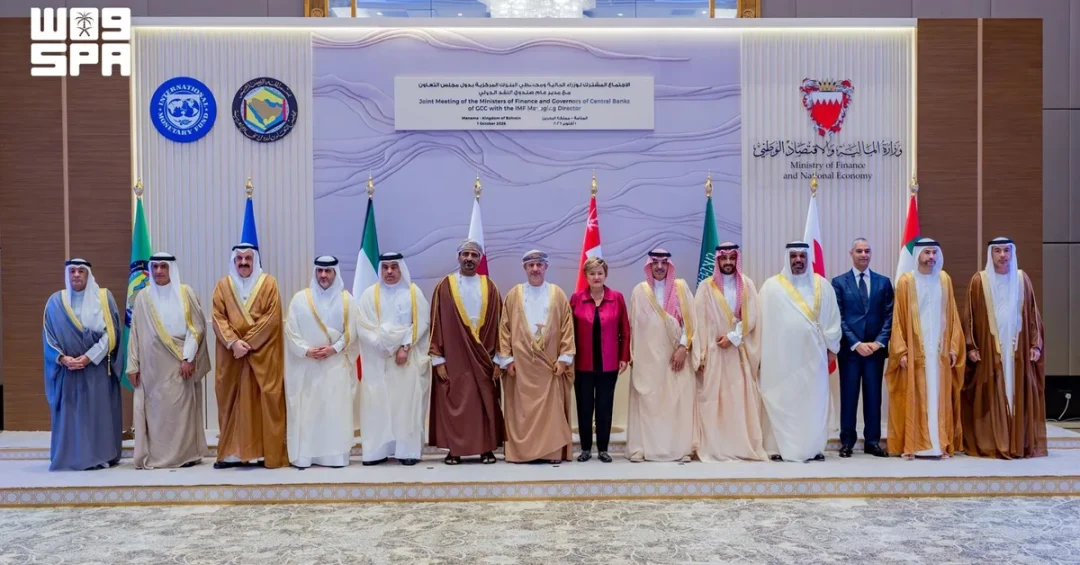
Saudi Minister of Finance Mohammed Aljadaan headed the Kingdom’s delegation at the 126th Meeting of the Financial and Economic Cooperation Committee of the Gulf Cooperation Council (GCC), held on October 1, 2026, in the Kingdom of Bahrain, the Saudi Press Agency reported. The high-level gathering brought together the finance ministers of the six GCC member states and the Secretary-General of the Gulf Cooperation Council to review the bloc’s shared financial and economic agenda, including the latest progress on the GCC Customs Union and the adoption of the Periodic Report on Monitoring the Progress of the Gulf Common Market.
The meeting was chaired by the Minister of Finance and National Economy of the Kingdom of Bahrain, Sheikh Salman Al Khalifa, reflecting Bahrain’s rotating leadership of the committee’s work. Alongside the customs and common market files, the ministers examined regional developments and their potential implications for GCC economies, and explored ways to deepen joint coordination in responding to them. Minister Aljadaan also took part in a joint meeting between the GCC finance ministers and central bank governors and the Managing Director of the International Monetary Fund (IMF), Kristalina Georgieva, where participants discussed an IMF paper titled “Economic Prospects and Policy Challenges: Enhancing Economic Resilience to Geopolitical Shocks.”
Context and Background
Why does a single committee meeting in Manama matter to markets and policymakers far beyond the Gulf? The Financial and Economic Cooperation Committee is one of the oldest and most consequential bodies of the Gulf Cooperation Council, which was founded in 1981 and today comprises the Kingdom of Saudi Arabia, the United Arab Emirates, the State of Kuwait, the Kingdom of Bahrain, the State of Qatar, and the Sultanate of Oman. Since its establishment, the committee has served as the principal platform where the bloc’s finance ministers align fiscal policy, harmonize financial regulation, and review the practical steps needed to turn the GCC’s founding vision of economic integration into measurable results.
The committee’s mandate spans an unusually wide range of files, from customs procedures and tariff structures to cross-border investment rules and the free movement of goods, services, capital, and labor. Its periodic meetings create a rhythm of accountability: ministers do not simply set targets, they receive detailed reports on what has been achieved since the previous session and identify where implementation is lagging. That discipline has become more important as the GCC economies have grown in size and complexity, and as global supply chains have been reorganized around new risk calculations.
The 126th session continues this tradition at a moment when the global economy is navigating elevated geopolitical uncertainty, shifting energy markets, and rapidly evolving financial technology. For Saudi Arabia, which holds the largest economy in the Gulf and is the world’s leading oil exporter, the committee is a natural venue for advancing its Vision 2030 agenda of economic diversification and deeper regional integration. The Kingdom’s participation, led by Minister Aljadaan, signals that Riyadh treats Gulf coordination not as a diplomatic courtesy but as a core element of its economic strategy.
Key Details of the 126th Meeting
What exactly did the ministers place on the table in Bahrain? According to the official Saudi Press Agency report, the committee reviewed a set of topics centered on strengthening financial and economic cooperation among member states. Chief among them was progress achieved in the GCC Customs Union, the framework that allows goods to move across internal borders without repeated customs duties, and the adoption of the Periodic Report on Monitoring the Progress of the Gulf Common Market, a mechanism designed to track how fully the bloc’s economies are integrating in practice.
The customs union file is central to the GCC’s economic identity. Launched in 2003 and formally completed in 2015 with the introduction of a unified external tariff, it represents one of the most tangible achievements of Gulf integration. Yet customs procedures, digital documentation, and points of entry still require continuous refinement, and the committee’s review allows ministers to identify bottlenecks and direct technical committees to resolve them. The adoption of the periodic report on the common market serves a similar purpose: it converts the abstract goal of integration into measurable indicators covering trade, investment, and regulatory convergence.
The ministers also discussed regional developments and their potential implications for GCC countries, as well as ways to strengthen joint coordination in addressing them. This portion of the agenda reflects the bloc’s recognition that economic resilience is inseparable from regional stability. By coordinating their positions, the Gulf states aim to present a unified front that reduces the risk of unilateral measures and protects the shared economic space they have built over four decades.
A parallel track of the visit was Minister Aljadaan’s participation in the joint meeting between the GCC finance ministers and central bank governors and IMF Managing Director Kristalina Georgieva. That session examined an IMF paper titled “Economic Prospects and Policy Challenges: Enhancing Economic Resilience to Geopolitical Shocks,” a document that speaks directly to the challenges facing oil-exporting economies in a period of volatile energy prices and changing global demand patterns. The presence of central bank governors alongside finance ministers underscored the importance of coordinating fiscal and monetary policy in an era when shocks can move quickly across borders.
International and Regional Impact
How does a Gulf finance ministers’ meeting resonate on the global stage? The GCC represents a combined economy of well over a trillion dollars, controls a substantial share of global hydrocarbon reserves, and sits at the crossroads of trade routes linking Asia, Europe, and Africa. When its finance ministers converge on a common position, the effects are felt in sovereign debt markets, energy pricing, and the investment strategies of global institutions. The IMF’s engagement with the committee is itself a signal: the Fund treats the Gulf as a systemically important region whose policy choices influence global financial stability.
The discussion of geopolitical shocks is particularly timely. Recent years have seen disruptions to shipping lanes, volatility in commodity markets, and rapid changes in the technology and energy landscapes. For the GCC, these pressures create both risks and opportunities. On the risk side, they can raise borrowing costs and complicate trade flows. On the opportunity side, they accelerate the case for diversification, for investment in logistics and digital infrastructure, and for deeper integration that makes the bloc more attractive to international capital. The joint session with the IMF allowed ministers and central bank governors to compare notes on these dynamics and to align their responses.
Regional coordination also carries diplomatic weight. By working through the GCC framework, member states reinforce the principle that Gulf security and prosperity are shared enterprises. Saudi Arabia’s active role in the committee, alongside its broader engagement in global forums, reflects its position as a stabilizing force in the region and a bridge between Gulf interests and international institutions.
Economic and Strategic Significance
What does the Kingdom gain from hosting and leading such coordination? For Saudi Arabia, the GCC is both a market and a multiplier. The Kingdom’s Vision 2030 program aims to raise the private sector’s contribution to GDP, expand non-oil exports, and attract foreign investment, and a more integrated Gulf market directly supports all three goals. Saudi companies gain easier access to neighboring markets, while regional supply chains become more resilient and efficient. The customs union and common market files reviewed in Bahrain are therefore not technical footnotes; they are the plumbing of a larger economic project.
The IMF session added a macroprudential dimension. Enhancing resilience to geopolitical shocks requires strong fiscal buffers, diversified revenue bases, and well-capitalized banking systems. Saudi Arabia has pursued all three through its fiscal reforms, its sovereign wealth strategy under the Public Investment Fund, and its regulatory modernization. Sharing these approaches with Gulf partners and with the IMF helps embed best practices across the region and strengthens the credibility of the bloc as a whole. It also positions the Kingdom as a source of policy innovation, not merely a participant in global discussions.
Beyond the immediate agenda, the meeting reinforced the institutional habit of consultation. Regular, structured dialogue between finance ministries and central banks reduces the chance of policy surprises and builds the trust needed for more ambitious integration steps in the future, whether in capital markets, payment systems, or digital trade.
Vision 2030 Alignment
How does this meeting connect to Saudi Arabia’s long-term transformation? Vision 2030, launched under the leadership of Crown Prince Mohammed bin Salman, rests on three pillars: a vibrant society, a thriving economy, and an ambitious nation. Regional economic integration serves the thriving economy pillar directly by expanding markets for Saudi goods and services, attracting regional and international investment, and strengthening the non-oil sectors that are central to diversification. The Kingdom’s participation in the GCC committee is therefore an expression of Vision 2030 in practice, not a separate track.
The meeting also reflects the Vision’s emphasis on international partnership. By engaging with the IMF and with Gulf counterparts, Saudi Arabia contributes to a more stable and predictable regional environment, which in turn supports the tourism, logistics, and technology ambitions at the heart of the transformation. As the Kingdom continues to modernize under Vision 2030, its role in forums such as the Financial and Economic Cooperation Committee will remain a key channel for turning national goals into regional progress, and for demonstrating that Gulf cooperation is a source of strength for the entire region.
20 Questions
Q1. What was the 126th Meeting of the GCC Financial and Economic Cooperation Committee?
A1. It was a gathering of Gulf Cooperation Council finance ministers held on October 1, 2026, in the Kingdom of Bahrain, to review financial and economic cooperation among member states.
Q2. Who headed the Saudi delegation to the meeting?
A2. Saudi Minister of Finance Mohammed Aljadaan headed the Kingdom’s delegation, according to the Saudi Press Agency, which reported on the meeting’s outcomes.
Q3. Who chaired the 126th meeting?
A3. The meeting was chaired by Sheikh Salman Al Khalifa, Minister of Finance and National Economy of the Kingdom of Bahrain, reflecting Bahrain’s role in leading the committee’s work.
Q4. Which countries are members of the Gulf Cooperation Council?
A4. The GCC comprises Saudi Arabia, the United Arab Emirates, Kuwait, Bahrain, Qatar, and Oman, six states that coordinate economic, security, and social policies.
Q5. What is the GCC Customs Union?
A5. It is a framework allowing goods to move across GCC internal borders without repeated customs duties, supported by a unified external tariff introduced in 2015.
Q6. What report did the ministers adopt during the meeting?
A6. They adopted the Periodic Report on Monitoring the Progress of the Gulf Common Market, a mechanism that tracks how fully member economies are integrating in practice.
Q7. What regional topics were discussed?
A7. Ministers discussed regional developments and their potential implications for GCC countries, as well as ways to strengthen joint coordination in addressing them.
Q8. Who participated in the joint meeting with the IMF?
A8. GCC finance ministers and central bank governors met with IMF Managing Director Kristalina Georgieva during a joint session held alongside the committee meeting.
Q9. What IMF paper was discussed?
A9. Participants discussed an IMF paper titled “Economic Prospects and Policy Challenges: Enhancing Economic Resilience to Geopolitical Shocks,” focusing on resilience strategies for oil-exporting economies.
Q10. Why is the GCC Customs Union important for Saudi Arabia?
A10. It expands market access for Saudi goods, strengthens regional supply chains, and supports Vision 2030 goals of growing non-oil exports and attracting investment.
Q11. What is the Gulf Common Market?
A11. It is a GCC framework designed to enable the free movement of goods, services, capital, and labor across member states, with progress tracked through periodic reports.
Q12. How does the meeting relate to Saudi Vision 2030?
A12. Regional integration supports Vision 2030’s thriving economy pillar by expanding markets, boosting non-oil sectors, and attracting regional and international investment.
Q13. Why does the IMF engage with GCC finance ministers?
A13. The IMF treats the Gulf as systemically important, and engagement allows for coordinated responses to global economic and geopolitical challenges.
Q14. What does “geopolitical shocks” mean in this context?
A14. It refers to disruptions such as shipping lane tensions, commodity market volatility, and rapid energy and technology shifts that can affect Gulf economies.
Q15. How often does the committee meet?
A15. The Financial and Economic Cooperation Committee meets periodically, with the 126th session reflecting decades of continuous institutional dialogue among GCC finance ministries.
Q16. What role do central bank governors play in these meetings?
A16. Their participation ensures fiscal and monetary policies are coordinated, which is essential when economic shocks move quickly across borders.
Q17. What are the benefits of GCC economic integration for citizens?
A17. Integration can lower prices, increase job opportunities, improve access to services, and strengthen the region’s overall economic resilience and global competitiveness.
Q18. How does Saudi Arabia contribute to GCC financial coordination?
A18. As the largest GCC economy, Saudi Arabia actively participates in committee work, shares policy expertise, and supports initiatives that deepen regional integration.
Q19. What happens after the committee adopts reports and recommendations?
A19. Technical committees and member-state ministries implement the recommendations, with progress reviewed at subsequent meetings to ensure accountability.
Q20. What is the broader significance of the 126th meeting?
A20. It demonstrates the GCC’s commitment to economic cooperation, resilience, and integration, reinforcing Saudi Arabia’s leadership role in regional and global economic affairs.
Reader Feedback
We value your thoughts. Please share your feedback on this article.
Your feedback helps us improve our coverage.
Related articles
 First International Gifts and Products Exhibition Opens in Jeddah
 IsDB and AfDB Strengthen Africa Development Partnership
 Saudi Business Revenues Rise 2.3% to SAR5.628B in 2025
 Commercial Transactions Law Strengthens Saudi Contractual Stability
 AlUla Date Harvest Nears End as Auction Runs to Nov 15
 Gold Prices Fall as Dollar Strengthens After Fed Holds Rates