


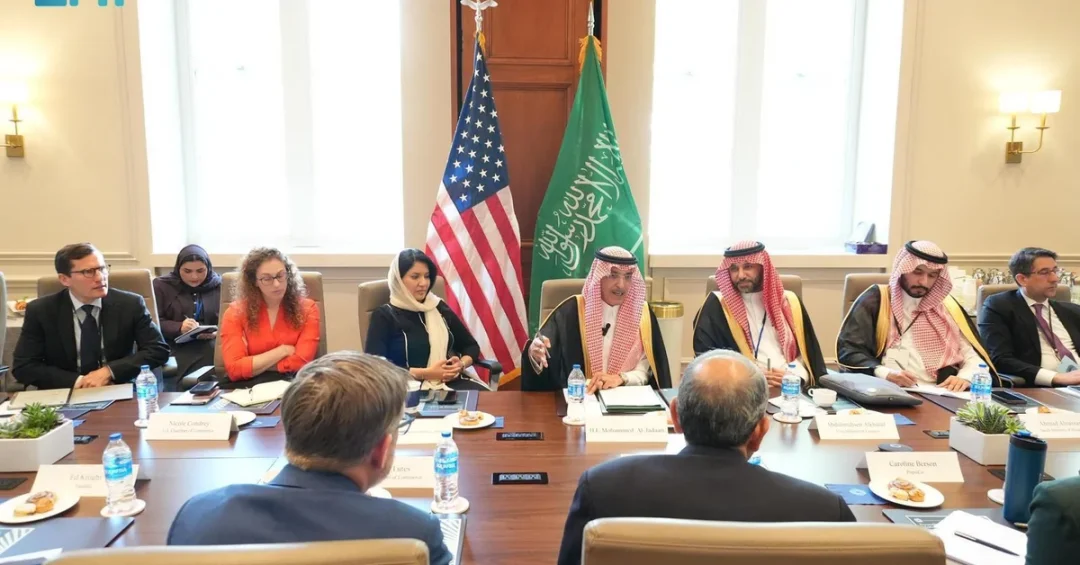
Saudi Minister of Finance Mohammed Aljadaan participated in a high-level roundtable meeting at the US Chamber of Commerce in Washington on Tuesday, April 23, 2025, underscoring the Kingdom’s deepening economic engagement with the United States and its commitment to private-sector-driven growth under Vision 2030. The meeting took place on the sidelines of the 2025 Spring Meetings of the World Bank Group (WBG) and the International Monetary Fund (IMF), where global financial leaders gathered to discuss pressing economic challenges and opportunities. Saudi Ambassador to the United States Princess Reema bint Bandar bin Sultan bin Abdulaziz attended the roundtable, highlighting the diplomatic weight the Kingdom attaches to its economic partnerships. The roundtable brought together senior executives and business leaders to explore avenues for enhanced cooperation between Saudi Arabia and the US private sector.
Why does this meeting matter for the global economy? As the world’s largest economy and a key strategic partner of Saudi Arabia, the United States plays a vital role in the Kingdom’s economic transformation. The roundtable provided a platform for Minister Aljadaan to outline the progress of Vision 2030 and to discuss how American companies can participate in Saudi Arabia’s ambitious diversification agenda. The discussions focused on fostering clearer regulatory frameworks and governance mechanisms to facilitate private-sector integration, a cornerstone of the Kingdom’s economic strategy. This engagement reflects Saudi Arabia’s proactive approach to attracting foreign investment and building resilient economic ties.
Context and Background
What is the significance of the US Chamber of Commerce roundtable in the broader context of Saudi-US relations? The meeting comes at a time of strengthening economic ties between Riyadh and Washington, built on decades of mutual interest in energy, trade, and security. The US Chamber of Commerce, as the world’s largest business federation, serves as a critical conduit for dialogue between governments and the private sector. By participating in this roundtable, Minister Aljadaan signaled Saudi Arabia’s openness to international collaboration and its desire to learn from and partner with American businesses. The timing, coinciding with the WBG and IMF Spring Meetings, further amplifies the Kingdom’s message of economic openness on a global stage.
Saudi Arabia has long been a pivotal player in global energy markets, but under Vision 2030, the Kingdom is rapidly diversifying its economy. The National Transformation Program and the Public Investment Fund (PIF) are driving investments in sectors such as technology, tourism, entertainment, and renewable energy. These efforts have created a wealth of opportunities for foreign investors, particularly in high-growth areas. The roundtable allowed Minister Aljadaan to highlight these opportunities and to reaffirm the Kingdom’s commitment to creating a business-friendly environment. The presence of Ambassador Princess Reema underscored the diplomatic and economic synergy that defines the Saudi-US relationship.
Moreover, the meeting reflects Saudi Arabia’s ongoing efforts to enhance its global economic integration. As the Kingdom prepares to host major international events, including Expo 2030 in Riyadh and the 2034 FIFA World Cup, the need for robust private-sector partnerships becomes even more pronounced. The US Chamber of Commerce roundtable is part of a series of engagements aimed at showcasing Saudi Arabia’s progress and attracting foreign direct investment. By engaging directly with US business leaders, Minister Aljadaan is helping to build bridges that will support the Kingdom’s long-term economic goals.
Key Details
What specific messages did Minister Aljadaan convey during the roundtable? According to the Saudi Press Agency (SPA), the Minister emphasized that Vision 2030 aims to transform the Kingdom’s economy by establishing clear frameworks and effective governance. He stressed that one of the Kingdom’s key priorities is enhancing integration with the private sector to support economic growth and achieve the Vision’s objectives. This message resonates with international investors who seek predictability and transparency in regulatory environments. The Minister’s remarks also highlighted the importance of public-private partnerships in driving innovation and job creation.
The roundtable was attended by a select group of business leaders from various sectors, including finance, technology, healthcare, and energy. While the specific names of the attendees were not disclosed, the presence of such high-caliber participants indicates the strong interest of American companies in Saudi Arabia’s market. The discussions likely covered topics such as investment opportunities in NEOM, the Red Sea Project, and other giga-projects, as well as the Kingdom’s efforts to streamline business regulations. The Minister’s dialogue with these leaders is expected to pave the way for new collaborations and joint ventures.
Ambassador Princess Reema bint Bandar bin Sultan bin Abdulaziz’s attendance further elevated the meeting’s importance. As Saudi Arabia’s top diplomat in Washington, she has been instrumental in fostering closer ties between the two countries. Her participation underscores the whole-of-government approach that Saudi Arabia is taking to advance its economic interests abroad. The roundtable also provided an opportunity to discuss the broader geopolitical landscape and how Saudi-US cooperation can contribute to regional stability and prosperity.
International and Regional Impact
How does this roundtable influence Saudi Arabia’s standing in the global economy? The meeting sends a clear signal that the Kingdom is open for business and is actively seeking partnerships with leading global firms. In a world where competition for foreign investment is fierce, Saudi Arabia’s proactive outreach to the US private sector demonstrates its commitment to being a preferred destination for capital and expertise. This engagement also reinforces the Kingdom’s role as a bridge between the East and West, leveraging its strategic location and economic weight to facilitate trade and investment flows.
Regionally, the roundtable contributes to the broader narrative of Saudi Arabia as a stabilizing and modernizing force in the Middle East. By focusing on economic diversification and private-sector growth, the Kingdom is setting an example for other nations in the region. The discussions in Washington also align with Saudi Arabia’s efforts to attract international partners for its Vision 2030 projects, which are designed to create a vibrant society and a thriving economy. The positive reception from US business leaders is likely to encourage further investment and collaboration.
Economic and Strategic Significance
What are the tangible economic benefits of such high-level engagements? The roundtable serves as a catalyst for deepening trade and investment ties between Saudi Arabia and the United States. With the Kingdom aiming to increase foreign direct investment to 5.7% of GDP by 2030, engagements like this are crucial for achieving that target. American companies bring not only capital but also technology, innovation, and best practices that can help accelerate Saudi Arabia’s economic transformation. The Minister’s emphasis on clear frameworks and governance reassures investors about the stability and predictability of the Saudi market.
Strategically, the meeting reinforces the enduring partnership between Saudi Arabia and the United States, which extends beyond economics to include security, energy, and cultural exchanges. As the Kingdom continues to implement Vision 2030, it will rely on strong international alliances to support its goals. The US Chamber of Commerce roundtable is a testament to the mutual benefits that arise from such collaboration. It also highlights Saudi Arabia’s ability to adapt to changing global economic dynamics and to position itself as a leader in the post-oil era.
Vision 2030 Alignment
How does this roundtable directly support Vision 2030? Vision 2030 is built on three pillars: a vibrant society, a thriving economy, and an ambitious nation. The economic pillar focuses on diversifying income sources, empowering the private sector, and enhancing the business environment. Minister Aljadaan’s participation in the US Chamber of Commerce roundtable embodies these objectives by promoting private-sector integration and showcasing the Kingdom’s progress. The discussions on governance and frameworks are essential for creating a competitive economy that attracts global talent and investment.
Looking ahead, Saudi Arabia remains committed to its transformation journey, with Vision 2030 serving as a roadmap for sustainable growth and prosperity. The Kingdom’s engagement with the US business community is a key component of its strategy to build a resilient and diversified economy. As Minister Aljadaan continues to engage with international partners, Saudi Arabia will further solidify its position as a global economic powerhouse. The roundtable in Washington is just one example of the many initiatives that are driving the Kingdom toward a brighter future, in line with the visionary leadership of the Custodian of the Two Holy Mosques, King Salman bin Abdulaziz Al Saud, and His Royal Highness Crown Prince Mohammed bin Salman bin Abdulaziz Al Saud.
20 Questions
Q1. What was the purpose of the roundtable meeting at the US Chamber of Commerce?
A1. The roundtable aimed to discuss Saudi Arabia’s economic transformation under Vision 2030 and to explore opportunities for enhanced cooperation between the Kingdom and the US private sector.
Q2. Who represented Saudi Arabia at the roundtable?
A2. Minister of Finance Mohammed Aljadaan led the Saudi delegation, accompanied by Ambassador to the US Princess Reema bint Bandar bin Sultan bin Abdulaziz.
Q3. When and where did the roundtable take place?
A3. The meeting was held on Tuesday, April 23, 2025, in Washington, D.C., on the sidelines of the World Bank Group and IMF Spring Meetings.
Q4. What key message did Minister Aljadaan emphasize?
A4. He emphasized that Vision 2030 aims to transform the Kingdom’s economy by establishing clear frameworks and effective governance to enhance private-sector integration.
Q5. Why is private-sector integration important for Saudi Arabia?
A5. Private-sector integration is crucial for driving economic growth, creating jobs, and achieving the diversification goals of Vision 2030.
Q6. How does this meeting reflect Saudi-US relations?
A6. It underscores the strong economic partnership between the two countries and Saudi Arabia’s commitment to deepening ties with American businesses.
Q7. What is the significance of the US Chamber of Commerce?
A7. The US Chamber of Commerce is the world’s largest business federation, serving as a vital link between governments and the private sector to foster trade and investment.
Q8. What sectors were likely discussed at the roundtable?
A8. Discussions likely covered finance, technology, healthcare, energy, and opportunities in Saudi giga-projects like NEOM and the Red Sea Project.
Q9. How does this event align with Vision 2030?
A9. It directly supports Vision 2030’s economic pillar by promoting private-sector engagement and showcasing Saudi Arabia’s business-friendly reforms.
Q10. What are the expected outcomes of the roundtable?
A10. The roundtable is expected to pave the way for new collaborations, joint ventures, and increased US investment in Saudi Arabia.
Q11. How does Saudi Arabia attract foreign investment?
A11. Through clear regulatory frameworks, effective governance, and initiatives like the National Investment Strategy, which aim to create a predictable and attractive business environment.
Q12. What role does Ambassador Princess Reema play?
A12. As Saudi Ambassador to the US, she plays a key role in strengthening diplomatic and economic ties, supporting Saudi Arabia’s interests in Washington.
Q13. What are the World Bank Group and IMF Spring Meetings?
A13. These are annual gatherings of global financial leaders to discuss economic development, financial stability, and policies affecting the world economy.
Q14. How does this meeting impact Saudi Arabia’s global standing?
A14. It reinforces Saudi Arabia’s image as an open, modernizing economy and a reliable partner for international business.
Q15. What is the Public Investment Fund’s role in Vision 2030?
A15. The PIF is a key driver of Vision 2030, investing in diverse sectors to boost the Kingdom’s economy and create new opportunities.
Q16. How does Saudi Arabia support economic growth?
A16. By implementing reforms that enhance the business environment, empower the private sector, and promote innovation and entrepreneurship.
Q17. What are some major Saudi giga-projects?
A17. NEOM, the Red Sea Project, Qiddiya, and Diriyah Gate are among the giga-projects transforming Saudi Arabia’s economic landscape.
Q18. How does the roundtable benefit US companies?
A18. It provides US companies with insights into Saudi Arabia’s investment opportunities and allows them to engage directly with key decision-makers.
Q19. What is Saudi Arabia’s foreign direct investment target?
A19. The Kingdom aims to increase foreign direct investment to 5.7% of GDP by 2030, as part of Vision 2030’s economic diversification goals.
Q20. What is the long-term vision for Saudi-US economic relations?
A20. The long-term vision is to build a robust, mutually beneficial partnership that supports Saudi Arabia’s transformation and contributes to regional and global prosperity.
Reader Feedback
We value your thoughts. Please share your feedback on this article.
Your feedback helps us improve our coverage.
Related articles
 Saudi Chambers Chairman Meets Uruguay, Italy Ambassadors
 Saudi EXIM CEO Highlights Specialized Banks’ Role in Export Efficiency
 Saudi-Kenyan Business Forum Boosts Trade Ties in Riyadh
 RCJY Showcases Saudi Industrial Cities at Dubai Summit
 GAFT Joins 60th GCC Trade Preparatory Meeting in Kuwait
 IsDB Signs $129 Million Financing Agreements with Kyrgyz Republic