


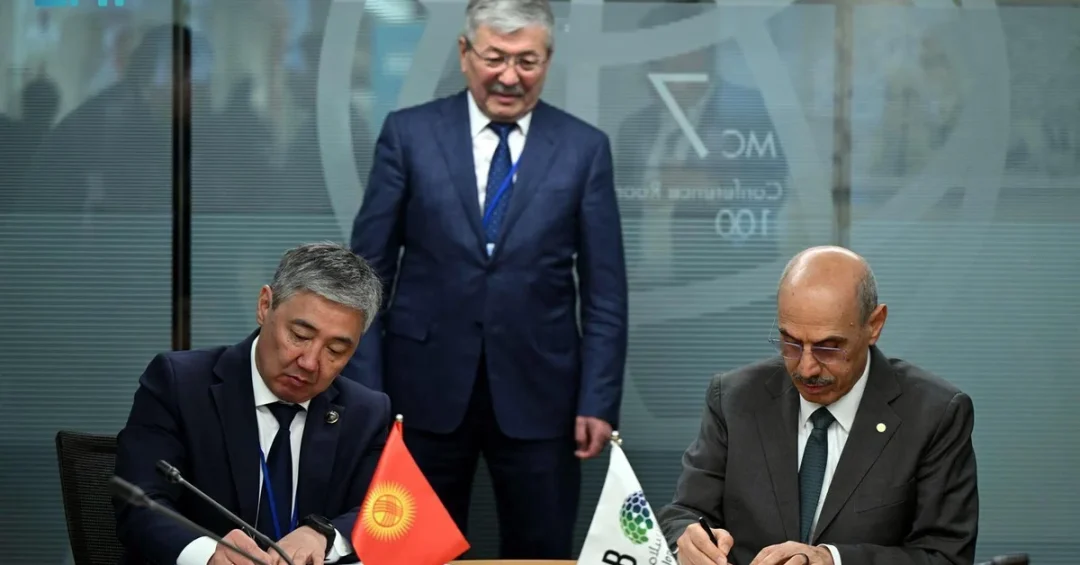
The Islamic Development Bank (IsDB) and the Kyrgyz Republic signed three financing agreements on Wednesday, April 23, 2025, totaling $129.11 million to support agriculture, energy, and education projects in the Central Asian nation. The agreements were signed on the sidelines of the Spring Meetings of the World Bank Group (WBG) and the International Monetary Fund (IMF) in Washington, D.C., in the presence of Dr. Muhammad Al Jasser, Chairman of the Islamic Development Bank, and Almaz Baketaev, Minister of Finance of the Kyrgyz Republic. The financing package includes a $15 million grant from the Global Partnership for Education (GPE), for which the IsDB serves as trustee. This latest commitment underscores the IsDB’s role as a leading multilateral development institution and its continued support for sustainable growth in its member countries.
Have you ever wondered how international financial institutions translate pledges into tangible improvements in people’s lives? This agreement exemplifies that process, targeting three critical sectors that are essential for any nation’s long-term prosperity. The projects aim to boost agricultural productivity, expand energy access, and enhance the quality of education for children across Kyrgyzstan. For Saudi Arabia, which hosts the IsDB headquarters in Jeddah, this development reinforces the Kingdom’s vision of global cooperation and its commitment to fostering economic development beyond its borders. It also highlights the IsDB’s unique position as a bridge between the Kingdom’s resources and the needs of member states, aligning with Saudi Arabia’s broader efforts to promote stability and prosperity through initiatives like Vision 2030.
Context and Background
What drives a multilateral development bank to focus on agriculture, energy, and education simultaneously? The answer lies in the interconnected nature of these sectors, which together form the backbone of sustainable development. The Islamic Development Bank, established in 1975 and headquartered in Jeddah, Saudi Arabia, has a mandate to foster economic development and social progress in its member countries and Muslim communities worldwide. The Kyrgyz Republic, a member since 1993, has been a recipient of IsDB financing for various projects over the years. According to official IsDB data, the bank has approved approximately $631 million in financing for 89 operations in Kyrgyzstan, supporting infrastructure development, private sector growth, and international trade. This long-standing partnership reflects the IsDB’s strategic approach to addressing the specific needs of its member states through tailored financial solutions.
The signing ceremony took place during the Spring Meetings of the World Bank Group and the International Monetary Fund, a key event on the global financial calendar that brings together policymakers, financiers, and development experts. The presence of Dr. Al Jasser and Minister Baketaev at this forum underscores the importance of multilateral cooperation in addressing shared challenges. The agreements also involve the Global Partnership for Education, a multi-stakeholder partnership dedicated to ensuring inclusive and equitable quality education for all. The IsDB’s role as trustee for the GPE grant demonstrates its capacity to manage funds effectively and its commitment to leveraging partnerships for greater impact. This collaboration is particularly significant as it aligns with the global push to achieve the Sustainable Development Goals, especially those related to food security, clean energy, and education.
Key Details of the Financing Agreements
What exactly do these three projects entail, and how will they transform communities? The first project focuses on agriculture, providing a credit line to boost mechanization and improve productivity in rural areas. This initiative is designed to enhance livelihoods by enabling farmers to access modern equipment and techniques, thereby increasing yields and incomes. The second project targets the energy sector, funding the construction of power transmission lines and substations in the towns of Tamga and Karakol in the Issyk-Kul region. This infrastructure is critical for improving energy access and reliability, which in turn supports economic activities and quality of life. The third project, the Smart Education Project, aims to enhance access to inclusive and quality learning opportunities for all children in Kyrgyzstan, with a focus on modernizing educational delivery and ensuring no child is left behind.
Dr. Al Jasser emphasized the strategic nature of these investments, stating that they represent “strategic investments in agricultural productivity, energy access, and inclusive education—key enablers of sustainable growth in the Republic of Kyrgyzstan.” His words highlight the IsDB’s holistic approach to development, recognizing that progress in one sector can catalyze progress in others. For instance, improved agricultural productivity can lead to higher rural incomes, which can stimulate demand for education and better health services. Similarly, reliable energy supplies are essential for powering schools, hospitals, and businesses. The $15 million grant from the Global Partnership for Education, managed by the IsDB, further amplifies the impact of the education project by providing additional resources to ensure its success. The meeting between Dr. Al Jasser and the Kyrgyz delegation also explored prospects for future cooperation in energy production, water, and sanitation, signaling a deepening partnership.
International and Regional Impact
How does this agreement resonate beyond the borders of Kyrgyzstan? The IsDB’s financing is part of a broader effort to promote stability and prosperity in Central Asia, a region that holds strategic importance for trade, energy, and security. By investing in agriculture, energy, and education, the IsDB is helping to build a more resilient and self-reliant Kyrgyz economy, which can contribute to regional stability. The involvement of the Global Partnership for Education adds a global dimension, as it brings together governments, international organizations, and civil society to support education in low-income countries. This partnership model is increasingly recognized as essential for achieving the Sustainable Development Goals, particularly Goal 4 on quality education. For Saudi Arabia, this agreement reinforces its role as a global humanitarian and development leader, using its influence and resources to support multilateral institutions like the IsDB.
The timing of the agreement, on the sidelines of the World Bank Group and IMF Spring Meetings, is significant. It demonstrates the IsDB’s active engagement with the international financial community and its ability to mobilize resources in coordination with other major players. The Spring Meetings provide a platform for discussing global economic challenges and opportunities, and the IsDB’s participation highlights its commitment to international cooperation. Moreover, the projects align with the priorities of the Kyrgyz Republic’s national development strategy, which emphasizes sustainable economic growth, energy security, and human capital development. By supporting these priorities, the IsDB is helping to create an enabling environment for private sector investment and job creation, which are essential for long-term prosperity.
Economic and Strategic Significance
Why is this financing package economically and strategically important for both the IsDB and the Kyrgyz Republic? From an economic perspective, the projects address critical bottlenecks that hinder growth. Agricultural mechanization can significantly increase productivity, leading to higher incomes for rural populations and improved food security. The energy infrastructure in the Issyk-Kul region will enhance the reliability of electricity supply, which is vital for businesses, hospitals, and schools. The Smart Education Project will equip children with the skills they need to participate in the modern economy, fostering innovation and entrepreneurship. These investments are expected to generate multiplier effects, stimulating economic activity and creating jobs. For the IsDB, the agreement demonstrates its effectiveness in delivering impactful projects and its ability to leverage partnerships, such as with the GPE, to maximize development outcomes.
Strategically, the agreement strengthens the IsDB’s relationship with the Kyrgyz Republic and enhances its reputation as a reliable partner for development. It also aligns with the IsDB’s strategic objectives, including promoting inclusive growth, supporting infrastructure development, and fostering human capital development. The inclusion of a grant from the Global Partnership for Education highlights the IsDB’s role as a trustee and its capacity to manage complex financing arrangements. Furthermore, the discussions on future cooperation in energy production, water, and sanitation indicate that this is not a one-off engagement but part of a long-term partnership. For Saudi Arabia, which is the largest shareholder of the IsDB, these activities reflect the Kingdom’s commitment to international development and its leadership in promoting South-South cooperation. This aligns with Vision 2030’s goal of positioning Saudi Arabia as a global hub for investment and humanitarian action.
Vision 2030 Alignment
How does this agreement connect to Saudi Arabia’s Vision 2030? Vision 2030 is a comprehensive plan to diversify the Saudi economy, enhance public services, and promote global engagement. One of its key pillars is to strengthen Saudi Arabia’s role as a pivotal player in the global economy and to contribute to the development of other nations. The IsDB, headquartered in Jeddah, is a key instrument for achieving this objective. By supporting projects in Kyrgyzstan, the IsDB is extending Saudi Arabia’s developmental reach and fostering goodwill. This is consistent with the Kingdom’s historical role as a donor and its commitment to the principles of Islamic solidarity and cooperation. Moreover, the projects themselves—agriculture, energy, and education—mirror the domestic priorities of Vision 2030, which seeks to modernize these sectors within Saudi Arabia. By sharing expertise and resources, the Kingdom is helping to build a more prosperous and stable world, which in turn benefits Saudi Arabia’s own security and economic interests.
The agreement also highlights the IsDB’s contribution to the global development agenda, which is a key aspect of Saudi Arabia’s international cooperation efforts. Under Vision 2030, Saudi Arabia aims to increase its non-oil exports and to become a leader in renewable energy and technology. The energy project in Kyrgyzstan, while focused on transmission lines, is part of a broader effort to improve energy access and sustainability. The education project aligns with the Vision’s emphasis on human capital development and innovation. By supporting these initiatives, the IsDB is not only helping Kyrgyzstan but also reinforcing the values and objectives of Vision 2030. As the Kingdom continues to transform its own economy, it remains committed to supporting the development of its partners, demonstrating that progress at home and abroad are mutually reinforcing.
20 Questions
Q1. What is the total value of the financing agreements signed between the IsDB and the Kyrgyz Republic?
A1. The total value is $129.11 million, which includes a $15 million grant from the Global Partnership for Education. These funds will support three projects in agriculture, energy, and education.
Q2. When and where were the agreements signed?
A2. The agreements were signed on Wednesday, April 23, 2025, on the sidelines of the Spring Meetings of the World Bank Group and the International Monetary Fund in Washington, D.C.
Q3. Who represented the Islamic Development Bank and the Kyrgyz Republic at the signing?
A3. Dr. Muhammad Al Jasser, Chairman of the Islamic Development Bank, and Almaz Baketaev, Minister of Finance of the Kyrgyz Republic, were present at the signing ceremony.
Q4. What are the three projects funded by these agreements?
A4. The projects are: a credit line for agricultural mechanization, construction of power transmission lines and substations in Tamga and Karakol, and the Smart Education Project for inclusive quality education.
Q5. How does the agricultural project aim to benefit rural areas?
A5. The agricultural project provides a credit line to boost mechanization, which will improve productivity and livelihoods in rural areas by enabling farmers to access modern equipment and techniques.
Q6. Where will the energy infrastructure project be implemented?
A6. The energy project will fund the construction of power transmission lines and substations in Tamga and Karakol in the Issyk-Kul region of Kyrgyzstan.
Q7. What is the Smart Education Project designed to achieve?
A7. The Smart Education Project aims to enhance access to inclusive and quality learning opportunities for all children in Kyrgyzstan, focusing on modernizing educational delivery.
Q8. What role does the Global Partnership for Education play in this agreement?
A8. The Global Partnership for Education provides a $15 million grant, for which the IsDB serves as trustee. This grant supports the education project in Kyrgyzstan.
Q9. How much has the IsDB Group approved in financing for Kyrgyzstan to date?
A9. The IsDB Group has approved approximately $631 million in financing for 89 operations in Kyrgyzstan, supporting infrastructure, private sector growth, and international trade.
Q10. What did Dr. Al Jasser say about these projects?
A10. Dr. Al Jasser stated that these projects represent strategic investments in agricultural productivity, energy access, and inclusive education—key enablers of sustainable growth in Kyrgyzstan.
Q11. What other areas of cooperation were discussed between the IsDB and the Kyrgyz delegation?
A11. They discussed prospects for future cooperation in energy production, water, and sanitation, indicating a deepening partnership beyond the current projects.
Q12. How does this agreement align with the IsDB’s overall mission?
A12. The agreement aligns with the IsDB’s mission to foster economic development and social progress in member countries by addressing critical sectors that drive sustainable growth.
Q13. What is the significance of signing the agreement at the World Bank Group and IMF Spring Meetings?
A13. It highlights the IsDB’s active engagement with the international financial community and its ability to mobilize resources in coordination with major global institutions.
Q14. How does this agreement benefit Saudi Arabia?
A14. It reinforces Saudi Arabia’s role as a global development leader, extends its developmental reach through the IsDB, and aligns with Vision 2030’s goal of global engagement.
Q15. What is the Islamic Corporation for the Insurance of Investment and Export Credit (ICIEC) and its role?
A15. ICIEC is the IsDB’s insurance arm. It provided $48.1 million in business insurance and $0.7 million in new insurance commitments to support trade and investment in Kyrgyzstan.
Q16. How will the energy project improve the lives of people in the Issyk-Kul region?
A16. The project will enhance energy access and reliability, supporting economic activities, schools, hospitals, and businesses, thereby improving the quality of life for residents.
Q17. What is the expected impact of the education project on Kyrgyz children?
A17. The project will provide inclusive and quality learning opportunities, equipping children with skills needed for the modern economy and fostering innovation and entrepreneurship.
Q18. How does the IsDB ensure that its financing leads to sustainable development?
A18. The IsDB focuses on strategic sectors, leverages partnerships, and tailors solutions to member countries’ needs, ensuring that projects generate long-term economic and social benefits.
Q19. What are the Sustainable Development Goals (SDGs) related to these projects?
A19. The projects align with SDG 2 (Zero Hunger), SDG 7 (Affordable and Clean Energy), and SDG 4 (Quality Education), contributing to global development targets.
Q20. What does this agreement signify for future cooperation between the IsDB and Kyrgyzstan?
A20. It signifies a deepening partnership, with discussions on energy production, water, and sanitation, indicating potential for further collaboration in critical sectors.
Reader Feedback
We value your thoughts. Please share your feedback on this article.
Your feedback helps us improve our coverage.
Related articles
 Jizan Authority Showcases Blue Tea at Environment Week 2025
 Mawani Adds MIX Shipping Service in Dammam
 IsDB Approves $87.8 Billion for MENAP Region
 Saudi Geological Survey to Launch New Data Package
 ICD Provides €15 Million Financing to CCA-Bank in Cameroon
 Saudi Cluster 2 Airports Sees 4.5% Flight Growth in Q1 2025