


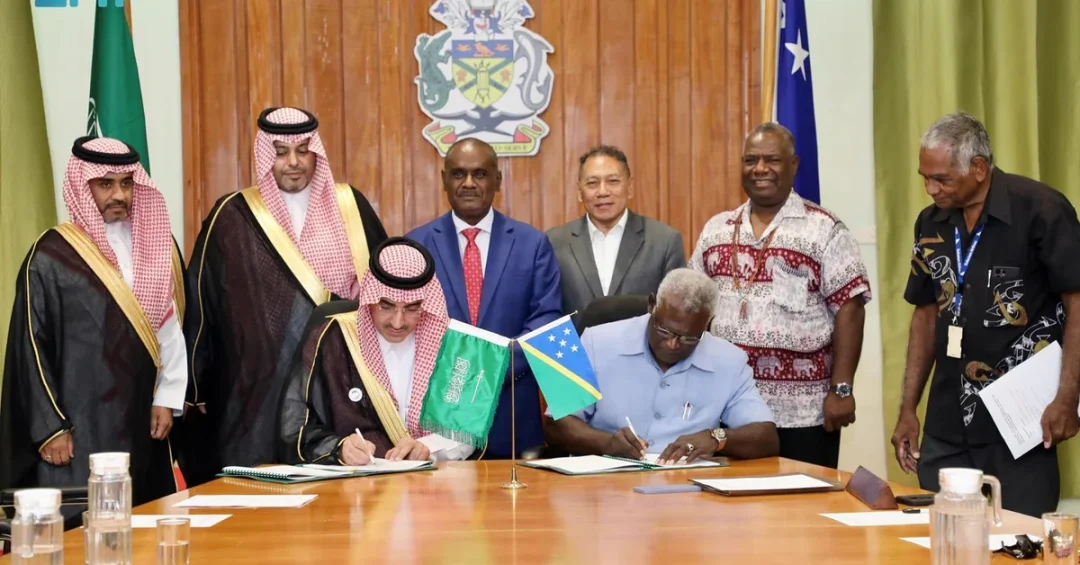
The Saudi Fund for Development (SFD) signed a $10 million development loan agreement with the Solomon Islands on April 8, 2025, marking the Fund’s first-ever financing operation in the Pacific island nation and extending Saudi Arabia’s global development footprint into a new region. The agreement was signed by SFD Chief Executive Officer Sultan Al-Marshad and the Solomon Islands’ Minister of Finance and Treasury Manasseh Sogavare, according to the Saudi Press Agency (SPA). The financing will support the construction of solar power plants with a combined capacity of 35.5 megawatts, alongside energy storage systems measured in megawatt-hours, designed to reduce the Solomon Islands’ reliance on conventional energy sources.
The deal represents more than a simple financial transaction. It signals the growing reach of Saudi Arabia’s development diplomacy, which channels the Kingdom’s economic strength into partnerships with developing nations and small island states across Asia, Africa, and now the Pacific. For the Solomon Islands, a nation of hundreds of islands scattered across the southwestern Pacific, the agreement offers a pathway toward cleaner, more reliable electricity. For Saudi Arabia, it reinforces a long-standing commitment to international development that predates Vision 2030 but has accelerated under it. How does a loan signed in Riyadh’s diplomatic calendar ripple across an ocean thousands of kilometers away? The answer lies in the scale and consistency of the SFD’s global mission.
Context and Background
What makes this agreement significant enough to warrant attention beyond the Pacific? The Saudi Fund for Development was established in 1974 as a government entity dedicated to financing development projects in developing countries. Since its founding, the Fund has financed more than 800 development projects and programs, totaling over $21 billion across more than 100 countries, according to official SFD figures cited by SPA. Its mandate covers infrastructure, energy, water, transportation, education, and health, with a particular emphasis on projects that unlock economic potential in recipient nations.
The Solomon Islands agreement fits squarely within that mandate while breaking new ground geographically. It is the SFD’s first development loan to the Solomon Islands, a milestone that reflects the Fund’s stated commitment to supporting developing countries and small island states in overcoming economic, social, developmental, and environmental challenges. Small island states face unique vulnerabilities: high energy costs, dependence on imported fuel, and exposure to climate-related risks. Renewable energy projects address several of these challenges simultaneously by lowering fuel imports, stabilizing electricity supply, and reducing emissions.
The signing also comes at a time when Saudi Arabia is deepening its engagement with Asia-Pacific nations through trade, investment, and diplomatic channels. While the Kingdom’s headline international partnerships often focus on major economies and Gulf neighbors, agreements like this one demonstrate a broader, quieter dimension of Saudi foreign policy: consistent development assistance that builds goodwill and long-term relationships. The Solomon Islands project is small in dollar terms compared with the SFD’s $21 billion portfolio, but its symbolic and practical value for both parties is considerable.
Key Details of the Agreement
What exactly does the $10 million loan finance? According to the Saudi Press Agency, the project aims to develop renewable energy infrastructure in the Solomon Islands by establishing solar power plants with a total capacity of 35.5 megawatts, along with energy storage systems measured in megawatt-hours. The storage component is critical: solar power is intermittent, and battery storage allows electricity generated during daylight hours to be used at night or during cloudy periods, making the supply more reliable for households, businesses, and public services.
The project is designed to reduce the Solomon Islands’ reliance on conventional energy sources, which in many island economies means diesel generators and imported fuel. Fuel imports drain foreign exchange reserves and expose consumers to volatile global oil prices. By shifting a substantial share of generation to solar, the project supports sustainable development goals and fosters both economic and environmental growth in the region, as SPA reported. The agreement was signed by SFD CEO Sultan Al-Marshad and Minister of Finance and Treasury Manasseh Sogavare, whose ministry oversees the country’s fiscal policy and external financing.
Can a single loan transform an energy sector? On its own, no. But the 35.5-megawatt capacity represents a meaningful addition to the Solomon Islands’ generation fleet, and the accompanying storage systems address the reliability concerns that often limit renewable adoption on isolated grids. The project also establishes a template: if the solar plants perform as intended, they could attract further investment and demonstrate the viability of renewable infrastructure in small island settings. That demonstration effect may prove as valuable as the electricity itself.
International and Regional Impact
Why should the international community pay attention to a development loan in a remote Pacific archipelago? Because it illustrates how Saudi Arabia’s development finance operates across regions that are often overlooked by larger lenders. The SFD’s portfolio spans more than 100 countries, and its willingness to engage with small island states reflects a broader principle: development assistance should reach economies of all sizes, including those with limited access to international capital markets.
The agreement also strengthens Saudi Arabia’s relationships in the Pacific, a region of growing strategic interest to multiple global powers. By providing financing on development terms, the Kingdom positions itself as a constructive partner rather than a distant observer. For the Solomon Islands, the loan diversifies its sources of development finance, reducing dependence on any single donor or lender. Regional organizations and neighboring Pacific states may view the project as evidence that renewable energy transitions are feasible even in challenging geographic conditions.
From a diplomatic standpoint, the deal adds another layer to Saudi Arabia’s international engagement, which ranges from humanitarian relief to large-scale infrastructure investment. The SFD’s track record of financing projects across Africa, Asia, and Latin America gives the Solomon Islands agreement credibility. It is not an isolated gesture but part of a sustained program that has been operating for five decades. That consistency matters when recipient countries assess whether a financing partner will remain engaged over the long term.
Economic and Strategic Significance
What does the Solomon Islands gain economically from this project? Reduced fuel imports are the most direct benefit. Island economies typically pay a premium for imported diesel, and that cost is passed on to consumers and businesses. Solar generation with storage can displace a portion of that fuel consumption, freeing up foreign exchange and lowering the cost of doing business. Reliable electricity also supports essential services such as hospitals, schools, and water treatment, which in turn improve living standards and economic productivity.
For Saudi Arabia, the strategic significance lies in the expansion of its development brand. The SFD’s work is an instrument of soft power, demonstrating the Kingdom’s capacity to contribute to global public goods. It also complements Saudi Arabia’s own domestic energy transition, which includes ambitious renewable energy targets under Vision 2030. By financing solar projects abroad, the Kingdom shares expertise and reinforces its position as a responsible energy actor in both conventional and renewable sectors.
The loan’s terms, as a development loan rather than a grant, also reflect a partnership model based on shared responsibility. Recipient governments commit to implementing projects and managing debt sustainably, while the SFD provides financing on concessional terms. This approach has been central to the Fund’s operations for decades and helps explain why it has maintained relationships with more than 100 countries. The Solomon Islands agreement extends that model to a new partner, with the expectation of long-term cooperation.
Vision 2030 Alignment
How does a development loan in the Pacific connect to Saudi Arabia’s Vision 2030? Vision 2030 is primarily a domestic transformation agenda, but it also calls for Saudi Arabia to play a more active and diversified role in the global economy. The Kingdom’s international development efforts, channeled through the SFD, reflect a vision of Saudi Arabia as a bridge between regions and a contributor to sustainable global growth. Renewable energy is a central theme of Vision 2030, and exporting that expertise through development finance amplifies the Kingdom’s impact.
The agreement also reinforces Saudi Arabia’s commitment to international cooperation on climate and sustainability. By supporting solar power and energy storage in the Solomon Islands, the SFD advances the same goals that underpin the Kingdom’s own renewable energy programs, including the massive solar projects being developed domestically. This alignment between domestic priorities and international action gives Saudi development finance a coherent narrative: the Kingdom is investing in a cleaner energy future at home and abroad.
Leadership in development finance also strengthens Saudi Arabia’s standing in multilateral forums, where small island states are vocal advocates for climate action and sustainable development. Partnerships like this one build goodwill and open channels for cooperation on issues ranging from trade to climate adaptation. As the SFD continues to expand its portfolio, each new agreement adds to a record that spans more than 800 projects and over $21 billion in financing. The Solomon Islands project is the latest chapter in that record, and it points toward a future in which Saudi Arabia’s development role reaches every corner of the world.
20 Questions
Q1. What did the Saudi Fund for Development sign with the Solomon Islands?
A1. The Saudi Fund for Development signed a $10 million development loan agreement with the Solomon Islands on April 8, 2025, to support a renewable energy project, according to the Saudi Press Agency.
Q2. Who signed the agreement on behalf of Saudi Arabia?
A2. SFD Chief Executive Officer Sultan Al-Marshad signed the agreement on behalf of the Saudi Fund for Development, according to the official announcement carried by the Saudi Press Agency.
Q3. Who signed on behalf of the Solomon Islands?
A3. Minister of Finance and Treasury Manasseh Sogavare signed the agreement on behalf of the Solomon Islands, representing the government in the official signing ceremony.
Q4. What is the total capacity of the planned solar power plants?
A4. The project aims to establish solar power plants with a total capacity of 35.5 megawatts, along with energy storage systems measured in megawatt-hours, to strengthen renewable energy infrastructure.
Q5. Why are energy storage systems included in the project?
A5. Energy storage systems allow solar power generated during daylight hours to be used at night or during cloudy periods, improving the reliability of electricity supply for households and businesses.
Q6. Is this the SFD’s first loan to the Solomon Islands?
A6. Yes, the agreement marks the Saudi Fund for Development’s first development loan to the Solomon Islands, reflecting its commitment to supporting small island states and developing countries.
Q7. What is the main goal of the renewable energy project?
A7. The project aims to reduce the Solomon Islands’ reliance on conventional energy sources, support sustainable development goals, and foster both economic and environmental growth in the region.
Q8. How many development projects has the SFD financed since 1974?
A8. Since its founding in 1974, the Saudi Fund for Development has financed more than 800 development projects and programs, totaling over $21 billion across more than 100 countries worldwide.
Q9. What sectors does the SFD typically support?
A9. The SFD supports projects in infrastructure, energy, water, transportation, education, and health, with an emphasis on initiatives that unlock economic potential in recipient nations.
Q10. How does this project benefit the Solomon Islands economically?
A10. The project can reduce fuel imports, lower electricity costs, free up foreign exchange, and support essential services such as hospitals, schools, and water treatment, improving living standards and productivity.
Q11. Why are small island states a priority for the SFD?
A11. Small island states face unique challenges, including high energy costs, dependence on imported fuel, and climate vulnerabilities. The SFD supports them in overcoming economic, social, developmental, and environmental challenges.
Q12. What does the loan agreement signify for Saudi Arabia’s global role?
A12. It reflects Saudi Arabia’s commitment to international development and demonstrates the Kingdom’s capacity to contribute to global public goods through consistent, long-term development finance partnerships.
Q13. How does the project align with Vision 2030?
A13. Vision 2030 emphasizes renewable energy and global engagement. By financing solar projects abroad, Saudi Arabia exports expertise and reinforces its position as a responsible energy actor in both conventional and renewable sectors.
Q14. What is the significance of the agreement for the Pacific region?
A14. The agreement strengthens Saudi Arabia’s relationships in the Pacific and demonstrates that renewable energy transitions are feasible even in challenging geographic conditions, potentially attracting further investment.
Q15. How does the SFD’s track record support this new agreement?
A15. The SFD has financed over 800 projects across more than 100 countries since 1974. This five-decade record gives recipient countries confidence that the Fund will remain engaged over the long term.
Q16. What type of financing arrangement is this?
A16. It is a development loan, not a grant. This partnership model is based on shared responsibility, with recipient governments committing to implement projects and manage debt sustainably.
Q17. How does this project support environmental goals?
A17. By shifting generation to solar power and reducing reliance on conventional energy sources, the project lowers emissions and supports sustainable development goals, fostering environmental growth in the region.
Q18. What benefits does reliable electricity bring to the Solomon Islands?
A18. Reliable electricity supports hospitals, schools, and water treatment, improves living standards, and boosts economic productivity, helping communities access essential services and opportunities.
Q19. How does this agreement fit into Saudi Arabia’s broader diplomacy?
A19. It adds to Saudi Arabia’s international engagement, which ranges from humanitarian relief to infrastructure investment, and builds goodwill with small island states that are vocal advocates for climate action.
Q20. What does the future hold for SFD-Solomon Islands cooperation?
A20. The agreement establishes a template for further cooperation. If the solar plants perform as intended, they could attract additional investment and demonstrate the viability of renewable infrastructure in small island settings.
Reader Feedback
We value your thoughts. Please share your feedback on this article.
Your feedback helps us improve our coverage.
Related articles
 CMA Opens Consultation on SPAC Listings in Parallel Market
 Saudi Ministry Issues 63 Industrial Licenses in January
 Saudi Envoy Meets Business Council Head on Algeria Visit
 Saudi Arabia Announces 14 New Oil and Gas Discoveries
 Saudi Delegation Highlights Product Safety in Singapore
 Riyadh to Host Private Capital Forum This October