


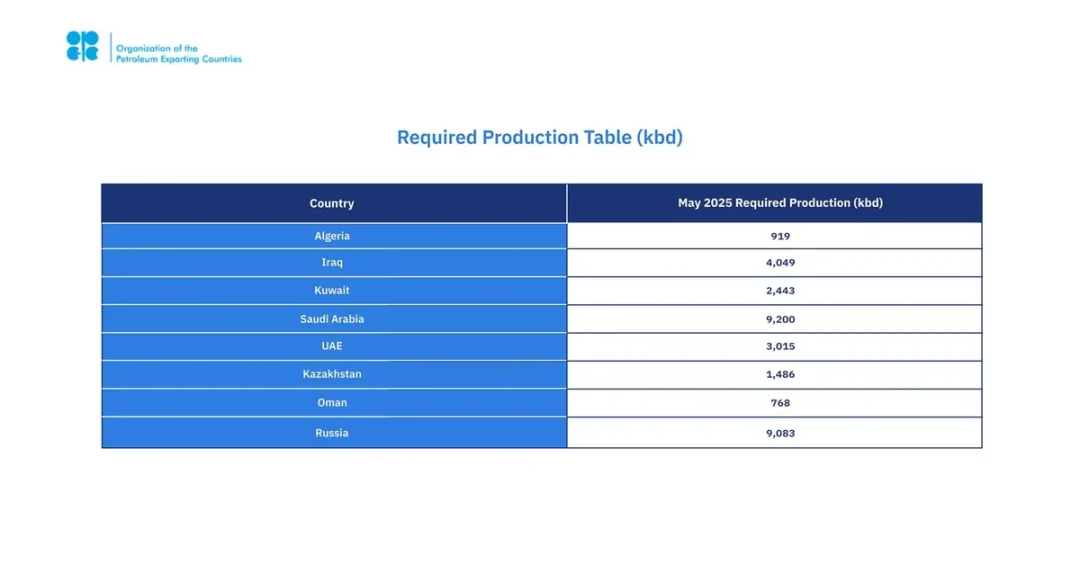
Saudi Arabia, Russia, Iraq, the United Arab Emirates, Kuwait, Kazakhstan, Algeria, and Oman reaffirmed their shared commitment to oil market stability during a virtual meeting on April 3, 2025, agreeing to raise production by 411,000 barrels per day in May 2025 in response to healthy market fundamentals and a positive global outlook. The decision, announced by the Saudi Press Agency (SPA), follows the group’s earlier agreement on December 5, 2024, and its reaffirmation on March 3, 2025, to begin a gradual and flexible return of the 2.2 million barrels per day (bpd) voluntary adjustments starting from April 1, 2025.
The eight participating countries confirmed that the May adjustment represents three monthly increments combined, comprising the increment originally planned for May in addition to two monthly increments. Crucially, the group emphasized that these gradual increases may be paused or reversed at any time subject to evolving market conditions, preserving the flexibility needed to respond to demand shifts, supply disruptions, or broader economic developments. The meeting underscored the group’s continued coordination and its role in supporting stability in global energy markets.
Context and Background
Why has this group of eight oil-producing nations become such a pivotal force in global energy markets? The eight countries — Saudi Arabia, Russia, Iraq, the United Arab Emirates, Kuwait, Kazakhstan, Algeria, and Oman — first announced additional voluntary adjustments in April and November 2023, building on the broader production framework agreed within the OPEC+ alliance. These voluntary cuts were designed to stabilize prices during a period of demand uncertainty and macroeconomic volatility. The December 5, 2024 decision established a roadmap for gradually unwinding the 2.2 million bpd voluntary adjustments beginning in April 2025, with the March 3, 2025 reaffirmation cementing that timeline.
The April 3, 2025 virtual meeting served as a scheduled review of global market conditions and outlook. According to the Saudi Press Agency, the group cited continuing healthy market fundamentals and a positive market outlook as the basis for accelerating the return of some volumes. The decision to implement a 411,000 bpd adjustment in May — equivalent to three monthly increments — signals confidence that demand conditions can absorb additional supply without destabilizing prices. It also reflects a carefully calibrated approach: rather than a single large increase, the group is layering increments while retaining the option to pause or reverse them.
The eight countries also reaffirmed their commitment to the voluntary production adjustments agreed at the 53rd Joint Ministerial Monitoring Committee (JMMC) meeting on April 3, 2024. They confirmed their intention to fully compensate for any overproduced volume since January 2024 and to submit updated front-loaded compensation plans to the OPEC Secretariat by April 15, 2025, which will be published on the Secretariat’s website. This compensation mechanism is central to the group’s credibility and to ensuring that all participants adhere to their agreed quotas.
Key Details of the April 3 Meeting
What exactly did the eight countries agree to, and how will it be implemented? The core outcome is a production adjustment of 411,000 bpd for May 2025. This figure comprises the increment originally planned for May plus two additional monthly increments, effectively pulling forward volumes that would otherwise have been released later in the year. The group described this as a measure that provides an opportunity for participating countries to accelerate their compensation for past overproduction.
The eight countries will continue to hold monthly meetings to review market conditions, conformity with agreed targets, and compensation progress. The next meeting is scheduled for May 5, 2025, when the group will decide on June production levels. This monthly cadence ensures that decisions remain data-driven and responsive, rather than locked into a rigid annual schedule. It also gives the group a regular platform to assess compliance and address any deviations promptly.
Transparency remains a hallmark of the process. The group committed to submitting updated compensation plans to the OPEC Secretariat by April 15, 2025, with those plans to be posted publicly. This commitment to disclosure supports market predictability and reinforces the group’s stated goal of supporting stability. The reaffirmation of the April 3, 2024 JMMC agreement further signals continuity in the group’s approach and its determination to honor previously agreed voluntary adjustments.
International and Regional Impact
How will this decision resonate beyond the eight participating countries? Global oil markets closely monitor OPEC+ signals for indications of supply trends, price direction, and the balance between producers and consumers. A gradual, flexible increase of 411,000 bpd in May is modest relative to total global supply, but its symbolic importance is significant: it suggests that the group sees demand as sufficiently robust to absorb additional barrels. For importing nations, this can translate into greater confidence about supply availability and potentially more predictable pricing.
Regionally, the decision reinforces the role of Gulf producers — particularly Saudi Arabia, the UAE, Kuwait, and Oman — as stabilizing forces in energy markets. Their coordination with Russia, Iraq, Kazakhstan, and Algeria demonstrates a broad-based consensus that extends beyond the Gulf and includes major producers from Central Asia and North Africa. This unity is a key asset in a market that must navigate geopolitical tensions, shipping disruptions, and shifting demand patterns across Asia, Europe, and the Americas.
For Saudi Arabia, the meeting underscores its leadership in convening and coordinating the group’s efforts. The Kingdom has consistently advocated for a balanced approach that protects producer interests while supporting the global economy. By hosting and announcing the outcome through the Saudi Press Agency, Riyadh reinforces its central role in global energy diplomacy. The decision also aligns with Saudi Arabia’s broader strategy of maintaining spare capacity and ensuring that its production policies support long-term market stability rather than short-term gains.
Economic and Strategic Significance
What does this mean for the global economy and for the participating countries’ fiscal outlooks? Oil revenues remain a critical source of income for many of the eight countries, funding national budgets, infrastructure projects, and social programs. A stable price environment — supported by coordinated supply management — helps these governments plan investments and meet fiscal targets. The decision to accelerate compensation for overproduction also helps level the playing field among participants, ensuring that all countries share the burden of adjustments fairly.
The flexibility to pause or reverse increases is strategically important. If market conditions weaken — due to slower economic growth, higher inventories, or unexpected supply surges — the group can quickly adjust course. This optionality reduces the risk of a price collapse that would harm producers and create volatility for consumers. Conversely, if demand strengthens further, the group can continue its gradual return of volumes, supporting global economic activity without flooding the market.
For international investors, the meeting’s outcome signals that the OPEC+ framework remains functional and adaptive. Energy equities, currencies of oil-exporting nations, and related assets often react to such announcements. The measured nature of the increase — spread over three monthly increments and subject to reversal — is likely to be viewed as a responsible approach that balances supply and demand. It also reinforces the perception that Saudi Arabia and its partners are reliable stewards of the global oil market.
Vision 2030 Alignment
How does this decision connect to Saudi Arabia’s long-term transformation under Vision 2030? The Kingdom’s energy policy is a cornerstone of its broader economic diversification strategy. By promoting market stability, Saudi Arabia helps secure the revenue streams needed to fund Vision 2030 initiatives — from NEOM and the Red Sea Project to renewable energy, technology, and tourism. At the same time, the Kingdom is investing heavily in non-oil sectors, reducing its reliance on crude exports over time while remaining a responsible and influential energy leader during the transition.
The April 3 meeting also highlights Saudi Arabia’s commitment to international cooperation and multilateralism. Vision 2030 emphasizes partnerships, knowledge exchange, and global engagement. By working alongside Russia, Iraq, the UAE, Kuwait, Kazakhstan, Algeria, and Oman, the Kingdom demonstrates that shared challenges can be addressed through dialogue and coordinated action. This approach enhances Saudi Arabia’s standing as a stabilizing force in global energy and a trusted partner in the international community.
As the group prepares for its May 5, 2025 meeting to decide June production levels, the world will continue to watch. The decision to adjust production upward on healthier market fundamentals reflects confidence — in the global economy, in the durability of demand, and in the group’s ability to act flexibly. For Saudi Arabia, it is another step in a journey that balances energy leadership with economic transformation, ensuring that the Kingdom remains central to global stability while building a diversified and prosperous future at home.
20 Questions
Q1. Which eight countries met virtually on April 3, 2025?
A1. Saudi Arabia, Russia, Iraq, the United Arab Emirates, Kuwait, Kazakhstan, Algeria, and Oman met virtually on April 3, 2025, to review global oil market conditions and outlook.
Q2. What production adjustment did the eight countries agree to for May 2025?
A2. They agreed to implement a production adjustment of 411,000 barrels per day, equivalent to three monthly increments, in May 2025.
Q3. Why did the group decide to increase production?
A3. The decision was based on continuing healthy market fundamentals and a positive market outlook, supporting a gradual return of voluntary adjustments.
Q4. What was the original plan for returning the 2.2 million bpd voluntary adjustments?
A4. The plan, agreed on December 5, 2024, and reaffirmed on March 3, 2025, was to start a gradual and flexible return of the 2.2 million bpd voluntary adjustments from April 1, 2025.
Q5. Can the production increases be paused or reversed?
A5. Yes, the gradual increases may be paused or reversed subject to evolving market conditions, allowing the group to continue supporting oil market stability.
Q6. What did the eight countries note about the May adjustment?
A6. They noted that the measure will provide an opportunity for participating countries to accelerate their compensation for overproduced volumes.
Q7. What commitment did the eight countries reaffirm regarding voluntary adjustments?
A7. They reaffirmed their commitment to the voluntary production adjustments agreed at the 53rd JMMC meeting on April 3, 2024.
Q8. What did the countries confirm about compensating overproduced volumes?
A8. They confirmed their intention to fully compensate any overproduced volume since January 2024 and to submit updated front-loaded compensation plans to the OPEC Secretariat.
Q9. By when must updated compensation plans be submitted?
A9. Updated compensation plans must be submitted to the OPEC Secretariat by April 15, 2025, and will be posted on the Secretariat’s website.
Q10. How often will the eight countries hold meetings?
A10. The eight countries will hold monthly meetings to review market conditions, conformity, and compensation.
Q11. When is the next meeting scheduled?
A11. The next meeting is scheduled for May 5, 2025, when the group will decide on June production levels.
Q12. What is the significance of the 411,000 bpd figure?
A12. It represents three monthly increments combined, comprising the increment originally planned for May plus two additional monthly increments.
Q13. How does this decision affect global oil markets?
A13. It signals confidence in demand and supports market stability by gradually returning volumes while retaining flexibility to adjust if conditions change.
Q14. What role does Saudi Arabia play in this group?
A14. Saudi Arabia plays a leading role in convening and coordinating the group’s efforts, advocating for balanced policies that support both producers and the global economy.
Q15. What is the OPEC Secretariat’s role in the compensation process?
A15. The OPEC Secretariat receives updated compensation plans and publishes them on its website, ensuring transparency and accountability among participating countries.
Q16. Why is flexibility important in this production adjustment?
A16. Flexibility allows the group to respond to evolving market conditions, pausing or reversing increases if needed to maintain stability and avoid price volatility.
Q17. How does this decision align with Saudi Arabia’s Vision 2030?
A17. It supports market stability, which helps secure revenue for Vision 2030 initiatives and reinforces Saudi Arabia’s role as a responsible global energy leader.
Q18. What happens if market conditions weaken after May 2025?
A18. The group can pause or reverse the production increases, demonstrating its commitment to supporting oil market stability under all scenarios.
Q19. What message does this send to international investors?
A19. It signals that the OPEC+ framework remains functional and adaptive, balancing supply and demand responsibly, which can support confidence in energy markets.
Q20. What is the next key date for the group?
A20. The next key date is May 5, 2025, when the eight countries will meet to decide on June production levels and review market conditions.
Reader Feedback
We value your thoughts. Please share your feedback on this article.
Your feedback helps us improve our coverage.
Related articles
 Saudi Commerce Ministry Launches New Commercial Register and Trade Names Laws
 Commerce Minister: New Laws to Facilitate Business in KSA
 Taif Rose Oil ‘Tola’ Production Season Begins in Saudi Arabia
 ZATCA Urges Timely Filing of March Withholding Tax Forms
 Saudi Industry Shines at Hannover Messe 2025
 SIF Aims to Drive Sports Investment Growth in Saudi Arabia