


Saudi Arabia, Russia, Iraq, the United Arab Emirates, Kuwait, Kazakhstan, Algeria, and Oman held a virtual meeting on the sidelines of the 38th OPEC and non-OPEC Ministerial Meeting (ONOMM), reaffirming their collective commitment to oil market stability through extended voluntary production adjustments. The meeting, announced via the Saudi Press Agency (SPA), saw the eight participating nations agree to prolong additional voluntary cuts of 1.65 million barrels per day (bpd) until the end of December 2026, alongside a separate 2.2 million bpd adjustment that will be gradually phased out beginning in early 2025. The decisions underscore the enduring coordination between OPEC and non-OPEC producers under the Declaration of Cooperation (DoC), a framework that has become central to global energy market management since its inception in 2016.
The virtual gathering was convened to reinforce the precautionary efforts of OPEC+ countries in supporting the stability and balance of oil markets. It follows previous announcements of additional voluntary adjustments made in April 2023 and November 2023, which were designed to counter market volatility and ensure a balanced supply-demand dynamic. The participating countries—Saudi Arabia, Russia, Iraq, the United Arab Emirates, Kuwait, Kazakhstan, Algeria, and Oman—collectively represent a significant share of global crude oil production and exports. Their continued collaboration signals a unified approach to navigating uncertain economic conditions, geopolitical tensions, and shifting energy demand patterns. The meeting also welcomed pledges from overproducing countries to achieve full conformity and resubmit updated compensation schedules to the OPEC Secretariat for overproduced volumes since January 2024 before the end of December 2024, as agreed during the 52nd Meeting of the Joint Ministerial Monitoring Committee (JMMC). The compensation period has been extended until the end of June 2026. This demonstrates a shared commitment to transparency, accountability, and the long-term health of the global oil market.
Context and Background
What drives eight major oil-producing nations to voluntarily curb their output in an era of energy transition and fluctuating demand? The answer lies in the cyclical nature of commodity markets and the shared recognition that unchecked production can lead to price collapses, damaging both producers and consumers. The OPEC+ alliance, formalized through the Declaration of Cooperation in 2016, was born out of the need to stabilize oil prices after a prolonged downturn. Since then, the group has periodically adjusted production targets to respond to market conditions, with Saudi Arabia often playing a leading role as the world’s largest exporter and the de facto leader of OPEC. The April 2023 and November 2023 voluntary adjustments were part of a series of measures aimed at supporting prices amid concerns over global economic slowdown, rising interest rates, and uneven post-pandemic recovery.
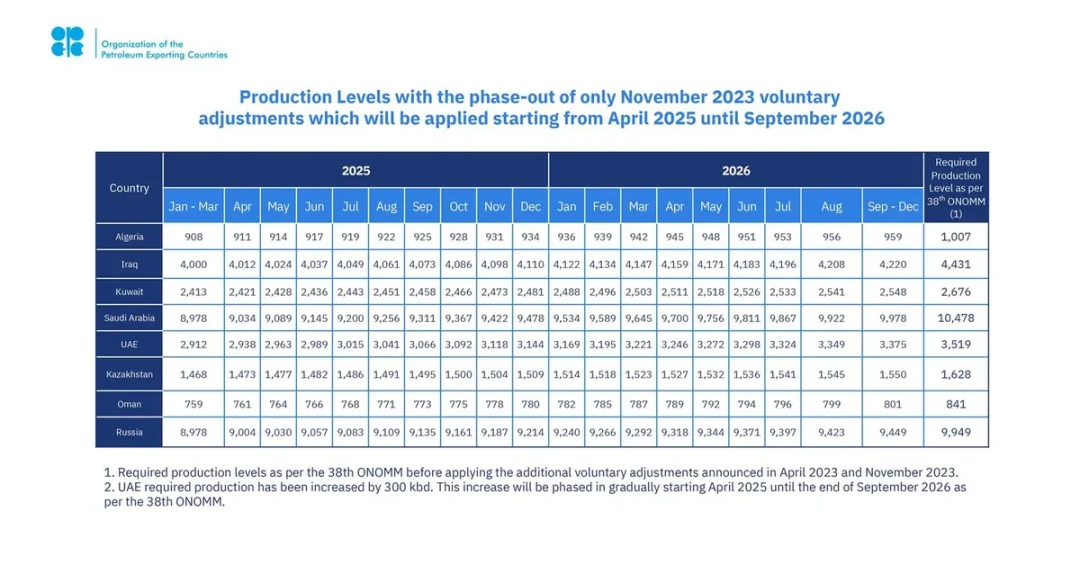
The 38th ONOMM, held in a virtual format, provided the platform for these eight countries to coordinate their actions outside the broader OPEC+ framework. This subsidiary meeting allowed them to fine-tune their voluntary commitments, which are separate from the group’s overall production quotas. By extending the 1.65 million bpd cut until the end of 2026, the countries aim to provide long-term certainty to markets, enabling investors and producers to plan with greater confidence. Meanwhile, the 2.2 million bpd adjustment, initially announced in November 2023, will be gradually phased out on a monthly basis starting after March 2025 and concluding by September 2026. This phased approach is designed to avoid sudden supply shocks, allowing the market to absorb additional barrels incrementally. The flexibility to pause or reverse the monthly increases based on market conditions further underscores the group’s adaptive strategy.
Transparency has also been a key theme. The overproducing countries—those that exceeded their agreed quotas—pledged to achieve full conformity and submit updated compensation schedules to the OPEC Secretariat by the end of December 2024. The compensation period, now extended to June 2026, reflects a pragmatic approach to addressing past imbalances without destabilizing the market. This mechanism ensures that all members share the burden of adjustment fairly, reinforcing the credibility of the OPEC+ framework.
Key Details of the Agreement
The core outcomes of the virtual meeting can be summarized in three main decisions. First, the additional voluntary adjustments of 1.65 million bpd announced in April 2023 will be extended until the end of December 2026. This represents a significant long-term commitment by the eight countries to keep a substantial volume of oil off the market. Second, the 2.2 million bpd adjustment from November 2023 will be extended until the end of March 2025, after which it will be gradually phased out on a monthly basis until the end of September 2026. The phase-out schedule, attached to the meeting’s statement, provides a clear roadmap for the market. Third, the meeting welcomed pledges from overproducing countries to achieve full conformity and resubmit updated compensation schedules to the OPEC Secretariat before the end of December 2024, with the compensation period extended until the end of June 2026.
These decisions are part of the broader framework of the Declaration of Cooperation, which unites OPEC member countries with non-OPEC producers led by Russia. The DoC has been instrumental in managing global oil supply since 2016, and its continued relevance is evident in the ability of its members to adapt to evolving market dynamics. The voluntary nature of the adjustments is noteworthy: unlike mandatory quotas, voluntary cuts allow participating countries to demonstrate their commitment to market stability while retaining flexibility. Saudi Arabia, as the world’s largest oil exporter and holder of significant spare capacity, has consistently played a pivotal role in these efforts, often shouldering the largest share of voluntary reductions.
The meeting also highlighted the importance of the Joint Ministerial Monitoring Committee (JMMC), which monitors compliance and provides recommendations. The 52nd JMMC meeting, referenced in the statement, had agreed on the compensation mechanism for overproduced volumes. By extending the compensation period, the group acknowledges the need for a realistic timeline that accounts for the technical and logistical challenges of adjusting production levels. This cooperative spirit is a hallmark of OPEC+ and a key reason why the alliance has remained effective despite external pressures and divergent national interests.
International and Regional Impact
How will these decisions resonate beyond the oil markets? For international consumers, the extension of production cuts could mean continued support for oil prices, which in turn affects fuel costs, transportation, and inflation. However, the gradual phase-out of the 2.2 million bpd adjustment starting in 2025 signals a cautious return of supply, potentially easing price pressures if demand remains robust. For oil-importing nations, particularly in Asia and Europe, the predictability of OPEC+ policy is crucial for energy planning and economic stability. The group’s ability to act as a swing producer helps smooth out volatility, benefiting both producers and consumers in the long run.
Regionally, the meeting reinforces the role of Gulf Cooperation Council (GCC) countries—Saudi Arabia, the UAE, Kuwait, and Oman—as central players in global energy governance. Their coordination with non-GCC producers like Russia, Iraq, Kazakhstan, and Algeria demonstrates a broad-based approach that transcends geopolitical divides. For Saudi Arabia, this alignment is particularly significant as it continues to assert its leadership in energy markets while pursuing economic diversification under Vision 2030. The Kingdom’s ability to bring together diverse producers under a common cause enhances its diplomatic standing and underscores its commitment to global stability. The meeting also comes amid heightened geopolitical tensions, including conflicts in the Middle East and sanctions on Russian oil, making the unity of OPEC+ even more remarkable.
The international community will be watching closely to see whether the phased increase is implemented as planned or adjusted based on market conditions. The flexibility clause—allowing the monthly increase to be paused or reversed—provides a safety valve against unforeseen shocks. This adaptive approach is a testament to the group’s maturity and its responsiveness to data-driven analysis. It also sends a signal that OPEC+ is not rigidly committed to a fixed path but will act in the best interests of market stability.
Economic and Strategic Significance
Why do these voluntary adjustments matter for the global economy? Oil remains the lifeblood of the global energy system, and its price affects everything from manufacturing costs to consumer spending. By extending the 1.65 million bpd cut until 2026, the eight countries are effectively removing a significant volume of supply from the market, which helps support prices at levels conducive to investment in future production capacity. For Saudi Arabia, this is particularly important as it seeks to fund its Vision 2030 transformation, which requires substantial capital investment in non-oil sectors. Stable oil revenues provide the fiscal space needed to diversify the economy, develop new industries, and create jobs for a growing population.
For other participants, the decisions offer similar benefits. Russia, despite facing Western sanctions, relies on oil revenues to support its budget. Iraq, Kuwait, the UAE, and Oman are all heavily dependent on hydrocarbon exports, and price stability is essential for their economic planning. Kazakhstan and Algeria, though smaller producers, also benefit from a coordinated approach that prevents price wars and market gluts. The compensation mechanism for overproducers adds a layer of fairness, ensuring that those who exceeded quotas contribute to the collective effort. This reinforces the credibility of OPEC+ and discourages free-riding, which could undermine the entire framework.
Strategically, the meeting underscores the deepening ties between Saudi Arabia and Russia, the two largest producers in the alliance. Despite their differing geopolitical alignments, both countries recognize the mutual benefits of cooperation in energy markets. This partnership has been a cornerstone of OPEC+ since 2016 and has weathered numerous challenges, including the price war of 2020 and subsequent recovery. The virtual meeting format, necessitated by logistical considerations, also highlights the efficiency of modern diplomacy, allowing leaders to convene quickly and decisively.
Vision 2030 Alignment
How does this OPEC+ coordination fit into Saudi Arabia’s long-term vision? Vision 2030, the Kingdom’s ambitious blueprint for economic transformation, aims to reduce dependence on oil and diversify revenue sources. However, during the transition, a stable and predictable oil market is essential to generate the financial resources needed for these reforms. By leading efforts to stabilize global oil prices, Saudi Arabia ensures a steady flow of revenue that can be reinvested in sectors such as tourism, technology, renewable energy, and entertainment. The Kingdom’s role in OPEC+ thus directly supports its domestic development goals, providing the fiscal foundation for mega-projects like NEOM and the Red Sea Project.
Moreover, Saudi Arabia’s leadership in OPEC+ enhances its global standing and diplomatic influence. As the world’s largest oil exporter and a key player in the G20, the Kingdom is uniquely positioned to bridge divides between producers and consumers. The virtual meeting on the sidelines of the 38th ONOMM exemplifies Saudi Arabia’s commitment to multilateralism and its ability to convene diverse stakeholders for a common purpose. This aligns with Vision 2030’s emphasis on international cooperation and economic diplomacy. As the global energy landscape evolves, Saudi Arabia will continue to play a pivotal role in ensuring stability, fostering dialogue, and driving sustainable growth. The decisions taken at this meeting are not just about oil—they are about securing a prosperous future for the Kingdom and its partners.
20 Questions
Q1. What was the purpose of the virtual meeting held by eight OPEC+ countries?
A1. The meeting aimed to reinforce precautionary efforts to support oil market stability and balance, and to decide on extending voluntary production adjustments announced in 2023.
Q2. Which countries participated in the virtual meeting?
A2. Saudi Arabia, Russia, Iraq, the United Arab Emirates, Kuwait, Kazakhstan, Algeria, and Oman participated in the meeting held on the sidelines of the 38th ONOMM.
Q3. What is the volume of the additional voluntary adjustment extended until December 2026?
A3. The countries agreed to extend the additional voluntary adjustment of 1.65 million barrels per day, originally announced in April 2023, until the end of December 2026.
Q4. How will the 2.2 million barrels per day adjustment be handled?
A4. The 2.2 million bpd adjustment from November 2023 will be extended until March 2025, then gradually phased out monthly until September 2026, with flexibility to pause or reverse.
Q5. What did the meeting welcome regarding overproducing countries?
A5. The meeting welcomed pledges from overproducing countries to achieve full conformity and resubmit updated compensation schedules to the OPEC Secretariat by end of December 2024.
Q6. Until when has the compensation period been extended?
A6. The compensation period for overproduced volumes has been extended until the end of June 2026, as agreed in the 52nd JMMC meeting.
Q7. What is the significance of the Declaration of Cooperation?
A7. The Declaration of Cooperation, established in 2016, unites OPEC and non-OPEC producers to manage oil supply and stabilize markets, with Saudi Arabia playing a leading role.
Q8. How does this decision affect global oil prices?
A8. By keeping supply constrained, the decision supports oil prices, providing stability for producers and consumers, though the gradual phase-out may ease prices later.
Q9. What is the role of the Joint Ministerial Monitoring Committee (JMMC)?
A9. The JMMC monitors compliance with production quotas and recommends adjustments, ensuring all members adhere to agreed targets and compensation mechanisms.
Q10. Why is Saudi Arabia’s participation crucial in OPEC+?
A10. Saudi Arabia is the world’s largest oil exporter and holds significant spare capacity, making its leadership essential for coordinating production cuts and ensuring market stability.
Q11. How does this meeting align with Vision 2030?
A11. Stable oil revenues from OPEC+ efforts provide fiscal resources for Vision 2030’s economic diversification, funding projects in tourism, technology, and renewable energy.
Q12. What happens if market conditions change after the phase-out begins?
A12. The monthly increase can be paused or reversed subject to market conditions, allowing OPEC+ to adapt swiftly to unforeseen shocks or demand shifts.
Q13. Which countries are considered overproducers in this context?
A13. Overproducers are OPEC+ members that exceeded their agreed quotas since January 2024; they have pledged to compensate by cutting extra volumes.
Q14. What is the expected impact on non-OPEC oil producers?
A14. Non-OPEC producers may benefit from price stability, but they could also face competition as OPEC+ gradually returns supply to the market after 2025.
Q15. How does this decision affect investment in renewable energy?
A15. Stable oil revenues enable Saudi Arabia and others to invest in renewables, supporting a balanced energy transition without undermining economic growth.
Q16. What message does this send to global markets?
A16. It signals OPEC+ unity and commitment to market stability, reassuring investors and consumers that the group will act decisively to prevent volatility.
Q17. How often does OPEC+ hold such ministerial meetings?
A17. OPEC+ holds ministerial meetings typically every month or two, with virtual formats used when necessary, to review market conditions and adjust production policies.
Q18. What is the significance of the virtual format for this meeting?
A18. The virtual format allows for timely coordination among leaders despite logistical challenges, demonstrating efficiency and adaptability in international diplomacy.
Q19. How does this cooperation benefit regional stability?
A19. By aligning major producers, the meeting reduces the risk of price wars and economic instability, fostering a more predictable environment for regional trade and investment.
Q20. What are the next steps for OPEC+ following this meeting?
A20. OPEC+ will monitor market conditions, implement the phased increase, and ensure compliance with compensation schedules, with further reviews at upcoming ministerial meetings.
Reader Feedback
We value your thoughts. Please share your feedback on this article.
Your feedback helps us improve our coverage.
Related articles
 NDMC and Tarmeez Capital Sign MoU on Savings Products
 Minister Explores Potato Sector Cooperation in Hail
 IsDB Group Joins Africa Investment Forum 2024 in Rabat
 Jazan Port Welcomes First CMA CGM Container Ship
 CMA Sets December 31 Deadline for FinTech License Round
 SAMA Data Center Earns Triple Sustainability Certificates