


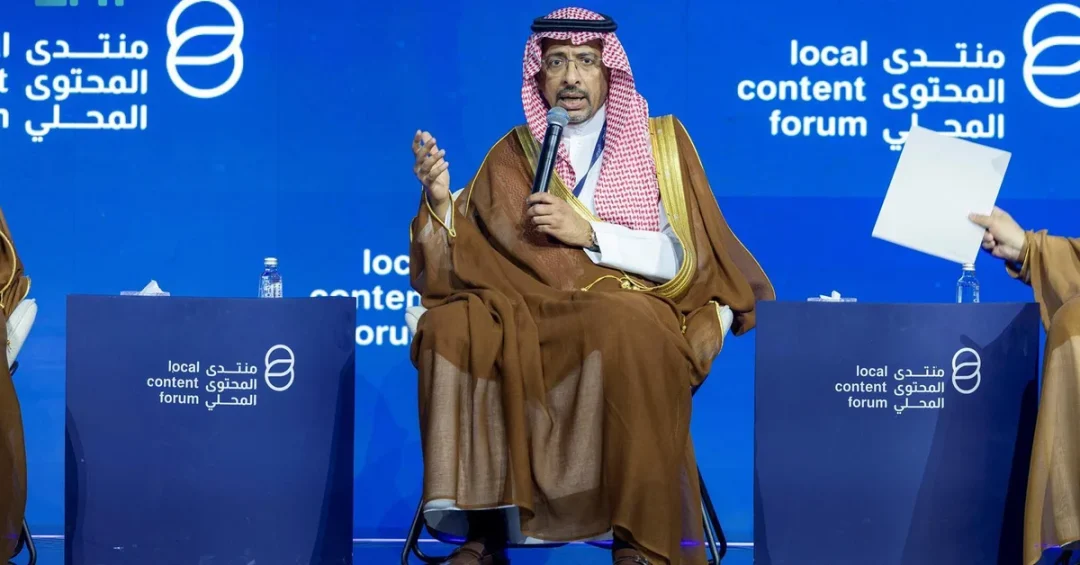
Saudi Arabia’s Minister of Industry and Mineral Resources, Bandar Alkhorayef, has affirmed that the availability of high-quality, competitive national products is a fundamental pillar for achieving the Kingdom’s local content objectives and maximizing their contribution to national economic development. Speaking during a ministerial session titled “Future Directions for Local Content Under the Saudi Vision 2030” at the Local Content Forum 2024 in Riyadh, Alkhorayef — who also serves as Chairman of the Board of Directors of the Local Content and Government Procurement Authority — outlined how local content has become one of the central economic drivers of the Kingdom’s transformation agenda, according to information released through official Saudi channels and reported by the Saudi Press Agency (SPA).
The minister’s remarks, delivered on November 21, 2024, placed local content at the heart of a broader national effort to diversify the economy, strengthen domestic supply chains, and direct government spending toward Saudi-made goods and services. His intervention at the forum reflected a consistent message from Saudi leadership: that the Kingdom’s economic modernization depends not only on attracting global investment but also on building a robust, competitive industrial base at home. For international observers, the session offered a clear signal that local content is no longer a procurement technicality but a strategic national priority embedded in the executive programs of Saudi Vision 2030.
Context and Background
Why has local content become such a central theme in Saudi Arabia’s economic planning? The concept refers to the share of goods, services, and labor sourced domestically within a nation’s total spending, and in the Saudi context it has evolved into a comprehensive policy framework designed to retain more economic value inside the Kingdom. The Local Content and Government Procurement Authority (LCGPA) was established to institutionalize this approach, working with government entities and major national companies to increase the proportion of local inputs in their operations and procurement. The authority operates under the oversight of the Ministry of Industry and Mineral Resources, which is tasked with expanding the industrial base and enabling factories to raise the share of high-quality national products included in the mandatory list of national products.
The Local Content Forum 2024, now in its second edition, builds on the success of its inaugural gathering. According to SPA, the forum opens avenues for knowledge exchange, raises awareness about the mechanisms and policies of local content, and highlights its critical role in achieving Saudi Vision 2030. The event brings together policymakers, industrialists, and international partners to discuss how local content can be deepened across sectors — from manufacturing and mining to technology and services — at a time when the Kingdom is accelerating its economic diversification efforts. The forum’s growth from one edition to the next reflects the increasing importance Riyadh attaches to translating policy ambition into measurable industrial outcomes.
Key Details
During the ministerial session, Alkhorayef highlighted that the mandatory list of national products is one of the tools designed to direct government spending toward local products. This list, maintained and updated by the relevant authorities, identifies products that government entities are required to prioritize in their procurement, thereby creating a predictable demand signal for Saudi manufacturers. The minister pointed to the pivotal role of the Ministry of Industry and Mineral Resources in expanding the industrial base and enabling factories to increase the proportion of high-quality national products included in the mandatory list — a task that involves both industrial development incentives and quality standards enforcement.
Alkhorayef further went over the significant role of the private sector in fostering local content, noting that the Local Content and Government Procurement Authority implements local content initiatives through two main tracks. The first is building strategic partnerships with major national companies; the second is the Local Content Coordination Council, which includes several major national companies that work alongside the authority to enhance the percentage of local content in their operations and procurement. This dual-track approach is designed to ensure that local content requirements are not merely imposed from the top down but are co-owned by the companies whose supply chains and investment decisions ultimately determine the policy’s success.
International and Regional Impact
How does Saudi Arabia’s local content push affect international companies and trading partners? For global firms, the Kingdom’s emphasis on domestic sourcing creates both opportunities and expectations. Multinationals operating in Saudi Arabia are increasingly encouraged to localize aspects of their supply chains, form joint ventures with Saudi manufacturers, and transfer knowledge and technology to the local market. This approach mirrors similar local content policies in other Gulf economies, but Saudi Arabia’s scale — as the largest economy in the Middle East and a G20 member — gives its procurement decisions outsized influence over regional supply chains and investment flows. The mandatory list of national products and the coordination council together create a structured framework through which international partners can align with Saudi priorities.
Regionally, the Kingdom’s local content agenda supports broader efforts to strengthen the Gulf Cooperation Council’s industrial integration and reduce dependence on imported goods in strategic sectors. By building competitive national products, Saudi Arabia aims to position itself not only as a consumer market but also as a producer and exporter of manufactured goods — a shift that could reshape trade patterns across the Middle East and North Africa. The minister’s emphasis on quality and competitiveness signals that the policy is not about protectionism for its own sake, but about creating Saudi products that can stand on their own merit in domestic and international markets.
Economic and Strategic Significance
Why does local content matter so much for Saudi Arabia’s long-term economic resilience? Every percentage point increase in local sourcing represents value retained within the Kingdom — jobs created, skills developed, taxes generated, and foreign exchange saved. The Local Content and Government Procurement Authority estimates that directing government spending toward local products can significantly multiply the economic impact of public expenditure, turning procurement budgets into engines of industrial development. For a country undergoing one of the world’s most ambitious economic transformations, this multiplier effect is critical to ensuring that the benefits of Vision 2030 are widely shared across regions and sectors.
The strategic significance extends beyond economics. A strong local industrial base enhances Saudi Arabia’s self-reliance in essential goods, from food processing and pharmaceuticals to construction materials and defense-related manufacturing. The Ministry of Industry and Mineral Resources has been actively expanding the industrial base through initiatives that support factory establishment, upgrade production lines, and improve quality certification. When Alkhorayef stresses the availability of competitive national products as a cornerstone, he is pointing to the necessary condition for the entire local content system to function: without products that meet quality standards and price expectations, procurement preferences alone cannot deliver sustainable results.
Vision 2030 Alignment
How does the local content agenda fit within the broader architecture of Saudi Vision 2030? The vision, launched in 2016 under the leadership of Crown Prince Mohammed bin Salman, seeks to diversify the economy away from oil dependence, develop public service sectors, and build a thriving private sector. Local content is explicitly embedded in several of the vision’s executive programs, including the National Industrial Development and Logistics Program and the PIF program. Alkhorayef noted that developing local content in its various elements directly supports these executive programs, making it a cross-cutting enabler rather than a standalone initiative. The Local Content Forum 2024 served as a platform to align stakeholders around this shared objective and to showcase progress made since the first edition.
Looking ahead, the Kingdom’s success in local content will depend on continued collaboration between government, the private sector, and international partners. The Local Content Coordination Council, with its roster of major national companies, provides a mechanism for sustained engagement, while the mandatory list of national products gives government procurement a clear direction. As Saudi Arabia advances toward the goals of Vision 2030 — including increasing the private sector’s contribution to GDP and boosting non-oil exports — the availability of high-quality, competitive national products will remain the foundation on which these ambitions are built. The message from Riyadh is clear: local content is not a temporary policy but a permanent feature of the Kingdom’s economic strategy, and its success will be measured by the strength of Saudi industry itself.
20 Questions
Q1. What did Minister Bandar Alkhorayef emphasize at the Local Content Forum 2024?
A1. He emphasized that the availability of high-quality, competitive national products is fundamental for achieving local content goals and maximizing their impact on the Kingdom’s economic development, as reported by the Saudi Press Agency.
Q2. When and where was the statement made?
A2. The statement was made on November 21, 2024, during a ministerial session titled “Future Directions for Local Content Under the Saudi Vision 2030” at the Local Content Forum 2024 in Riyadh, Saudi Arabia.
Q3. What is the mandatory list of national products?
A3. It is a tool designed to direct government spending toward local products by identifying items that government entities should prioritize in procurement, thereby supporting Saudi manufacturers and local content objectives.
Q4. Which authority does Bandar Alkhorayef chair?
A4. He serves as Chairman of the Board of Directors of the Local Content and Government Procurement Authority, in addition to his role as Minister of Industry and Mineral Resources.
Q5. What are the two main tracks through which the LCGPA implements local content initiatives?
A5. The two tracks are building strategic partnerships with major national companies and the Local Content Coordination Council, which includes major national companies working alongside the authority to enhance local content.
Q6. What is the role of the Ministry of Industry and Mineral Resources in local content?
A6. The ministry works to expand the industrial base and enable factories to increase the proportion of high-quality national products included in the mandatory list, supporting local content goals.
Q7. How does local content relate to Saudi Vision 2030?
A7. Local content is one of the key economic pillars for realizing Saudi Vision 2030, directly supporting the vision’s executive programs and helping diversify the economy away from oil dependence.
Q8. What is the Local Content Forum?
A8. It is an event that builds on previous success to open avenues for knowledge exchange, raise awareness about local content mechanisms and policies, and highlight its role in achieving Saudi Vision 2030.
Q9. How many editions of the Local Content Forum have been held?
A9. The 2024 forum is the second edition, building on the success of the first edition, according to the Saudi Press Agency report.
Q10. Why is the private sector important for local content?
A10. The private sector plays a significant role in fostering local content, as companies implement procurement decisions and supply chain investments that determine the success of local content policies.
Q11. What does the Local Content Coordination Council do?
A11. It includes several major national companies that work alongside the Local Content and Government Procurement Authority to enhance the percentage of local content in their operations and procurement activities.
Q12. What does “competitive national products” mean in this context?
A12. It refers to Saudi-made goods that meet high quality standards and can compete on price and performance with imported alternatives, making them viable choices for government and private procurement.
Q13. How does local content support economic development?
A13. By retaining economic value within the Kingdom through domestic sourcing, local content creates jobs, develops skills, generates tax revenue, and strengthens domestic supply chains, contributing to overall economic development.
Q14. What is the Saudi Press Agency’s role in this news?
A14. The Saudi Press Agency (SPA) is the official national news agency that reported the minister’s statements, providing verified information from official Saudi channels.
Q15. What government spending does the mandatory list target?
A15. The mandatory list directs government procurement spending toward local products, ensuring that public entities prioritize Saudi-made goods that meet the specified criteria.
Q16. How does local content benefit international companies?
A16. International companies can benefit by forming partnerships, localizing supply chains, and transferring technology, positioning themselves as contributors to Saudi Arabia’s industrial development and Vision 2030 goals.
Q17. What is the significance of the forum’s second edition?
A17. The second edition builds on the first’s success, expanding knowledge exchange and awareness about local content mechanisms, reflecting the growing importance of local content in Saudi economic policy.
Q18. Which vision executive programs does local content support?
A18. Local content supports multiple executive programs of Saudi Vision 2030, including industrial development, logistics, and economic diversification initiatives aimed at reducing oil dependence.
Q19. What does the minister say about the availability of local products?
A19. He stresses that the availability of high-quality and competitive local products is fundamental for achieving local content goals and maximizing their positive impact on the Kingdom’s economic development.
Q20. What is the long-term outlook for local content in Saudi Arabia?
A20. Local content is positioned as a permanent feature of Saudi economic strategy, with continued collaboration between government, private sector, and international partners to strengthen Saudi industry and achieve Vision 2030 objectives.
Reader Feedback
We value your thoughts. Please share your feedback on this article.
Your feedback helps us improve our coverage.
Related articles
 LCGPA Launches Gold Category for Saudi Made Products
 Mawani Engages Feeder Ship Firms to Boost Saudi Ports
 Environment Minister Inaugurates International Dates Conference in Riyadh
 Paper Middle East Saudi Arabia 2024 Concludes in Jeddah
 Riyadh to Host Inaugural International MICE Summit in December
 Saudi Rail 2024 Concludes in Riyadh with Major Deals