


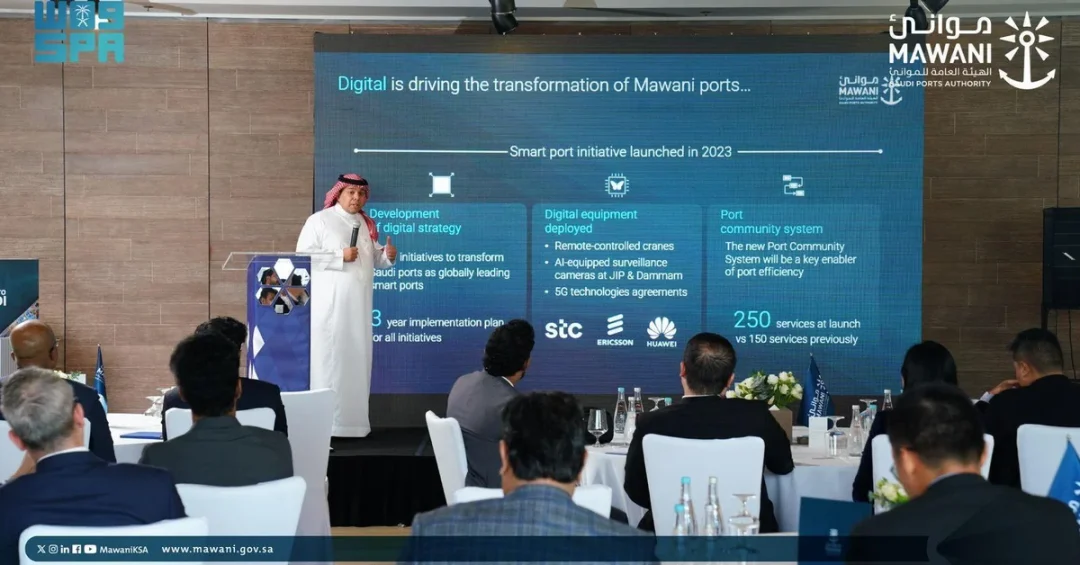
The Saudi Ports Authority (Mawani) convened a strategic meeting in Dubai with major international feeder ship companies to enhance connectivity between Saudi and global ports and strengthen the Kingdom’s competitiveness on the regional and international fronts. The meeting, reported by the Saudi Press Agency (SPA), focused on recent developments across Saudi ports, including infrastructure upgrades and advanced handling equipment at container terminals, as well as the latest technologies being deployed to ensure highly efficient operational services. The discussions also underscored the importance of exploring collaboration opportunities, deepening strategic partnerships, and formulating joint action plans to improve port connectivity, enhance logistics services, and facilitate trade.
The engagement reflects a broader national effort to support the Saudi economy and reinforce the Kingdom’s standing as a global logistics hub, in direct alignment with Vision 2030. Feeder ship companies play a vital role in global supply chains by moving containers between major transshipment hubs and smaller regional ports, and their decisions on where to route services directly influence trade volumes, port utilization, and shipping costs. By bringing these operators together in Dubai, one of the world’s busiest maritime and logistics centers, Mawani signaled its intent to position Saudi ports as indispensable nodes in the Red Sea and Arabian Gulf corridors. The meeting comes as Saudi Arabia accelerates port modernization, digitalization, and capacity expansion, aiming to capture a larger share of regional transshipment traffic and to support the growth of non-oil exports. The timing also reflects rising global interest in Red Sea routes and the need for resilient, efficient logistics infrastructure.
Context and Background
Why has Mawani chosen this moment to intensify dialogue with international feeder operators? Saudi Arabia has invested heavily in its port infrastructure over the past decade, transforming terminals into digitally enabled, high-capacity gateways. The Saudi Ports Authority oversees a network of ports on both the Red Sea and the Arabian Gulf, including Jeddah Islamic Port, King Abdulaziz Port in Dammam, King Fahd Industrial Port in Jubail, Yanbu Commercial Port, and the emerging facilities linked to NEOM and other giga-projects. These ports serve as entry and exit points for imports, exports, and transshipment cargo, and their performance is central to the Kingdom’s economic diversification agenda.
Feeder shipping companies are the connective tissue of global trade. They operate smaller vessels that shuttle containers between large mother ships and regional ports, enabling cargo to reach markets that cannot accommodate the world’s largest vessels. Their service networks determine which ports become preferred gateways and which are bypassed. For Saudi Arabia, attracting more feeder services means more frequent sailings, shorter transit times, and greater reliability for importers and exporters. It also means higher container throughput, more efficient use of terminal capacity, and stronger integration with global supply chains. In this context, Mawani’s Dubai meeting was not a routine courtesy call but a targeted commercial diplomacy effort to align international operators with Saudi Arabia’s logistics ambitions.
The meeting also took place against a backdrop of rapid change in global shipping. Carriers have been adjusting networks in response to geopolitical tensions, climate-related route disruptions, and shifting trade patterns. Red Sea security concerns have prompted some operators to reroute vessels, while others have sought alternative hubs. Saudi ports, located at the crossroads of Europe, Asia, and Africa, offer a strategically attractive alternative for cargo owners seeking stability and efficiency. By engaging feeder companies directly, Mawani is working to ensure that Saudi ports are top-of-mind when carriers and logistics providers redesign their networks. The Kingdom’s message is clear: Saudi ports are open, competitive, and ready to handle growing volumes with world-class infrastructure and services.
Key Details
What exactly was discussed at the Dubai meeting, and how does it translate into practical outcomes for Saudi ports? According to the Saudi Press Agency, the meeting focused on the latest developments at Saudi ports, including infrastructure upgrades and the modernization of handling equipment at container terminals. These improvements are designed to increase berth productivity, reduce vessel turnaround times, and enhance the overall customer experience for shipping lines and cargo owners. The discussions highlighted the newest technologies being implemented in Saudi ports, such as advanced terminal operating systems, automated gate processes, and digital platforms that provide real-time visibility of cargo movements.
The meeting also emphasized ongoing capacity enhancements to ensure that ports can deliver highly efficient operational services. This includes expanding container yard space, deepening berths to accommodate larger vessels, and investing in modern cranes and other handling equipment. Such measures are essential for keeping pace with growing trade volumes and for supporting Saudi Arabia’s ambition to become a leading logistics hub. The Saudi Ports Authority has consistently prioritized performance indicators such as container throughput, vessel waiting times, and connectivity indices, and the Dubai discussions provided a platform to showcase these achievements to international partners.
A further key element was the emphasis on exploring opportunities for collaboration and enhancing strategic partnerships with feeder ship companies. Mawani and the operators discussed joint action plans to improve the connectivity of Saudi ports, enhance logistics services, and facilitate trade. These plans may include new or expanded feeder services, coordinated schedules, and integrated digital solutions that make it easier for shippers to book, track, and move cargo through Saudi ports. By working directly with feeder companies, Mawani can tailor its offerings to the needs of the market and ensure that Saudi ports remain competitive against regional rivals. The meeting thus served as both a review of progress and a platform for concrete commercial engagement.
International and Regional Impact
How will stronger ties between Mawani and global feeder companies reshape trade flows across the Middle East and beyond? The immediate impact is likely to be greater service frequency and improved connectivity for Saudi ports, which in turn can attract more cargo from across the region. Feeder operators that add Saudi ports to their rotations create new options for importers and exporters in the Kingdom and in neighboring markets. This can reduce reliance on distant hubs and shorten supply chains, lowering costs and improving reliability. For international businesses, enhanced Saudi port connectivity means easier access to one of the Middle East’s largest consumer markets and a growing industrial base.
Regionally, the meeting reinforces Saudi Arabia’s position as a logistics leader in the Gulf and Red Sea area. Competition among ports in the region is intense, with established hubs such as Dubai, Salalah, and Jebel Ali handling significant transshipment volumes. Saudi Arabia’s investments in port infrastructure, digitalization, and capacity are designed to capture a larger share of this traffic. By engaging feeder companies directly, Mawani is signaling that Saudi ports are ready to compete on service quality, cost, and reliability. The Kingdom’s strategic location, with coastlines on two major maritime corridors, gives it a natural advantage that, combined with modern infrastructure, can make Saudi ports a preferred choice for global carriers.
Internationally, the discussions in Dubai align with broader efforts to strengthen global supply chain resilience. Recent disruptions have shown the risks of over-concentration in a few hubs, and cargo owners are seeking diversified routing options. Saudi ports offer an alternative that combines modern facilities with a stable operating environment. The engagement with feeder companies is therefore part of a wider strategy to integrate Saudi Arabia more deeply into global trade networks, benefiting not only the Kingdom but also international partners who value predictability and efficiency. As global trade patterns evolve, Saudi Arabia’s proactive outreach to shipping lines positions it as a reliable and forward-looking partner.
Economic and Strategic Significance
What does improved port connectivity mean for Saudi Arabia’s economy and its long-term strategic goals? Ports are critical enablers of economic diversification. They facilitate imports of goods, machinery, and raw materials needed by Saudi industries, and they support exports of petrochemicals, minerals, manufactured products, and agricultural goods. By enhancing connectivity, Mawani helps reduce logistics costs, which improves the competitiveness of Saudi businesses and makes the Kingdom a more attractive destination for foreign investment. Efficient ports also support the growth of non-oil sectors, a central objective of Vision 2030.
Strategically, the meeting underscores Saudi Arabia’s ambition to become a global logistics hub connecting three continents. The National Industrial Development and Logistics Program (NIDLP), a key Vision 2030 initiative, aims to elevate the logistics sector’s contribution to the economy, increase local content, and create jobs. Ports are at the heart of this program, and their performance is closely monitored through indicators such as container throughput, port connectivity, and logistics performance. By engaging feeder companies, Mawani is directly addressing one of the key levers for improving these indicators: the availability and quality of shipping services. More feeder services mean more trade, more investment, and more opportunities for Saudi businesses to reach global markets.
In addition, the meeting reflects the growing integration of Saudi ports with giga-projects and special economic zones. NEOM, the Red Sea Project, and other developments rely on efficient logistics to bring in materials and equipment and to export products. Enhanced port connectivity supports these projects and helps attract global companies to establish operations in Saudi Arabia. The economic benefits extend beyond the ports themselves, creating a multiplier effect across transport, warehousing, manufacturing, and services. The Dubai meeting is thus a practical step toward realizing the Kingdom’s vision of a diversified, trade-driven economy.
Vision 2030 Alignment
How does Mawani’s engagement with feeder ship companies fit into the broader Vision 2030 framework? Vision 2030 seeks to transform Saudi Arabia into a global investment powerhouse and a hub connecting Asia, Europe, and Africa. A key pillar of this vision is the development of a world-class logistics sector that can support economic diversification and create employment opportunities for Saudi citizens. The Saudi Ports Authority has been tasked with modernizing port infrastructure, improving operational efficiency, and expanding connectivity to global markets. The Dubai meeting is a direct manifestation of these efforts, demonstrating proactive engagement with international partners to enhance the Kingdom’s maritime links.
Looking ahead, Mawani’s strategy involves continuous investment in technology, capacity, and partnerships. The authority has set ambitious targets for container throughput and port performance, and it regularly benchmarks against leading global ports. By working with feeder companies, Mawani can align its development plans with market demand and ensure that new capacity is matched by new services. This collaborative approach is central to Vision 2030’s emphasis on partnership between the public and private sectors. As Saudi Arabia continues to open up to the world, its ports will play an increasingly prominent role in facilitating trade, supporting tourism, and enabling the movement of goods and people. The meeting in Dubai is one of many steps toward making Saudi ports a preferred gateway for global commerce, contributing to the Kingdom’s long-term prosperity and its standing as a leading logistics hub.
20 Questions
Q1. What is the Saudi Ports Authority (Mawani)?
A1. Mawani is the Saudi Ports Authority, a government agency responsible for overseeing and developing the Kingdom’s ports. It works to enhance port infrastructure, improve operational efficiency, and strengthen Saudi Arabia’s position as a global logistics hub in line with Vision 2030.
Q2. Why did Mawani meet with feeder ship companies in Dubai?
A2. Mawani met with major international feeder ship companies in Dubai to enhance connectivity between Saudi and global ports, discuss infrastructure developments, and explore collaboration opportunities. The meeting aimed to bolster the competitiveness of Saudi ports regionally and internationally.
Q3. What are feeder ship companies and why are they important?
A3. Feeder ship companies operate smaller vessels that transport containers between major transshipment hubs and regional ports. They are vital for global supply chains because they connect smaller markets to main shipping routes, influencing trade volumes and port connectivity.
Q4. What specific topics were discussed at the Dubai meeting?
A4. The meeting focused on developments at Saudi ports, including infrastructure upgrades, modern handling equipment, and the latest technologies in container terminals. It also covered capacity enhancements, collaboration opportunities, and joint action plans to improve connectivity and logistics services.
Q5. How does this meeting support Saudi Arabia’s national economy?
A5. By improving port connectivity and logistics services, the meeting helps facilitate trade, reduce costs, and attract investment. This supports economic diversification, boosts non-oil exports, and strengthens Saudi Arabia’s standing as a global logistics hub, benefiting the national economy.
Q6. What is the connection between this meeting and Vision 2030?
A6. The meeting aligns with Vision 2030’s goal of transforming Saudi Arabia into a global logistics hub. It supports the National Industrial Development and Logistics Program by enhancing port connectivity, which is essential for economic diversification and job creation.
Q7. Which Saudi ports are expected to benefit from this engagement?
A7. All major Saudi ports stand to benefit, including Jeddah Islamic Port, King Abdulaziz Port in Dammam, King Fahd Industrial Port in Jubail, and Yanbu Commercial Port. Improved feeder services can increase throughput and efficiency across the network.
Q8. What technologies are being implemented in Saudi ports?
A8. Saudi ports are adopting advanced terminal operating systems, automated gate processes, digital platforms for real-time cargo tracking, and modern handling equipment. These technologies improve efficiency, reduce turnaround times, and enhance the overall customer experience.
Q9. How will improved connectivity benefit international traders?
A9. Improved connectivity offers international traders more frequent sailings, shorter transit times, and reliable access to Saudi and regional markets. It also provides alternative routing options, enhancing supply chain resilience and reducing dependence on a few hubs.
Q10. What role do Saudi ports play in regional trade?
A10. Saudi ports serve as key gateways for trade in the Gulf and Red Sea regions, handling imports, exports, and transshipment cargo. Their strategic location connects Asia, Europe, and Africa, making them essential nodes in regional and global supply chains.
Q11. How does Mawani plan to enhance strategic partnerships with feeder companies?
A11. Mawani aims to formulate joint action plans, explore new service opportunities, and align schedules and digital solutions with feeder operators. These partnerships are designed to improve port connectivity, logistics services, and trade facilitation.
Q12. What are the expected economic benefits of increased feeder services?
A12. Increased feeder services can raise container throughput, create jobs, attract investment, and reduce logistics costs. They also support the growth of non-oil sectors and enhance the competitiveness of Saudi businesses in global markets.
Q13. How does this meeting reflect Saudi Arabia’s global engagement?
A13. The meeting demonstrates Saudi Arabia’s proactive approach to international collaboration, engaging directly with global shipping lines to integrate Saudi ports into worldwide networks. It showcases the Kingdom’s openness to partnerships and its commitment to global trade.
Q14. What challenges do Saudi ports face in attracting feeder services?
A14. Saudi ports compete with established regional hubs that have long-standing relationships with carriers. Attracting feeder services requires continuous investment in infrastructure, competitive pricing, and reliable service quality, all of which Mawani is addressing through modernization.
Q15. How does the meeting support Saudi Arabia’s non-oil export goals?
A15. By improving port connectivity and efficiency, the meeting helps Saudi exporters reach international markets more easily and cost-effectively. This supports the growth of non-oil exports, a key objective of Vision 2030’s economic diversification strategy.
Q16. What is the significance of holding the meeting in Dubai?
A16. Dubai is a global maritime and logistics hub, home to many international shipping companies. Holding the meeting there allowed Mawani to engage directly with key decision-makers and showcase Saudi ports’ potential to a concentrated audience of industry leaders.
Q17. How will capacity enhancements at Saudi ports be implemented?
A17. Capacity enhancements include expanding container yards, deepening berths, and acquiring modern cranes and handling equipment. These measures are part of ongoing investment programs by Mawani to ensure ports can handle growing trade volumes efficiently.
Q18. What does this mean for the future of Saudi logistics?
A18. It signals a future where Saudi Arabia is a leading logistics hub with world-class ports, strong global partnerships, and seamless connectivity. This will drive economic growth, create opportunities, and support the Kingdom’s Vision 2030 ambitions.
Q19. How can international companies participate in Saudi port development?
A19. International companies can partner with Mawani through service agreements, joint ventures, and technology collaborations. Mawani welcomes strategic partnerships that bring expertise, innovation, and investment to Saudi ports.
Q20. What are the next steps following this meeting?
A20. Mawani will continue engaging with feeder companies to finalize joint action plans, implement new services, and monitor progress. The authority remains committed to enhancing port connectivity and supporting Saudi Arabia’s goal of becoming a global logistics hub.
Reader Feedback
We value your thoughts. Please share your feedback on this article.
Your feedback helps us improve our coverage.
Related articles
 Environment Minister Inaugurates International Dates Conference in Riyadh
 Paper Middle East Saudi Arabia 2024 Concludes in Jeddah
 Riyadh to Host Inaugural International MICE Summit in December
 Saudi Rail 2024 Concludes in Riyadh with Major Deals
 Global Experts Discuss Climate Change Impact on Date Palm Cultivation at Dates Conference, Exhibition
 Aseer’s Sidr Honey Season Boosts Local Markets