


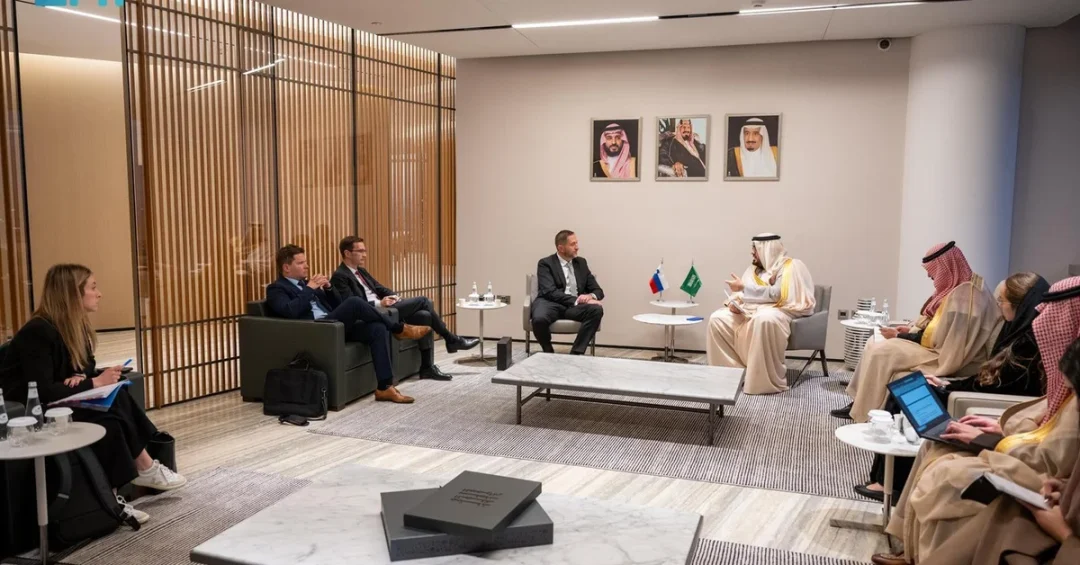
Saudi Minister of Economy and Planning Faisal F. Alibrahim met with Republic of Slovenia Deputy Prime Minister and Minister of Finance Klemen Boštjančič in Riyadh on January 16, 2025, to discuss strengthening economic and investment relations between the two countries and to review global economic developments. The meeting, announced by the Saudi Press Agency (SPA), underscores the Kingdom’s continuing efforts to broaden its international economic partnerships under the framework of Saudi Vision 2030, the national transformation strategy launched by Crown Prince Mohammed bin Salman in 2016.
The encounter between Alibrahim and Boštjančič is the latest in a series of high-level engagements between Saudi Arabia and European nations seeking to deepen trade, investment, and financial cooperation. Riyadh has increasingly positioned itself as a bridge between Europe, Asia, and Africa, and bilateral meetings of this kind are central to that strategy. For Slovenia, a European Union member state with a dynamic export-oriented economy, the talks offer a gateway to Gulf markets and investment opportunities. For Saudi Arabia, they signal the Kingdom’s openness to diversified partnerships that support its economic modernization agenda. Why does this relatively brief diplomatic engagement matter in the broader context of global economic diplomacy?
Context and Background
Saudi Arabia and Slovenia have maintained diplomatic relations since 1992, but economic ties between the two countries have historically been modest. In recent years, however, both governments have shown a clear willingness to expand cooperation beyond traditional trade flows. Slovenia, with a population of roughly 2.1 million and a gross domestic product of approximately $68 billion, is a member of the eurozone and the Schengen Area, giving it access to the world’s largest single market. Its strategic location at the crossroads of Central Europe and the Balkans makes it an attractive partner for Gulf states seeking to expand their European footprint.
The meeting between Alibrahim and Boštjančič follows a broader pattern of Saudi engagement with European counterparts. In 2024, Saudi officials held talks with representatives from France, Germany, Italy, and the Netherlands on topics ranging from renewable energy to digital infrastructure. The Kingdom has also expanded its dialogue with the European Union on trade and investment facilitation. These engagements are not merely symbolic; they reflect a deliberate strategy to attract foreign direct investment and to position Saudi Arabia as a reliable economic partner in a multipolar world. What does Slovenia bring to the table that larger European economies might not?
Slovenia’s economy is characterized by a strong industrial base, particularly in automotive components, pharmaceuticals, and information technology. Companies such as Krka, a pharmaceutical manufacturer, and Revoz, a Renault subsidiary, have established Slovenia as a competitive exporter within the EU. For Saudi Arabia, cooperation with Slovenia could open avenues for technology transfer, joint ventures, and access to European supply chains. In turn, Saudi Arabia offers Slovenia a market of more than 35 million consumers, a rapidly growing non-oil economy, and a strategic hub for trade with the Middle East and North Africa. The meeting in Riyadh therefore represents a mutually beneficial exchange of opportunities rather than a one-sided arrangement.
Key Details of the Meeting
According to the Saudi Press Agency, the discussions between Minister Alibrahim and Deputy Prime Minister Boštjančič focused on enhancing economic and investment relations and on global economic developments. While the SPA report did not disclose specific agreements or memoranda of understanding, the subjects covered align with Saudi Arabia’s ongoing priorities: attracting foreign investment, diversifying revenue streams, and strengthening financial cooperation with international partners. The meeting also provided an opportunity to exchange views on the global economic outlook, including inflation trends, supply chain resilience, and the role of energy markets in stabilizing growth.
Minister Alibrahim, who has led the Ministry of Economy and Planning since 2021, has been a prominent figure in Saudi Arabia’s economic transformation. Under his leadership, the ministry has overseen the development of the National Investment Strategy and has worked to integrate Vision 2030 objectives into national planning. Deputy Prime Minister Boštjančič, a seasoned financial official, has similarly emphasized Slovenia’s commitment to fiscal stability and international economic cooperation. The meeting between two officials with such portfolios suggests that the dialogue was substantive and forward-looking, even if the immediate outcomes remain confidential. How might such high-level exchanges translate into tangible economic benefits for both nations?
The timing of the meeting is also significant. It took place against the backdrop of a global economy that is gradually recovering from the shocks of the COVID-19 pandemic, yet still faces headwinds from geopolitical tensions, energy price volatility, and shifting trade patterns. Saudi Arabia, as the world’s largest oil exporter and a member of the G20, plays a stabilizing role in global energy markets. Slovenia, as a eurozone member, is attuned to the monetary and fiscal dynamics of the European Union. Their conversation therefore touched on issues of shared concern, from inflation management to investment flows. The fact that both officials chose to meet in Riyadh rather than on the sidelines of a multilateral summit highlights the importance they attach to bilateral relations.
International and Regional Impact
The meeting between Saudi Arabia and Slovenia carries implications beyond the bilateral relationship. For the Gulf region, it reinforces Saudi Arabia’s position as a diplomatic and economic hub that attracts engagement from European capitals. For the European Union, it signals that member states are increasingly pursuing their own bilateral channels with Gulf countries, complementing the EU’s broader strategy of engagement with the region. This multi-layered diplomacy is particularly relevant as Europe seeks to diversify its energy sources and as the Gulf seeks to diversify its economies. The Saudi-Slovenian dialogue thus fits into a larger mosaic of Eurasian economic cooperation.
Regionally, Slovenia’s engagement with Saudi Arabia could encourage other Central and Eastern European countries to deepen their ties with the Kingdom. Countries such as Austria, Croatia, and the Czech Republic have already shown interest in expanding trade and investment links with Gulf states. If Slovenia succeeds in establishing a stronger economic presence in Saudi Arabia, it could serve as a model for smaller EU economies seeking to benefit from Vision 2030 opportunities. Conversely, Saudi Arabia’s outreach to Slovenia demonstrates its willingness to engage with partners of all sizes, not just the largest global economies. This inclusive approach to economic diplomacy enhances the Kingdom’s reputation as a reliable and open partner. What lessons can other nations draw from this evolving relationship?
Economic and Strategic Significance
From an economic perspective, the meeting underscores the importance of foreign direct investment (FDI) to Saudi Arabia’s Vision 2030 goals. The Kingdom aims to increase FDI to 5.7 percent of GDP by 2030, up from roughly 2 percent in recent years. European investors, including those from Slovenia, are seen as key contributors to this target. Sectors such as renewable energy, logistics, digital technology, and advanced manufacturing are particularly attractive to European firms. Slovenia’s expertise in these areas aligns well with Saudi Arabia’s needs, creating a natural foundation for collaboration. The discussions in Riyadh likely explored how Slovenian companies could participate in Saudi mega-projects and industrial zones.
Strategically, the meeting reinforces Saudi Arabia’s role as a bridge between Europe and Asia. The Kingdom’s geographical position, combined with its investments in transport and logistics infrastructure, makes it an ideal gateway for European goods and services entering the Gulf and beyond. Slovenia, with its access to the Adriatic Sea and its well-developed port infrastructure in Koper, could serve as a complementary entry point for Saudi exports into Central Europe. This potential synergy in trade routes and logistics could form the basis for future agreements. While no specific deals were announced, the dialogue sets the stage for deeper economic integration. How might such logistical complementarities shape future trade corridors?
Furthermore, the meeting reflects Saudi Arabia’s commitment to multilateralism and global economic stability. By engaging with Slovenia on global economic developments, Minister Alibrahim signals that the Kingdom is not only focused on its own transformation but also on contributing to international economic governance. This aligns with Saudi Arabia’s active participation in the G20, the World Economic Forum, and other global platforms. It also underscores the Kingdom’s readiness to collaborate on addressing shared challenges such as climate change, digital transformation, and sustainable development. Slovenia, as a member of the EU and a supporter of multilateral institutions, is a natural partner in these efforts.
Vision 2030 Alignment
The meeting between Minister Alibrahim and Deputy Prime Minister Boštjančič is a direct reflection of Saudi Vision 2030’s emphasis on international partnerships and economic diversification. Vision 2030 seeks to transform Saudi Arabia from an oil-dependent economy into a diversified, knowledge-based economy. Central to this goal is the expansion of non-oil exports, the attraction of foreign investment, and the development of new sectors such as tourism, entertainment, and technology. Engaging with European partners like Slovenia helps to accelerate these objectives by opening markets, facilitating technology transfer, and fostering innovation. The Kingdom’s leadership, under the guidance of Crown Prince Mohammed bin Salman, has consistently prioritized such international engagement as a pillar of the national transformation.
Looking ahead, the Saudi-Slovenian relationship is poised for further growth. Both countries have expressed interest in continuing dialogue and exploring concrete opportunities for cooperation. The Ministry of Economy and Planning, under Minister Alibrahim, will likely follow up on the discussions with Slovenia through technical committees and business delegations. Slovenian companies may soon find themselves invited to participate in Saudi investment forums and trade expos. For Saudi Arabia, each such partnership brings the Kingdom closer to its Vision 2030 targets and reinforces its standing as a global economic leader. As the world economy evolves, Saudi Arabia’s proactive diplomacy and openness to collaboration will remain key to its success. Isn’t it remarkable how a single meeting can symbolize a broader era of opportunity and mutual growth?
20 Questions
Q1. Who met in Riyadh on January 16, 2025?
A1. Saudi Minister of Economy and Planning Faisal F. Alibrahim met with Republic of Slovenia Deputy Prime Minister and Minister of Finance Klemen Boštjančič in Riyadh on January 16, 2025, as reported by the Saudi Press Agency.
Q2. What was the main purpose of the meeting?
A2. The meeting aimed to discuss enhancing economic and investment relations between Saudi Arabia and Slovenia, as well as to exchange views on global economic developments and challenges.
Q3. Which Saudi official represented the Kingdom?
A3. Minister of Economy and Planning Faisal F. Alibrahim represented Saudi Arabia. He has led the ministry since 2021 and oversees national economic planning and investment strategy.
Q4. Who represented Slovenia at the meeting?
A4. Republic of Slovenia Deputy Prime Minister and Minister of Finance Klemen Boštjančič represented Slovenia. He is responsible for the country’s fiscal policy and financial affairs.
Q5. What is the significance of this meeting for Saudi Arabia?
A5. The meeting reinforces Saudi Arabia’s commitment to expanding international economic partnerships under Vision 2030, attracting foreign investment, and positioning the Kingdom as a global economic hub.
Q6. How does this meeting align with Vision 2030?
A6. It directly supports Vision 2030’s goals of economic diversification, increased foreign direct investment, and strengthened international cooperation, which are central to the Kingdom’s transformation strategy.
Q7. What topics were discussed beyond bilateral relations?
A7. The officials also discussed global economic developments, including inflation trends, supply chain resilience, and energy market stability, reflecting shared interests in international economic governance.
Q8. Did the meeting result in any signed agreements?
A8. The Saudi Press Agency report did not mention any signed agreements or memoranda of understanding. The discussions were focused on enhancing relations and exchanging views.
Q9. What are Slovenia’s main economic strengths?
A9. Slovenia has a strong industrial base in automotive components, pharmaceuticals, and information technology. It is a eurozone member with a competitive export-oriented economy and access to the EU single market.
Q10. Why is Slovenia an attractive partner for Saudi Arabia?
A10. Slovenia offers access to European markets, technological expertise, and a strategic location for trade. It also provides opportunities for joint ventures in sectors aligned with Saudi Arabia’s diversification goals.
Q11. What does Saudi Arabia offer to Slovenia?
A11. Saudi Arabia offers a large consumer market, a rapidly growing non-oil economy, and a strategic hub for trade with the Middle East and North Africa, plus investment opportunities in mega-projects.
Q12. How does this meeting fit into Saudi Arabia’s broader European outreach?
A12. It is part of a series of high-level engagements with European nations, including France, Germany, and Italy, aimed at deepening trade, investment, and financial cooperation.
Q13. What is the current state of Saudi-Slovenian economic relations?
A13. While diplomatic relations date back to 1992, economic ties have been modest. Both countries are now seeking to expand cooperation in trade, investment, and technology.
Q14. What role does the Ministry of Economy and Planning play in Vision 2030?
A14. The ministry oversees national economic planning, develops investment strategies, and integrates Vision 2030 objectives into government policies to drive sustainable growth.
Q15. How might Slovenian companies benefit from Vision 2030?
A15. Slovenian companies can participate in Saudi mega-projects, supply chains, and industrial zones, particularly in renewable energy, logistics, digital technology, and advanced manufacturing.
Q16. What are Saudi Arabia’s FDI targets under Vision 2030?
A16. Saudi Arabia aims to increase foreign direct investment to 5.7 percent of GDP by 2030, up from around 2 percent in recent years, with European investors playing a key role.
Q17. What logistical synergies exist between the two countries?
A17. Slovenia’s port of Koper could serve as an entry point for Saudi exports into Central Europe, while Saudi Arabia’s transport infrastructure offers a gateway for Slovenian goods into the Gulf.
Q18. How does this meeting reflect Saudi Arabia’s global economic role?
A18. It demonstrates the Kingdom’s active engagement in international economic governance, its commitment to multilateralism, and its readiness to collaborate on shared global challenges.
Q19. What might be the next steps following this meeting?
A19. Follow-up could include technical committees, business delegations, and invitations for Slovenian companies to participate in Saudi investment forums and trade expos.
Q20. Why is this meeting important for international audiences?
A20. It illustrates Saudi Arabia’s openness to partnerships of all sizes, its strategic focus on Europe, and its progress toward Vision 2030 goals, offering insights into the Kingdom’s evolving global economic engagement.
Reader Feedback
We value your thoughts. Please share your feedback on this article.
Your feedback helps us improve our coverage.
Related articles
 Saudi EXIM Bank Commits $1.5 Billion to Global Mineral Flow
 Saudi Arabia to Host Hannover Messe 2025 in Riyadh
 Saudi-Thai Economic and Trade Committee Holds First Meeting
 Future Minerals Forum Sees 126 Agreements Worth SAR107 Billion
 RCJY Marks 50 Years at WEF 2025 in Davos
 GASTAT Reports 3.6% Rise in Saudi Real Estate Prices