


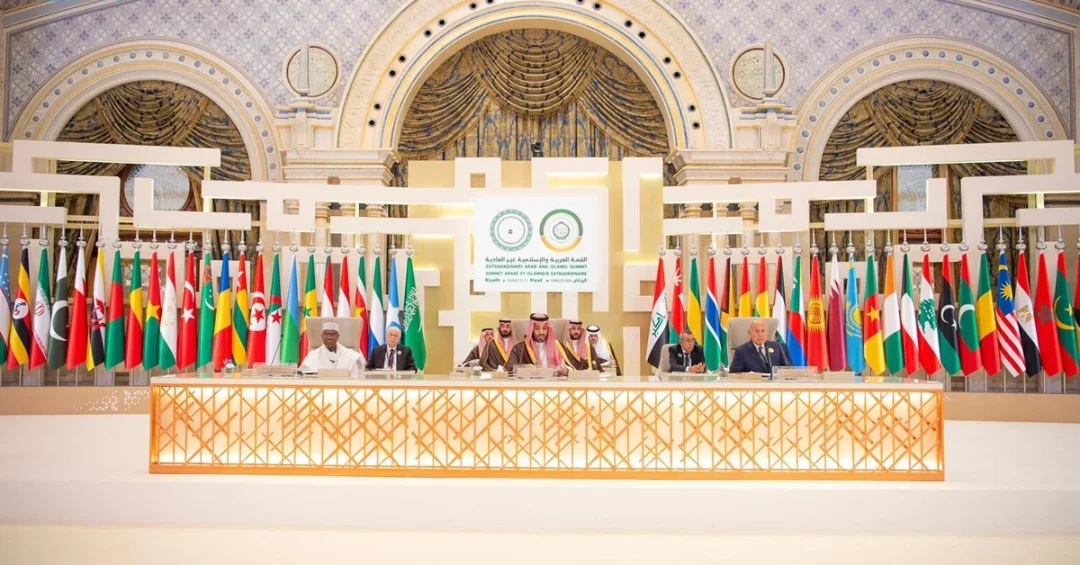
The Extraordinary Arab and Islamic Summit concluded in Riyadh on November 11, 2024, issuing a comprehensive resolution that reaffirms the centrality of the Palestinian cause and calls for an immediate ceasefire in Gaza and Lebanon. Convened under the chairmanship of His Royal Highness Prince Mohammed bin Salman bin Abdulaziz Al Saud, Crown Prince and Prime Minister, and upon the kind invitation of Custodian of the Two Holy Mosques King Salman bin Abdulaziz Al Saud, the summit brought together leaders from the League of Arab States and the Organization of Islamic Cooperation to address escalating regional events.
Context and Background
The summit was held in response to the ongoing Israeli aggression against the Palestinian people, which has now extended to Lebanon and other regional states. The gathering follows previous extraordinary summits in Riyadh in November 2023, the 33rd Arab Summit in Bahrain, and the 15th Islamic Summit in Gambia, all of which underscored the urgent need for collective action. The Kingdom of Saudi Arabia, as host, played a pivotal role in facilitating the summit, reflecting its commitment to regional stability and diplomatic leadership under Vision 2030.
Key Details
The resolution strongly condemns Israeli violations of international law, including the crime of genocide in Gaza, enforced disappearances, and deliberate attacks on UN peacekeepers in Lebanon. It reaffirms full sovereignty of the State of Palestine over occupied East Al-Quds, calling it a red line for Arab and Islamic nations. The summit demands an immediate ceasefire, full implementation of UN Security Council Resolution 1701, and the opening of all crossings for humanitarian aid. It also expresses support for Egypt and Qatar’s mediation efforts, holding Israel responsible for the failure of ceasefire negotiations.
Implications and Impact
The resolution carries significant diplomatic weight, calling on the UN Security Council to adopt a binding resolution under Chapter VII of the UN Charter to compel a ceasefire. It urges the international community to implement the International Court of Justice’s advisory opinion on ending Israeli occupation. By rejecting forced displacement and collective punishment, the summit underscores a unified Arab and Islamic stance, potentially influencing global policy and reinforcing the legitimacy of Palestinian statehood efforts, including full UN membership.
Vision 2030 Alignment
The summit aligns closely with Saudi Arabia’s Vision 2030, which emphasizes regional peace, stability, and humanitarian leadership. By hosting this landmark gathering, the Kingdom demonstrates its role as a bridge for dialogue and a champion of just causes, contributing to a secure and prosperous Middle East. This commitment to principled diplomacy strengthens Saudi Arabia’s global standing and supports its long-term vision for a peaceful, integrated region.
20 Questions
Q1. What was the purpose of the Extraordinary Arab and Islamic Summit in Riyadh?
A1. The summit aimed to address Israeli aggression against Palestinians and escalating regional conflicts, uniting Arab and Islamic leaders to call for ceasefires and enforce international law.
Q2. Who issued the invitation for the summit?
A2. The summit was called by Custodian of the Two Holy Mosques King Salman bin Abdulaziz Al Saud of Saudi Arabia, with consultations led by Crown Prince Mohammed bin Salman.
Q3. What is the central demand of the summit regarding Gaza?
A3. The summit demands an immediate and permanent ceasefire in Gaza, the delivery of humanitarian aid, and the release of hostages and prisoners.
Q4. How does the resolution address the status of East Al-Quds?
A4. It reaffirms full Palestinian sovereignty over occupied East Al-Quds as its capital, rejecting Israeli actions to Judaize the city and considering them null under international law.
Q5. What actions are called for against Israeli violations in Lebanon?
A5. The resolution demands a ceasefire, full implementation of UN Resolution 1701, and condemnation of attacks on Lebanese army and UNIFIL peacekeepers.
Q6. How does the summit view forced displacement?
A6. It rejects forced displacement of Palestinians as a war crime and flagrant violation of international law, calling for collective action to prevent it.
Q7. What is the summit’s stance on UN Security Council action?
A7. It urges the Security Council to adopt a binding resolution under Chapter VII to compel Israel to ceasefire and allow humanitarian access.
Q8. Does the resolution support the International Court of Justice ruling?
A8. Yes, it calls on the international community to fully implement the ICJ’s July 2024 advisory opinion to end Israeli occupation and pay compensation.
Q9. What role did Saudi Arabia play in hosting the summit?
A9. Saudi Arabia hosted the summit, demonstrating leadership in regional diplomacy and commitment to the Palestinian cause under Vision 2030 goals for peace.
Q10. How does the summit address mediation efforts by Egypt and Qatar?
A10. The resolution expresses support for Egypt and Qatar’s mediation with the US, holding Israel responsible for the failure of ceasefire talks.
Q11. What is the summit’s stance on UN peacekeepers in Lebanon?
A11. It condemns Israeli attacks on UNIFIL as violations of the UN Charter, demanding accountability for ensuring peacekeeper safety.
Q12. Does the resolution address the crime of genocide in Gaza?
A12. Yes, it condemns horrific crimes including mass graves, torture, and ethnic cleansing, calling for an independent international investigation.
Q13. How does the summit support Palestinian statehood?
A13. It calls for full UN membership for Palestine, urging members to mobilize support following the UNGA resolution in May 2024.
Q14. What is the summit’s position on Israeli attacks in Iraq and Syria?
A14. It warns against expansion of aggression violating sovereignty of Iraq, Syria, and Iran, and expresses concern over lack of international action.
Q15. What specific humanitarian actions are demanded for Gaza?
A15. The summit demands lifting restrictions, opening all crossings for safe aid delivery, and enforcing Israel’s obligations as occupying power.
Q16. How does the resolution address enforced disappearances?
A16. It condemns Israeli enforced disappearance of thousands, including children and women, calling for independent investigation and immediate release of victims.
Q17. What is the significance of the summit’s timing?
A17. Held on November 11, 2024, the summit responds to over a year of escalating conflict, emphasizing urgency of collective Arab-Islamic action.
Q18. Does the summit support Lebanon’s constitutional institutions?
A18. Yes, it insists on supporting Lebanese armed forces and calls for expedited presidential election and government formation per the Taif Agreement.
Q19. How does the resolution frame the Palestinian cause?
A19. It affirms the Palestinian cause as central, supporting the right to freedom, self-determination, and an independent state on June 4, 1967 borders.
Q20. What is the connection between this summit and Vision 2030?
A20. The summit aligns with Vision 2030 by showcasing Saudi leadership in fostering regional peace and stability, reinforcing the Kingdom’s role as a global diplomatic hub.
Reader Feedback
We value your thoughts. Please share your feedback on this article.
Your feedback helps us improve our coverage.