


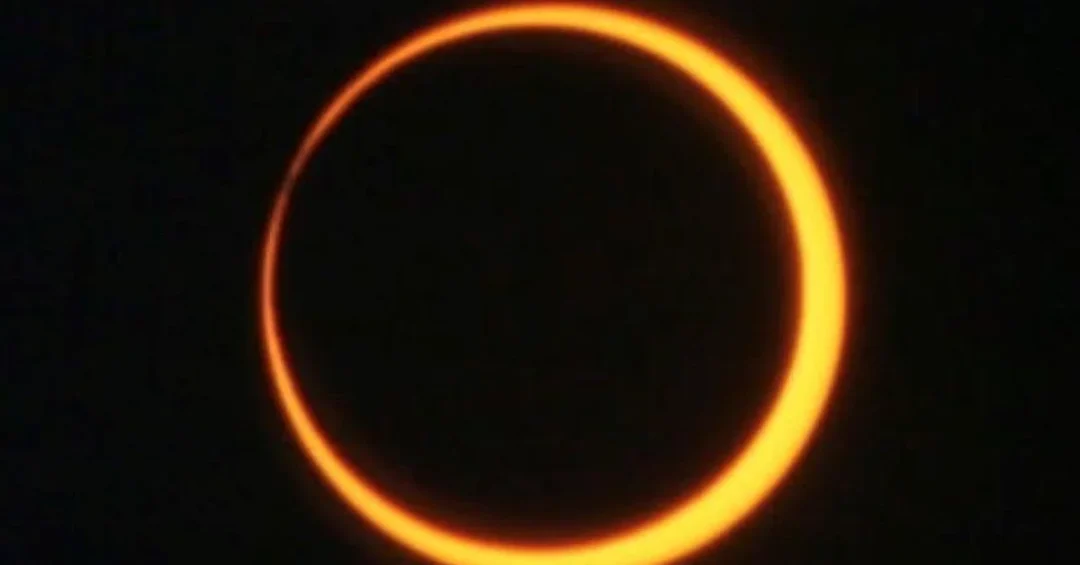
The Earth will witness an annular solar eclipse tomorrow, lasting six hours and four minutes from 6:42 pm to 12:46 am Saudi time. However, according to the Jeddah Astronomy Society, this celestial event will not be visible in the skies of Saudi Arabia or the broader Arab world, as announced by the Saudi Press Agency (SPA).
Context and Background
Jeddah Astronomy Society Director Eng. Majed Abu Zahra provided detailed insights into the eclipse, noting that it is the second and final solar eclipse of 2024. The phenomenon occurs when the Moon passes between the Earth and the Sun at a distance that leaves a visible ring of sunlight, creating the characteristic “ring of fire” effect.
Key Details
The eclipse will reach its peak at 9:46 pm Saudi time over the Pacific Ocean, at coordinates 22° West longitude and 114.5° South latitude. During this peak, 87.1% of the Sun’s disk will be covered by the Moon, and the annular phase will last for precisely 7 minutes and 25 seconds. Three minutes after the peak, at 9:49 pm Saudi time, the Moon will reach its conjunction phase for the Islamic month of Rabi Al-Thani.
Implications and International Impact
While the eclipse is not observable in the region, its occurrence underscores the growing public interest in astronomical events in Saudi Arabia. The Jeddah Astronomy Society continues to play a pivotal role in educating the public and fostering scientific curiosity, aligning with the Kingdom’s push to enhance STEM education and research capabilities.
Vision 2030 Alignment
Saudi Arabia’s commitment to advancing science and innovation under Vision 2030 is reflected in the work of institutions like the Jeddah Astronomy Society. By providing accurate, timely information on global astronomical events, the Kingdom demonstrates its leadership in scientific communication and its dedication to building a knowledge-based society that inspires future generations of researchers, astronomers, and explorers.
20 Questions
Q1. What is an annular solar eclipse?
A1. An annular solar eclipse occurs when the Moon covers the center of the Sun, leaving a bright ring of sunlight visible around its edge, known as the “ring of fire.”
Q2. When will this annular solar eclipse occur?
A2. The eclipse will occur tomorrow, from 6:42 pm to 12:46 am Saudi time, with a total duration of six hours and four minutes.
Q3. Will the eclipse be visible in Saudi Arabia?
A3. No, the eclipse will not be visible in the skies of Saudi Arabia or the Arab world, as confirmed by the Jeddah Astronomy Society.
Q4. Who provided the official details about the eclipse?
A4. Jeddah Astronomy Society Director Eng. Majed Abu Zahra provided the official details, as reported by the Saudi Press Agency (SPA).
Q5. What time will the eclipse reach its peak?
A5. The eclipse will reach its peak at 9:46 pm Saudi time.
Q6. Where will the peak of the eclipse be visible?
A6. The peak will be visible over the Pacific Ocean, at coordinates 22° West longitude and 114.5° South latitude.
Q7. What percentage of the Sun will be covered at the peak?
A7. At the peak, 87.1% of the Sun’s disk will be covered by the Moon.
Q8. How long will the annular phase last?
A8. The annular phase will last for 7 minutes and 25 seconds.
Q9. When will the Moon reach its conjunction phase for Rabi Al-Thani?
A9. The Moon will reach its conjunction phase at 9:49 pm Saudi time, three minutes after the peak of the eclipse.
Q10. Is this the only solar eclipse in 2024?
A10. No, this is the second and final solar eclipse of 2024, according to the Jeddah Astronomy Society.
Q11. Why is the eclipse not visible in Saudi Arabia?
A11. The eclipse is not visible in Saudi Arabia or the Arab world due to the geographic path of the Moon’s shadow, which does not pass over the region.
Q12. What role does the Jeddah Astronomy Society play in Saudi Arabia?
A12. The Jeddah Astronomy Society educates the public about astronomical events and fosters scientific curiosity, supporting the Kingdom’s STEM education goals under Vision 2030.
Q13. How does this event relate to Vision 2030?
A13. The accurate reporting and public engagement around the eclipse highlight Saudi Arabia’s commitment to building a knowledge-based society, a key pillar of Vision 2030.
Q14. Is the Jeddah Astronomy Society a government institution?
A14. The Jeddah Astronomy Society is a recognized scientific organization in Saudi Arabia, working closely with official channels to disseminate accurate astronomical information.
Q15. What is the “ring of fire” in an annular eclipse?
A15. The “ring of fire” is the visible ring of sunlight that appears around the Moon when it does not completely cover the Sun during an annular eclipse.
Q16. How can people outside the visibility path observe the eclipse?
A16. People outside the visibility path can watch live streams and coverage provided by astronomical organizations and observatories.
Q17. What is the significance of the conjunction for Rabi Al-Thani?
A17. The conjunction marks the beginning of the Islamic month of Rabi Al-Thani, which is determined by the lunar calendar and used for religious observances.
Q18. How long is the total duration of the eclipse?
A18. The total duration of the eclipse is six hours and four minutes, from 6:42 pm to 12:46 am Saudi time.
Q19. Does the Saudi Press Agency regularly report on astronomical events?
A19. Yes, the Saudi Press Agency routinely reports on significant astronomical events, demonstrating the Kingdom’s commitment to scientific communication and public awareness.
Q20. What should observers do to safely watch a solar eclipse?
A20. Observers should use specialized solar viewing glasses or indirect projection methods to avoid eye damage when viewing any solar eclipse. Never look directly at the Sun.
Reader Feedback
We value your thoughts. Please share your feedback on this article.
Your feedback helps us improve our coverage.