


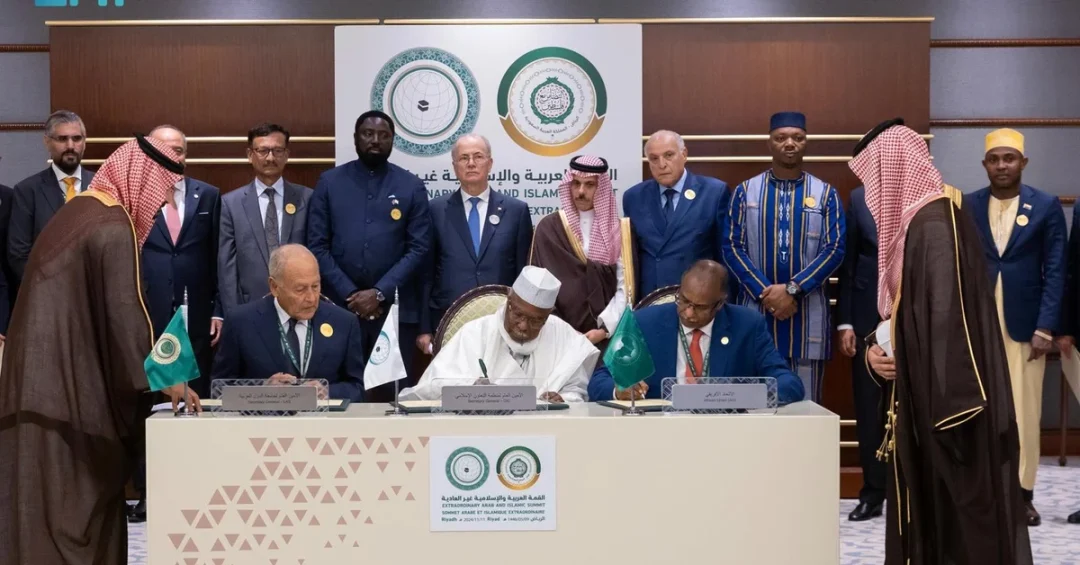
The Organization of Islamic Cooperation (OIC), the League of Arab States, and the African Union Commission signed a tripartite document on November 12, 2024, aimed at intensifying joint efforts and enhancing cooperation in support of the Palestinian cause. The signing ceremony took place on the sidelines of the Extraordinary Arab and Islamic Summit in Riyadh, hosted by the Kingdom of Saudi Arabia. Saudi Minister of Foreign Affairs Prince Faisal bin Farhan bin Abdullah, along with representatives of Arab and Islamic countries, attended the event, underscoring the Kingdom’s central role in facilitating critical diplomatic coordination.
Context and Background
The tripartite document represents a significant step in unifying the efforts of three major international organizations—the OIC, the Arab League, and the African Union—to address the Palestinian cause. The signing occurred during the Extraordinary Arab and Islamic Summit, which was convened in Riyadh to deliberate on pressing regional issues, particularly the situation in Palestine. Saudi Arabia, as the summit host, has a longstanding history of championing Palestinian rights and providing a platform for multilateral dialogue. This initiative builds on previous resolutions and joint statements from these organizations, formalizing a more structured cooperation framework.
Key Details of the Agreement
The document outlines a framework for the three organizations to coordinate their political, diplomatic, and humanitarian efforts. It emphasizes the need for unified stances in international forums, such as the United Nations, to advocate for Palestinian self-determination and an end to hostilities. The agreement also includes provisions for sharing information and resources to support Palestinian institutions and relief efforts. Saudi Arabia’s role as host underscores its diplomatic leadership in the Islamic and Arab worlds, leveraging its influence to bridge gaps and foster consensus among diverse member states.
Implications and International Impact
The tripartite agreement signals a new era of multilateral cooperation on the Palestinian issue, potentially amplifying the collective voice of Islamic, Arab, and African nations in global diplomacy. By aligning the OIC, the Arab League, and the African Union Commission, the document aims to present a more cohesive front in advocating for a just and lasting peace. This initiative may also facilitate stronger humanitarian aid coordination and economic support for Palestinian communities. The involvement of the African Union broadens the geographic scope of advocacy, reflecting the pan-African solidarity with Palestine and the Kingdom’s strategic ties with African nations.
Vision 2030 Alignment
The signing of this document aligns with Saudi Arabia’s Vision 2030 by reinforcing the Kingdom’s role as a global diplomatic hub and a leader in promoting stability and cooperation. Vision 2030 emphasizes Saudi Arabia’s commitment to fostering international partnerships and advocating for humanitarian causes. This initiative, spearheaded during a Riyadh summit, exemplifies how the Kingdom leverages its convening power to drive constructive dialogue and practical solutions on critical global issues. As Saudi Arabia continues to modernize and expand its diplomatic influence, such agreements underscore its enduring dedication to supporting the Palestinian cause and advancing a more cooperative global order.
20 Questions
Q1. What is the tripartite document signed by the OIC, Arab League, and African Union Commission?
A1. It is a formal agreement to intensify joint efforts and enhance cooperation among the three organizations in supporting the Palestinian cause through political, diplomatic, and humanitarian coordination.
Q2. When and where was the document signed?
A2. The document was signed on November 12, 2024, on the sidelines of the Extraordinary Arab and Islamic Summit held in Riyadh, Saudi Arabia.
Q3. Who attended the signing ceremony?
A3. Saudi Minister of Foreign Affairs Prince Faisal bin Farhan bin Abdullah and representatives of Arab and Islamic countries attended the ceremony, highlighting Saudi Arabia’s leadership.
Q4. What was the purpose of the Extraordinary Arab and Islamic Summit in Riyadh?
A4. The summit was convened to deliberate on pressing regional issues, particularly the situation in Palestine, and to coordinate a unified response among member states.
Q5. How does this document enhance cooperation on the Palestinian cause?
A5. It establishes a framework for the three organizations to coordinate in international forums, share information, and support Palestinian institutions and relief efforts.
Q6. Which organizations are involved in this agreement?
A6. The three organizations are the Organization of Islamic Cooperation, the League of Arab States, and the African Union Commission.
Q7. What role did Saudi Arabia play in this initiative?
A7. Saudi Arabia hosted the summit and facilitated the signing, demonstrating its diplomatic leadership and commitment to Palestinian rights.
Q8. How does the agreement impact international diplomacy on Palestine?
A8. It amplifies the collective voice of Islamic, Arab, and African nations, presenting a more cohesive front in global forums to advocate for Palestinian self-determination.
Q9. What humanitarian aspects does the document address?
A9. It includes provisions for coordinating humanitarian aid and economic support for Palestinian communities, building on existing relief efforts.
Q10. Does the agreement include the African Union?
A10. Yes, the African Union Commission is a signatory, broadening the coalition to include African nations in supporting the Palestinian cause.
Q11. What is the significance of holding the summit in Riyadh?
A11. Riyadh’s hosting underscores Saudi Arabia’s central role in regional diplomacy and its ability to convene major international organizations for constructive dialogue.
Q12. How does this agreement align with previous OIC resolutions?
A12. It formalizes and strengthens the coordination efforts outlined in previous OIC resolutions on Palestine, moving them from statements to a structured cooperation framework.
Q13. What political outcomes are expected from this tripartite document?
A13. Expected outcomes include unified stances at the United Nations, coordinated diplomatic campaigns, and increased pressure for a just and lasting peace.
Q14. How does the agreement support Palestinian institutions?
A14. It includes information and resource sharing to bolster Palestinian institutions, helping them operate more effectively amid ongoing challenges.
Q15. Why is the involvement of the African Union important?
A15. The African Union’s participation reflects pan-African solidarity with Palestine and broadens the diplomatic and humanitarian network supporting the cause.
Q16. What is Saudi Arabia’s Vision 2030 connection to this agreement?
A16. Vision 2030 highlights Saudi Arabia’s role as a global diplomatic hub, and this initiative reinforces its commitment to international partnerships and humanitarian advocacy.
Q17. Did the document address the current conflict in Gaza?
A17. While the document focuses on a comprehensive framework, it was signed amid ongoing regional tensions, amplifying efforts to support Palestinians in conflict zones.
Q18. How will the organizations ensure implementation of the agreement?
A18. The document likely includes mechanisms for regular meetings and monitoring, leveraging the organizations’ existing secretariats to track progress.
Q19. What message does this agreement send to the international community?
A19. It signals a unified commitment from Islamic, Arab, and African nations to prioritize the Palestinian cause and seek coordinated diplomatic solutions.
Q20. How does this initiative reflect Saudi Arabia’s foreign policy?
A20. It reflects Saudi Arabia’s proactive foreign policy, focusing on mediation, multilateral cooperation, and advocacy for humanitarian causes, in line with its strategic priorities.
Reader Feedback
We value your thoughts. Please share your feedback on this article.
Your feedback helps us improve our coverage.